Type L vs Type M Copper Pipe: Wall Thickness, Pressure, Code and Cost
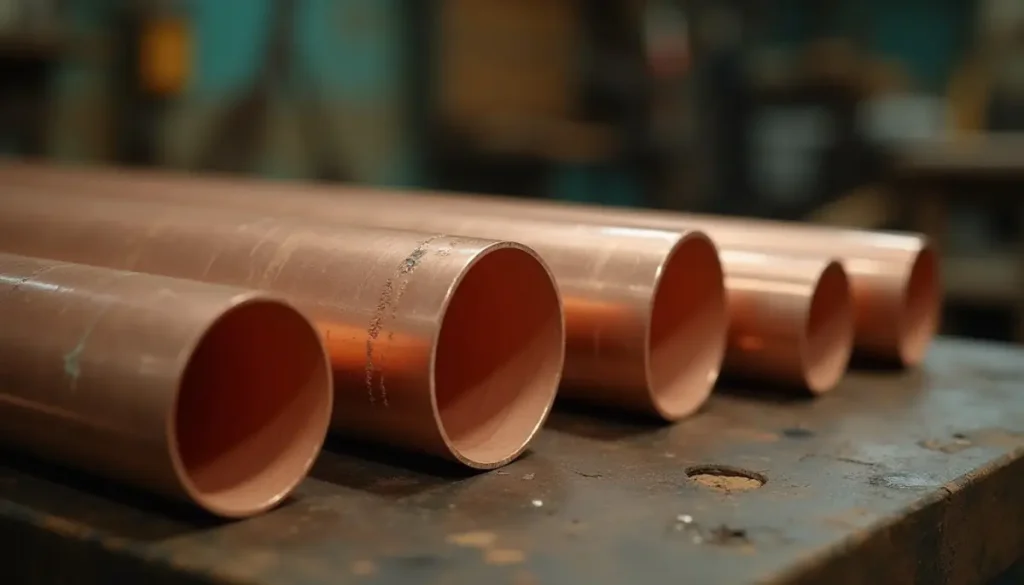
Type L vs Type M copper comes down to wall thickness: same outside diameter, but 3/4-inch Type L has a 0.045-inch wall rated 1,002 psi, while Type M has 0.032 inch and 701 psi.
Key Takeaways
- At 3/4 inch, the Copper Development Association (CDA) lists wall thickness of 0.065 inch for Type K, 0.045 inch for Type L and 0.032 inch for Type M. All three share a 0.875 inch outside diameter.
- CDA Table 14.3 rates 3/4-inch drawn tube at 100°F to 1,466 psi (K), 1,002 psi (L) and 701 psi (M), all far above normal house pressure.
- Color code per CDA Table 14.1 is green for K, blue for L, red for M and yellow for DWV drainage tube.
- The 2025 California Plumbing Code (UPC-based) Section 604.3 sets Type L as the minimum but allows Type M above ground in a building and underground outside it.
- A 10-foot, 3/4-inch Mueller stick listed at $52.95 in Type L vs $39.95 in Type M at PexUniverse in October 2026.
- The CDA caps velocity at 8 ft/s cold and 5 ft/s hot to limit erosion corrosion.
What is the difference between Type L and Type M copper?
The only physical difference between Type L and Type M copper is wall thickness. Both are made to ASTM B88, both have an outside diameter 1/8 inch larger than the nominal size, and both join with the same fittings. Type L has the thicker wall, so it holds more pressure, resists more corrosion loss before a pinhole and costs more per foot.
The CDA Copper Tube Handbook puts it plainly: Type K walls are thicker than Type L, and Type L walls are thicker than Type M, for any given diameter. Because the outside stays fixed, the extra wall eats into the bore. A 3/4-inch Type M tube has an inside diameter of 0.811 inch, while Type L measures 0.785 inch.
Strength, cost, code acceptance and longevity all follow from how much copper sits in the wall. For copper as a material, see our guide to copper plumbing.
How thick is Type K vs L vs M copper pipe?
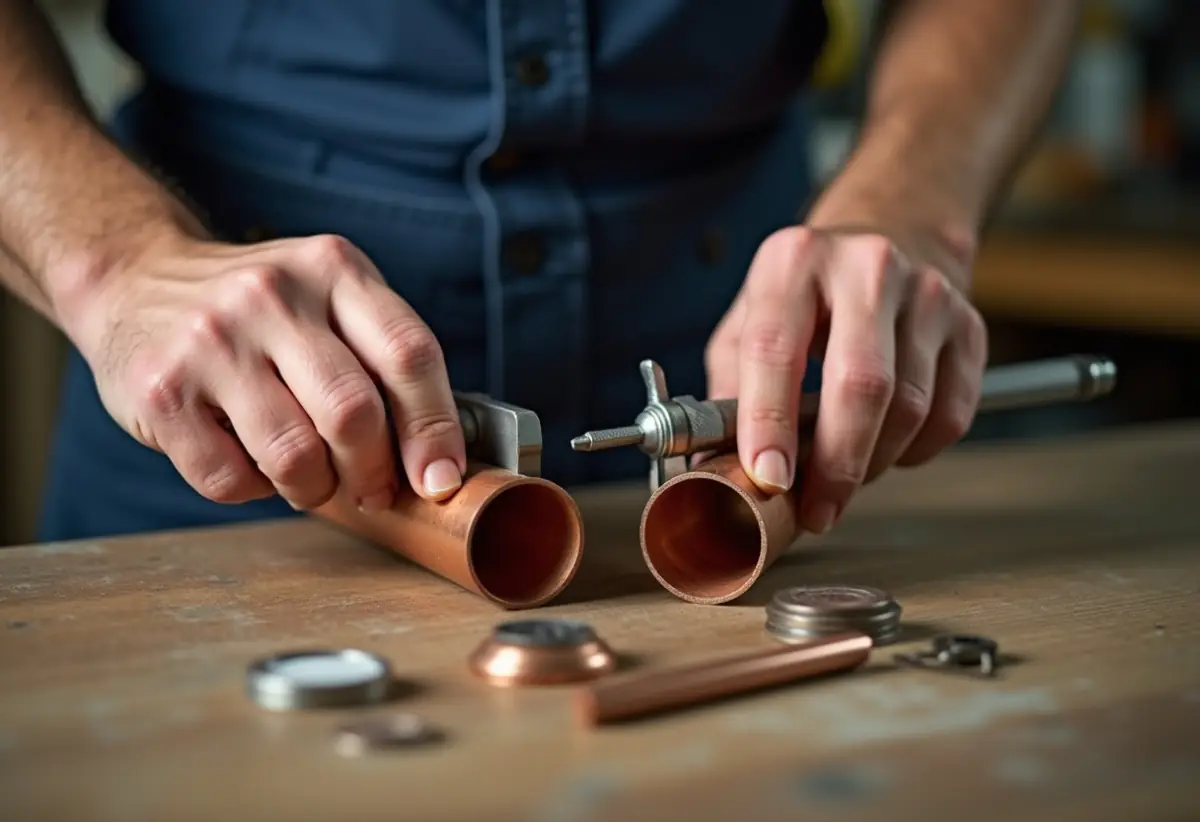
At the two sizes that run most homes, the CDA Handbook (Tables 14.2a to 14.2c) lists 1/2-inch walls of 0.049 inch for Type K, 0.040 inch for Type L and 0.028 inch for Type M. At 3/4 inch the walls are 0.065, 0.045 and 0.032 inch. Type L is roughly 40% thicker than Type M at both sizes.
| Spec (CDA tables) | Type K | Type L | Type M |
|---|---|---|---|
| 1/2 in wall thickness | 0.049 in | 0.040 in | 0.028 in |
| 1/2 in inside diameter | 0.527 in | 0.545 in | 0.569 in |
| 3/4 in wall thickness | 0.065 in | 0.045 in | 0.032 in |
| 3/4 in inside diameter | 0.745 in | 0.785 in | 0.811 in |
| 3/4 in weight, tube only | 0.641 lb/ft | 0.455 lb/ft | 0.328 lb/ft |
One side effect few guides mention: thinner walls mean a bigger bore. CDA Table 14.2 gives 3/4-inch Type M a bore area of 0.517 square inch against 0.484 for Type L, about 7% more room for water.
What do the copper pipe color codes mean?
The copper pipe color code tells you the wall type at a glance. Per CDA Table 14.1, Type K is printed in green, Type L in blue, Type M in red and DWV drainage tube in yellow. ACR refrigeration tube is also blue but is sized by actual outside diameter.
The colored ink only appears on hard (drawn) tube. Every type must also carry an incised stamp showing tube type, maker and country of origin, which is your only mark on a soft coil.
| Type | Color code | Wall at 3/4 in | Rated pressure, 3/4 in drawn, 100°F | Typical use |
|---|---|---|---|---|
| Type K (ASTM B88) | Green | 0.065 in | 1,466 psi | Buried water service, utility-specified service lines, heavy-duty and fire lines |
| Type L (ASTM B88) | Blue | 0.045 in | 1,002 psi | Interior supply, commercial work, soft-coil service lines, hydronic heat, gas where allowed |
| Type M (ASTM B88) | Red | 0.032 in | 701 psi | Residential interior supply where code allows, chilled water, sprinkler mains |
| DWV (ASTM B306) | Yellow | Not made in 3/4 in (0.040 in at 1 1/4 in) | Not for pressure supply | Drain, waste and vent lines |
How much pressure can Type L vs Type M copper handle?
Far more than any house will ever deliver. CDA Table 14.3 rates 3/4-inch drawn Type L at 1,002 psi and Type M at 701 psi at 100°F, and average tested burst pressures run 5,900 and 4,715 psi. The IPC calls for a pressure-reducing valve above 80 psi static, so pressure alone rarely decides between Type L and Type M copper.
Brazing anneals the copper next to the joint, and the CDA says to use the annealed rating then: 582 psi for 3/4-inch Type L and 852 psi for Type K.
The joint can be the weak link, not the tube. CDA Table 14.4a rates soldered joints made with 95-5 tin-antimony solder at 1,090 psi at 100°F for sizes up to 1 inch. That is lower than the 3/4-inch Type K tube rating, which means upgrading the wall type does not raise the system’s real limit past the joint.
At 1/2 inch the pattern holds. CDA lists 1,534 psi for Type K, 1,242 psi for Type L and 850 psi for Type M, drawn at 100°F. Drawn ratings do not drop at all between 100°F and 250°F, because the allowable stress the CDA uses stays at 10,300 psi across that range.

Is Type M copper allowed by plumbing code?
Type M is allowed in many US jurisdictions, with limits. The International Plumbing Code lists Types K, L and M for water service and distribution. The Uniform Plumbing Code sets Type L as the minimum but makes an exception for Type M above ground in or on a building and underground outside of structures. Local amendments can be stricter, so the answer depends on your city.
The UPC language, as adopted in Section 604.3 of the 2025 California Plumbing Code, reads that copper tube for water piping “shall have a weight of not less than Type L,” followed by the Type M exception. In practice that rules out Type M under a slab inside the building footprint, where a leak is hardest to reach.
Specs can be stricter than code. Before buying, check three places:
- Your adopted code edition and local amendments.
- Your water utility’s service line rules, which often name Type K.
- The project spec on commercial and multifamily jobs.
Where should you use Type K, Type L and Type M copper?
Use Type K or Type L soft coil for buried service lines, Type L for interior supply in commercial work and anywhere the spec demands it, and Type M for residential interior supply where code allows. The CDA Copper Tube Handbook lists all three for domestic water service and distribution, and leaves the final choice to the designer and the local code.
The CDA’s own minimums are leaner than many plumbers expect: Type M hard or Type L soft coil for underground services, and Type M for distribution above and below ground. Codes and utilities often go heavier.
- Type K: buried service lines and spots where the tube may take a hit.
- Type L: commercial interior supply, hydronic heat (the CDA’s pick), soft-coil services and gas where allowed.
- Type M: residential lines above ground, chilled water and sprinkler mains (NFPA accepts K, L and M, per the CDA).
Type M is not normally sold in the annealed (soft) temper, per CDA Table 14.3c. If you need coils you can bend by hand, you are buying Type L or Type K. Our overview of the types of plumbing pipes shows where copper sits next to PEX, CPVC and galvanized steel.
Does Type M copper get pinhole leaks faster than Type L?
A thinner wall gives corrosion less metal to chew through, so Type M can reach a pinhole sooner in the same water. The CDA Handbook ranks water chemistry, velocity and workmanship as the main causes of copper corrosion. Fix those and either type lasts decades. Ignore them and even Type L can fail early.
The CDA describes aggressive pitting water as high in dissolved solids such as sulfates and chlorides, with a pH of 7.2 to 7.8, carbon dioxide above 10 ppm and dissolved oxygen present.
Velocity is the other lever. The CDA advises staying under 8 feet per second for cold water and 5 feet per second for hot water up to about 140°F, and 2 to 3 feet per second above 140°F. The CDA singles out circulating hot water loops for extra care, since they run hot and nonstop.
Burrs on unreamed tube ends and leftover flux also make the CDA’s list of causes. If your area has known pinhole trouble, Type L buys margin, but a water test and a properly sized system buy more.
How much more does Type L copper cost than Type M?
Type L costs roughly a third more than Type M at the same size, because it carries more copper. CDA weights show 3/4-inch Type L at 0.455 lb per foot against 0.328 lb for Type M, about 39% more metal. In October 2026, a 10-foot Mueller stick at 3/4 inch listed for $52.95 in Type L and $39.95 in Type M at PexUniverse.
That retail gap works out to about 33%, or $1.30 per foot. Fittings, solder and labor cost the same whatever the wall type, and copper prices swing with the commodity market, so treat any quote as a snapshot.
See the live listings for 3/4-inch Type L and 3/4-inch Type M before you budget. If the price of copper is the real question, our PEX vs copper comparison covers what switching materials saves.
Can you mix Type L and Type M copper on the same job?
Yes. Because Types K, L and M share the same outside diameter at every nominal size, one set of fittings fits all three. A wrought copper coupling, a press fitting or a push fitting joins Type L to Type M without an adapter. That lets a job run Type L mains with Type M branches where code allows it.
Soldering is the same job on every type, with lead-free solder required in potable systems (the CDA cites the 1986 Safe Drinking Water Act Amendment’s 0.2% lead cap). The thinner Type M wall heats faster, so avoid overheating, which bakes flux and invites pitting. Our walkthrough on how to solder copper pipe covers the steps.
Bending is where they differ. Type L and Type K soft coils bend by hand, while Type M comes hard and straight, so plan elbows for Type M runs.
How we sourced this
All dimensions, pressure ratings, burst figures, color codes, velocity limits and corrosion guidance come from the Copper Development Association’s Copper Tube Handbook (Publication A4015-26/24, February 2026 print edition), Tables 14.1, 14.2a to 14.2d, 14.3a to 14.3c, 14.4a and 14.5. Code language comes from Section 604.3 of the 2025 California Plumbing Code, which adopts the UPC model text. Retail prices are Mueller 3/4-inch by 10-foot straight lengths listed at PexUniverse on October 14, 2026. We consulted secondary blogs and charts but cited none, because some mislabel 150°F annealed values as working pressure. Canadian and New York City rules were excluded as unconfirmed.
Frequently asked questions
Which is better, Type L or Type M copper?
Type L is the stronger pipe. At 3/4 inch it has a 0.045 inch wall and a 1,002 psi rating versus 0.032 inch and 701 psi for Type M, per the Copper Development Association. Both far exceed house pressure, so Type M is fine where code allows it, while Type L buys extra corrosion margin and wider code acceptance.
Can Type M copper be used for water lines?
Yes, in many areas. The International Plumbing Code lists Types K, L and M for water service and distribution. The Uniform Plumbing Code, as adopted in the 2025 California Plumbing Code, sets Type L as the minimum but permits Type M above ground in or on a building and underground outside the structure. Local amendments can be stricter.
What color is Type L copper?
Type L hard copper carries blue printed markings. Type K is green, Type M is red and DWV drainage tube is yellow, per Table 14.1 of the CDA Copper Tube Handbook. Only hard (drawn) tube gets the colored ink. Soft coils and all tube also carry an incised stamp showing the type, maker and country of origin.
Can you use Type M copper underground?
Sometimes. The Uniform Plumbing Code exception allows Type M underground outside of structures but not under the slab inside the building. The CDA recommends Type M hard or Type L soft coils for underground services. Many utilities and local codes still call for Type K on the service line, so check with your water purveyor and building department.
Is Type K better than Type L copper?
Type K has the thickest wall, 0.065 inch at 3/4 inch versus 0.045 inch for Type L, and a 1,466 psi drawn rating per the CDA. That extra metal adds margin against backfill damage and corrosion, which is why many service lines use it. Inside a house, Type L already carries far more pressure than the system will ever see.
How can you tell if copper pipe is Type L or Type M?
Look for the printed stripe and incised stamp. Blue ink means Type L and red means Type M. If the markings are gone, measure the wall with calipers on a cut end. A 3/4 inch pipe reads about 0.045 inch for Type L and 0.032 inch for Type M. Both have the same 0.875 inch outside diameter.
Can you connect Type L to Type M copper?
Yes. Types K, L and M share the same outside diameter at each nominal size under ASTM B88, so the same wrought solder fittings, press fittings and push fittings fit all three. A Type L line can transition to Type M with a standard coupling. The joint rating, not the tube type, often sets the lower pressure limit.