Brown Water From Faucet: Causes, Is It Safe, and What to Do
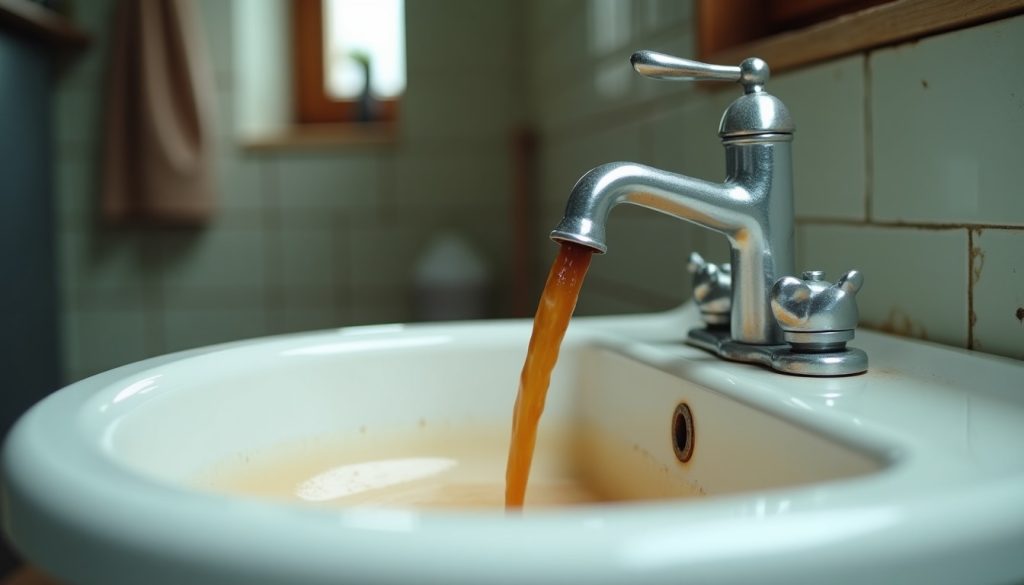
Brown water from faucet taps usually means rust or manganese stirred loose by hydrant flushing or a main break, and it clears once you run the cold tap; if it returns, suspect pipes, water heater, or source water.
Key Takeaways
- EPA sets a non-enforceable secondary standard of 0.3 mg/L for iron, the metal behind rusty, orange-brown water, per its secondary drinking water standards.
- Manganese turns water brown to black at far lower levels: EPA’s cosmetic limit is 0.05 mg/L, six times stricter than iron.
- Manganese also carries an EPA lifetime health advisory of 0.3 mg/L, and EPA advises against giving infants under 6 months water above that level for more than 10 days, per MassDEP.
- The ASCE 2021 Report Card counts a water main break about every two minutes in the US, the most common trigger for sudden brown water at every tap.
- Brown water at the hot tap only points to water heater sediment or a rusting tank, not the city supply.
- Municipal flushing guides commonly advise running a cold tap for about 5 minutes and calling the utility if it is not clear after 10 minutes and a 30-minute rest.
What causes brown water from a faucet?
Brown water from a faucet comes from one of four sources: sediment stirred up in the city main by hydrant flushing or a break, iron or manganese dissolved in the source water, rust flaking off old galvanized steel pipes inside the house, or sediment and corrosion inside the water heater. The first is temporary. The other three keep coming back until you fix them. Since dissolved metals are a common culprit, it helps to know the specifics of iron in well water before deciding how to treat it.
Iron oxidizes to rust and turns water yellow, orange, or reddish brown. Manganese oxidizes to a darker brown or black. EPA treats both as nuisance chemicals that cause color, taste, and staining problems. Manganese does not always tint the whole glass; it can also show up as dark grains, which our guide to black specks in water sorts by cause.
Is brown water from the faucet safe to drink?
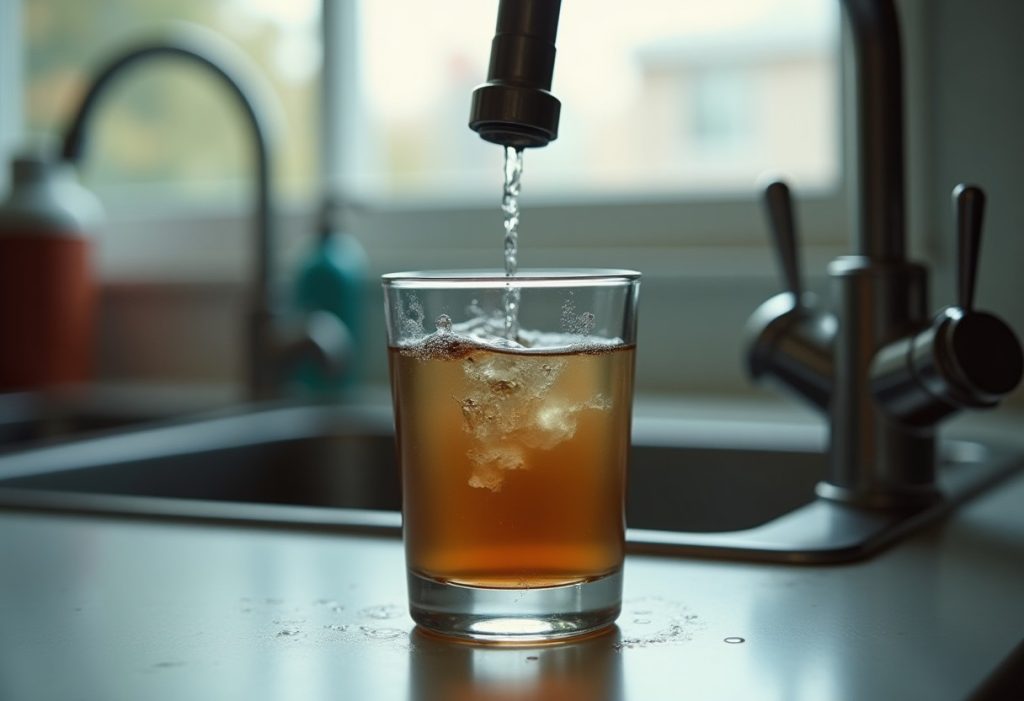
Brown water from the faucet is usually a cosmetic problem, not a poisoning risk, but you should not drink it while it is brown. EPA’s limits for iron (0.3 mg/L) and manganese (0.05 mg/L) are secondary standards set for color, taste, and staining. Manganese is the exception that deserves attention: EPA also publishes a health advisory for it, and infants are the group most at risk.
Secondary standards are guidelines. EPA does not enforce them on utilities, and water above them is not automatically unsafe. Iron at levels that tint water is mostly a taste and laundry problem.
Manganese is different. EPA set a lifetime health advisory of 0.3 mg/L and a 10-day advisory of 1 mg/L, and it advises that infants under 6 months not be given water above 0.3 mg/L for longer than 10 days, according to MassDEP’s consumer guidance. If your water is brown to black and you mix infant formula, switch to bottled water until a test says otherwise.
There is one more reason not to shrug off rusty water in an old house. Corroding galvanized pipe can collect lead from an upstream lead service line and release it later. EPA’s Lead and Copper Rule Improvements require utilities to replace galvanized lines that are or were downstream of lead. Color does not tell you whether lead is present; only a lab test does.
Is the brown water hot only, cold only, or at every tap?
Where the brown water shows up tells you where the problem lives. Brown at every tap, hot and cold, starting suddenly, points to the city main. Brown at the hot side only points to the water heater. Brown that shows up mostly on the first draw of the morning points to old galvanized pipe. Brown at a single faucet points to that fixture or its branch line. A single fixture running cloudy instead of brown points toward a different issue, which is worth ruling out with the glass test for cloudy water.
Run this test at one sink: catch a white cup of cold only, then hot only, and compare. Repeat at a faucet on another floor.
| What you see | Most likely cause | Quick check | Who fixes it |
|---|---|---|---|
| Every tap, hot and cold, started suddenly | Hydrant flushing or a main break stirring up sediment | Utility alerts, crews on the street, neighbors with the same color | Water utility |
| Hot side only, cold runs clear | Water heater sediment, spent anode, or a rusting tank | Compare hot and cold at the same sink | You (flush) or a plumber (tank replacement) |
| Worst on first morning draw, clears in a minute or two | Corroding galvanized steel pipe inside the house | Scratch the pipe near the meter: silver gray and a magnet sticks | Plumber (repipe) |
| One faucet only | Debris in the aerator, a corroded supply line, or a little-used branch | Unscrew and rinse the aerator, then run the tap | You, or a plumber for the branch |
| Cold and hot, steady for weeks, private well | Iron or manganese in the groundwater | Certified lab test for iron and manganese | Water treatment installer |
| Brown to black tint, black stains in fixtures | Manganese, from the source or the utility’s treatment | Black rather than orange staining | Utility (city water) or treatment (well) |
Stains tell the metals apart. EPA lists reddish or orange staining for iron and black staining for manganese, so a black toilet ring means manganese, and the infant guidance above applies.
How long does brown water last after hydrant flushing or a main break?
Brown water from hydrant flushing or a main break is usually short-lived and clears once the sediment flushes out of your service line. Published municipal flushing guides commonly tell residents to run a cold tap for about 5 minutes, and if the water is still discolored after 10 minutes, to stop for 30 minutes and then run it again. Color that lasts into the next day is a call to the utility.
Iron and other particles settle in water mains during normal, slow flow. When a crew opens a hydrant or a pipe bursts, the flow change lifts that layer toward your house. DC Water, for example, warns customers that hydrant inspections may cause temporary discoloration and advises running cold water until it clears.
Breaks are common. The ASCE 2021 Report Card estimates a water main break about every two minutes in the US and 6 billion gallons of treated water lost each day, and it graded drinking water infrastructure a C minus. For what happens during a water main break, including who owns which pipe, see our dedicated guide.
During the wait, use only cold water so sediment stays out of your water heater, and skip laundry until the cold tap runs clear.
Why does brown water keep coming back in an older house?
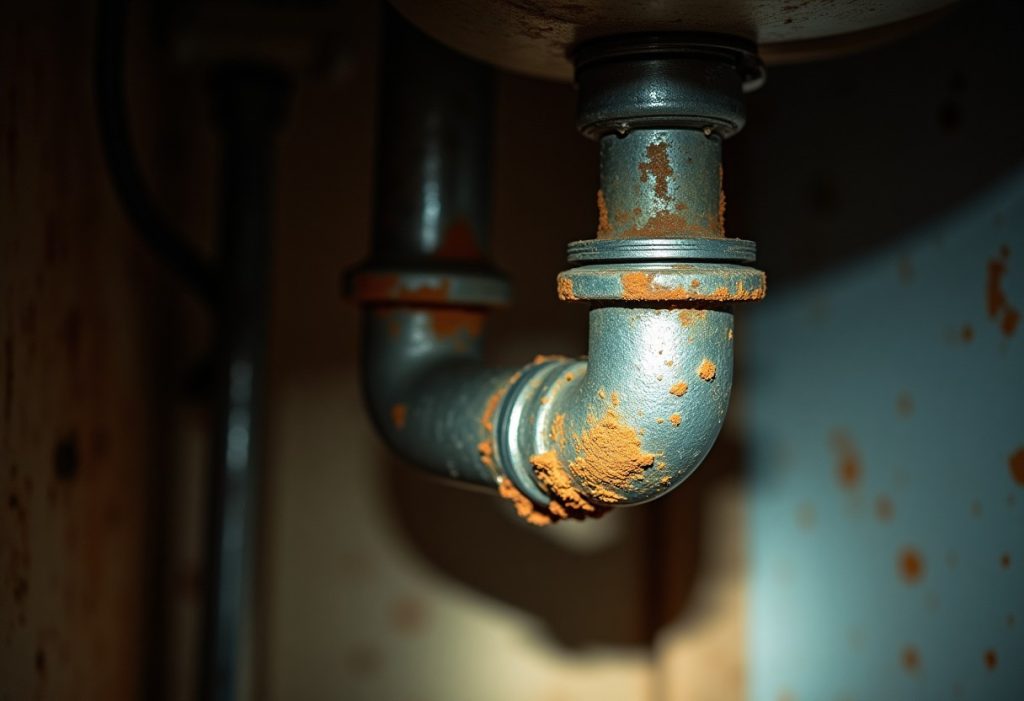
Brown water that returns every morning, clears after a minute, and shows up even when the utility reports clean water usually comes from galvanized steel pipe inside the house. Galvanized pipe is steel coated in zinc. Once the zinc wears through, the steel rusts from the inside, rust builds up as scale, and flakes break off into the water, worst after it sits overnight.
Water that sits in a rusting pipe picks up iron, so the first gallon of the day is the darkest. Low pressure often comes with it, because the same scale narrows the pipe bore.
To confirm, find an exposed section near the water meter, the water heater, or under a sink. Galvanized pipe is dull silver gray, has threaded fittings, and a magnet sticks to it. Copper is reddish and nonmagnetic; PEX is plastic. If you find galvanized, our comparison of galvanized vs copper pipe covers what replacement involves and why most plumbers recommend repiping rather than patching.
What if brown water from the faucet comes from iron or manganese in the source?
If brown water from the faucet is steady at hot and cold taps for weeks, and the house has copper or PEX plumbing, the metals are probably in the water before it reaches your pipes. That is most common on private wells, where groundwater dissolves iron and manganese from rock, but city systems that draw on groundwater can deliver it too.
Groundwater often carries iron in a dissolved, clear form that turns brown only after it meets air. If clear water browns while it sits in a glass, dissolved iron or manganese is the likely cause.
On a private well, no utility tests the water for you. Send a sample to a state certified lab and ask for iron, manganese, pH, and hardness at minimum. Compare the results with the EPA levels in the chart above. On city water, ask your utility for its latest Consumer Confidence Report, which lists detected contaminants.
Treatment depends on the numbers. A whole house water filter rated for iron and manganese, such as an oxidizing media filter or an air injection system, removes metals at the point of entry. Size the system to your lab results, not to the color in the glass.
Why is only the hot water brown?
Brown water at the hot tap only means the problem is inside the water heater. Sediment and rust collect in the bottom of the tank, and every hot draw stirs some of it up. A spent anode rod or a corroding steel tank adds more rust. If the cold side at the same faucet runs clear, the city and your pipes are not the cause.
The first fix is cheap. Flush the water heater by draining it through the drain valve until the water runs clear, then check whether the brown returns. If rust is back within days, inspect the anode rod. Rusty water plus a leak at the base, or rust that follows a fresh anode, usually means the tank itself is failing and needs replacing.
What should you do right now when brown water comes out?
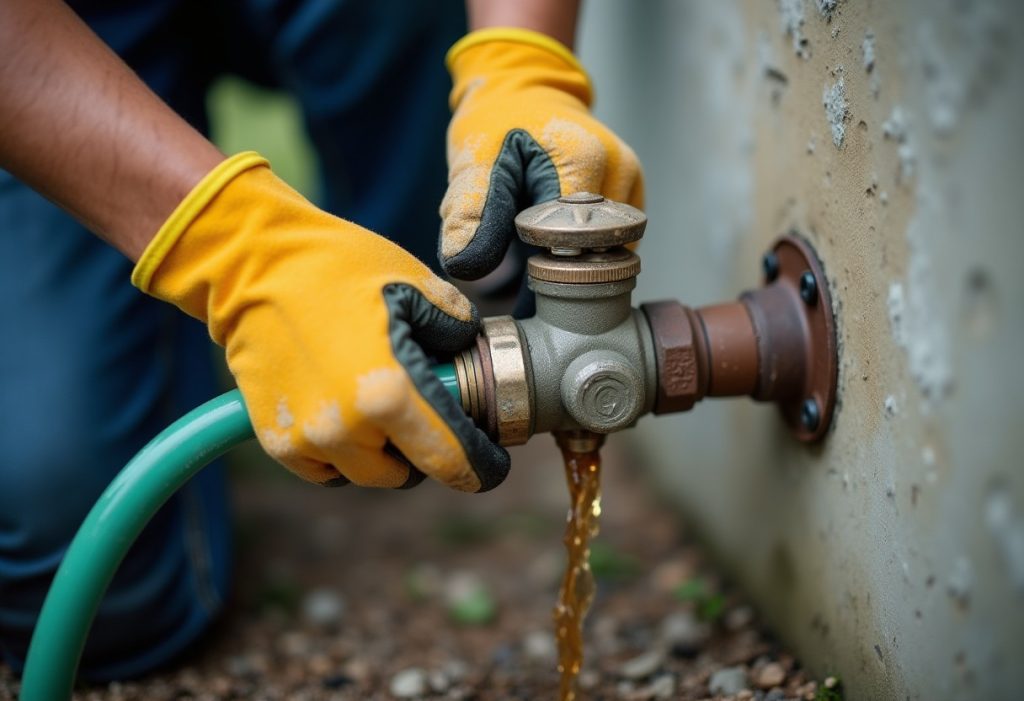
Stop using hot water, run the cold tap closest to the water meter for about 5 minutes, and check whether neighbors or your utility report the same problem. Those three moves tell you within minutes whether you are dealing with a temporary main event or a problem inside your house. Hold off on laundry and drinking until the color clears.
- Turn off hot water use. Skip the dishwasher, washer, and hot taps.
- Run the lowest cold tap. A bathtub spout or outdoor spigot moves the most water. Run it for about 5 minutes and watch for the color to fade.
- Check the source. Look for utility alerts, flushing schedules, or crews on the street, and ask a neighbor whether their water is brown.
- Wait and retry. If it is still brown after 10 minutes, stop for 30 minutes and run it again, as many municipal flushing guides advise.
- Run the hot side last. Once cold runs clear, open each hot tap until it clears too.
- Clean the aerators. Rinse out trapped rust flakes.
- Save stained laundry wet. Do not put stained clothes in the dryer. Heat sets rust stains. Rewash with a rust remover before drying.
When should you call the water utility about brown water instead of a plumber?
Call the water utility when brown water appears at every tap at once, neighbors see it too, crews are working nearby, or the cold tap is still brown after the run-and-wait routine. Call a plumber when only the hot water is brown, the brown is limited to certain taps, or it keeps returning after the utility confirms its water leaving the main is clear.
When you call, give the address, the start time, whether hot and cold are both affected, and whether neighbors see it. Utilities use these reports to find breaks, and many will flush the hydrant nearest you.
The utility’s responsibility usually ends at the meter or the property line, depending on local rules. Pipes and the water heater on your side are yours to fix. On a private well, start with a certified lab test.
How we sourced this
We reviewed the top-ranking pages for “brown water from faucet” and “why is my tap water brown” in October 2026, then went to primary sources for every number. Limits for iron, manganese, and color come from EPA’s secondary drinking water standards page. Manganese health advisories come from EPA values as published by the Massachusetts Department of Environmental Protection. Main break frequency and water loss come from the ASCE 2021 Report Card for America’s Infrastructure. Flushing steps reflect common municipal flushing guidance; DC Water’s notice is cited only for its advice to run cold water until it clears. Run times vary by utility, so follow your own utility’s notice. We consulted 9 sources and cited 6. We excluded contractor and filter-vendor blogs as sources for any figure, and we do not quote treatment costs because they vary by region and water chemistry.
Frequently asked questions
Is brown water from the faucet safe to drink?
Usually it is not a health emergency, but it is not water you should drink by choice. EPA treats iron and manganese as secondary contaminants with cosmetic limits of 0.3 mg/L and 0.05 mg/L. Manganese has a separate EPA lifetime health advisory of 0.3 mg/L. Run the cold tap until it clears, and use bottled water for infant formula until the color is gone.
How long does brown water last after hydrant flushing or a main break?
Most flushing discoloration clears at the cold tap within a few minutes of running water. Published municipal flushing guides commonly say to run a cold tap for about 5 minutes, and if it is still brown after 10 minutes, stop for 30 minutes and try again. If the color lasts into the next day, call your water utility.
Why is only my hot water brown?
If the cold tap at the same sink runs clear and only the hot side is brown, the problem is almost always inside the water heater. Sediment and rust settle at the bottom of the tank, and a corroding steel tank or a spent anode rod adds more. Flushing the tank often clears it. Rust that returns quickly after a flush points to a tank near the end of its life.
Why is the water brown at only one faucet?
A single brown faucet usually means the problem is local to that fixture or the short pipe run feeding it. Debris trapped in the aerator, a corroded supply line, or a galvanized branch that rarely gets used can all release rust at one tap. Unscrew and rinse the aerator first, then run that tap for a few minutes and see if it clears.
Can brown water stain or ruin laundry?
Yes. Iron leaves reddish or orange stains and manganese leaves black or brown stains, per EPA secondary standards. Hold off on laundry until the cold tap runs clear. If a load picks up stains, keep it wet and do not put it in the dryer, because heat sets rust stains. Rewash with a rust stain remover, and ask your utility whether it offers one after flushing.
Is it safe to shower or bathe in brown water?
Brief contact with discolored tap water during a shower is generally not a health concern, because the iron and manganese behind the color are regulated by EPA for cosmetic effects, not skin contact. The bigger risks are staining tubs, towels, and light hair. If the brown water follows a main break and your utility issues a boil water notice, follow that notice for bathing guidance.
Will a water filter fix brown water?
A filter fixes brown water only when the cause is steady iron or manganese in your source water, such as a private well. Iron and manganese filters, oxidizing media, and some softeners can remove dissolved metals. A filter will not fix a corroding water heater or rusting galvanized pipes, and it will clog fast during a one-off hydrant flush, so find the cause before you buy one.
Who do I call about brown water, the city or a plumber?
Call your water utility first if every tap turned brown at once, neighbors see it too, or crews are working nearby. Call a plumber if only the hot water is brown, only certain taps are affected, or brown water keeps showing up after the utility confirms its water is clear. Private well owners should test with a certified lab before calling either.


