Wall-Hung Toilet: Pros, Cons, Carrier and Cost
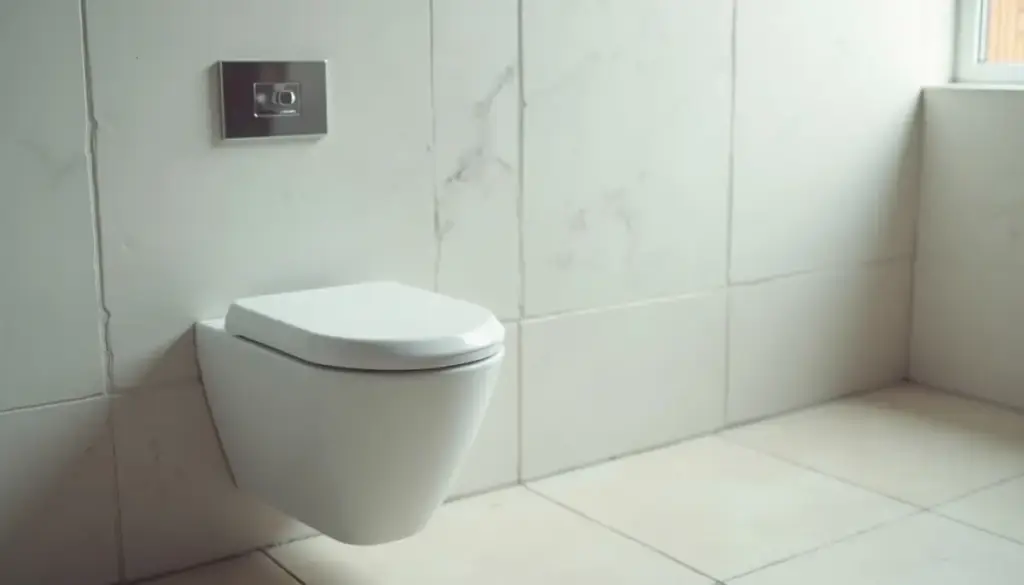
A wall hung toilet bolts a tankless bowl to a steel carrier hidden in the wall, with the tank behind a flush plate, and it costs $800 to $2,500 installed (Fixr) against $350 to $500 for a floor-mount.
Key Takeaways
- Geberit’s Duofix carriers and Kohler’s K-6284 tank and carrier system are both rated to support 880 pounds (400 kg) when installed per the maker’s instructions.
- Geberit sells separate carriers for 2×4 walls (minimum 3.5 inch framing) and 2×6 walls (minimum 5.5 inch framing), with studs set 19.75 inches apart.
- The carrier sets the bowl rim anywhere from 15 to 19 inches above the floor on Geberit frames, so the seat height is chosen at rough-in, not by the fixture.
- Fixr says a wall-hung toilet can free up as much as 10 inches of floor depth versus a floor-mounted model.
- Fixr puts the installed cost at $800 to $2,500, while Consumer Reports says the parts alone tend to run upward of $600 versus under $200 for a standard toilet.
- Geberit and Kohler in-wall tanks flush 1.6 or 0.8 gallons, and Geberit offers a 1.28 or 0.8 gallon version.
How does a wall-hung toilet work?
A wall-hung toilet splits into three parts. A steel carrier frame bolts to the floor and studs inside the wall, a plastic tank rides on that frame, and a ceramic bowl hangs off two threaded rods that stick out through the finished wall. You flush with a button plate mounted on the wall over the tank, and the bowl never touches the floor.
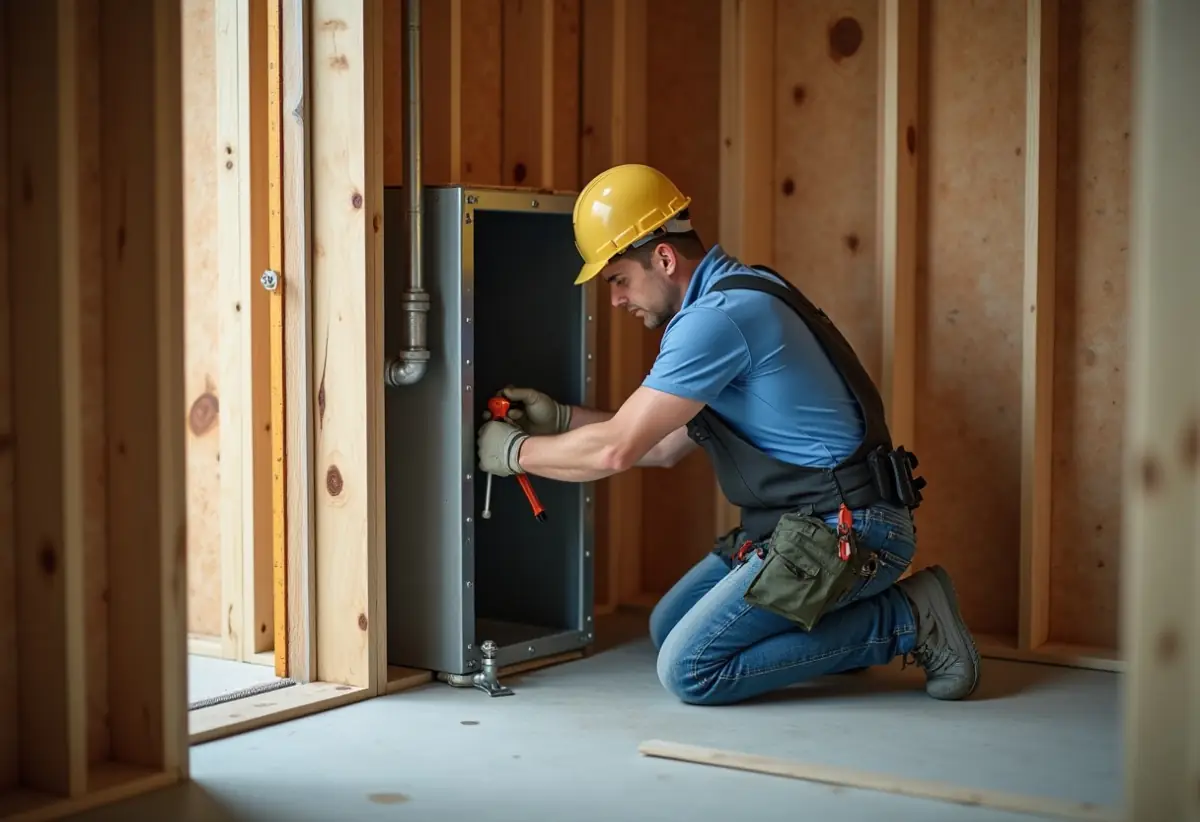
The carrier does the structural work. Geberit describes its frame as steel and requires framing members that can take an 880 pound (400 kg) load without damage to the wall. The bowl simply clamps to that frame, which is why the load rating belongs to the carrier, not the china.
The tank sits inside the stud cavity. On Geberit’s spec sheets it is impact resistant high density polyethylene, insulated so it does not sweat inside the wall. Water comes in through a supply no smaller than 1/2 inch copper, and Geberit lists a minimum flow pressure of just 2 psi.
Waste leaves through a rear outlet on the back of the bowl, runs through a horizontal connector in the carrier and drops into the drain line. That is the big plumbing difference from a floor-mount, which drops straight into a closet flange. If you are weighing styles, our rundown of the main types of toilets covers one-piece, two-piece and corner models next to the wall-hung option.
How much weight can a wall-mounted toilet hold?
A properly installed wall-mounted toilet on a name-brand carrier is rated for 880 pounds. Geberit’s 2×4 and 2×6 Duofix spec sheets and Kohler’s K-6284 specification both cite 880 pounds (400 kg). F.W. Webb, a large plumbing distributor, says most residential wall-hung toilets carry a 500 pound rating, so check the exact number for the carrier you buy.
The rating assumes the frame is anchored the way the maker says. Geberit spells out that the framing members, not just the carrier, must carry the 880 pounds. Short lag bolts, a carrier fastened to rotted subfloor or skipped floor anchors all cut into that margin.
The figures you see online do not always agree. Kohler’s printed spec cites 880 pounds for the K-6284, while the model’s Studio Kohler web page lists 500 pounds, and the model is now flagged as discontinued. When a heavy user or a grab-bar style load is in play, go with the lower number or get the current installation guide in writing.
The bowl has its own test. Geberit notes that under the European standard, wall-hung WC and bidet ceramics must withstand loads of up to 400 kg, and its frames are tested to match.
Does a wall hung toilet carrier need a 2×6 wall?
Not always. Most in-wall tank systems were designed around 2×6 framing, and Geberit’s 2×6 carrier needs a framing wall or plumbing chase at least 5.5 inches thick. Geberit also makes a 2×4 Duofix frame that fits a wall at least 3.5 inches thick. Kohler’s K-6284 system is built for 2×6 studs.
Stud spacing matters as much as depth. Both Geberit frames call for wood or steel framing members set 19.75 inches (500 mm) apart, which does not match standard 16 inch on-center layout. Plan on adding studs or blocking at the toilet location.
Many remodelers build a false wall or chase in front of the existing wall rather than tearing into a 2×4 exterior or load-bearing wall. Consumer Reports notes the finished wall usually needs to be about 10 inches thick, depending on the model, which describes that kind of built-out chase. It costs a few inches of room depth but avoids cutting structural studs.
| Carrier system | Wall framing | Load rating | Flush volumes | Rim height |
|---|---|---|---|---|
| Geberit Duofix for 2×4 (111.798) | Min. 3.5 in wall, studs 19.75 in apart | 880 lb (400 kg) | 1.6 / 0.8 gpf | 15 to 19 in |
| Geberit Duofix for 2×6 | Min. 5.5 in wall, studs 19.75 in apart | 880 lb (400 kg) | 1.6 / 0.8 or 1.28 / 0.8 gpf | 15 to 19 in |
| Kohler K-6284 tank and carrier | 2×6 studs | 880 lb per spec sheet (500 lb on web page) | 1.6 / 0.8 gpf | Set on frame |
| Typical residential wall-hung (F.W. Webb) | Varies by carrier | 500 lb | Varies | Varies |
What are the pros and cons of a wall-hung toilet?
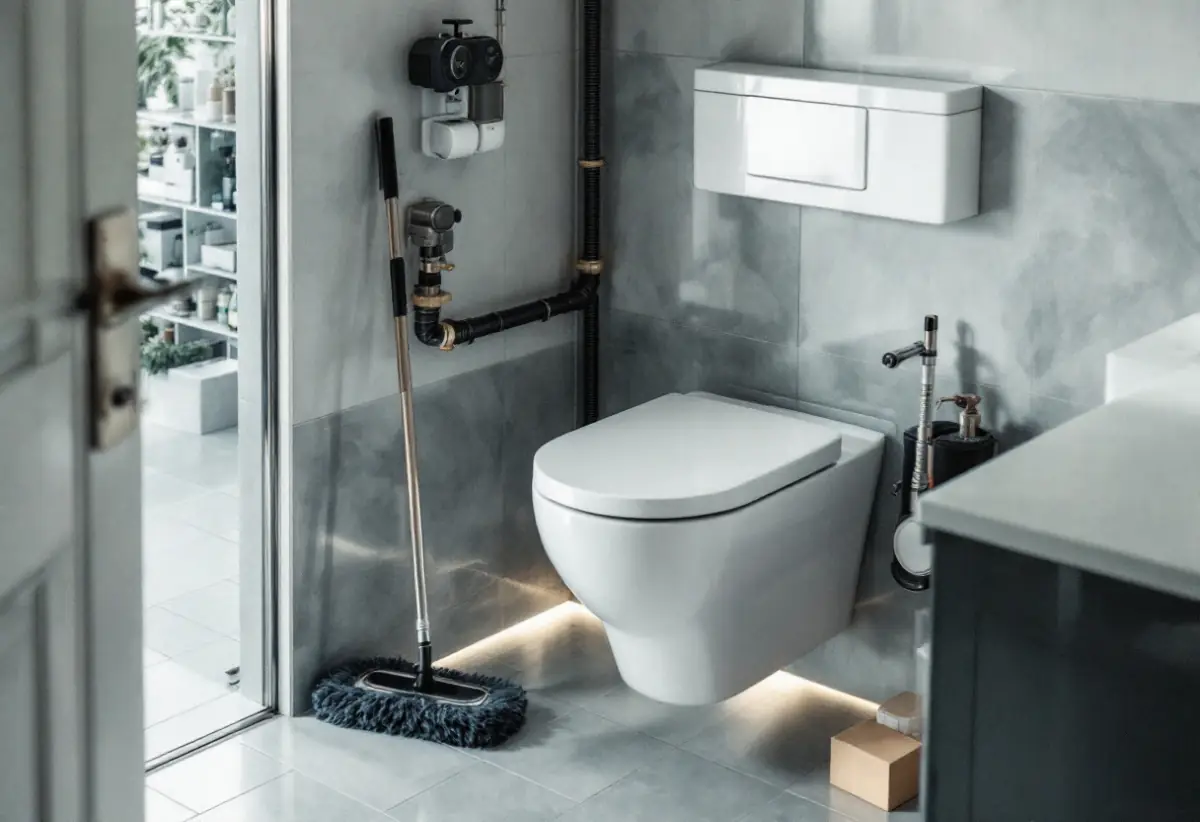
The pros are floor space, easy cleaning, adjustable height and a quieter tank buried in insulation. The cons are a higher price, an invasive install, a tank you cannot see, and parts that must match one maker’s system. Fixr, Consumer Reports and the maker spec sheets agree on that trade.
Pros
- Space. Fixr says a wall-hung model can save as much as 10 inches of depth because the tank lives in the wall.
- Cleaning. No base, no bolt caps and no caulk line to scrub. You mop straight under the bowl.
- Height. The carrier sets the rim from 15 to 19 inches on Geberit frames, so a tall or short household can get a custom fit.
- Noise. The tank sits inside a closed wall cavity, so refill sounds are muffled compared with an exposed tank.
Cons
- Price. Consumer Reports says the parts tend to total upward of $600, versus under $200 for a standard toilet.
- Install. The wall has to be open, framed to the carrier and finished again.
- Matching parts. Bowls, carriers and flush plates are often sold separately, and Fixr warns that buyers must confirm the parts work together.
- Hidden leaks. A slow leak at the tank or drain connection can wet the wall before you notice it.
| Factor | Wall-hung | Floor-mount |
|---|---|---|
| Installed cost (Fixr) | $800 to $2,500 | $350 to $500 |
| Fixture price (Fixr) | About $500 to $2,000 or more | About $220 to $350 |
| Average labor (Fixr) | About $350 | About $180 |
| Wall needed | 2×4 or 2×6 carrier, open wall | Any finished wall |
| Seat height | Set on carrier, 15 to 19 in rim (Geberit) | Fixed by the model |
| Floor depth | Up to 10 in less (Fixr) | Tank adds depth |
| Drain | Rear outlet into the wall | Floor flange |
| Tank repair | Through the flush plate opening | Lift the tank lid |
| Swap difficulty | Remodel job | Same-day swap |
How much does a wall-hung toilet cost installed?
Plan on $800 to $2,500 for a wall-hung toilet installed, according to Fixr, against $350 to $500 for a floor-mount. The fixture alone runs about $500 to $2,000 or more, and Fixr pegs average installation labor at about $350 versus about $180 for a standard toilet. Wall framing and finish work push real jobs higher.
Fixr’s own example shows the split. A TOTO Maris wall-hung bowl at about $1,000 plus about $350 to install comes to $1,350, while a TOTO Entrada floor-mount at $200 plus about $180 comes to $380.
Angi lists wall-mounted units at about $300 to $1,500 before installation. Consumer Reports says installing a standard toilet runs $150 to $300, while a wall-mounted unit is likely to start near $500 and can reach $1,000 or more depending on location and the work involved. Horow, a toilet brand, puts in-wall tank jobs at $1,200 to $2,400 or more in its 2026 guide, driven by wall opening, carrier framing and finish repair.
Get quotes that break out the carrier, bowl, flush plate, framing, drywall and tile. If the toilet is part of a larger project, our guide to plumbing work in a bathroom remodel shows where moving drains and supplies adds cost.
How do you reach the tank on an in-wall tank toilet?
You reach an in-wall tank through the opening behind the flush plate. The plate unclips or unscrews from its frame, and the hole behind it is sized so a plumber can reach the fill valve and flush valve without cutting drywall or tile. That access is what makes a concealed tank practical to own.
- Shut off the water. On many concealed tanks the service valve sits behind the plate.
- Remove the flush plate and the actuator linkage behind it.
- Lift out the flush valve or fill valve through the opening.
- Swap in the maker’s matched replacement part, then reassemble and test both flush buttons.
Geberit’s spec sheets note that its carriers work with Geberit Sigma actuator plates, sold separately, so the plate you pick has to match the tank series.
How much water does a wall-hung toilet use?
Most wall-hung toilets are dual flush. Kohler’s K-6284 and Geberit’s 2×4 Duofix flush 1.6 gallons for a full flush and 0.8 for a short one, and Geberit’s 2×6 line also comes as 1.28 and 0.8. The 1.6 gallon full flush matches the federal limit, and the 1.28 option meets the EPA WaterSense cap.
Dual-flush toilets are rated on an average. EPA WaterSense counts the effective volume as two reduced flushes plus one full flush, divided by three. By that method, our math puts a 1.6 and 0.8 system at about 1.07 gallons per flush and a 1.28 and 0.8 system at about 0.96 gallons.
That is less than many single-flush floor models still in homes. For the full comparison by toilet age and type, see how much water a toilet uses per flush.
Can you retrofit a wall hung toilet in an existing bathroom?
Yes, but treat it as a remodel. Consumer Reports notes that switching from a floor model usually means opening the wall, rerouting the waste pipe and patching floor tile, and it adds that moving supply and waste lines or reworking studs can cost several hundred dollars more. Horow estimates one to three days of work.
The drain is the hard part. A floor-mount drops into a flange in the floor, while a wall-hung bowl needs its drain to come out of the wall at the carrier’s outlet height, usually a 3 or 4 inch line depending on the system and local code. That often means cutting the floor to reroute the old line into the wall.
Start with the numbers. Our page on standard toilet rough-in measurements covers the distances you will be moving away from. Then confirm the carrier’s own rough-in drawing, framing depth and stud spacing before you open the wall.
How we sourced this
We read the current Geberit North America spec sheets for its 2×4 (111.798) and 2×6 Duofix carriers, Kohler’s K-6284 tank and carrier listing, Geberit’s statement on the European load standard, and the EPA WaterSense toilet specification. Cost figures come from Fixr, Consumer Reports, Angi and Horow; we consulted several retailer pages but cited only maker specs and named cost guides. Load ratings are the makers’ published numbers, not our own tests. Where sources disagree (Kohler’s 880 versus 500 pound figures), we show both. Effective flush volumes are our calculation using the WaterSense method. Spec sheets reviewed October 2026; Geberit’s 2×4 carrier sheet is the primary source for framing and load figures, and Studio Kohler for the K-6284 page.
Frequently asked questions
How much weight can a wall-mounted toilet hold?
Geberit and Kohler both rate their in-wall carrier systems to support 880 pounds (400 kg) when the carrier is installed per their instructions. F.W. Webb says most residential wall-hung toilets carry a 500 pound rating. The steel carrier and the framing behind it carry the load, so a sloppy install lowers the real limit no matter what the box says.
Are wall-hung toilets worth the extra cost?
They are worth it when you are already opening the wall, want an adjustable seat height, or need floor space in a small bathroom. Fixr puts the installed price at $800 to $2,500 against $350 to $500 for a floor-mount, so a straight swap in a finished bathroom rarely pays off on cost alone.
Can you put a wall-hung toilet on a 2×4 wall?
Yes, with the right carrier. Geberit sells a Duofix frame for 2×4 construction that fits a framing wall or chase at least 3.5 inches thick. Its 2×6 version needs at least 5.5 inches. Check which carrier your bowl and flush plate are built for before you frame, because the two are not interchangeable.
How do you fix a wall-hung toilet tank that runs or leaks?
Pull off the flush plate. On Geberit and similar systems the plate covers a service opening that reaches the fill valve and flush valve inside the tank, so most repairs happen through that hole without opening drywall or tile. Shut the supply valve first, then swap the worn part with the maker’s matched replacement.
Do wall-hung toilets use less water?
Usually, yes. Geberit and Kohler carriers ship as dual-flush systems at 1.6 and 0.8 gallons per flush, and Geberit also offers a 1.28 and 0.8 setup. Using the EPA WaterSense method of two short flushes per full flush, those work out to roughly 1.07 and 0.96 gallons per flush on average.
What height should a wall-hung toilet be?
Geberit’s carriers let the installer set the bowl rim anywhere from 15 to 19 inches above the finished floor. Many people pick 17 to 19 inches for the seat because that matches the ADA seat height range and is easier on knees. Decide the height before the wall closes, since it is set on the frame.
Can you install a wall-hung toilet in an existing bathroom?
You can, but it is a remodel job, not a swap. Consumer Reports notes that switching from a floor model usually means opening the wall, rerouting the waste pipe and patching floor tile. Expect new framing, a horizontal drain connection, a new supply line in the wall and finish repair on both the wall and floor.
Are wall mounted toilets a good idea?
They work well when a wall is already open, when a household wants adjustable seat height, or when floor space is tight. Pros include saved depth, easier cleaning, custom rim height and a quieter tank. Fixr prices installation at $800 to $2,500 versus $350 to $500 for a floor-mount, so a straight swap in a finished bathroom rarely pays off on cost alone.
What are some common problems with wall-mounted toilets?
Common issues include higher price, an invasive install that requires opening the wall, and parts sold separately that must match one maker's carrier, bowl and flush plate system. A slow leak at the tank or drain connection can wet the wall before anyone notices. Retrofitting also means rerouting the waste pipe, patching floor tile, and possibly reworking studs or supply lines.