How Much Water Does a Toilet Use per Flush?
How much water does a toilet use per flush? A toilet sold in the US since 1994 uses 1.6 gallons or less, WaterSense models use 1.28 or less, and pre-1980 toilets used 5 to 7 gallons.
Key Takeaways
- Federal rule 10 CFR 430.32 caps gravity tank toilets made after January 1, 1994 at 1.6 gallons per flush (gpf), a limit set by the Energy Policy Act of 1992.
- EPA WaterSense labels only toilets that use 1.28 gpf or less and still pass a flush performance test.
- Toilets are the largest indoor water use: 24% of indoor use, or 33.1 gallons per household per day, in the Water Research Foundation REU2016 study.
- REU2016 measured about 5 flushes per person per day and an average real-world flush of 2.6 gpf, well above today’s 1.28 gpf.
- A family of four flushes about 7,300 times a year, so a 3.5 gpf toilet uses 25,550 gallons while a 1.28 gpf model uses 9,344 (our arithmetic).
- EPA says a worn flapper can waste up to 200 gallons per day, and a WaterSense retrofit saves a home nearly 13,000 gallons a year.
How much water does a toilet use per flush, by era?
A toilet uses anywhere from 0.8 to about 7 gallons per flush, and the year it was made is the best predictor. Pre-1980 toilets often used 5 to 7 gallons, 1980s models dropped to about 3.5, federal law capped new toilets at 1.6 gallons in 1994, and EPA WaterSense models use 1.28 or less. High-efficiency models go as low as 0.8.
The 1.6 gpf limit comes from the Energy Policy Act of 1992. The Department of Energy codified it in 10 CFR 430.32, which applies to gravity tank-type toilets manufactured after January 1, 1994. Blowout bowls, a commercial style, are allowed 3.5 gpf.
EPA describes older toilets as using as much as 6 gallons per flush. Utility conservation programs, such as the Seattle-area Saving Water Partnership, put pre-1980s toilets at 5 to 7 gallons and 1980 to 1993 models at about 3.5 gallons.
The chart uses 6 gpf as the midpoint for pre-1980 toilets. The REU2016 bar is a measured average across real homes, which mixes old and new toilets.
| Toilet era or type | Gallons per flush | Source or basis |
|---|---|---|
| Pre-1980 gravity toilet | 5 to 7 | EPA WaterSense (up to 6); utility estimates |
| 1980 to 1993 “water saver” | 3.5 | Utility estimates; 3.5 was the common design volume |
| Federal standard, made after Jan 1, 1994 | 1.6 max | Energy Policy Act of 1992; 10 CFR 430.32 |
| WaterSense labeled | 1.28 max | EPA WaterSense specification |
| Dual flush, WaterSense | 1.28 max effective | EPA WaterSense (one full plus two reduced flushes, averaged) |
| MaP Premium | 1.1 max | MaP Testing |
| High-efficiency single flush | 1.0 or 0.8 | Manufacturer ratings; all qualify for WaterSense |
What do dual flush and 0.8 gpf toilets actually use?
A dual flush toilet uses two volumes, a full flush for solids and a reduced flush for liquids, such as 1.6 and 1.1 gallons or 1.28 and 0.8 gallons. WaterSense rates it by an effective flush volume, the average of one full flush and two reduced flushes, which must be 1.28 gallons or less. Single flush high-efficiency models rated 1.0 or 0.8 gpf beat that outright.
The weighting assumes people use the small button twice as often as the big one. For a 1.6/1.1 model the math is (1.6 + 1.1 + 1.1) divided by 3, or about 1.27 gpf. For a 1.28/0.8 model it is (1.28 + 0.8 + 0.8) divided by 3, or 0.96 gpf.
The catch is behavior. If everyone in the house pushes the full button out of habit, a 1.6/1.1 dual flush toilet uses 1.6 gallons every time, more than a 1.28 gpf single flush model. Our comparison of gravity, pressure-assist, and dual flush toilet types covers which design fits which bathroom.
How many gallons per year does a toilet use for a family of four?
A family of four flushes about 7,300 times a year, so a toilet’s gallons per flush times 7,300 gives its annual use. That is roughly 43,800 gallons for a 6 gpf pre-1980 toilet, 25,550 for a 3.5 gpf 1980s model, 11,680 for a 1.6 gpf toilet, and 9,344 for a 1.28 gpf WaterSense model.
The assumption comes from the Water Research Foundation’s Residential End Uses of Water, Version 2 (REU2016), which logged about 5 flushes per person per day. Four people times 5 flushes is 20 flushes a day, and 20 times 365 is 7,300 flushes a year.
| Toilet era or type | Gallons per flush | Gallons per day (20 flushes) | Gallons per year (7,300 flushes) |
|---|---|---|---|
| Pre-1980, low end | 5.0 | 100 | 36,500 |
| Pre-1980, midpoint | 6.0 | 120 | 43,800 |
| Pre-1980, high end | 7.0 | 140 | 51,100 |
| 1980 to 1993 | 3.5 | 70 | 25,550 |
| REU2016 measured average | 2.6 | 52 | 18,980 |
| Federal max, 1994 and later | 1.6 | 32 | 11,680 |
| WaterSense max | 1.28 | 25.6 | 9,344 |
| Dual flush 1.28/0.8 (effective) | 0.96 | 19.2 | 7,008 |
| High-efficiency 1.0 | 1.0 | 20 | 7,300 |
| High-efficiency 0.8 | 0.8 | 16 | 5,840 |
Real households drift from these numbers, since people who work from home flush more there. Treat the table as a benchmark against your own bill.
Why are toilets the largest indoor water use?
Toilets get flushed more than any other fixture gets used, about 5 times per person per day, and every flush is a fixed volume. REU2016 measured toilets at 24% of indoor household water use, or 33.1 gallons per household per day. EPA WaterSense puts the share at nearly 30%, a figure that reflects homes with more older toilets.
The 2.6 gpf average is the number to notice. It sits a full gallon above the 1.6 gpf legal limit, which means millions of pre-1994 toilets were still in service when the study logged them. Every one of those is a candidate for replacement.
Showers, faucets, and clothes washers follow toilets in the indoor ranking. Our breakdown of how the average home uses water walks through each fixture, and our residential water use report tracks the national numbers behind them.
Working the REU2016 figures backward, 33.1 gallons divided by 0.24 implies total indoor use of about 138 gallons per household per day.
How can you tell how many gallons per flush your toilet uses?
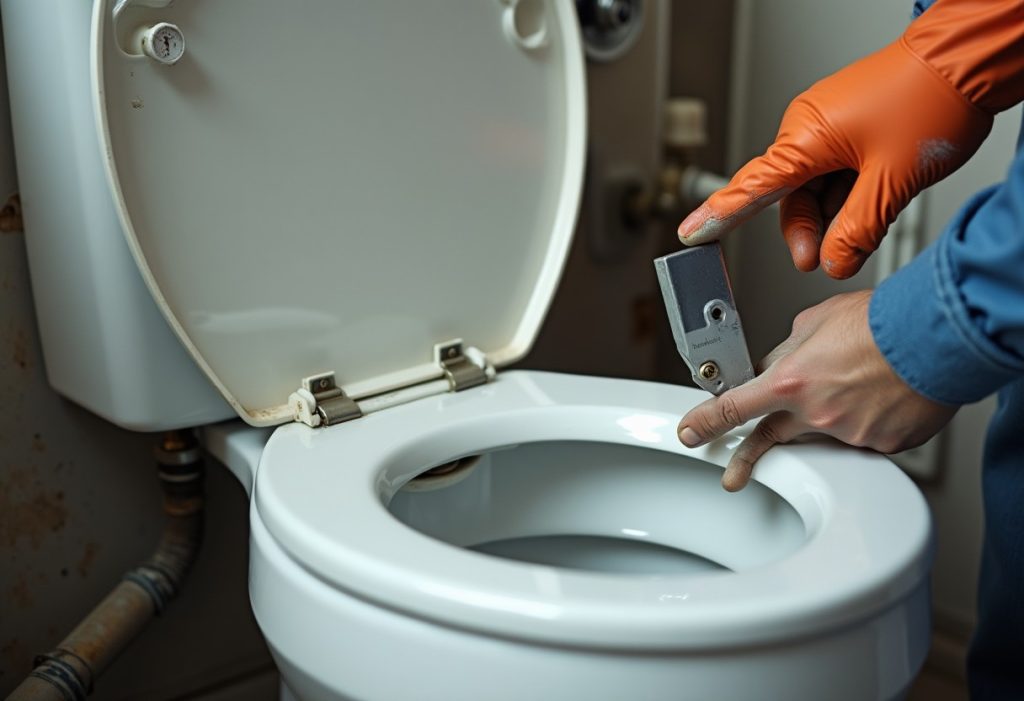
Look for a stamp first. Most toilets made since 1994 have the gallons per flush cast or printed behind the seat hinge on the bowl, or on the inside back wall of the tank, shown as gpf or Lpf (6.0 Lpf equals 1.6 gpf). No stamp means checking the manufacture date or measuring the tank drop yourself.
- Lift the seat and check the bowl just behind the hinge for a mark like 1.6 GPF / 6.0 LPF or 1.28 GPF / 4.8 LPF.
- Take the tank lid off and look at the inside back wall and the underside of the lid. Many makers cast a date there, often year and month.
- Use the date as a proxy. A date of 1994 or later usually means 1.6 gpf or less; 1980 to 1993 usually means about 3.5; earlier often means 5 or more.
- If there is no stamp and no date, run a tank-mark test. Shut off the supply valve, mark the water line with a pencil, flush, and mark the low point.
- Measure the inside length and width of the tank and the drop between the two marks in inches. Multiply them together and divide by 231 to convert cubic inches to gallons.
Here is a worked example. A tank measuring 18 by 6 inches inside, with a 4 inch drop, gives 18 times 6 times 4, or 432 cubic inches. Divided by 231, that is about 1.9 gallons per flush.
Shutting off the supply first matters, and most guides skip why. With the valve open, the fill valve starts refilling the tank during the flush, so the drop reads short and the toilet looks more efficient than it is. Expect the tank method to run slightly under the true volume anyway, since tanks taper and the bowl refill tube adds a little water.
A WaterSense label on the box or the toilet means 1.28 gpf or less. A tank that holds far more water than the stamp suggests is normal, because water below the flush valve opening never leaves the tank.
How much water does a leaking toilet waste?
A leaking toilet can waste more water than it uses to flush. EPA says a worn flapper can waste up to 200 gallons per day, and its Fix a Leak Week data puts average household leaks at more than 9,300 gallons a year. Most toilet leaks are silent, slipping from the tank into the bowl with no sound.
Put that 200 gallon figure next to the family table above. A leak that bad wastes more in one day than a family of four uses flushing a 6 gpf toilet (120 gallons).
The test takes 10 minutes. EPA recommends a few drops of food coloring in the tank; if color shows in the bowl within 10 minutes without a flush, the flapper is leaking. EPA also says to check the flapper periodically and replace it at least every five years.
The other common leak runs over the top of the overflow tube when the fill valve is set too high, and that one usually makes a hiss. Our guide on how to fix a running toilet covers both the flapper and fill valve fixes with inexpensive parts from any hardware store.
Does a low flow toilet flush as well as an old one?
A current low flow toilet usually flushes as well as an old 3.5 gpf toilet, and many flush better, because bowl and trapway design now does the work that extra water used to do. WaterSense requires a toilet to remove at least 350 grams of test media per flush. Independent MaP testing scores models up to 1,000 grams.
MaP (Maximum Performance) testing uses realistic organic-based test media and reports how many grams a toilet clears in one flush. To earn a MaP Premium rating, a toilet must use no more than 1.1 gpf and remove at least 600 grams, well above the WaterSense floor.
The weak-flush reputation dates to the mid 1990s, when makers shrank tank volume to meet the 1.6 gpf rule without redesigning the bowl. Many of those first-generation toilets needed two flushes, which erased the savings. Today’s models are engineered around the lower volume from the start.
- Check the MaP score before buying. A higher gram score means more headroom, and MaP Premium models clear at least 600 grams.
- Look for a 2 inch or larger flush valve and a fully glazed trapway, which help a small volume move solids.
- Do not put a brick or bottle in the tank of a 1.6 or 1.28 gpf toilet. It starves a flush that was designed for that exact volume.
How much can you save by replacing an old toilet?
Replacing older toilets with WaterSense models can cut a home’s toilet water use by 20 to 60%, nearly 13,000 gallons a year, according to EPA WaterSense. EPA puts the dollar savings at more than $170 a year and $3,400 over the life of the toilets, depending on local water and sewer rates.
Our family-of-four table shows where the savings come from. Swapping a 3.5 gpf toilet for a 1.28 gpf model saves 25,550 minus 9,344, or about 16,206 gallons a year. Swapping a 6 gpf toilet saves about 34,456 gallons.
Replacing a working 1.6 gpf toilet is a weaker case. The same family saves only 11,680 minus 9,344, or 2,336 gallons a year. In that case a new flapper and a fill valve adjustment usually pay back faster than a new fixture.
Nationally, EPA estimates that replacing every old, inefficient toilet with a WaterSense model would save more than 260 billion gallons of water a year. Some utilities offer rebates on WaterSense toilets, and in many areas new toilets sold must already meet 1.28 gpf under state rules, including California and Texas.
How we sourced this
We used primary sources for every figure: EPA WaterSense (residential toilets and Fix a Leak Week pages), the Water Research Foundation REU2016 study for flush counts, average flush volume, and toilet share of indoor use, the federal water closet standard in 10 CFR 430.32, and MaP Testing for performance thresholds. Pre-1980 and 1980s flush volumes are typical ranges reported by EPA and utility conservation programs, not legal limits. Annual gallon figures are our arithmetic using REU2016’s 5 flushes per person per day for four people (7,300 flushes a year). We excluded dollar savings beyond EPA’s own estimates because water and sewer rates vary widely by utility. Sources checked October 2026.
Frequently asked questions
How many gallons does a toilet use per flush?
It depends on when it was made. Toilets made after January 1, 1994 are capped at 1.6 gallons per flush by federal rule, WaterSense models use 1.28 or less, and high-efficiency models go down to 1.0 or 0.8. Toilets from the 1980s often used 3.5 gallons, and many pre-1980 toilets used 5 to 7 gallons per flush.
How much water does a toilet use per day?
The Water Research Foundation’s 2016 end-use study measured 33.1 gallons per household per day going to toilets, from about 5 flushes per person per day. A family of four on 1.28 gpf toilets flushes roughly 25.6 gallons a day. The same family on a 3.5 gpf toilet from the 1980s flushes about 70 gallons a day.
How do I know if my toilet is low flow?
Lift the seat and look behind the hinge, or check the inside back wall of the tank, for a stamp reading 1.6 gpf, 1.28 gpf, or 6.0 Lpf. No stamp but a date of 1994 or later usually means 1.6 gpf or less. A WaterSense label means 1.28 gpf or less. Older dates or a big 3.5 stamp mean it is not low flow.
Do low flow toilets clog more?
Early 1.6 gpf designs from the mid 1990s had a reputation for double flushing, but current models are tested much harder. WaterSense requires a toilet to clear at least 350 grams of test media per flush, and models with a MaP Premium rating clear at least 600 grams while using 1.1 gallons or less. Check the MaP score before you buy.
Is it worth replacing a 1.6 gpf toilet?
Only if it leaks, cracks, or flushes poorly. Swapping a working 1.6 gpf toilet for a 1.28 gpf model saves about 2,336 gallons a year for a family of four at 5 flushes per person per day. Replacing a 3.5 gpf or older toilet saves 16,000 gallons or more, and EPA estimates WaterSense toilets save a home more than $170 a year.
How much water does a running toilet waste?
A lot more than the flush itself. EPA says a worn flapper can waste up to 200 gallons per day, which is more than a family of four uses flushing a 6 gpf toilet. Put a few drops of food coloring in the tank and wait 10 minutes without flushing. Color in the bowl means the flapper is leaking and needs replacing.
Can you flush a toilet with a bucket of water?
Yes. Pouring roughly a gallon or more of water quickly into the bowl starts the siphon and clears the bowl, which is handy during a water outage or when the fill valve fails. Pour fast and aim at the center of the bowl. A slow pour just raises the water level without triggering the flush.
What wastes the most water in a house?
Toilets are the largest indoor water use in a house. The Water Research Foundation REU2016 study found toilets account for 24% of indoor household water use, or 33.1 gallons per household per day, more than showers, faucets, and clothes washers, which follow toilets in the indoor ranking.