Upflush Toilet: How Macerating Toilets Work, Cost and Limits
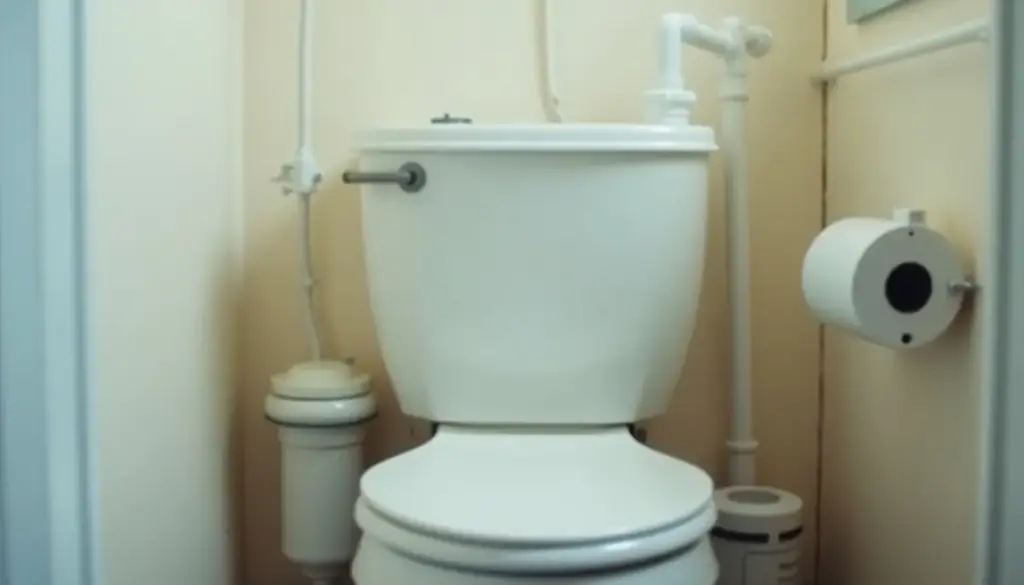
An upflush toilet grinds waste in a macerator box behind the bowl and pumps it through 3/4 or 1 inch pipe, up to 15 feet high on a Saniflo SaniPLUS or 25 feet on a Liberty Ascent II.
Key Takeaways
- The Saniflo SaniPLUS pumps up to 15 feet vertically or 150 feet horizontally, and Saniflo’s manual says every 3 feet of lift uses up 30 feet of horizontal run.
- Liberty Pumps rates the Ascent II at 25 feet of usable head with 150 feet of 1 inch lateral, and 36 feet at shut-off.
- IPC 2021 Section 712.4.1 requires macerating toilet systems to comply with ASME A112.3.4/CSA B45.9 and be installed per the maker’s instructions.
- Saniflo requires a 1 1/2 inch vent on the unit and bans air admittance valves on it, plus a 120 volt, 15 amp GFCI receptacle at least 40 inches from a tub or shower.
- Fixr puts an installed macerating toilet at $600 to $1,300; Amazon listed the SaniPLUS 002 pump alone at $895.51 on October 28, 2026.
- Saniflo says its units last 10 to 15 years, per Hunker, and its manuals allow only human waste, toilet paper and water.
How does an upflush toilet work?
An upflush toilet is a rear-outlet bowl clamped to a sealed plastic box that holds a pressure switch, a spinning cutter and an impeller. Water from the flush raises the level in the box, the switch starts the motor, the blade shreds the waste and paper, and the impeller pushes the slurry through a 3/4 or 1 inch pipe to the sewer.
Saniflo’s SaniPLUS installation manual lists a pressure chamber with a membrane and micro switch, an oil-filled induction motor, a cutter blade and an impeller. Its nameplate reads 115 V, 60 Hz, 4.5 A, 1/2 HP.
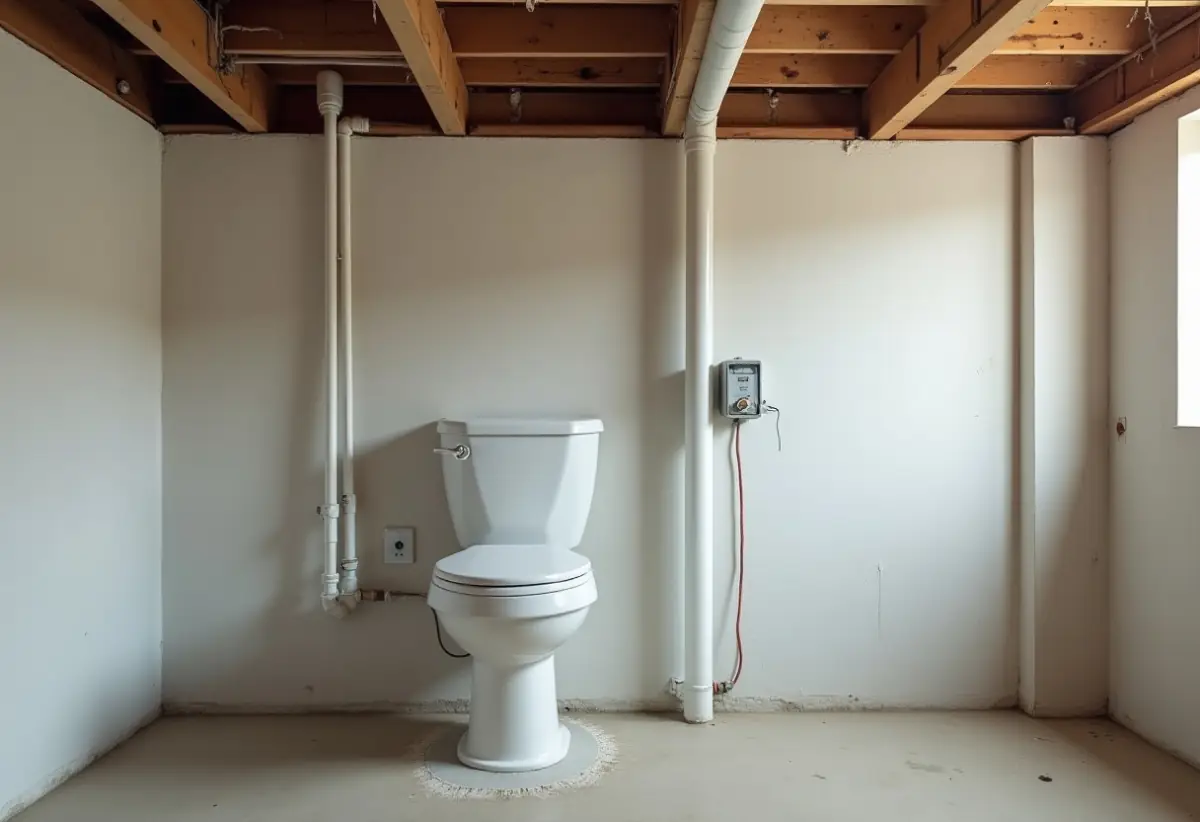
A gravity toilet drops into a 3 or 4 inch floor drain; the upflush bowl exits out the back through a rear spigot, so nothing penetrates the slab. That suits a basement bathroom plumbing job where the sewer runs overhead, and why it sits apart from the other toilet types you might compare.
Liberty’s Ascent II swaps the diaphragm switch for solid-state sensors and adds a high-water alarm with 9 volt battery backup.
How high and how far can an upflush toilet pump?
A SaniPLUS or SaniACCESS 2 pumps up to 15 feet straight up or 150 feet sideways, not both at full value. Saniflo’s rule is that 3 feet of vertical lift equals 30 feet of horizontal run, and each 90 degree turn costs about 3 feet of height. Liberty rates the Ascent II at 25 feet of usable head with 150 feet of 1 inch lateral.
A SaniPLUS that climbs 9 feet to a joist-level stack has about 60 feet of run left, and two 90 degree turns cut usable lift by another 6 feet.
The chart applies Saniflo’s equivalence to the 150 foot maximum, before turn losses. Saniflo’s SaniACCESS 2 manual adds routing rules:
- Go up first; keep any horizontal pipe before the lift under 18 inches.
- Once the line turns horizontal, never turn it upward again.
- Slope horizontal discharge at least 1/4 inch per foot toward the stack.
- Make each 90 with a long sweep or two 45s.
- Keep the discharge an independent line, at least 3 feet long before it enters a larger stack.
- Fit a full-port ball valve and a union low on the discharge, and clip rigid pipe every 3 feet.
- If the stack connection sits below the unit’s base, a vacuum relief valve may be needed at the high point.
Which upflush toilet models fit which bathroom?
Pick by lift and fixture count. The SaniACCESS 2 handles a toilet and sink at 15 feet. The SaniPLUS and SaniACCESS 3 add a shower or tub at the same 15 feet. The Sanibest Pro and Liberty Ascent II reach 25 feet, and Saniflo markets the 1 HP Sanibest Pro for laundry too. Prices are live listings, not quotes.
| Model | Max lift | Max run | Extra fixtures | Price checked Oct 28, 2026 |
|---|---|---|---|---|
| Saniflo SaniACCESS 2 (081), 1/2 HP | 15 ft | 150 ft | One sink via a 1 1/2 in side inlet (half bath) | No live Amazon price at check |
| Saniflo SaniPLUS (002), 1/2 HP, 4.5 A | 15 ft | 150 ft | Sink, shower, tub via two 2 in side inlets with check valves | $895.51 pump only (Amazon) |
| Saniflo SaniACCESS 3 (082), 1/2 HP | 15 ft | 150 ft | Full bath, black and gray water (listing) | $895.51 pump only (Amazon) |
| Saniflo Sanibest Pro (013), 1 HP | 25 ft | 150 ft | Full bath plus laundry (listing) | No live Amazon price at check |
| Liberty Ascent II (ASCENTII-ESW, -RSW, -MUW), 1/2 HP, 7.9 A | 25 ft usable (36 ft shut-off) | 150 ft through 1 in pipe | Lavatory and shower; inlets take 1 1/2 or 2 in pipe | No live Amazon price at check |
Specs come from Saniflo’s manuals and Amazon listings and the Liberty Ascent II sales sheet (Rev 11/21). To hide the box behind a wall, Liberty sells the 18 inch K001184 extension pipe for 2 by 4 or 2 by 6 walls; Saniflo says a toilet on its extension must be raised 3/8 inch.
What else can drain into a macerating toilet, and what can’t?
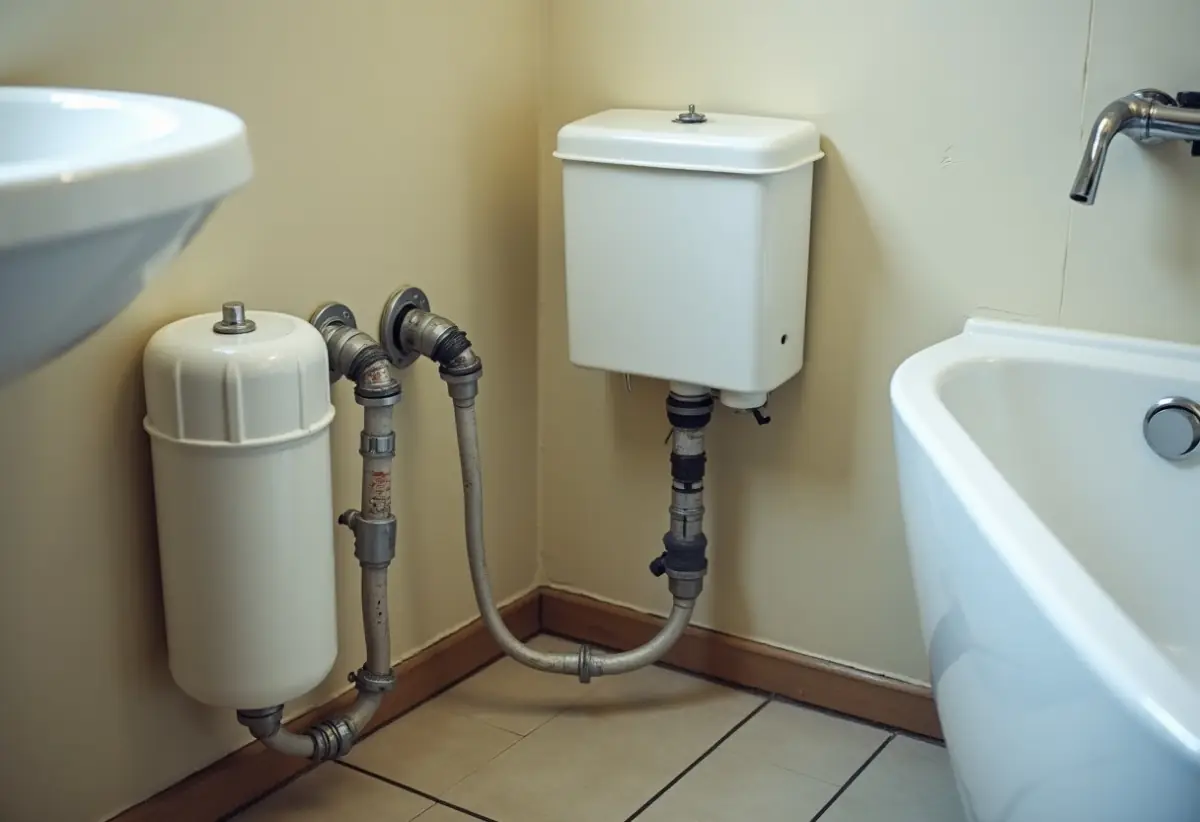
A full-bath macerator can take a sink, a shower and a bathtub, but only one toilet per unit. Saniflo’s manuals rule out kitchen waste, dishwashers and clothes washers on the SaniPLUS and SaniACCESS 2. Liberty caps fluid temperature at 104°F, so hot appliance discharge is out on that unit too.
The side inlets sit low, so fixtures must be raised to get slope. Saniflo’s SaniPLUS manual sets these numbers:
- Shower: the underside of the shower tray must sit at least 7 inches above the floor.
- Bathtub: set it on a 2 by 8 platform (2 by 6 minimum) to fit the P-trap.
- All drains: 1/4 inch per foot of fall; cap unused inlets.
The same manual bans condoms, tampons, sanitary pads, cotton swabs, solvents, paint, food waste, plastic bags, hairpins, building debris and kitty litter, plus bleach blocks in the tank, which attack the fill and flush valve seals.
Does an upflush toilet meet code, and how is it vented and wired?
Yes, when the unit is listed and installed by the book. IPC 2021 Section 712.4.1 states that “Macerating toilet systems shall comply with ASME A112.3.4/CSA B45.9 and shall be installed in accordance with the manufacturer’s instructions.” Liberty and Saniflo both cite CSA and IAPMO certification for their units.
Two more IPC lines matter. The Section 712.4.2 exception lets a macerator serving one water closet use a 3/4 inch discharge opening, while ejectors taking toilets must pass 2 inch spheres. Section 712.3.5 sends pump discharge into horizontal piping through a wye on top of the pipe, at least 10 pipe diameters from the base of any stack. California’s UPC-based code has a parallel section, CPC 710.13.
Saniflo’s manuals set the rest:
- Vent: tie the unit’s 1 1/2 inch vent port into the building vent system and vent every fixture feeding it. No air admittance valve on the unit; air must move both ways.
- Power: a 120 volt, 15 amp grounded GFCI receptacle at least 40 inches from a shower or tub.
- Discharge pipe: rigid 3/4 or 1 inch Type M copper, CPVC or PVC, never flexible hose.
How much does an upflush toilet cost compared with a sewage ejector pit?
Fixr puts an installed macerating toilet at $600 to $1,300, with toilet labor alone at $150 to $440. An ejector route costs more because the slab gets cut. Roto-Rooter quotes Denver basement baths at $6,000 to $12,000 for a half bath on existing plumbing and $12,000 to $25,000 or more for a full bath with an ejector pump.
Treat Fixr’s range as a floor. On October 28, 2026, Amazon listed the SaniPLUS 002 and SaniACCESS 3 pumps alone at $895.51 each, before bowl, tank, pipe and labor. Pit hardware can cost less: Amazon listed an RL-WCS50TA 1/2 HP sewage system with an 18 by 30 inch basin at $403.97, and Fixr puts an installed sewage pump at $600 to $1,800. Roto-Rooter attributes the jump to the additional plumbing and electrical work, which our sewage ejector pump guide breaks down.
| Factor | Upflush macerating toilet | Sewage ejector pit |
|---|---|---|
| Slab work | None | Cut and patch for basin and drains |
| Discharge size | 3/4 or 1 in (IPC 712.4.2 exception) | Must pass 2 in solids; 2 in discharge needs 21 gpm (IPC Table 712.4.2) |
| Toilets served | One per unit (Saniflo) | Several fixtures on one basin |
| Equipment price seen | $895.51 pump only, SaniPLUS 002 (Amazon) | $403.97, RL-WCS50TA system with basin (Amazon) |
| Typical project | $600 to $1,300 installed toilet (Fixr) | $12,000 to $25,000+ full bath with ejector (Roto-Rooter, Denver) |
Roto-Rooter’s totals are whole bathrooms, so check the full cost to add a bathroom. The same page says macerating toilets “require more frequent maintenance” than an ejector system.
What are the most common Saniflo toilet problems, and how do you fix them?
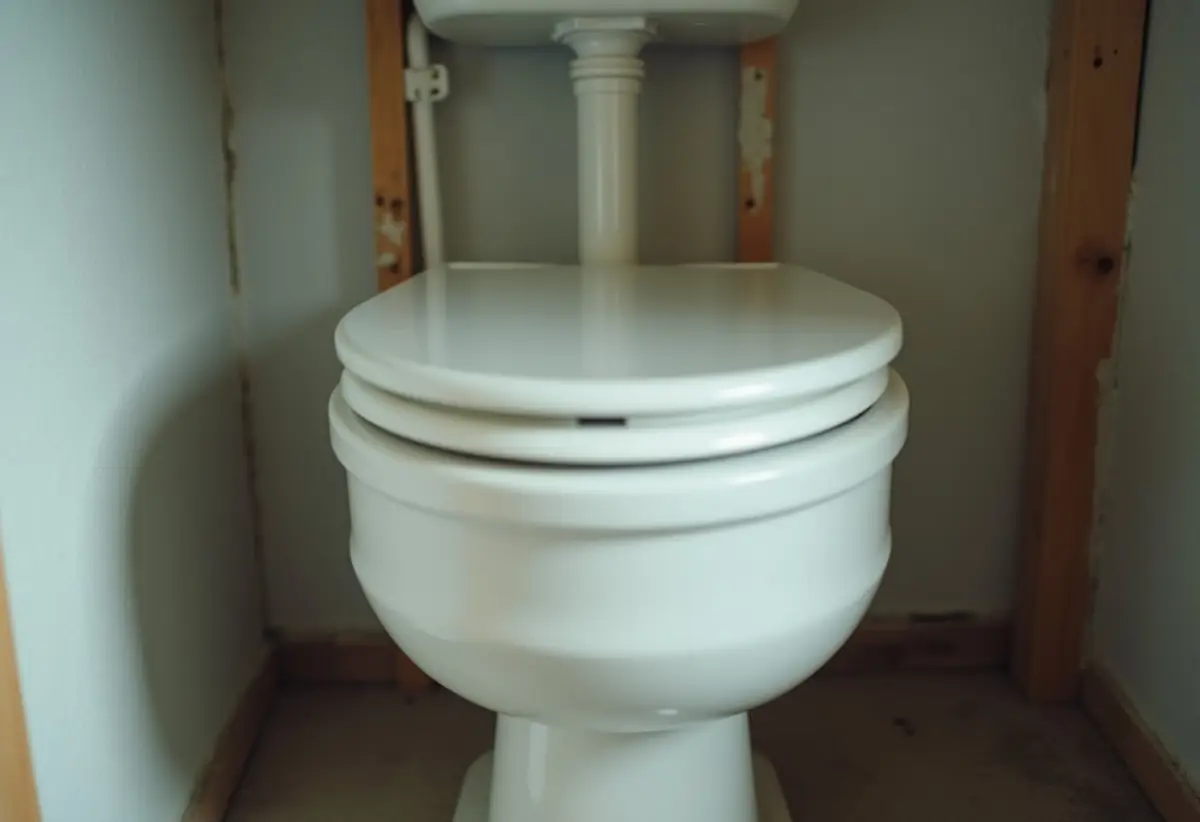
Most Saniflo toilet problems trace to four causes: a leaking tank that keeps restarting the motor, a tripped thermal overload, a foreign object jammed in the blades, or a blocked discharge or vent. Saniflo’s manuals walk through each, and the first checks need only a flashlight and the breaker panel.
- Unit starts by itself: check for a tank leaking into the bowl, a dripping faucet on a connected fixture, or an unseated check valve. Saniflo warns a drip can cycle the motor until the overload trips and the box floods.
- Unit stopped and will not restart: confirm the GFCI, breaker, fuse and plug, then wait about 20 minutes for the thermal overload to reset.
- Water rises in the bowl or drains slowly: check that the discharge and vent pipes are clear; Saniflo lists both among its first hydraulic checks.
- Foreign object in the unit: close the tank supply and discharge ball valve, unplug, and empty the bowl and box with a wet/dry vacuum. On a SaniPLUS, fish the object out through the toilet inlet with a folded wire.
- Side inlet clogged (shower or sink drains slowly): remove the inlet sleeve and free the rubber check flap with a screwdriver.
Never run the unit with the lid off or touch the motor’s dielectric oil, Saniflo says. Past these steps, its manual lists a U.S. support line, 800-571-8191.
How do you maintain an upflush toilet, and how long does it last?
Saniflo says the toilet needs no maintenance in normal use, but suggests cleaning the macerating unit once a year with Saniflo’s lime and scale remover where water is hard, and never with bleach. Saniflo says its units last 10 to 15 years, per Hunker, which also reports lab tests past 50,000 cycles.
Saniflo’s manuals add these routines:
- Away for a while: shut off the tank supply and flush once so the unit pumps itself empty.
- Freezing space: pour a jug of plumber’s antifreeze into the tank and flush. Saniflo does not cover freeze damage under warranty.
- Noise: keep the bowl off the wall, set it level so the rubber mounts work, and clip the discharge every 3 feet.
- Alarm: Saniflo recommends its optional Sanialarm, fitted to the lid, to warn of an abnormal water level.
Warranties vary. The SaniACCESS 2 manual we read carries 2 years; Saniflo’s current SaniPLUS listing advertises 4.
How we sourced this
We read Saniflo’s SaniPLUS and SaniACCESS 2 manuals, Liberty’s Ascent II sales sheet (Rev 11/21), IPC 2021 Chapter 7 on UpCodes, Fixr’s toilet and sump pump cost pages, Roto-Rooter’s Denver basement bathroom page and Hunker’s upflush guide. Prices are Amazon listings checked October 28, 2026. The chart is our arithmetic from Saniflo’s 3 ft = 30 ft rule. We left out decibel ratings and Liberty prices we could not verify.
Frequently asked questions
Can you put a regular toilet on a macerator?
Usually not. A macerator such as the Saniflo SaniPLUS connects to a toilet with a rear spigot outlet, the horizontal horn that sticks out the back of the bowl. A standard floor-outlet toilet drains straight down into a 3 or 4 inch flange and has nothing to clamp the macerator boot onto. Buy the bowl the pump maker specifies.
Can you use an upflush toilet when the power goes out?
No. The Saniflo SaniPLUS manual says not to use the toilet or any fixture connected to the macerator during a power loss, because the unit will not pump until power returns. Liberty’s Ascent II adds a 9 volt battery backed alarm, but the pump itself still needs 115 volt power.
Do upflush toilets need a vent?
Yes. Saniflo’s manuals say the macerating unit must be vented to the plumbing vent system through its 1 1/2 inch vent port, and every fixture that drains into it must be vented too. Saniflo specifically forbids an air admittance valve or any spring loaded cheater vent on the unit, because air has to move both ways as the box fills and empties.
How long do macerating toilets last?
Saniflo says its units last 10 to 15 years, according to Hunker, which also reports lab testing past 50,000 cycles, close to 30 years at five flushes a day. Saniflo’s manuals tie that life to use, warning that flushing banned items can damage the unit and void the warranty, and they call for yearly cleaning with lime and scale remover in hard water.
Can a shower drain into an upflush toilet?
Yes, on full-bath models such as the SaniPLUS, SaniACCESS 3, Sanibest Pro and Liberty Ascent II. The catch is height. Saniflo says the underside of a shower tray must sit at least 7 inches above the floor so the trap can slope into the side inlet at a quarter inch per foot of fall.
Is an upflush toilet cheaper than a sewage ejector pit?
Usually, for one toilet. Fixr puts an installed macerating toilet at $600 to $1,300, while Roto-Rooter quotes $12,000 to $25,000 or more for a full basement bathroom built around an ejector pump, including finish work. Roto-Rooter favors an ejector system when it must handle every basement fixture over the long term.
Can you flush wipes in an upflush toilet?
No. Saniflo’s manuals limit macerators to human waste, toilet paper and water, and list condoms, tampons, sanitary pads and cotton swabs as items the unit cannot take without damage. Wipes are not on the allowed list, and Saniflo says ignoring its cautions may damage the unit and void the warranty. Keep a lidded bin beside the toilet.
What are some common problems with upflush toilets?
Most Saniflo toilet problems trace to four causes. A leaking tank that keeps restarting the motor, a tripped thermal overload, a foreign object jammed in the blades, or a blocked discharge or vent. A drip can cycle the motor until the overload trips and the box floods. Clogged side inlets can also make a shower or sink drain slowly.