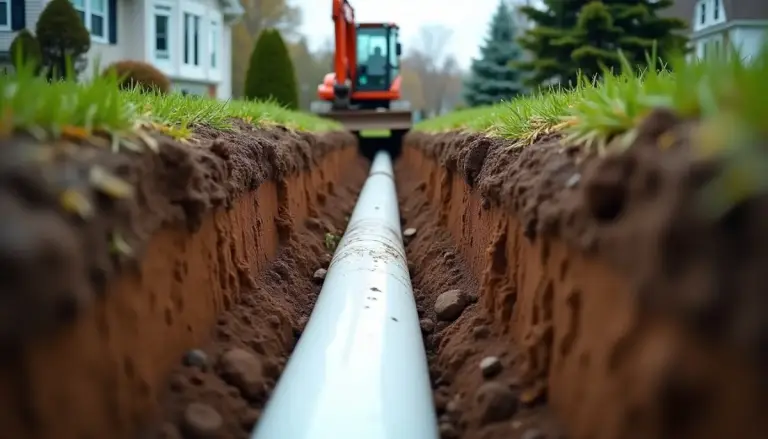
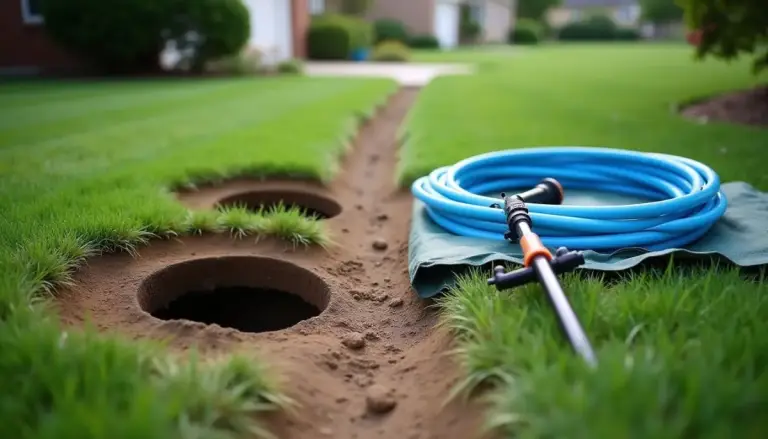
Sewer Line Belly: Causes, Signs, Fixes and Repair Cost
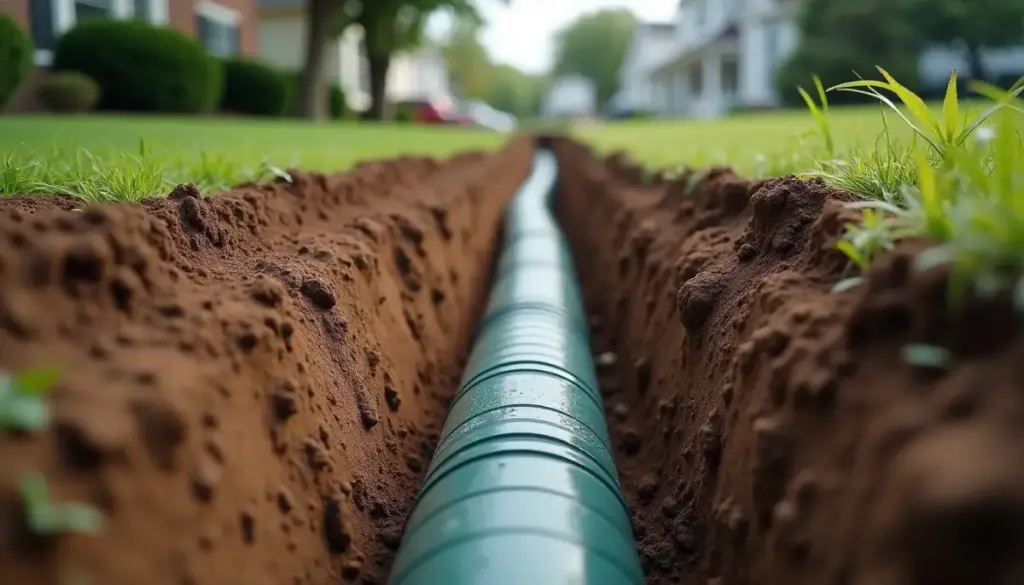
A sewer line belly is a low spot where the pipe sags and wastewater pools; shallow ones can be monitored, but a belly causing repeat clogs usually needs a dig-and-re-bed repair at $50 to $250 per foot, per HomeAdvisor.
Key Takeaways
- The International Plumbing Code (Table 704.1) requires a uniform slope of at least 1/8 inch per foot for 3 to 6 inch drain pipe. A belly breaks that rule.
- A camera inspection, $100 to $500 per HomeAdvisor and This Old House, confirms a belly.
- HomeAdvisor (updated June 2026) prices partial sewer line replacement at $50 to $250 per foot and full replacement at an average of $3,319.
- Cured-in-place lining ($90 to $250 per foot, HomeAdvisor) seals cracks but follows the existing pipe, so it does not remove a belly.
- In EBMUD’s East Bay service area, a private sewer lateral compliance certificate is required to close escrow when a property is sold.
What is a sewer line belly?
A sewer line belly is a section of buried drain pipe that has sagged below the grade around it, forming a shallow U where wastewater and solids collect instead of draining. It is also called a sag or a low spot. The pipe can be fully intact. The problem is the slope, because water cannot run uphill out of the dip. Correct slope depends on pipe size, so it helps to check code minimum slope requirements before diagnosing a belly as the culprit.
InterNACHI, the home inspector association, describes a belly in its sewer scope materials as a low spot that forms when soil below the pipe settles or compacts. Most sit in the private lateral between the house and the main.
A belly is one of several other common sewer line problems, and it often travels with offset or separated joints.
What causes a belly in a sewer line?
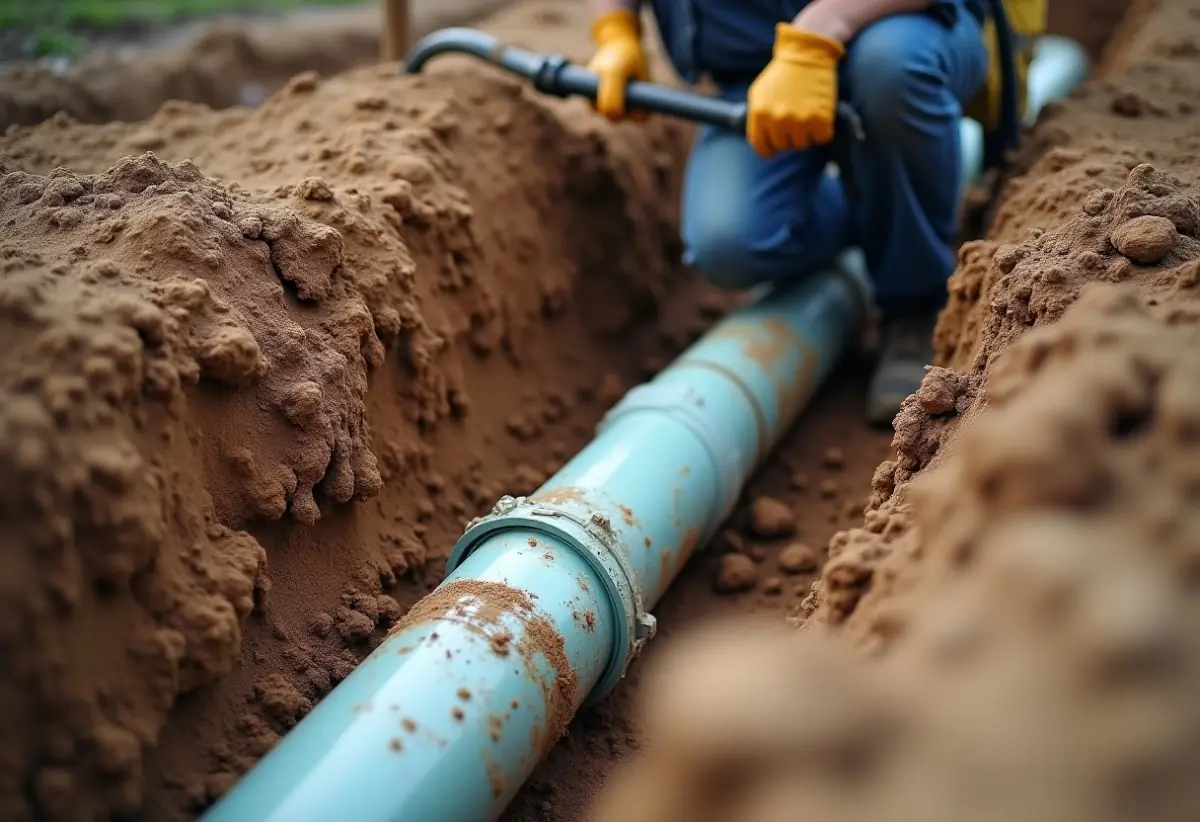
Almost every sewer line belly starts with the ground under the pipe, not the pipe itself. When the bedding beneath a section loses support, the weight of the soil above and the water inside pushes that section down. Poor compaction at installation, settling soil, erosion, frost and nearby excavation are the usual triggers.
- Poor bedding at installation. Pipe laid on loose fill, rocks or uneven trench bottoms has nothing solid to rest on. Plumbing codes, including the IPC, require buried piping to be supported along its whole length for this reason.
- Soil settling. Backfill not compacted in layers keeps settling for years.
- Erosion from a leak. A cracked or separated joint lets water seep out and carry soil away, which leaves a void the pipe sinks into.
- Frost heave. Freezing soil lifts shallow lines, and they do not always settle back at grade.
- Nearby digging. Utility trenches, foundation work and stump grinding can disturb the soil holding the lateral at grade.
Material matters too. PVC and ABS flex under load, so a weak base shows up as a sag sooner. In clay and cast iron, the belly more often forms at a joint.
What are the signs of a sewer line belly?
The classic signs of a sewer line belly are drains that slow down across the house, clogs that come back in the same place soon after clearing, gurgling toilets or tubs, and sewage backing up into the lowest drain. None of these prove a belly on their own, because roots and breaks cause the same symptoms.
- Recurring main-line clogs. The line clogs again within weeks or months at the same distance from the cleanout.
- Whole-house slow drains. Several fixtures drain slowly, not just one.
- Gurgling. Air trapped behind standing water bubbles back through toilets and floor drains when a large volume drains.
- Backups at the lowest fixture. A basement floor drain or first-floor shower backs up when the washer or dishwasher empties.
- Soft or sunken soil above the line. A depression over the lateral can point to erosion from a leak inside the sagged section.
The tell is timing. A clog from grease or wipes clears and stays clear. A belly keeps collecting solids, so the problem returns.
How is a sewer line belly found and measured?
A sewer line belly is confirmed with a push camera run through a cleanout, which shows standing water in a pipe that should be draining, or the camera lens going under water. A locator then marks the belly’s position and depth on the surface. Visual symptoms alone cannot tell a belly apart from roots or a partial collapse.
That is why the first dollar on a suspected belly should go to a sewer camera inspection, not to excavation. HomeAdvisor and This Old House both put camera inspections at $100 to $500.
- Run water during the scope. InterNACHI’s guidance notes that flowing water makes a pooling belly easier to see than a dry pipe.
- Note where water starts and stops. The footage counter gives the belly’s length.
- Estimate depth of water. Inspectors describe it as a share of the pipe’s height, from a thin film to a fully submerged lens.
- Locate from above. A transmitter in the camera head lets the operator mark the spot and depth on the ground, which sets the dig plan and the price.
Ask for the video file. If the camera went under water, the pipe wall in that stretch was not visible, so cracks inside the belly may still be hiding.
How bad is a sewer line belly, and can you live with one?
A shallow sewer line belly that holds a thin layer of water and has never caused a backup is often something homeowners live with, paired with periodic cleaning and a camera check every year or two. A belly that fills most of the pipe, causes repeat clogs or sits beside cracked joints or roots usually needs repair.
No plumbing code grades bellies. The table below is The Plumbing Brief’s editorial guide, built from how inspectors and plumbers describe camera footage. It is a starting point for a conversation with your plumber, not a code standard.
| Severity | What the camera shows | Typical symptoms | Typical fix |
|---|---|---|---|
| Minor | Thin film or shallow puddle over a few feet; camera stays above water | None, or slightly slow drains | Monitor; re-scope every 1 to 2 years or after any backup |
| Moderate | Water partway up the pipe over several feet; some debris or paper settling | Occasional main-line clog, gurgling | Scheduled cleaning (snaking or hydro-jetting); plan a spot repair |
| Severe | Water fills most of the pipe or the lens goes under; long run of standing water | Clogs every few weeks or months, backups at lowest drain | Excavate, re-bed and relay the section at code slope |
| Belly with damage | Standing water plus cracks, separated or offset joints, or roots | Backups, odor, sunken soil above the line | Spot repair at minimum; full replacement if damage runs the length of the line |
Two conditions push even a mild belly toward repair: an upcoming sale, since a buyer’s scope will flag it, and an old clay or cast iron line, where the same settling is likely stressing nearby joints.
What slope does code require for a sewer line?
The International Plumbing Code requires horizontal drainage pipe to run at a uniform slope of at least 1/4 inch per foot for pipe 2-1/2 inches or smaller, 1/8 inch per foot for 3 to 6 inch pipe, and 1/16 inch per foot for 8 inch and larger, under Table 704.1. Most house sewers are 4 inch pipe.
The ICC’s own IPC essentials guide notes that 1/4 inch per foot is the most common slope for horizontal drains of all sizes, with lesser slopes allowed for 3 inch and larger pipe. The Uniform Plumbing Code, used in many Western states, sets similar rules. Your local code decides which applies.
The word that matters for a belly is “uniform.” Section 704.1 requires uniform alignment at uniform slopes, so a line that averages enough fall from house to street can still fail if one stretch dips. On a 4 inch lateral at 1/8 inch per foot, a 40 foot run only needs 5 inches of total fall, which is why a few inches of settlement can wipe out the grade in one section.
How do you fix a sewer line belly, and what does it cost?
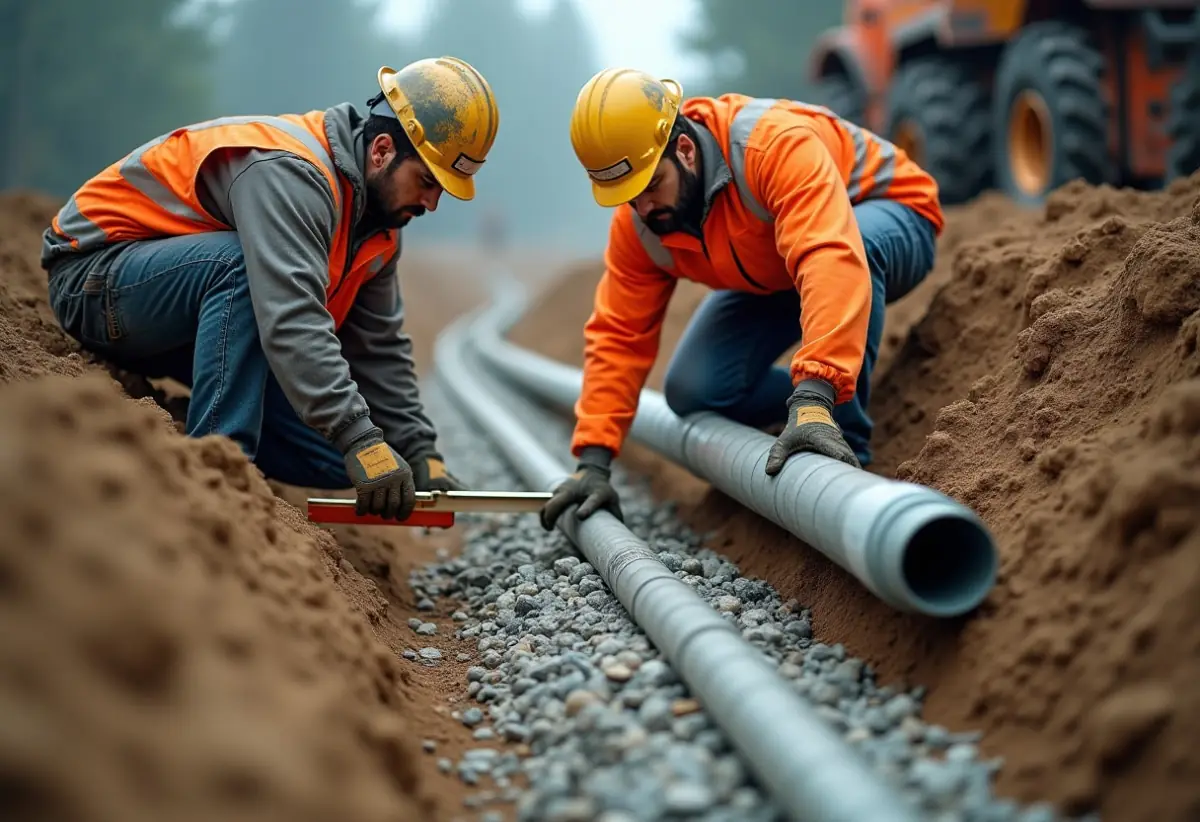
The reliable fix for a sewer line belly is to dig up the sagged section, rebuild the bed under it with compacted material and relay the pipe at code slope. HomeAdvisor prices this kind of partial replacement at $50 to $250 per foot. Lining does not remove a belly, and pipe bursting may not, because both follow the old path.
| Method | Does it remove the belly? | Published cost | Best for |
|---|---|---|---|
| Cleaning and monitoring | No, it manages the symptoms | Per-visit cleaning plus a $100 to $500 camera check (HomeAdvisor) | Minor bellies with no damage |
| Spot repair (excavate and re-bed) | Yes, for the dug section | $50 to $250 per foot for partial replacement (HomeAdvisor) | A single belly in an otherwise sound line |
| Open-cut full replacement | Yes, the whole line is relaid at grade | $60 to $250 per foot (HomeAdvisor); $50 to $200 per foot excavation (This Old House) | Multiple bellies, old clay or Orangeburg, widespread damage |
| Pipe bursting | Often not; the new pipe follows the old route | $60 to $200 per foot (HomeAdvisor) | Cracked or undersized lines with acceptable grade |
| Cured-in-place lining (CIPP) | No; the liner takes the shape of the host pipe | $90 to $250 per foot (HomeAdvisor) | Cracks and root entry where slope is fine |
The chart plots the midpoint of each published per-foot range: HomeAdvisor (June 2026) for lining, full and partial replacement and bursting, and This Old House (March 2026) for traditional excavation. The method that fixes a belly is the one that changes the grade.
A typical belly repair follows a set sequence.
- Mark the belly from the camera locate, and call 811 before digging.
- Pull a permit where your city requires one. HomeAdvisor lists a typical sewer permit at about $200.
- Excavate the sagged section back to pipe that sits at grade.
- Remove the low pipe and rebuild the trench bottom with compacted gravel or sand bedding.
- Relay new pipe at code slope and join it with approved couplings.
- Pass inspection, backfill in compacted layers, re-scope and restore the yard. HomeAdvisor puts landscaping repair at $4.50 to $12 per square foot.
Cost climbs with depth, length and any driveway or patio on top. For the full menu of sewer pricing, including replacement by material and line length, see our full sewer line repair cost breakdown.
If a plumber pitches lining or bursting for a belly, ask in writing whether the finished line will meet code slope through the low spot. Our guide to trenchless sewer repair methods covers where lining and bursting fit and where they do not. A common hybrid is to re-bed the belly, then line the rest.
Does insurance cover a sewer line belly, and does it matter when selling a home?
Standard homeowners policies often exclude a sewer line belly, because the usual causes (wear and tear, deterioration and settling) are common exclusions. An optional service line coverage endorsement may pay for a buried lateral repair, depending on its terms. At sale, a belly found on a buyer’s sewer scope often becomes a repair credit request.
Check three things first: whether your policy has a service line endorsement and what it excludes, whether sewer backup coverage applies (it may pay for indoor cleanup but not the pipe), and who owns the lateral. In many cities the homeowner owns it from the house to the main or the property line.
For sellers and buyers, a few local rules raise the stakes. In EBMUD’s private sewer lateral program in the San Francisco East Bay, a compliance certificate is required to close escrow on a sale, and also at final sign-off for remodels over $100,000. If the work cannot finish before title transfers, EBMUD offers a time extension certificate good for 180 days. The certificate is about a leak-free lateral, so a belly with open joints can fail the test.
Elsewhere, the sewer scope is a negotiation tool. Buyers commonly ask for a credit sized to a plumber’s written quote. Sellers who fix a belly first should keep the permit and a post-repair camera video.
How we sourced this
We reviewed the top-ranking pages for “sewer line belly” and related cost questions in October 2026 and consulted 12 sources, citing 5. Slope rules come from the ICC’s International Plumbing Code Table 704.1 and its IPC essentials guide. Costs come from HomeAdvisor’s sewer line replacement guide (updated June 19, 2026) and This Old House’s sewer line replacement cost guide (updated March 30, 2026). Belly definition and camera practice come from InterNACHI sewer scope materials. Sale requirements come from EBMUD’s private sewer lateral page. We excluded cost pages with no named methodology or author. Chart values are midpoints we calculated from published ranges. The severity table is editorial guidance, not a code standard.
Frequently asked questions
Does a sewer line belly need to be replaced?
Not always. A shallow belly that holds a little water and has never caused a backup can often be monitored with a camera every year or two and cleared when needed. Replace or re-bed the section when the belly causes repeat clogs, holds water across most of the pipe, or sits next to cracked joints or roots. A full line replacement only makes sense when the whole pipe is failing.
How much does it cost to fix a belly in a sewer line?
HomeAdvisor lists partial sewer line replacement, the usual dig-and-re-bed fix for a belly, at $50 to $250 per linear foot, and a full replacement averages $3,319 within a normal range of $1,388 to $5,323. Deep lines, lines under driveways and long bellies push the price higher. Add $100 to $500 for the camera inspection that finds and measures the belly.
Can you live with a belly in your sewer line?
Many homeowners do, for years, when the belly is shallow. The trade-off is maintenance. Solids and paper settle in the low spot, so expect slower drains and the occasional clog, and plan on periodic cleaning plus a camera check after any backup. If the belly keeps clogging despite cleaning, or water fills most of the pipe on camera, living with it usually costs more than fixing it.
What causes a belly in a sewer line?
Most bellies start with the soil under the pipe. Loose or poorly compacted bedding at installation, soil that settles over time, water from a leaking joint washing soil away, frost heave in cold climates, and nearby digging for utilities or tree removal can all let a section drop. Plastic pipe flexes more than cast iron, so a weak base shows up as a sag sooner.
Is a sewer belly a deal breaker when buying a house?
Usually not, but it is a negotiating point. Ask the inspector how long the belly is, how much of the pipe it fills, and whether joints or roots are involved, then get a plumber’s written quote. Buyers often ask for a repair credit or price reduction. In parts of the San Francisco East Bay, EBMUD requires a sewer lateral compliance certificate to close escrow, which raises the stakes.
Can pipe lining fix a sewer line belly?
No. Cured-in-place pipe lining coats the inside of the existing pipe and follows its shape, so the low spot stays low and keeps collecting water. Lining can seal cracks and joints inside a belly but cannot change the slope. Pipe bursting also tends to follow the old path. To remove the sag, the section usually has to be dug up, re-bedded on compacted material and relaid at proper grade.
How much belly is acceptable in a sewer line?
No plumbing code sets an allowed belly depth. The International Plumbing Code requires drainage pipe to run at a uniform slope, at least 1/8 inch per foot for 3 to 6 inch pipe, so any belly technically falls short. In practice, plumbers judge it by how much water it holds on camera, how long it runs, and whether it causes clogs. A thin film of water is usually tolerated.