Rheem Water Heater Blinking: What Each Flash Count Means
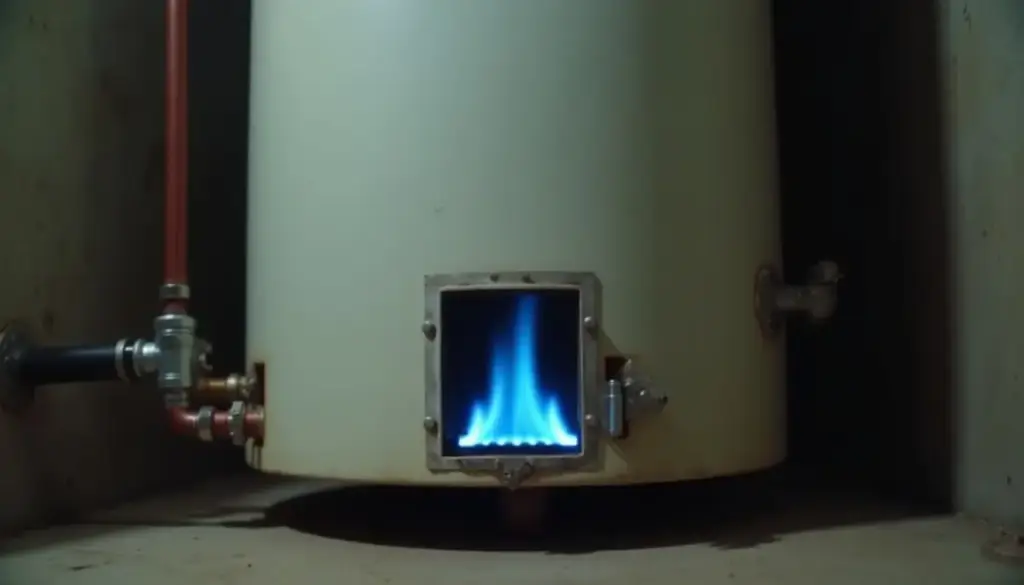
A Rheem water heater blinking blue once every 3 seconds is normal. Blinking red is a fault, and the flash count names it: on Rheem’s thermopile gas tanks, 2 is low thermopile voltage, 4 a high temperature trip, 5 a sensor failure and 7 a gas control failure.
Use this table for a gas tank with a knob, a STATUS light and a piezo button just below the knob. The same chart is printed in Rheem’s AP23698 (29 to 55 gallon low NOx), AP22858 (48 to 98 gallon FVIR) and AP19928 Rev 02 (75 and 98 gallon ultra low NOx). A power cord and blower on top, or a keypad with a SERVICE NEEDED light, means a different chart: go to the family table.
| Flashes and color | Rheem’s meaning | What you do | Stop and call |
|---|---|---|---|
| Any count, with a gas smell | Possible gas leak | Leave the building first. Do not light anything, touch an electrical switch or use any phone inside. From a neighbor’s phone or outside, call the gas supplier, or 911 if you cannot reach the supplier. | Now. Stay out until the gas supplier or fire department authorizes your return. |
| 0, no light | Knob off, pilot not lit, or too little millivolt power | Turn the knob on. To relight: knob OFF, wait 5 minutes and smell for gas near the floor (any smell, use the first row), knob to PILOT, hold it in and click the piezo button until STATUS blinks, then confirm the flame in the sight glass. | No blink after 90 seconds means repeat the steps. Call if the pilot will not stay lit after several attempts, or if the knob does not pop back out. |
| Constantly lit | Pilot recently went out and the thermopile is cooling, or knob recently turned to OFF | Follow the lighting steps on the tank label. | Same as the no-light row. |
| 1 blue | Normal operation, or knob in PILOT with the pilot lit | Set the knob to your temperature. | Nothing to call about. |
| 2 red | Low thermopile voltage, pilot still lit | Check that the thermopile connector is seated at the gas control, look for damaged wires, and view the pilot assembly. Rheem says not to remove the inner door. | Code stays after those checks. Ask for a thermopile and pilot assembly check. |
| 3 or 6 | Not on this chart | Recount two groups. A true 3 or 6 means another control family, so use the family table. | Still 3 or 6 on a tank with no blower or keypad: call with the model number, since this chart does not define it. |
| 4 red | High water temperature limit tripped | No owner fix is listed. Treat the hot water as scalding: Rheem’s chart gives about 1.5 seconds to a serious burn at 150°F. | Now. Ask whether the single use gas shut-off opened, because Rheem replaces the control if it did. |
| 5 red | Water temperature sensor failure | No owner fix is listed. | Now. Ask for the temperature sensor to be checked before any control is priced. |
| 7 red | Combination gas control (thermostat) failure | No owner fix is listed. Have the model and serial from the rating plate ready. | Now. Ask for a gas control diagnosis. |
| 8 red | False pilot flame signal (the label says Flame Sense Error) | No owner fix is listed. | Now. |
| 9 red | Chamber sensor failure | No owner fix is listed. | Now. |
| 10 red | Chamber temperature shutdown | Move stored fuels and solvents away and keep the air openings clear. Rheem names flammable vapors and blocked combustion air inlets as combustion shutoff triggers. | Now. The manual says to contact a technician when the combustion shutoff trips. |
Codes 4, 5, 7, 8, 9 and 10 all end in one instruction from Rheem: contact a qualified service technician. Rheem’s caution also bars owners from repairing the gas control, burners or safety devices. Its national service line is 1-800-432-8373 and asks for the model and serial number from the rating plate.
How do you count Rheem flashes and tell a normal blink from a fault?
Count one full group between dark gaps, count the next group, and trust the number only when both match. AP23698 words each code as blinks “every three (3) seconds,” while Rheem’s Technical Service Bulletin 1627 describes the same kind of code as flashes followed by a “three second pause.”
- Start counting right after a gap, not in the middle of a burst.
- Note the color, blue or red.
- Count a second group. If the two disagree, count a third.
- If the pilot dies when you let go, repeat the lighting steps and keep the knob held in until the code is fully read. Rheem says the pilot must be lit to view codes.
Three blink patterns look like faults and are not. One blue blink every 3 seconds is normal on the thermopile chart. Turning the knob to OFF with the pilot lit makes the light stay on briefly and shift from blue to red, per AP23698. On a PowerVent, TB 1627 lists a short flash every 4 seconds as idle and a heartbeat that alternates bright and dim as a call for heat, neither one a fault.
Watch the gap on a PowerVent: one flash and a 3 second pause is code 12, low flame signal, not idle. A steady light is not the normal state on the thermopile chart either, whatever some pages say, because Rheem ties it to a pilot that recently went out.
What does a Rheem water heater blinking 7 times mean?
On a Rheem thermopile tank, 7 red flashes means the combination gas control (thermostat) has failed, per AP23698, and the manual’s only step is a technician. Ask for confirmation of the code and a price on the part and labor. Our guide to replacing a water heater gas control valve carries HomeGuide’s $150 to $550 installed range and the replace-or-keep arithmetic for an older tank.
On a PowerVent ESII with a Honeywell control, 7 flashes is code 47, flammable vapor sensor lockout, and the first check is for gasoline or other flammable vapors around the heater. If you smell any, use the gas-smell row above and leave. TB 1627 has the technician read the sensor at about 11 to 45 kΩ and replace it above 45 kΩ.
That bulletin is the likely source of the “7 reset” advice on the web. It clears the PowerVent lockout by cycling power and rotating the dial through HOT 7 times within 30 seconds, and only when sensor resistance is in range. It is a technician step for code 47 on that one control, not a fix for a failed gas control on a thermopile tank.
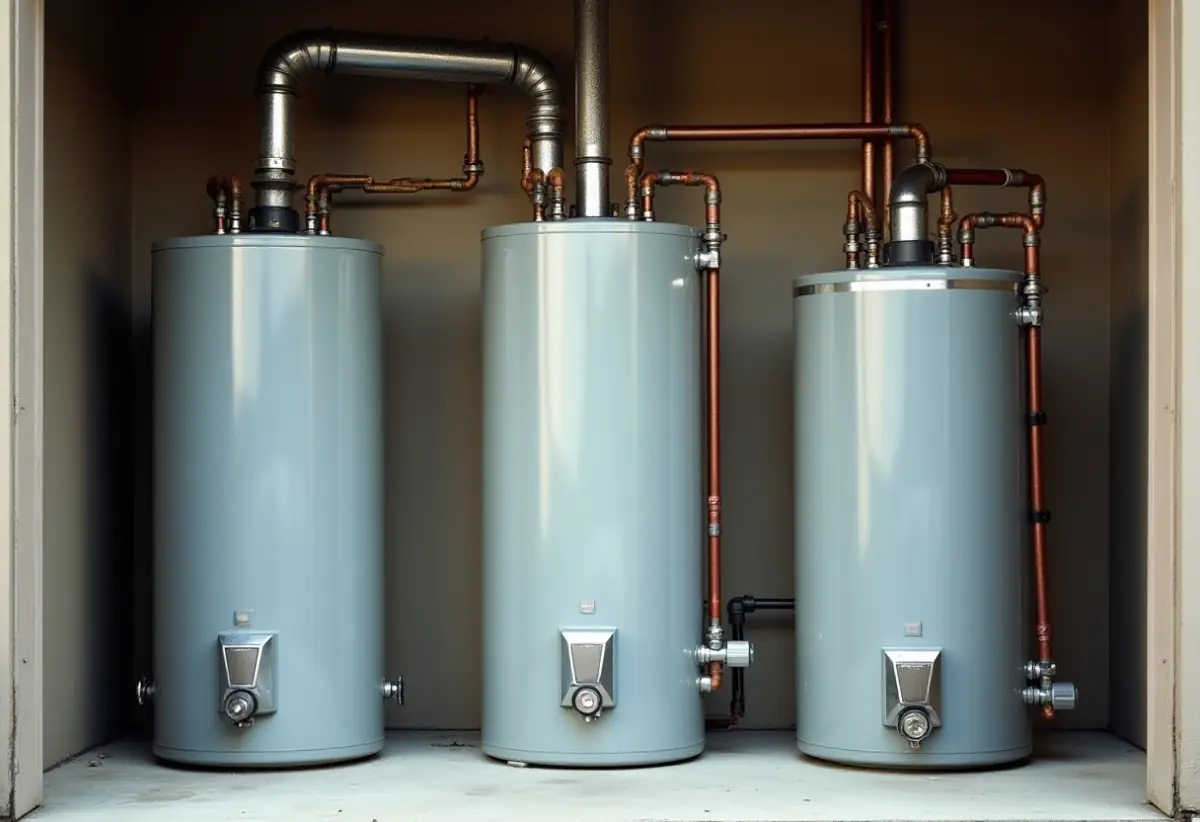
Which flash codes change between Rheem tanks, PowerVents and electrics?
Nearly every count changes meaning across Rheem’s three control families, so the family comes before the count. A 4 is a water temperature trip on two of them and an element wiring or cut out problem on the third. Numbers in parentheses are the display codes in TB 1627. Rheem’s hybrid heat pump tanks skip blink counts altogether and show alarm codes on a display, which our Rheem heat pump water heater error codes table lists.
| Count | Thermopile gas tank (AP23698) | PowerVent ESII, Honeywell control (TB 1627) | Electric with electronic control (AP21980 Rev 02) |
|---|---|---|---|
| 1 | Normal (blue) | Low flame signal, heater keeps running (12) | Lower thermistor failure |
| 2 | Low thermopile voltage | Pressure switch failed closed (44) | Leak detected or shutoff valve error |
| 3 | Not listed | Pressure switch failed open (46) | Dry fire, tank not filled |
| 4 | High temperature limit | Thermal cut off lockout at 199°F (31) | Element wiring or emergency cut out |
| 5 | Temperature sensor failure | Flame out of sequence (14) | Control or power board error |
| 6 then a second count | Not listed | 6-1 failed ignition (11), 6-2 recycle limit (45), 6-3 flame lost (13), 6-5 hard lockout (10) | Not listed |
| 7 | Gas control failure | Flammable vapor sensor lockout (47) | Not listed |
| 8 then a second count on PowerVent | 8 alone: false pilot flame | 8-1 vapor sensor fault (49), 8-2 temperature sensor (89), 8-3 electronics (15), 8-4 valve (93) | Not listed |
| 9 | Chamber sensor failure | Not listed | Not listed |
| 10 | Chamber temperature shutdown | Not listed | Not listed |
PowerVent: an ECO lockout at 199°F needs sensed water below 120°F and a power cycle to clear, and failed ignition (6-1) waits 5 minutes before retrying, then goes to hard lockout after 3 soft lockouts. Rheem’s GG50T06PVT manual also lists a 6-4 soft lockout for flame out of sequence, which TB 1627 omits. Repeat lockouts call for a technician to check gas pressure against the rating plate, the electrode and the pilot tube.
Electric: the blinks come from the SERVICE NEEDED light, per AP21980 Rev 02, and a solid red light is an alert with the heater still running. Owners can act on 3 blinks (fill the tank, recycle power) and, on heaters with a leak sensor, on 2 blinks when the pan is dry (disconnect, dry and reinstall the sensor). Four blinks can mean a tripped ECO. Rheem says a qualified service technician must investigate why it tripped and correct the cause before the heater returns to service, so call first. Rheem’s reset: turn the power off at the breaker, verify with a volt meter that it is off, as Rheem’s tune-up kit sheet requires, remove the control and insulation, press the red RESET button, and refit both before restoring power. The rest of that chart is a service call.
Did Rheem’s flash chart change by model year?
Yes: the older chart stops at 8. Rheem’s AP16801, dated 04/13 and written for 30 to 60 gallon tanks with electronic control, calls the status light “the blinking red light” and defines codes 0, 1, 2, 4, 5, 7 and 8, with no 9 or 10. The 2021 to 2023 PDFs on Rheem’s site add chamber sensor failure (9) and chamber temperature shutdown (10), and they split normal blue from fault red. AP16801 still lists code 1 as normal operation, so one slow red blink on a tank with that chart is not automatically a fault.
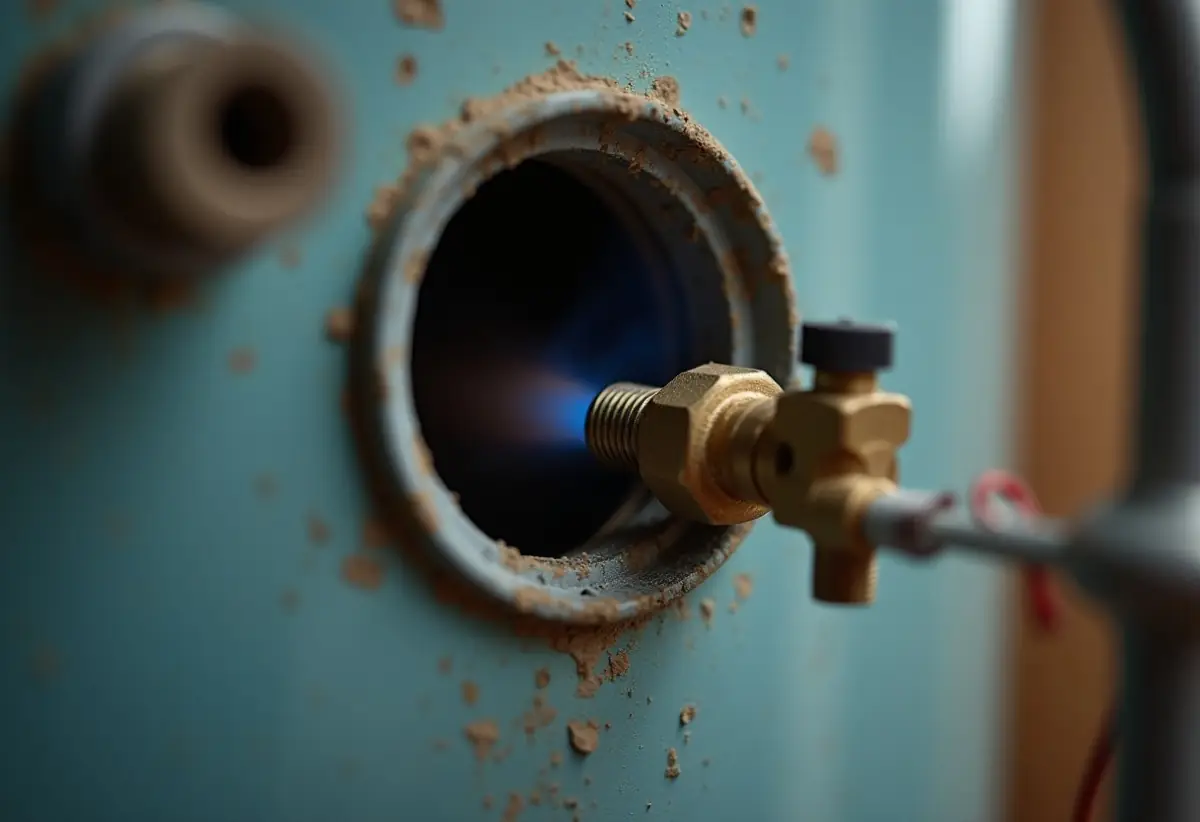
Is the fault the pilot, the thermopile or a sensor?
The count separates them: 0 points at the pilot or knob, 2 at the thermopile with the pilot still burning, and 5 or 9 at a sensor. Start a 0 with our pilot light relighting steps. If the tank has no hot water and the light reads normal, the no hot water checklist covers the causes a flash code will not show.
Every status-light tank manual we read names a thermopile, not a single thermocouple, so check before buying a part. AP22858’s pilot table says “loose thermocouple,” yet its own status chart and parts diagram say thermopile. Our thermocouple replacement guide shows how the two differ. On AP23698 a pilot that drops on release can also be a defective safety magnet, which means replacing the gas control through a technician.
Which Rheem water heaters have no flash code to count?
Rheem’s super high efficiency condensing tanks report faults on a touchscreen, not a count. AP21831 Rev 02 says the Service button blinks on the home screen during an active alarm and opens the alarm list, and service manual AP23008 Rev 03 covers the RSHE and GHE models, including Maximus and Triton LD. Any Rheem gas control without a STATUS light has nothing to count either, so diagnose it by the pilot flame. A blinking temperature indicator on an AP21980 electric just means an element is heating.
Frequently asked questions
Why is my Rheem water heater blinking red instead of blue?
On recent Rheem thermopile tanks, red reports a fault and one blue blink every 3 seconds is normal. The exception is the older manual AP16801, dated 04/13, which calls the status light a blinking red light and still lists code 1 as normal operation. Count the group before you assume a failure.
Can I reset a Rheem gas control that is blinking 7 times?
AP23698 gives owners no reset for 7 red flashes, only a call to a qualified service technician. Relighting is Rheem’s routine for a pilot that is out, and it does not repair a failed control. Expect the technician to confirm the code and replace the combination gas control.
Does a solid Rheem status light mean the heater is fine?
No. Rheem’s chart ties a constantly lit status light to a pilot that recently went out while the thermopile cools, or a knob recently turned to OFF. Normal operation is one blue blink every 3 seconds, so a solid light calls for the lighting steps on the tank label.
Why does the Rheem status light quit when I release the knob?
The pilot dropped out, and Rheem says the pilot must be lit to show a code. AP23698 lists a disconnected or defective thermopile, a defective safety magnet, an opened single use shut-off and a tripped combustion shutoff device as causes. Hold the knob in to read the code, then call a technician.
What does one red blink mean on a Rheem electric water heater?
AP21980 Rev 02 defines one red blink and a pause on the SERVICE NEEDED light as a disconnected or failed lower thermistor, and Rheem says to call for service. A blinking water temperature indicator is a separate signal, and it only means a heating element is on.
How we sourced this
We read Rheem forms AP23698, AP22858, AP19928 Rev 02, AP21980 Rev 02, AP21831 Rev 02, AP23008 Rev 03 and Technical Service Bulletin 1627, plus the AP16801 and GG50T06PVT manuals on ManualsLib. PDF years come from file metadata. The cost range is HomeGuide’s, as cited on our valve page. We could not confirm a White-Rodgers control or a Ruud label on any blink chart we opened, or tie these forms to specific Performance or Professional model numbers, so check your own tank’s label. Rheem tankless codes were left out.