Can You Use PEX for a Shower Valve? Makers, Stub-Outs and the Shower Head Drop Ear Rule
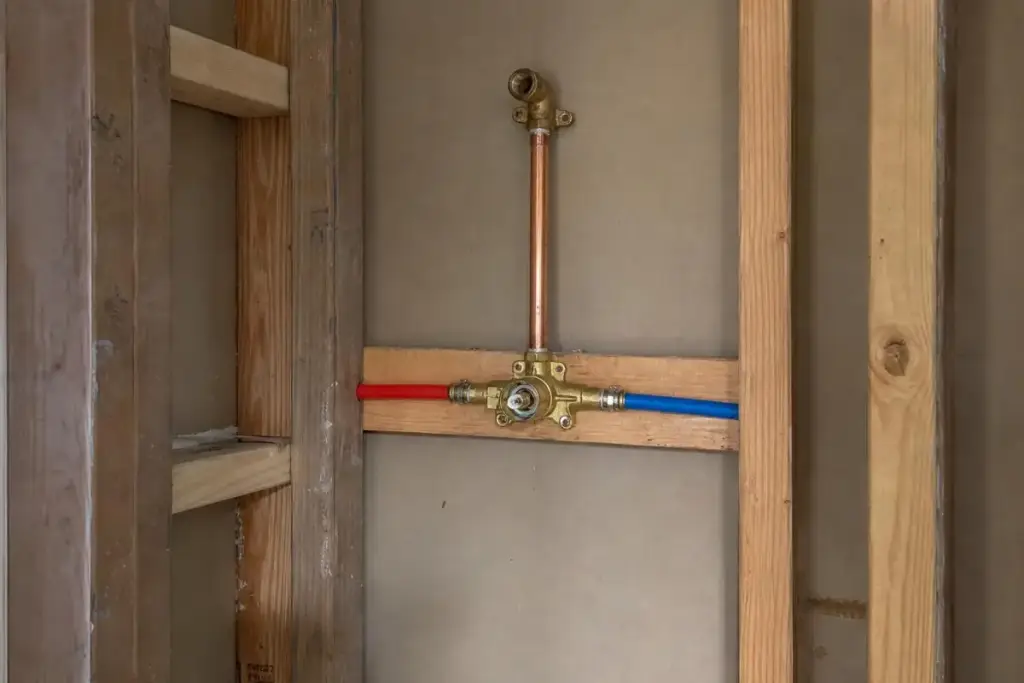
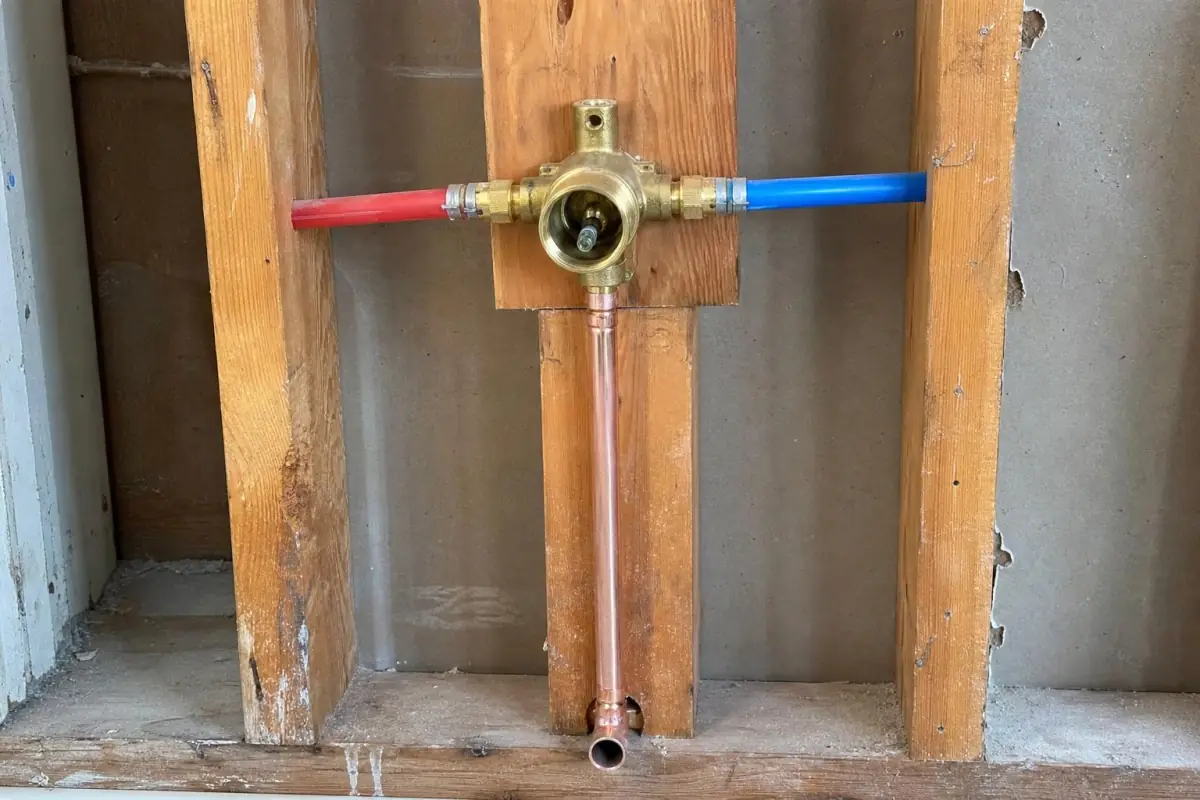
Yes, it is OK to use PEX for a shower valve’s hot and cold supplies, and Delta, Moen, Kohler and Pfister all sell valve bodies with PEX inlets. The catch is the outlets: Delta’s R10000 sheet bans PEX on the tub spout drop, and the shower arm needs a drop-ear elbow fixed to blocking.
Which pipes at a tub and shower valve can be PEX?
The two inlets can be PEX, the riser to the shower head can be PEX if it ends in a fixed elbow, and the drop to the tub spout should be metal. Delta’s R10000 installation sheet 50353 Rev O says the pipe between the valve body and tub spout “must be a minimum of 1/2″ copper pipe or 1/2″ iron pipe in a straight drop no less than 8″ but no more than 18″ long with only one iron pipe or copper 90 degree elbow,” and then: “Do not use PEX tubing for tub spout drop.”
Moen’s Posi-Temp instruction sheet INS13333 sets the same limit in its own words: if a tub spout is installed, “the drop and lookout must be 1/2″ copper or 1/2″ IPS pipe with no restrictive fittings,” with the spout 6 to 11 inches below the valve. A slip-fit spout connects with copper tubing only. Kohler’s K-8304-PX spec sheet calls for a straight pipe or tube drop of 7 to 18 inches with a single elbow to a wall-mount spout.
On a shower-only valve the bottom port gets plugged instead. Moen INS13333 says a shower-only installation needs a plug soldered into the bottom port, and Kohler says to cap the shower outlet when a deck-mount spout, diverter or handshower is connected to the spout outlet.
Maker rules for PEX at the valve: Delta, Moen, Kohler, Pfister, Uponor
Every listed valve family takes PEX only on the inlet side; the outlets stay universal, sweat or threaded, which is why the tub drop is still a metal decision. Each row comes from the maker’s own sheet.
| Maker and PEX model | Inlet joint | Outlets | Tub spout drop rule | Test before trim |
|---|---|---|---|---|
| Delta R10000-PX, R10000-PXWS (stops) | 1/2 in PEX crimp | UN: 1/2 in NPT male, 1/2 in copper female | 1/2 in copper or iron, 8 to 18 in straight, one 90; no PEX | 200 psi air or 300 psi water with supplied cap |
| Delta R10000-MF, R10000-MFWS (stops) | 1/2 in PEX cold expansion | UN, same as above | Same sheet, same rule | Same |
| Moen 62380 (no stops), 62360 (stops) | ASTM F1807 crimp; not for the Wirsbo expansion system | Copper or IPS per INS13333 | 1/2 in copper or IPS, no restrictive fittings, spout 6 to 11 in below valve | Pre-installed test plug; FP62380 adds a flush plug |
| Kohler K-8304-PX (Rite-Temp) | 1/2 in PEX crimp, F1807 style | 1/2 in NPT and direct sweat | Straight pipe or tube, 7 to 18 in, single elbow | 150 psi max, air or water, test cap sold separately |
| Pfister JX8-410P, JX8-440P (0X8) | 1/2 in cold expansion PEX | 1/2 in universal | 0X8 guide 13354-03 links shower-head flow while filling the tub to wrong tub piping or a restricted tub outlet | Per the 0X8 valve guide |
| Uponor ProPEX (fittings, no valve) | F1960 expansion ring | LF4235050: 1/2 in PEX x 1/2 in FIP drop ear | Not a valve; follow the valve sheet | Rated 160 psi at 73°F, 100 psi at 180°F |
Two decisions fall out of the table. First, match the inlet joint to the house: an Uponor ProPEX house fits a Delta R10000-MF or the Pfister JX8-440P directly, while the Moen 62380 spec sheet states its PEX Posi-Temp valves are not to be used with the Wirsbo expandable joining system. Second, budget a short copper or IPS drop for every tub-shower, whichever of the 5 inlet versions you buy, because none of the 4 valve makers’ documents approves a PEX tub drop.
Why 1/2 inch PEX fails the tub spout test: the bore math
Half-inch PEX has about 24% less open area than half-inch Type L copper, so a tub spout fed by PEX backs water up into the shower riser. Both share a 0.625 inch outside diameter, but Uponor’s AquaPEX submittal lists a 0.475 inch inside diameter, while the CDA Copper Tube Handbook tables list 0.545 inch for Type L and 0.569 inch for Type M.
| 1/2 in tube | Inside diameter | Bore area (pi x ID squared / 4) | Velocity at 5.0 gpm | Friction loss vs Type L at equal flow |
|---|---|---|---|---|
| Type M copper | 0.569 in | 0.254 sq in | 6.3 ft/s | 0.81x |
| Type L copper | 0.545 in | 0.233 sq in | 6.9 ft/s | 1.00x |
| PEX (AquaPEX) | 0.475 in | 0.177 sq in | 9.1 ft/s | 1.95x to 1.99x |
Inputs: 5.0 gpm is the maximum flow Kohler lists for the K-8304-PX at 45 psi, converted at 231 cubic inches per gallon. Friction loss scales with diameter to the 4.87 power (Hazen-Williams) or the 5th power (Darcy at a fixed friction factor), so (0.545 / 0.475) raised to those powers gives 1.95 and 1.99. A tub spout diverter works by blocking the spout and pushing water up the riser; when the drop itself loses about twice the pressure per foot, the shower outlet starts carrying flow while the tub fills. Pfister’s 0X8 guide lists exactly that symptom and points to the tub piping. The real joint is tighter still, because crimp (F1807) and expansion (F1960) fittings both put the barb inside the tube. That bore gap at one spout is a narrower question than how PEX and copper compare on cost and corrosion across a whole house.
Crimp or expansion at the valve: match the inlet to the house system
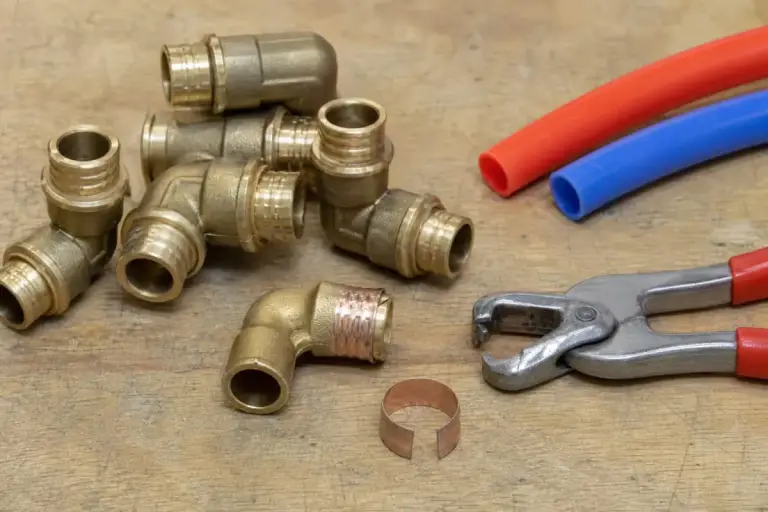
Use the joint the valve body was certified with, not the one in your tool bag. Moen’s 62380 lists ASTM F1807 among its certifications and INS13333 puts a full circle crimping tool on the PEX tool list. Kohler’s K-8304-PX inlets are F1807 style crimp. Delta’s R10000 spec sheet notes the PX models need proper crimping tooling and the MF models cold expansion tooling, and Pfister’s JX8-440P is cold expansion. Uponor’s drop-ear submittal adds that a ProPEX ring is required for every ProPEX connection. If the house is PEX-B with crimp rings and the valve has expansion inlets, the fix is a transition fitting outside the valve, not a crimp ring on an expansion barb; the four joint systems are laid out in crimp, cinch and expansion PEX joints.
The shower head drop ear rule and securing PEX near the valve
The shower arm must thread into an elbow that is screwed to framing, because a PEX riser cannot hold the torque of tightening a head. Moen INS13333 recommends the shower arm be installed with a flanged elbow attached to a wood brace, at 78 inches above the stall floor with the valve center at 45 to 48 inches. On a PEX riser that elbow is a part like Uponor’s ProPEX LF4235050, a 1/2 inch PEX by 1/2 inch FIP lead-free brass drop ear rated 180°F at 100 psi and 200°F at 80 psi, with LF4235038 as the 3/8 inch FIP version.
The valve body needs the same anchoring. Moen says to fix it to a cross member through the mounting tabs, Delta’s bracket goes up with the word “UP” on top, and Kohler places supports 2 inches from the stud face for finished walls of 3/4 to 1-1/2 inches, or 3 inches from the finished wall face for thicker walls. Strap both 1/2 inch PEX supplies to that same blocking so a handle turn cannot rock the valve body.
Solder, test, then close the wall
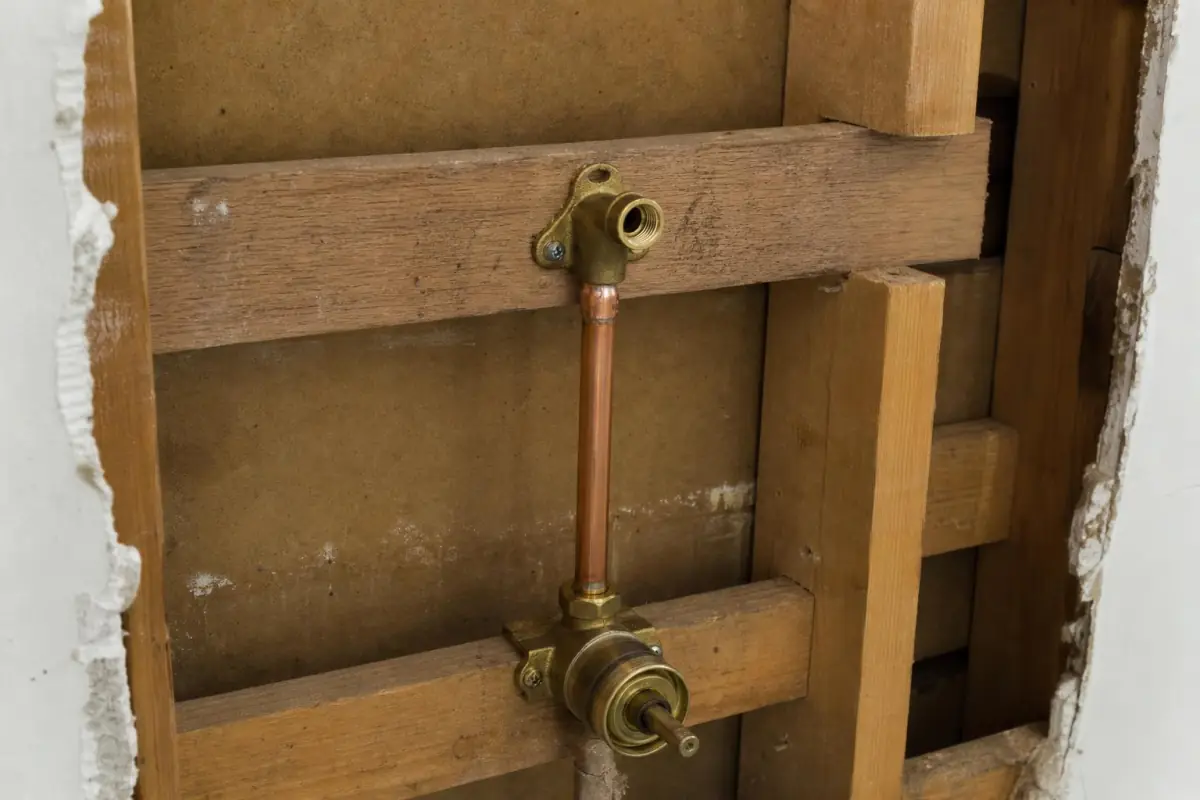
Do all copper soldering before PEX goes on, then pressure test, then flush, then drywall. Delta 50353 says to remove the bonnet and test cap before soldering and warns that high heat can damage the screen; the drop ear’s 200°F rating is far below torch temperature, so solder the copper drop and any sweat adapters first and let them cool. Delta’s cap allows 200 psi air or 300 psi water, Kohler’s allows 150 psi maximum, and Delta has you flush the rough-in before the cartridge goes in.
The PEX inlets do not change the anti-scald rule. Section 412.3 of the 2021 International Plumbing Code and IRC Section P2708.4 require a pressure-balance, thermostatic or combination valve with a limit stop set so water does not exceed 120°F; ASSE 1016/ASME A112.1016/CSA B125.16 is the product standard the valve is certified to, and the choice between those types is covered in pressure-balance, thermostatic and combination shower valves. IPC Section 604.9 separately requires a water-hammer arrestor where quick-closing valves are used on the system. If the wall is already finished and only the body is failing, check whether a valve body can be swapped without opening the wall before cutting tile.
PEX shower valve questions
Can I run PEX from the shower valve to the shower head?
Delta’s R10000 sheet bans PEX only on the tub drop and asks for proper fittings on the shower outlet. The PEX riser must end in a drop-ear elbow, such as Uponor LF4235050, screwed to solid blocking so the arm cannot twist the joint. Moen’s INS13333 recommends a flanged elbow on a wood brace.
Can I use 3/4 inch PEX to the tub spout instead of copper?
Some installers do it to recover bore area, but Delta’s R10000 sheet says do not use PEX tubing for the tub spout drop, without a size exception. Moen asks for 1/2 inch copper or IPS with no restrictive fittings. Following the valve sheet keeps the warranty and the inspection simple.
Do I need a special crimp tool for a PEX inlet shower valve?
You need the tool for the joint the valve was built for. Moen 62380 and Kohler K-8304-PX take ASTM F1807 copper crimp rings and a full circle crimper. Delta R10000-MF and Pfister JX8-440P take cold expansion PEX, so an expander and rings are needed.
Should a shower valve be pressure tested before drywall?
Yes. Delta’s test cap allows 200 psi air or 300 psi water with the cartridge out, and Kohler allows 150 psi maximum with a test cap sold separately. Delta then calls for flushing the valve before the cartridge goes in. The local inspector sets the test pressure for the whole system.
Is a PEX shower valve less reliable than a copper one?
Delta’s R10000 spec sheet covers universal, IPS, PEX crimp and PEX cold expansion versions of one forged brass body, and Moen certifies its 62380 to ASME A112.18.1 and ASSE 1016. The difference is only the inlet joint, which must match the PEX system in the house.
How we sourced this
We read Delta installation sheet 50353 Rev O and spec sheet DSP-B-R10000 Rev L, Moen INS13333 (3/23) and the 62380 spec sheet (Rev 6/18), the Kohler K-8304-PX spec sheet, the Pfister JX8-440P spec sheet and 0X8 guide 13354-03, Uponor’s ProPEX drop ear and AquaPEX submittals, the CDA copper tube tables, the ICC 2021 IPC 412.3 change summary and the IRC P2708.4 text. Bore areas, velocities and friction ratios are our arithmetic from those dimensions. Prices and a Pfister tub drop length were left out because the maker pages and documents we could open did not show them.