Can You Replace a Shower Valve Without Opening the Wall? What Fits Through the Trim Hole
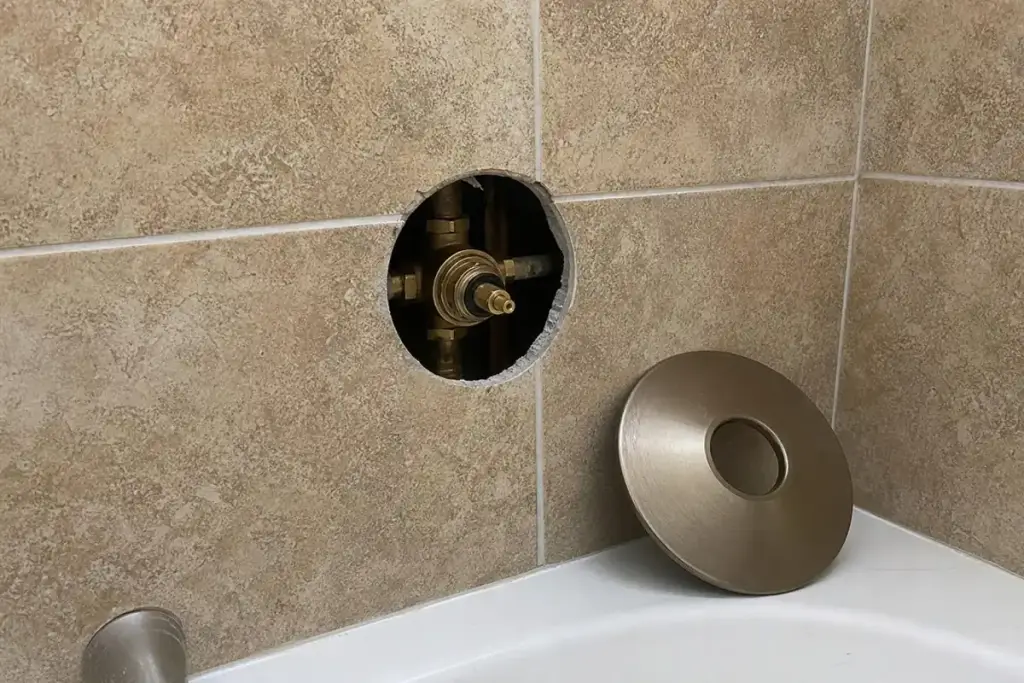
Can you replace a shower valve without opening the wall? Yes for the cartridge, which slides out the front of Moen M-PACT, Delta R10000 and Kohler Rite-Temp bodies. Swapping the brass body from the front needs a tile cut about 5-1/2 to 7-1/2 in. wide, hidden under a 12 to 13-1/2 in. remodel plate, or access from behind.
Cartridge job or body job: which one does your shower need?
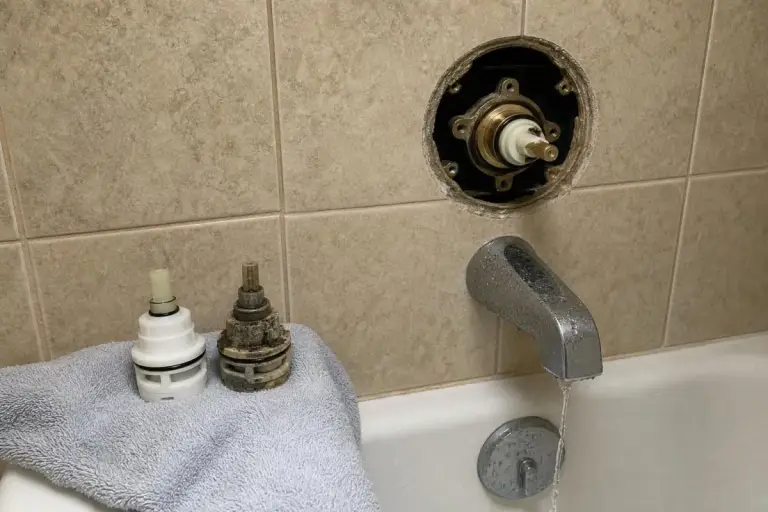
Most “replace the valve” jobs are cartridge jobs, and those never touch the wall. A drip from the showerhead, a handle that turns stiffly, or water that drifts hot and cold all trace to the cartridge, which comes out after you pull the handle, the escutcheon and the retaining clip or bonnet nut. Moen’s Posi-Temp trims on the M-PACT platform use the 1222 cartridge, Kohler sells K-8305 series Rite-Temp cartridges for its K-8304 bodies, and Delta’s TempAssure 17T sheet states that all parts are replaceable from the front of the R10000 valve.
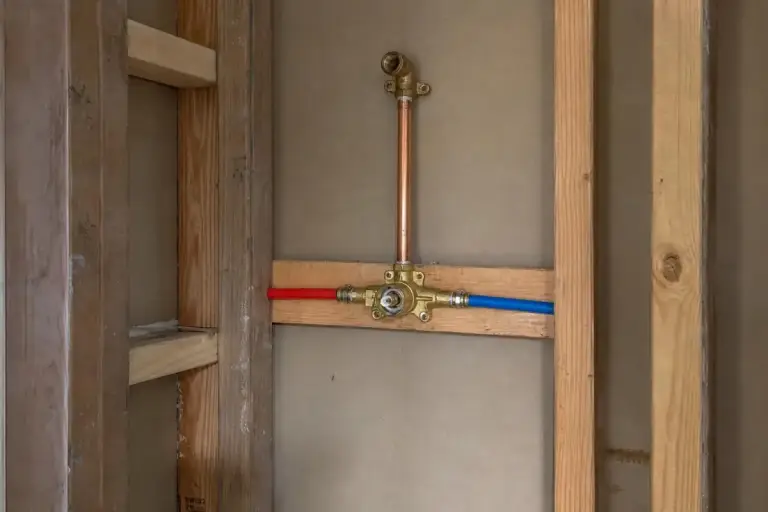
The body itself has to go in four cases: water leaks from a cracked casting or a sweat joint inside the cavity, the cartridge series is no longer sold, the threads that hold the bonnet are stripped, or you are converting an old two- or three-handle valve to a single lever. If the cartridge is fused in place, try the extraction steps in our guide to a shower cartridge that is stuck before condemning the body, since a seized 1222 or K-8305 is still a front-side repair.
Age alone rarely decides it. Our breakdown of how long shower valves last separates the forged brass body, which usually outlives several cartridges, from the seals and springs that wear.
Delta R10000, Moen M-PACT, Kohler Rite-Temp: trim hole sizes and the plate that hides a bigger cut
Each maker’s published wall opening, body width and oversized cover plate, taken from its own spec sheets:
| Valve family | Opening or body size on the spec sheet | Standard trim | Maker’s oversized plate |
|---|---|---|---|
| Moen M-PACT Posi-Temp (2520 / 2510 bodies) | 4-1/2 in. wall opening for thick walls; 2-1/4 to 3-1/2 in. round opening for thin plastic surrounds; body width not printed on the trim sheets | 7 in. escutcheon (Brantford T2152); 7-1/2 in. (Eva T2131) | Moen 1920: 13-1/2 in. wide x 9 in. tall, screw holes 9 in. apart, accepts any 7 in. round escutcheon; needs 6 in. between valve and spout centerlines |
| Delta MultiChoice R10000-UN / UNBX | 4 in. x 4 in. front outline; 5-1/16 in. wide on the R10000-UNWS with stops; plasterguard flush with finished wall, plus or minus 1/4 in. | 13/14, 17 and 17T series trims on one body | Delta RP29827: 13 in. wide x 8-1/8 in. tall, covers old handles up to 8 in. on center; $59.64 online, $74.55 list on deltafaucet.com, November 2026 |
| Kohler Rite-Temp K-8304-US | 4 to 4-1/2 in. round cutout for finished walls under 3/4 in.; 5 in. for walls over 3/4 in.; body 6 in. across the PEX inlets | Rite-Temp trims sized to the K-8304 rough | Kohler K-TS21946 Remodel trim: 12 in. wide x 7-3/4 in. tall; requires a K-8304 or K-8300 body |
A Moen 4-1/2 in. opening sits under a 7 in. escutcheon with 1-1/4 in. of tile on each side. Kohler’s own sheet jumps the cutout to 5 in. once the finished wall passes 3/4 in., so check the trim’s escutcheon diameter before cutting. On a Delta R10000, moving from a 14 series pressure-balance trim to 17T thermostatic is a cartridge and trim change, with extension kits RP77991 (13/14 series), RP77992 (17 series) and RP75136 (17T, adds up to 1-3/8 in.) for deep walls.
The remodel plates change the budget. They screw to the tile and the regular escutcheon mounts on top, so the hidden cut can be anything that stays inside the plate and leaves tile under both screws, which on the Moen 1920 means narrower than 9 in. Moen’s sheet adds a depth limit too: if the valve sits more than 2 in. behind the finished wall on a Posi-Temp body, order the 96945 series extension kit. Kohler’s K-TS21946 sheet calls for its K-10350 deep rough-in kit on finished walls of 3-1/2 to 4-1/4 in.
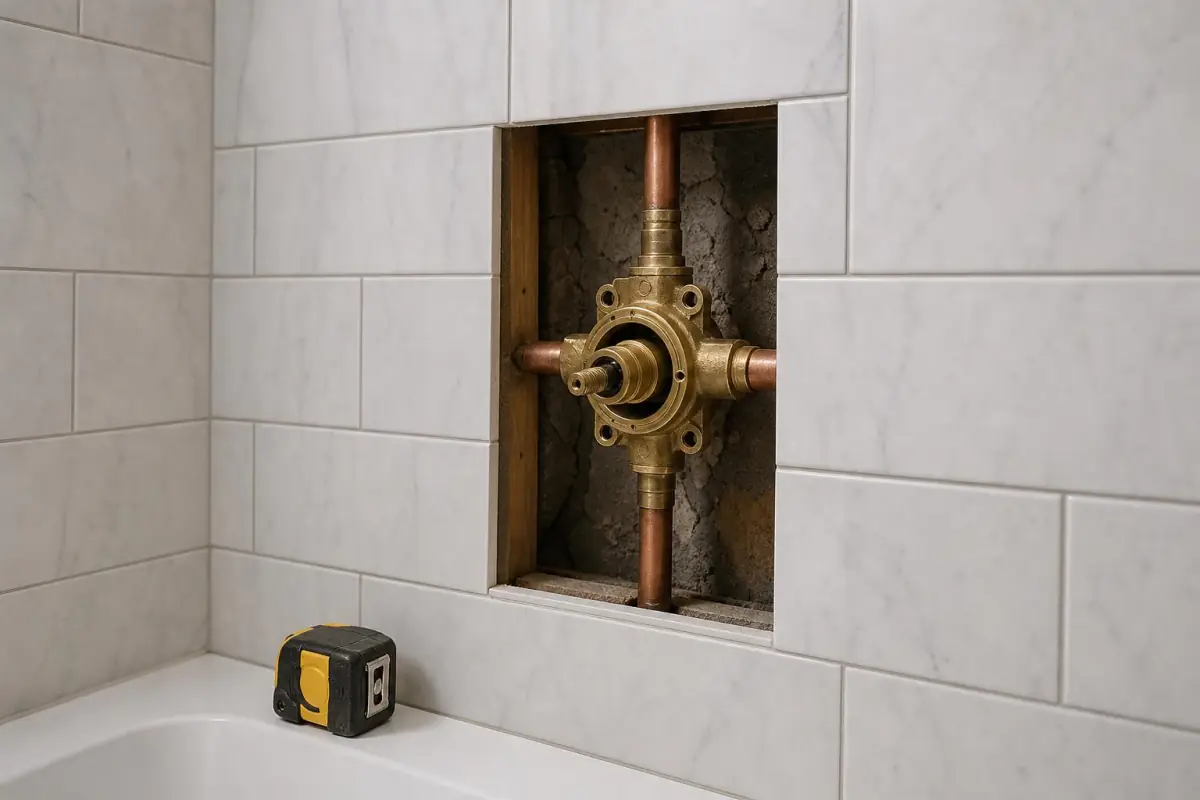
How wide does the tile cut need to be to change the brass body?
A body swap needs a cut wide enough to make the supply joints, and the joining method sets that width. The computed table uses one input from each maker (body width) and one from Viega’s ProPress pocket guide PG-PP 724604: a 1/2 in. press joint needs at least 3/4 in. between the tube and any obstruction (dimension A) for both the standard and compact jaw. Minimum cut width = body width + 2 x 3/4 in.
| Body (width input) | Press-fit cut width | Plate it fits under | Tile left each side of the cut |
|---|---|---|---|
| Delta R10000-UN (4 in.) | 4 + 1-1/2 = 5-1/2 in. | RP29827, 13 in. wide | (13 minus 5-1/2) / 2 = 3-3/4 in. |
| Delta R10000-UNWS (5-1/16 in.) | 5-1/16 + 1-1/2 = 6-9/16 in. | RP29827, 13 in. wide | (13 minus 6-9/16) / 2 = 3-7/32 in. |
| Kohler K-8304-US (6 in.) | 6 + 1-1/2 = 7-1/2 in. | K-TS21946, 12 in. wide | (12 minus 7-1/2) / 2 = 2-1/4 in. |
Height is the tighter limit: the cut must stay under 8-1/8 in. on the Delta plate, 7-3/4 in. on the Kohler and 9 in. on the Moen 1920, and the valve’s outlet joints above and below the body have to fit inside that. The 7-1/2 in. Kohler width is 2-1/2 in. wider than Kohler’s own 5 in. cutout, so it can only hide under the Remodel trim, never under a standard Rite-Temp escutcheon.
Soldered joints need more room than press joints, and no maker publishes the extra. Delta’s R10000 installation sheet says to remove the bonnet and test cap before soldering, to pull the stops on with-stops models, and warns that high heat can damage the inlet screens. Viega’s guide sets 1-1/2 in. as the minimum distance between a new solder joint and an existing 1/2 in. ProPress fitting. Family Handyman, which solders its replacement through the tile hole, warns that working through that smaller opening can be difficult, if not impossible, and that a large access panel makes the job much easier.
PEX bodies avoid the torch at the inlets: the K-8304-US has F1960 cold-expansion inlets and Delta sells R10000-PX (crimp) and R10000-MF (cold expansion) versions. Neither sheet gives a crimp or expansion tool clearance.
When going in from behind beats cutting tile
If the shower wall backs onto a closet, hallway or bedroom, the drywall side is the cheaper door. Family Handyman’s two-handle conversion guide recommends a paintable plastic access panel of at least 14 x 14 in., located by poking a hole through from the shower side, cutting a pilot hole 3 in. smaller than the panel, then cutting to the frame and gluing it in after the valve work.
From behind, the tile stays untouched, but the new body still has to land at the right depth. Delta wants 2-3/4 in. (plus or minus 1/4 in.) from the stringer to the face of the R10000 plasterguard, with that face flush with the finished tile. Kohler requires a support 2 in. from the stud face for finished walls of 3/4 to 1-1/2 in. thick. The access route moves the labor bill more than the parts do, as our shower valve replacement cost breakdown shows.
What the new valve must meet: 2021 IPC 412.3, ASSE 1016 and the 120°F stop
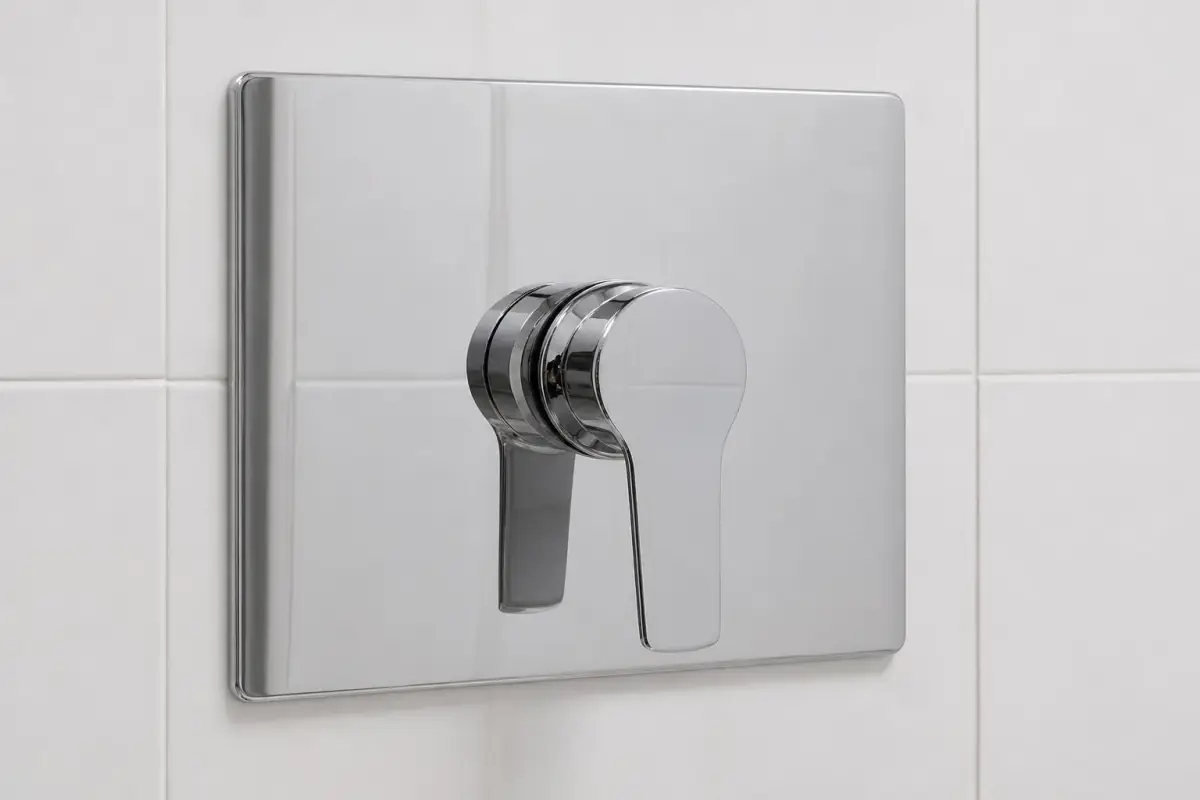
Any replacement body has to be an anti-scald valve. The 2021 International Plumbing Code moved the rule from section 424.3 to section 412.3, which requires balanced-pressure, thermostatic or combination valves conforming to ASSE 1016/ASME A112.1016/CSA B125.16 or ASME A112.18.1/CSA B125.1, rated for the installed showerhead’s flow and fitted with a limit stop field-set so water cannot exceed 120°F. One- and two-family homes fall under IRC P2708.4, which carries the same ASSE 1016 language, as South Carolina’s adoption at 8-1243 shows.
This is why an old two-handle compression valve cannot go back in like for like: it has no pressure-balance or thermostatic mechanism, so a single-lever 1016 body replaces it. Kohler’s K-8304-US sheet lists ASSE 1016 certification; Delta’s R10000 sheet lists ASME A112.18.1/CSA B125.1. Our guide to shower valve types compares pressure-balance and thermostatic designs if you are choosing between them.
A body swap is permit work in many jurisdictions. Santa Cruz County, California, for example, exempts valve leak repairs only when the work does not replace or rearrange pipes, valves or fixtures, so a cartridge change qualifies and a new body does not.
Shower valve swaps without opening the wall: common questions
Can I replace a shower valve myself from the front?
A cartridge swap is a front-side job most owners can do with the water off and the right puller. A body swap through a tile hole means sweating or pressing joints inside a cut of roughly 5-1/2 to 7-1/2 in., a pressure test and often a permit, so many owners hire a licensed plumber for that part.
Can you convert a two-handle shower to one handle without removing tile?
Yes, with a remodel plate. Moen’s 1920 (13-1/2 x 9 in.), Delta’s RP29827 (13 x 8-1/8 in.) and Kohler’s K-TS21946 (12 x 7-3/4 in.) cover the old handle holes. The single-lever body goes in through one central cut that must stay inside the plate.
Will a Moen trim fit a Delta or Kohler valve?
No. Each trim is built for its own body and cartridge, such as the Moen 1222 on M-PACT Posi-Temp, Delta 13, 14, 17 and 17T trims on the R10000, and Kohler K-8305 cartridges on K-8304 bodies. Changing brands means changing the body, which means opening the wall from one side.
How big a hole do you need to replace a shower valve body?
Using Viega’s 3/4 in. jaw clearance per side, press fittings need about 5-1/2 in. for a Delta R10000-UN, 6-9/16 in. for the R10000-UNWS and 7-1/2 in. for a Kohler K-8304-US. Soldering needs more, and Family Handyman recommends a panel of at least 14 x 14 in. when working from behind.
Do you need a permit to replace a shower valve?
Often for the body, rarely for the cartridge. Santa Cruz County, California exempts leak repairs on valves only when no pipe, valve or fixture is replaced or rearranged. A new body is a replaced valve, so check with your building department before cutting tile.
How we sourced this
We read Moen spec sheets for the T2131 and T2152 Posi-Temp trims and the 1920 cover plate, Delta’s DSP-B-R10000 Rev. K sheet, the R10000 installation manual and the RP29827 product page (price checked November 2026), Kohler’s K-8304-US and K-TS21946 spec sheets, Viega’s ProPress pocket guide PG-PP 724604, the ICC’s 2021 IPC change summary for section 412.3, South Carolina’s IRC P2708.4 adoption, Santa Cruz County’s permit page and Family Handyman’s access-panel guide. The cut widths are our arithmetic from those sheets. Moen body width, Danco and Oatey plate dimensions and expansion-tool clearances could not be confirmed from maker documents and were left out.