Can You Plunge a Floor Drain? When It Works and When It Pushes the Clog Somewhere Worse
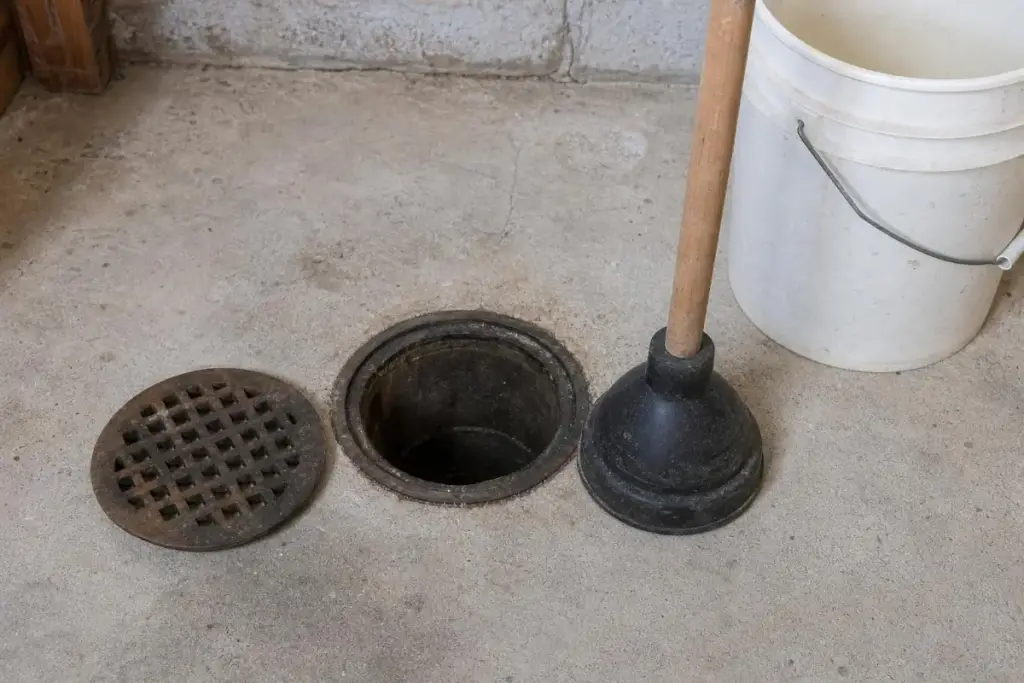
Yes, you can plunge a floor drain, but it only works when the clog sits in the drain’s own trap, the U bend holding a 2 to 4 inch water seal under the grate. If water rises in the floor drain when an upstairs toilet flushes, the blockage is in the main line, and plunging pushes sewage toward another opening.
The 2-minute test: is the clog in the floor drain trap or the main line?
Run one other fixture for 2 minutes and watch the grate: if the floor drain level rises, the blockage is downstream of where that fixture joins, which is the main building drain, and a plunger will not reach it.
- Flush one upstairs toilet once, or run a sink for 2 minutes. Water climbing at the grate means a main line block. Stop using water and skip the plunger.
- Every other fixture drains normally and only the floor drain holds water: the clog is in the floor drain trap or its branch. That is plunger territory.
- Open the main cleanout from a dry spot. Under IPC 2021 Section 708.1.3, a cleanout must sit at the building drain to building sewer junction or within 10 feet upstream of it. Standing water in that riser puts the clog downstream of it, and the method for reading it is in our guide to a sewer cleanout full of water.
- The drain is dry and the basement smells of sewer gas: there is no clog. The trap has evaporated, which the last section covers.
If water came up the grate on its own during heavy rain, or neighbors report the same thing, start with the timing table in our page on a basement floor drain backing up, because a public sewer surcharge is not something any tool in your basement can fix.
Which tool for which floor drain clog, and what each costs
Match the symptom to zones A to D in the diagram, then pick the smallest tool that reaches it. Prices are national figures dated 2025 or 2026.
| What you see | Where the clog likely is | Tool | Cost range (source, date) |
|---|---|---|---|
| Only the floor drain holds water; every fixture upstairs drains | A: the floor drain trap, often lint or sediment | Plunger with the cup over the whole opening | Small snakes and cleaners about $20 (Inch Calculator, 2026 guide) |
| Plunging lowers the water, then it stalls again | B: the branch between trap and building drain | Hand auger or 25 ft power auger | 25 ft power auger $27 for 4 hours, $36 for 24 hours (Nickell Rental rate card, Nov 2026) |
| Floor drain rises when a toilet flushes or the washer pumps out | C: building drain or lateral past the stack | Drum machine with 1/2 in cable, fed from the cleanout | Sewer line snaking $150 to $375; $300 to $600 with a camera (Fixr, updated Jan 31, 2025) |
| Street-side cleanout full, or neighbors backing up at the same hour | D: lateral at the street or the public main | Call the city sewer department before a plumber | Ask the utility who pays before anyone rods the line |
The table’s message is that the plunger is the right tool for exactly one row. The RIDGID K-400 operator’s manual, a common rental drum machine, rates it for 1-1/2 to 4 in lines with the right cable: 3/8 in cable for 1-1/2 to 3 in pipe and 1/2 in cable for 3 to 4 in pipe (K-400 manual). A 4 in building drain therefore needs the 1/2 in cable, so check what the rental counter hands you.
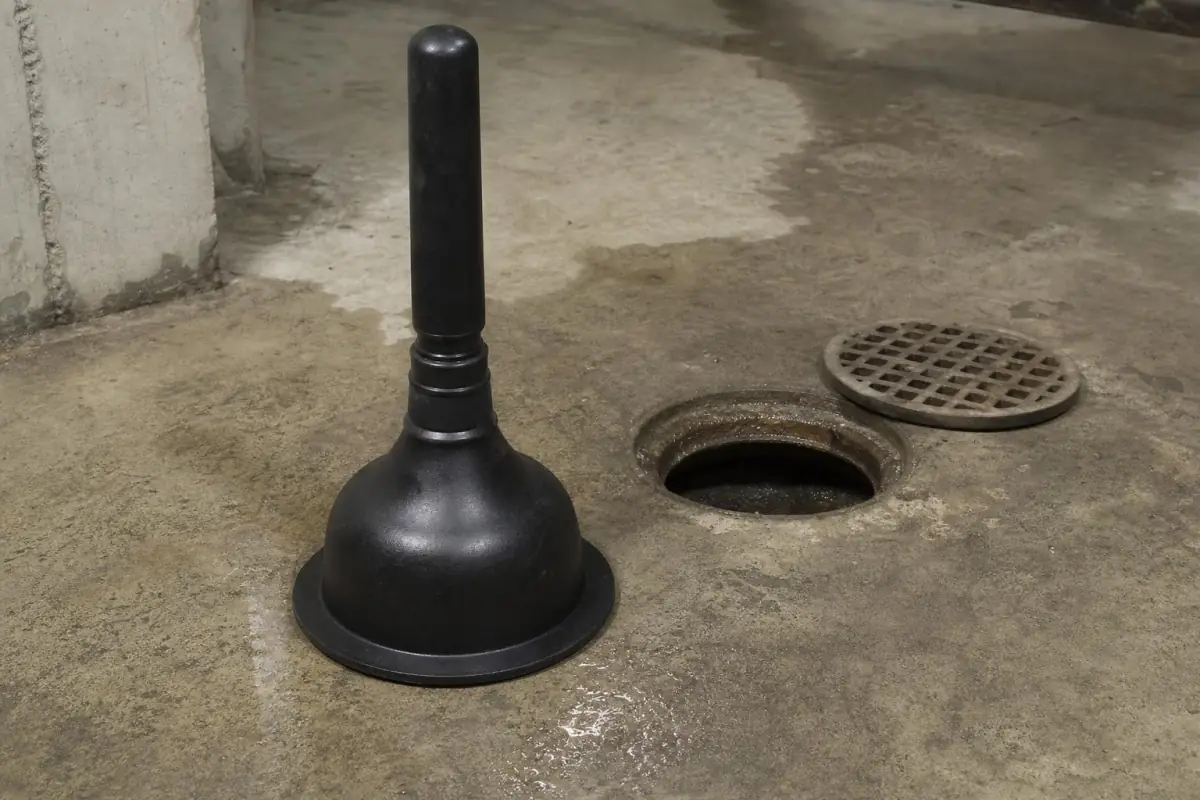
How much force does plunging a floor drain put on the pipes?
A firm plunger stroke makes only 0.7 to 2.1 psi, which is enough to shift a soft trap clog and enough to push water out of any unsealed opening on the same branch. The arithmetic uses the cup’s area: a 6 in cup covers 28.27 square inches (3.1416 x 3 in x 3 in), and pressure equals push force divided by that area.
| Push on the handle | Pressure under a 6 in cup | Height it lifts water in an open pipe | Force on a 3 in cleanout plug | Force on a 4 in cleanout plug |
|---|---|---|---|---|
| 20 lb | 0.71 psi | 19.6 in | 5.0 lb | 8.9 lb |
| 40 lb | 1.41 psi | 39.2 in | 10.0 lb | 17.8 lb |
| 60 lb | 2.12 psi | 58.7 in | 15.0 lb | 26.7 lb |
Inputs: 6.00 in cup, a full seal on flat concrete, water rather than air under the cup, 27.68 inches of water per psi, plug faces of 7.07 and 12.57 square inches. The push forces are example inputs, not measurements.
Two things follow. IPC 2021 Section 802.4.3 lets a washer standpipe rise as little as 18 inches above its trap weir, and a 20 lb push lifts water 19.6 inches, so an open standpipe on the same branch can spit water across the laundry room before the clog moves. And a main line already backed up 8 feet into the stack holds about 3.5 psi of static pressure, more than the hardest stroke in the table adds, so plunging a main line clog sends water sideways toward the weakest seal instead of through the blockage.
How to plunge a basement floor drain without spraying the room
Take the grate off, empty the drain body, seal every other opening on the branch, then plunge with water, not air, under the cup. IPC 2021 Section 413.2 requires floor drains to have removable strainers and to be built so the drain can be cleaned, so the grate is meant to come off.
- Lift or unscrew the grate and pull out any strainer basket. Wear rubber gloves: the RIDGID K-400 manual warns that drains may hold chemicals and bacteria that can cause burns or infection.
- Remove any ball float. Delaware DNREC’s I-ADAPT backflow valve sheet describes a ball float check placed at the bottom of a floor drain to stop water flowing up through it. With the ball seated, a plunger pushes against the ball, not the clog.
- Hand-clear the throat. Laundry lint from a washer that drains to the floor and sand from mopped floors pack the top of a 2 in or 3 in outlet; IPC 2021 Section 413.3 sets 2 in as the minimum.
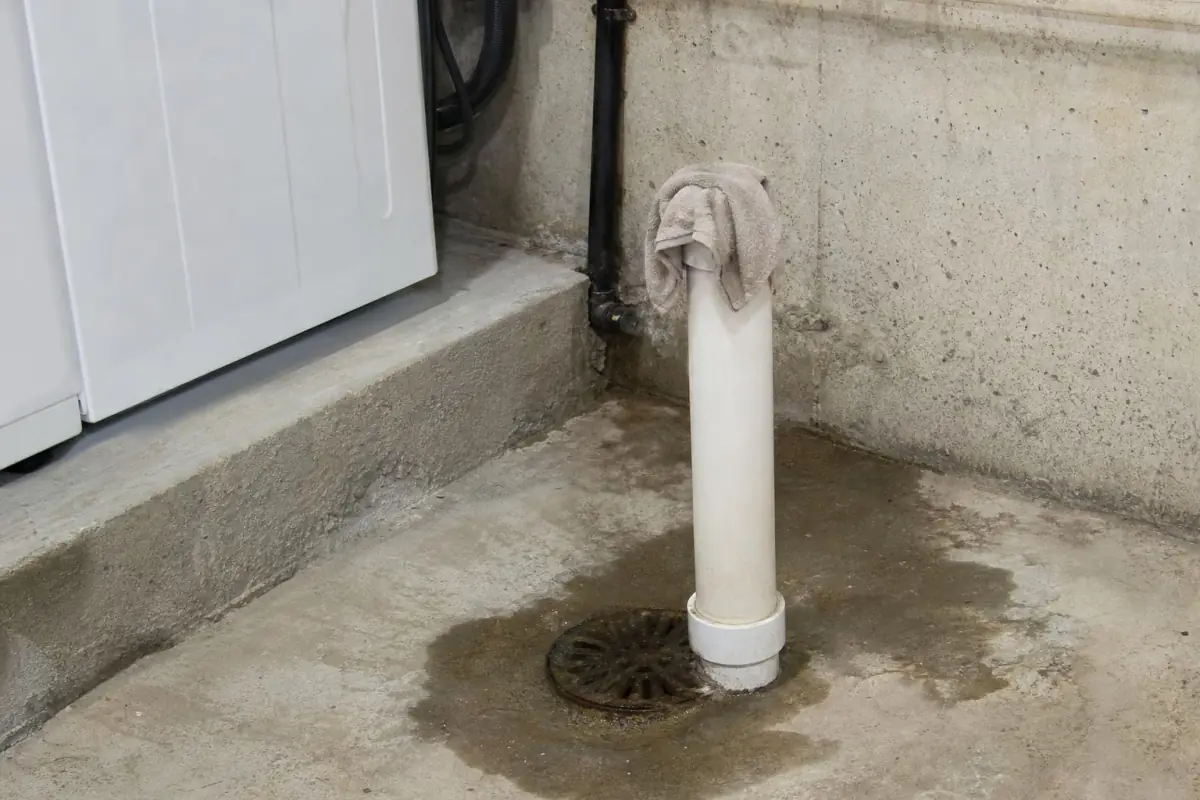
- Seal the other openings. Stuff a wet rag into the laundry standpipe, plug the laundry tub and close any basement shower drain, per the standpipe arithmetic above.
- Cover the cup rim with water, seat the 6 in cup flat on the concrete around the opening, press slowly once to purge air, then work sharp strokes and pull back hard.
- Test with a 5 gallon bucket poured at a steady rate. Water that drains without rising means the trap is clear. Water that rises again means the clog is in zone B or beyond: switch to an auger.
Stop plunging when toilet paper or sewage appears at the grate, because that material came from upstream fixtures and the clog is in the shared building drain. The job then needs a drum machine through the cleanout. For sink, tub and toilet clogs elsewhere in the house, the method order in how to unclog a drain still holds.
Do enzyme or chemical cleaners work on a floor drain clog?
Neither dissolves the sand, silt and grit that make up most floor drain clogs, because those are minerals and both product types attack organic matter. A chemical opener poured on standing water dilutes into it and then sits in the trap the next person has to plunge or snake. If you used one, tell whoever runs the machine what you poured before they open the drain, because the K-400 manual’s burn warning applies to exactly that water.
IPC 2021 Section 1003.1 requires interceptors where sand would harm the sewer, and a house drain has none, so a floor drain taking mop water collects grit in its trap. A yearly grate-off cleanout by hand does more than any bottle.
Is the floor drain tied to the sanitary sewer or a storm drain?
In a code-built house it goes to the sanitary sewer: IPC 2021 Section 1104.2 says floor drains shall not be connected to a storm drain. Older houses in combined-sewer cities send both kinds of water down one pipe, which is why Delaware DNREC calls structures on combined systems even more likely to need backflow valves. Lincoln, Nebraska’s sewer backup prevention page warns that a solid floor drain plug can damage the floor through uplift pressure, and that a floor drain standpipe works only until sewage reaches the next opening, such as a shower, toilet or sink.
A floor drain that smells but never backs up is the opposite problem. IPC 2021 Section 1002.4 sets a trap seal of 2 to 4 inches, and Section 1002.4.1 requires protection for trap seals subject to evaporation. Pour a gallon of water into a dry drain to restore the seal, and if it dries out again between uses, a trap primer keeps it filled automatically.
Floor drain plunging questions
What kind of plunger works on a floor drain?
A flat cup plunger seals best on a concrete floor because the rim sits flat around the opening. Pick a cup wider than the grate opening, which on most residential floor drains is a 2 or 3 inch outlet, and remove the grate first so the cup seats on the drain body or the floor.
Why does my floor drain gurgle when the washing machine drains?
The washer pump pushes water faster than a partly blocked branch or building drain can carry it, so air is forced back through the floor drain trap. Lint from the washer is a common cause. If the floor drain also rises during the drain cycle, the restriction is downstream and needs a drum machine with 1/2 inch cable on a 4 inch line.
Can plunging a floor drain damage the pipes?
A plunger makes roughly 0.7 to 2.1 psi under a 6 inch cup with a 20 to 60 pound push, which is less than the 3.5 psi a drain already holds when sewage stands 8 feet up the stack. The real risk is spraying dirty water out of an unsealed standpipe or a loose cleanout plug on the same line.
Who do I call if the floor drain backs up with sewage?
Call the city sewer department first if neighbors are affected or the street side cleanout is full, since the public main is the utility’s job. If only your house is affected, ask for a drum machine run through the main cleanout plus a camera, about $300 to $600 per Fixr’s 2025 figures.
How we sourced this
We read IPC 2021 Sections 413, 708.1.3, 802.4.3, 1002.4, 1003.1 and 1104.2 (Texas-adopted text on UpCodes), plus the RIDGID K-400 operator’s manual, the Delaware DNREC I-ADAPT backflow valve sheet and the City of Lincoln, Nebraska backup prevention page. Prices come from Fixr (updated January 31, 2025), Inch Calculator’s 2026 guide and the Nickell Rental rate card as listed in November 2026. The pressure table is arithmetic from stated inputs; nothing was tested. Claims that chemical openers attack cast iron could not be confirmed in a manufacturer document and were left out.