Plumbing Manifold: How PEX Home-Run Systems Work
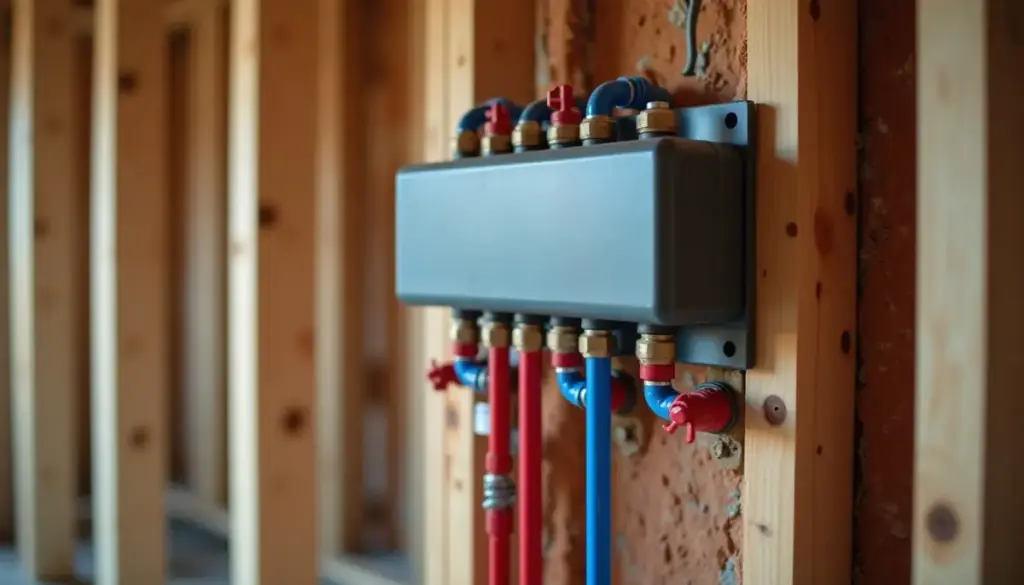
A plumbing manifold is a central header that splits one supply trunk into separate PEX lines, one per fixture, so every fixture gets its own shutoff and its own short, small-diameter run.
Key Takeaways
- IRC Table P2903.8.1 rates a 3/4 inch plastic manifold for 17 gpm and a 1 inch plastic manifold for 29 gpm; metallic bodies drop to 11 and 20 gpm (IRC P2903.8 via UpCodes).
- Home-run lines may be 3/8 inch when the developed length is 60 feet or less and source pressure is at least 40 psi (IRC P2903.8.2).
- Half-inch PEX CTS SDR 9 holds 1.18 ounces per foot, 3/8 inch holds 0.64 and 3/4 inch holds 2.35, per a DOE table modified from IPC Table E202.1 (DOE Building Science Education).
- The EPA WaterSense hot water delivery limit of 0.5 gallon (64 ounces) caps a 1/2 inch PEX run at about 54 feet and a 3/8 inch run at about 100 feet.
- Valves placed at the manifold must be labeled with the fixture they serve, and hose bibb lines need a readily accessible air bleed (IRC P2903.8.5 and P2903.8.6).
- Pro Remodeler reported installed home-run PEX costs 28 percent below copper in one comparison (Pro Remodeler).
What is a plumbing manifold?
A plumbing manifold is a pipe header with one inlet and a row of smaller outlets. The water service or water heater feeds the inlet, usually through a 3/4 inch or 1 inch trunk, and each outlet sends a dedicated tube to one fixture. A full home run usually pairs a hot and a cold manifold side by side, so the valves read like a breaker panel.
PEX made the layout practical because coiled tube reaches a second-floor bath without a joint: one fitting at the manifold and one at the fixture, instead of a tee at every branch.
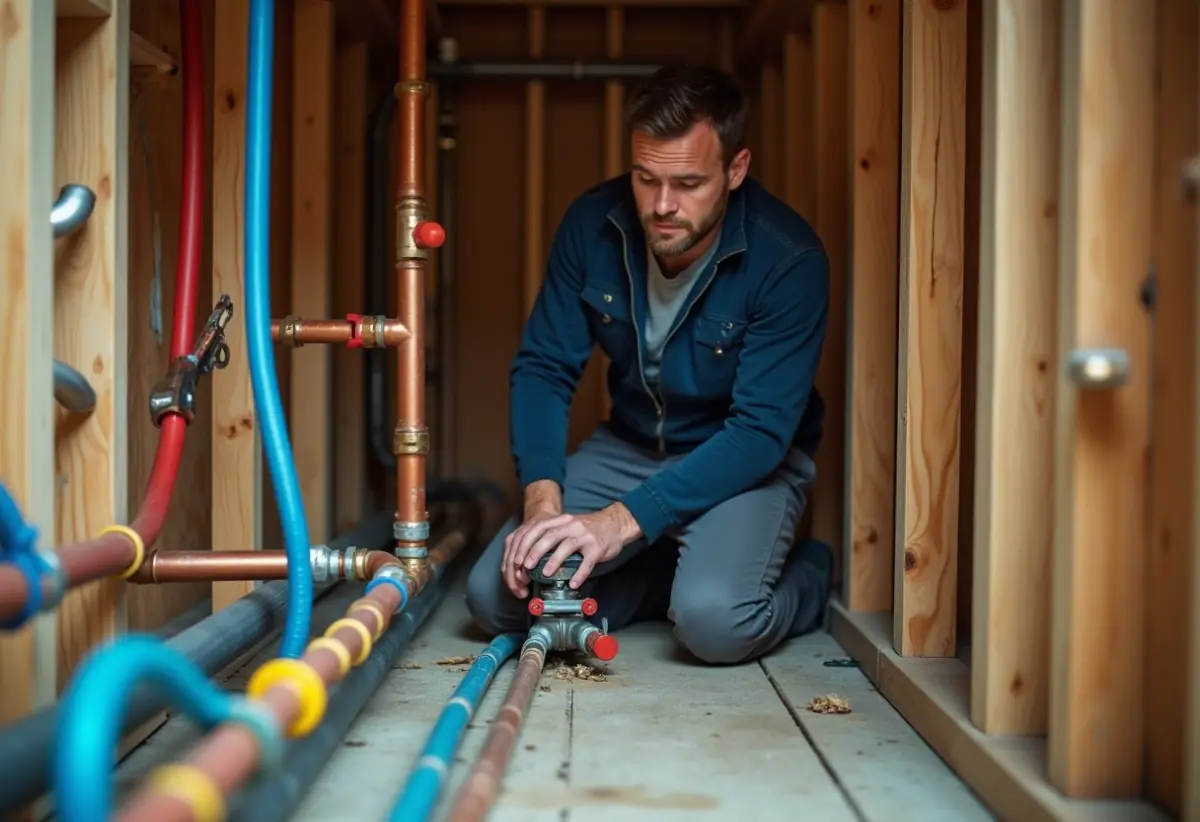
How does a PEX home-run system differ from trunk-and-branch and hybrid layouts?
A home-run system gives every fixture its own uninterrupted line from a central manifold. Trunk-and-branch runs one large pipe through the house and tees smaller branches off it, the way rigid copper was always installed. A hybrid (remote manifold) runs a trunk to a fixture group, such as a bathroom, and feeds each fixture from a small manifold there.
Fine Homebuilding’s three designs for PEX plumbing systems lays out these same three options. The choice turns on distance from the water heater to the farthest fixture, fixture count and how much drilling the framing tolerates.
- Home run: most tube and drilling, zero concealed branch fittings.
- Trunk and branch: least tube, but every tee is a buried joint and 3/4 inch trunk holds twice the water per foot of 1/2 inch.
- Hybrid or remote manifold: a trunk to each wet area, then short home runs. Viega’s MiniBloc is mostly used this way, per PEXUniverse’s manifold catalog.
A 70 foot run of 1/2 inch tube holds 82.6 ounces, over the WaterSense 64 ounce limit, so a tall house with a corner mechanical room usually needs a hybrid.
Which plumbing manifold types are there, and which one fits your house?
Plumbing manifold types split along four lines: body material (copper or polyalloy plastic), connection type (crimp, expansion, press, push-fit or sweat), valved or unvalved ports, and open or closed ends. Match the connection to your tube and tool, and buy two or three spare ports.
Per PEXUniverse, valved copper models have quarter-turn miniature ball valves over each branch, “closed” manifolds cap one end while “open” ones flow through so they can be ganged, and copper inlets run 3/4 inch to 2 inch. Branches sit 2 inches apart on PEX models and 3 inches on sweat models, so 12 PEX ports need about 24 inches of wall.
| Manifold | Body material | Tube connection | Port shutoffs | Best fit |
|---|---|---|---|---|
| Viega ManaBloc | Polyalloy | Crimp, press or compression | Quarter-turn valve on every port | Whole-house home run, 6 to 14 or more fixtures |
| Viega PEX Press Poly manifold | Polyalloy | Viega PEX Press | None (valveless) | Branch splits where valves sit at the fixture |
| Copper PEX crimp manifold | Copper | ASTM F1807 crimp | Sold with or without ball valves | Crimp-tool shops, PEX-A or PEX-B |
| Copper expansion manifold | Copper | ASTM F1960 expansion | Valved or plain models | PEX-A systems such as Uponor ProPEX |
| Poly PEX-A expansion manifold | Polyalloy | ASTM F1960 expansion | None (valveless) | PEX-A remote manifolds behind access panels |
| Copper sweat manifold | Copper | Sweat (solder) | Valved or plain models | Mixed copper and PEX work, 3 in branch spacing |
F1960 expansion fittings are made for PEX-A, so check how PEX-A and PEX-B tubing differ before buying an expansion header. F1807 crimp manifolds take either tube type with copper crimp rings, and if you have switched tools, compare crimp rings versus clamp rings because a stainless clamp ring also seats on an F1807 barb. PEXHouse stocks a typical example, a closed 10-port copper header with a 3/4 inch F1807 crimp inlet and ten valved 1/2 inch crimp outlets.
How much water sits in each line, and how long does hot water take?
Every foot of tube between the water heater and a faucet holds water that must run down the drain before hot water arrives. Half-inch PEX CTS SDR 9 holds 1.18 ounces per foot (0.0092 gallon), 3/8 inch holds 0.64 ounces (0.0050 gallon) and 3/4 inch holds 2.35 ounces (0.0184 gallon), per the DOE table modified from IPC Table E202.1.
The wait math is simple: gallons in the line divided by flow in gallons per minute, times 60, gives seconds. At 1.5 gpm, the WaterSense ceiling for a bathroom faucet, a 50 foot home run works out like this.
Those are floor values; the cold tube wall absorbs heat, so real waits run longer. Compare a trunk-and-branch run of 40 feet of 3/4 inch PEX plus a 10 foot 1/2 inch branch: that holds 105.8 ounces (0.83 gallon) and needs about 33 seconds at 1.5 gpm, versus 18.4 seconds for a 50 foot 1/2 inch home run.
The EPA WaterSense new-home spec limits stored hot water between the heater and a fixture to 0.5 gallon, or 64 ounces. Divide 64 by ounces per foot for the longest compliant run: about 100 feet of 3/8 inch PEX, 54 feet of 1/2 inch PEX, 41 feet of 1/2 inch copper type L and 27 feet of 3/4 inch PEX.
What does the IRC require for a plumbing manifold?
The International Residential Code covers manifolds in Section P2903.8, which applies to hot and cold manifolds with gridded or parallel-connected lines to each fixture. Section numbers below are from the IRC text published on UpCodes; your adopted edition and local amendments govern.
| Manifold nominal ID | Plastic, max gpm | Metallic, max gpm |
|---|---|---|
| 3/4 in | 17 | 11 |
| 1 in | 29 | 20 |
| 1-1/4 in | 46 | 31 |
| 1-1/2 in | 66 | 44 |
Table P2903.8.1 limits are velocity-based, 12 feet per second for plastic and 8 feet per second for metallic, and “total gallons per minute is the demand for all outlets.” If your fixture demand adds to 20 gpm, a 3/4 inch plastic body (17 gpm) is too small, a 1 inch plastic body (29 gpm) fits with room to spare and a 1 inch copper body (20 gpm) sits exactly at its limit.
- P2903.8.2 minimum size: lines may be 3/8 inch where developed length is 60 feet or less and meter or source pressure is at least 40 psi. A water heater fed from the end of a cold manifold needs a manifold one size larger than the heater feed.
- P2903.8.3 orientation: horizontal or vertical mounting is allowed.
- P2903.8.4 support and protection: secure plastic bundles per the tube maker and support them per Section P2605. Sleeve or wrap any bundle bent 45 degrees or more where it touches framing.
- P2903.8.5 valving: fixture valves may sit at the fixture or at the manifold; valves at the manifold must be labeled with the fixture served.
- P2903.8.6 hose bibb bleed: install a readily accessible air bleed on hose bibb supplies, at the manifold or at the hose bibb.
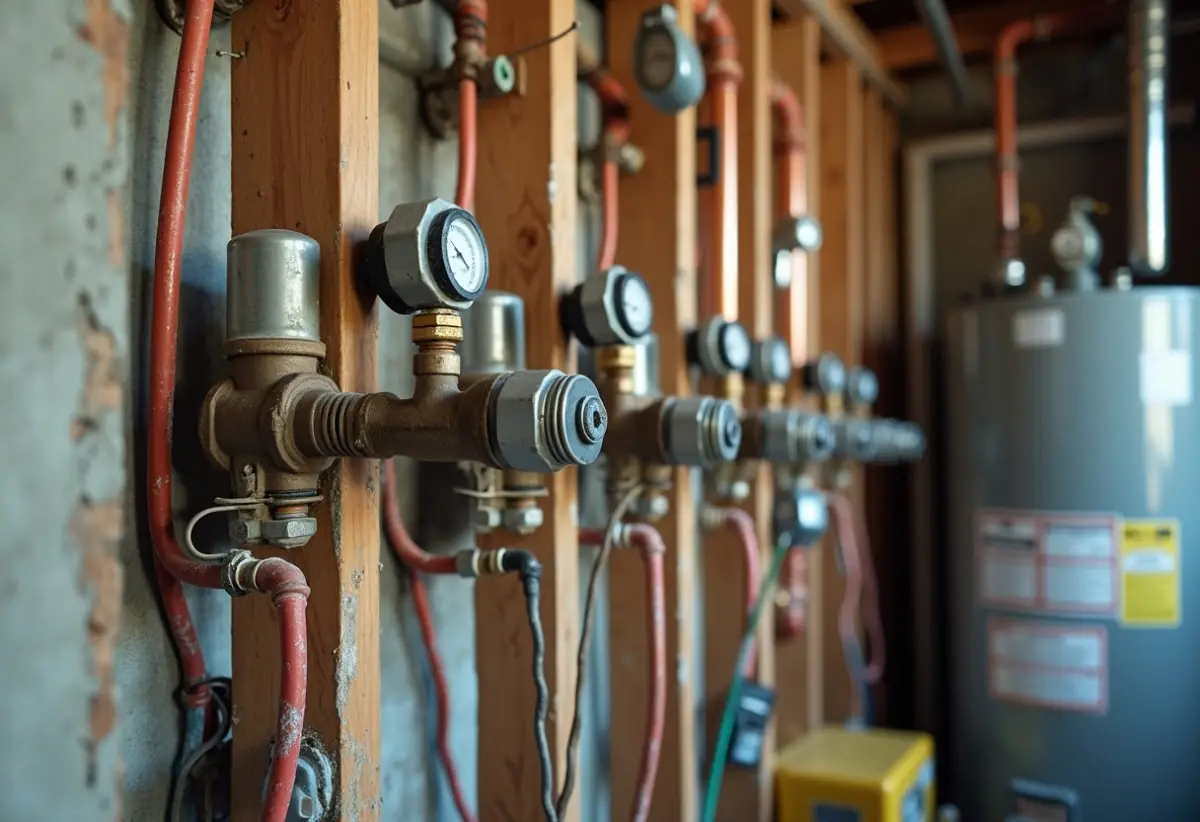
What are the pros and cons of a manifold system, in numbers?
A manifold system trades extra tube footage for fewer concealed joints, individual shutoffs and less water held in each hot line. In one Pro Remodeler comparison, installed home-run PEX cost 28 percent less than copper even though copper materials were slightly cheaper.
| Factor | Home-run manifold | Trunk and branch |
|---|---|---|
| Concealed fittings per fixture | 0 (one at manifold, one at fixture) | At least 1 tee per branch |
| Water in a 50 ft hot run | 59 oz in 1/2 in PEX, 32 oz in 3/8 in | 105.8 oz for 40 ft of 3/4 in plus 10 ft of 1/2 in |
| Purge time at 1.5 gpm | 18.4 s (1/2 in), 10.0 s (3/8 in) | About 33 s |
| Shutoffs | One per fixture at the panel (valved bodies) | At fixture stops only |
| Tube footage | Highest | Lowest |
Two cautions. A long home run in 1/2 inch tube can blow past the 54 foot WaterSense limit, so a far bathroom may need 3/8 inch tube (if it qualifies under P2903.8.2), a remote manifold or a recirculation loop. And a manifold does nothing about thermal expansion; if your service has a check valve or pressure-reducing valve, size a thermal expansion tank for the water heater.
How do you install and label a plumbing manifold?
Installing a plumbing manifold takes eight steps: plan runs, size the trunk, mount the body, run tube, protect bundles, make connections, label ports and pressure test. For the tube-handling basics, see our full PEX installation walkthrough.
- Map every run. Any hot run over 54 feet of 1/2 inch PEX exceeds the WaterSense 64 ounce limit; move the manifold, use 3/8 inch where P2903.8.2 allows, or add a remote manifold.
- Size the trunk. Add outlet demand and pick the body from Table P2903.8.1: 3/4 inch plastic to 17 gpm, 1 inch plastic to 29 gpm. If the water heater feeds from the end of the cold manifold, go one size larger than the heater feed.
- Mount the manifold. Pick a reachable wall near the water heater; allow 2 inches per PEX port (3 on sweat outlets).
- Pull tube. Run each line continuous, no wall fittings, both ends marked.
- Protect and support bundles. Sleeve or wrap any bundle bent 45 degrees or more where it bears on framing, and support it per P2605 and the tube maker’s spacing.
- Make connections. Use the fitting system the manifold is built for: F1960 expansion with PEX-A, F1807 crimp or clamp rings on barbed outlets, or Viega press on Viega press bodies.
- Label every valve. Tag each port with its fixture (for example “2F hall bath, lav hot”) per P2903.8.5. Add the hose bibb air bleed required by P2903.8.6.
- Pressure test before cover. Cap fixture ends, test at the pressure your inspector requires and check every manifold joint.
How we sourced this
We reviewed the top-ranking pages for “plumbing manifold” and “what is a manifold in plumbing” in October 2026, then checked claims against primary sources. Code text comes from IRC P2903.8 on UpCodes (2012 IRC text with 2018 excerpts). Water volumes come from the DOE Building Science Education Solution Center table modified from IPC Table E202.1, converted at 128 ounces per gallon. Product types and branch spacing come from the PEXUniverse manifold catalog. Purge times are our arithmetic and exclude heat lost to the pipe wall. We left out manufacturer prices and port-count claims we could not confirm on a maker page.
Frequently asked questions
What is a manifold in plumbing?
A plumbing manifold is a header that takes one hot or cold supply trunk and splits it into many smaller outlets, each feeding a single fixture or a small group. In a PEX home-run system every outlet runs as one continuous tube to its fixture, so the manifold becomes the shutoff panel for the house. Valves at the manifold must be labeled with the fixture they serve under IRC P2903.8.5.
What size should a PEX manifold trunk be?
Size the trunk from the total demand of every outlet it serves. IRC Table P2903.8.1 lets a 3/4 inch plastic manifold carry 17 gpm and a 1 inch plastic manifold carry 29 gpm. Metallic bodies are rated lower, 11 gpm at 3/4 inch and 20 gpm at 1 inch, because the table caps metal at 8 feet per second instead of 12.
Can I use 3/8 inch PEX from a manifold?
Often yes. IRC P2903.8.2 allows individual distribution lines as small as 3/8 inch when the developed length is 60 feet or less and the pressure at the meter or source is at least 40 psi. Some fixtures, such as one-piece toilets and whirlpool tubs, may need a larger line per the maker, so check the fixture spec sheet first.
Is a home-run manifold system better than trunk and branch?
The answer turns on run length and fixture count. A home run uses no concealed branch fittings and lets you shut off each fixture at one panel, but it needs much more tube. Small-diameter home runs also hold less water per foot, so 50 feet of 1/2 inch PEX holds 0.46 gallon versus 0.92 gallon for 3/4 inch, which shortens the wait for hot water.
Do PEX manifolds need shutoff valves?
Code does not require them. IRC P2903.8.5 lets fixture valves sit either at the fixture or at the manifold, and if they are at the manifold each one must be labeled with the fixture it serves. Valved manifolds such as Viega ManaBloc put a quarter-turn valve on every port, which is why most installers buy valved bodies for whole-house home runs.
Where should a plumbing manifold be installed?
Put it where you can reach and read every valve, typically a basement wall, mechanical room or utility closet near the water heater. The IRC allows horizontal or vertical mounting under P2903.8.3. A central spot keeps the longest hot run short, which matters because every foot of 1/2 inch PEX holds 1.18 ounces of water you must purge before hot water arrives.
How long does hot water take from a PEX manifold?
Divide the water held in the line by the flow rate. A 50 foot run of 1/2 inch PEX holds about 0.46 gallon, so at 1.5 gpm it takes roughly 18 seconds just to push the cold water out. The same run in 3/8 inch PEX takes about 10 seconds. Real waits run longer because the cold pipe wall also absorbs heat.