How to Read a Water Meter: Dials, Digital Displays, CCF to Gallons, and the Leak Test
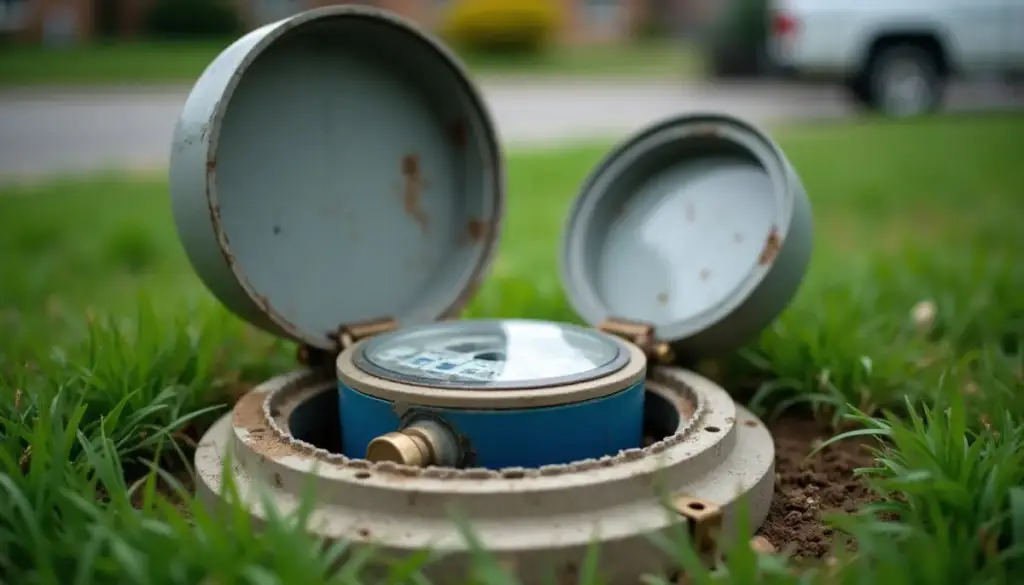
To read a water meter, open the meter box, read the odometer digits left to right (plus any fixed zeros), note the unit printed on the face, and subtract an earlier reading to get your usage.
Key Takeaways
- One CCF (100 cubic feet) equals 748 gallons, based on the USGS conversion of 7.48 gallons per cubic foot.
- On Neptune residential gallon meters, one full sweep hand revolution equals 10 gallons, per the City of Blue Springs, Missouri reading guide.
- The small triangle, star, or wheel on the dial is the low flow indicator; the City of San Diego meter glossary labels it the leak detection tattletale.
- EPA WaterSense says to read the meter before and after a two-hour window with no water use; any change means you probably have a leak.
- The average household’s leaks waste more than 9,300 gallons a year, and 9% of homes leak 50 gallons or more a day, per EPA WaterSense.
- A meter that moves 1 cubic foot during a two-hour no-use test points to roughly 32,760 gallons a year (our arithmetic from the USGS factor).
Where is my water meter located?
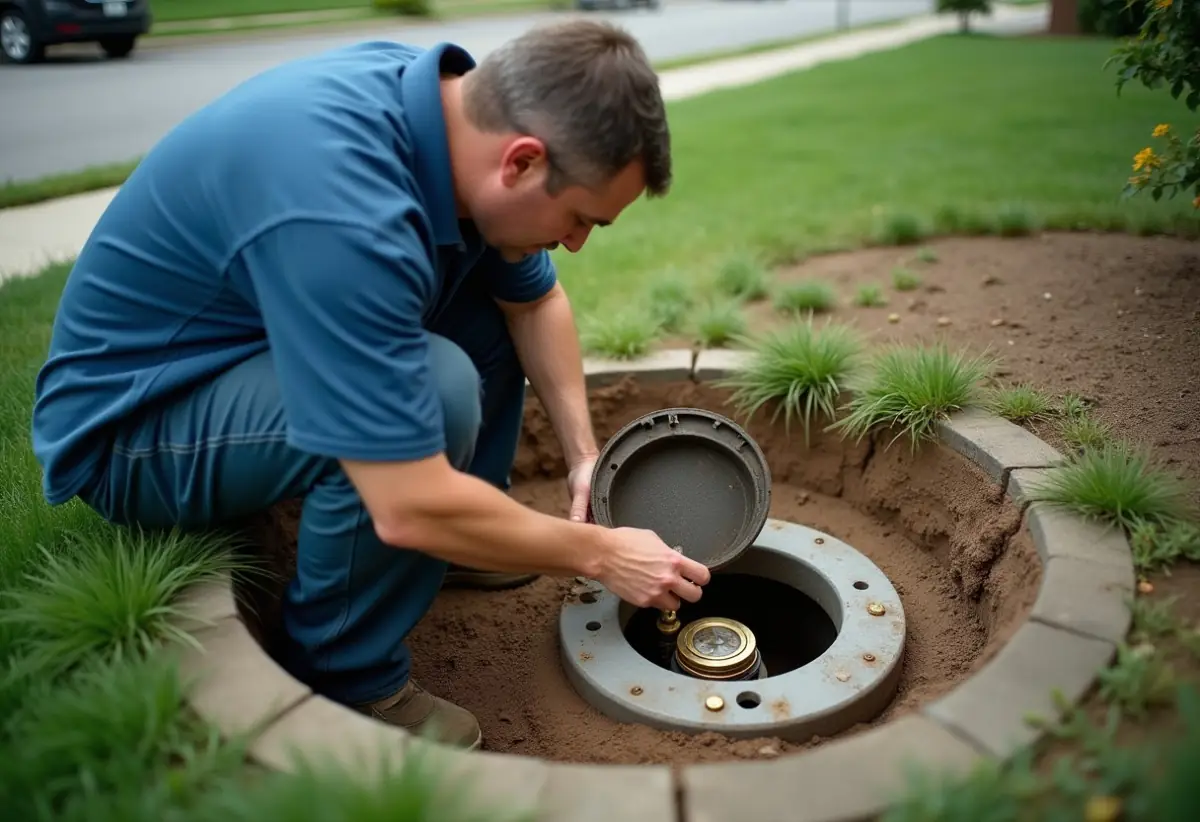
Most US homes have the water meter in an underground box near the street, curb, or sidewalk, under a lid marked “water.” In colder climates the meter often sits indoors instead, in a basement or utility room where the service line enters, usually near the main shutoff valve. The meter box, the register on top of the meter, and the valve are all close together. Before shutting that valve off, it helps to know the warning signs covered in slab leak detection and repair costs.
The City of Mountain View, California, describes its typical residential meter box as a concrete box of about 15 by 20 inches near the curb. Lids come in concrete, cast iron, or plastic. Plastic lids often have a small slot you open with a flat screwdriver; heavy metal lids may need a meter key or a second person.
- Outdoor box: check the front yard along the property line, near the driveway, or in the sidewalk strip.
- Indoor meter: follow the main line from where it comes through the foundation wall, often near the water heater or furnace.
- Condos and apartments: meters may share a utility closet; match the serial number on your bill to the one on the meter.
Look before reaching in: meter boxes collect water, spiders, and sometimes wasps. If you need to close the curb valve in the box during an emergency, our guide on how to shut off the water to your house walks through both the curb valve and the house-side main.
What type of water meter do I have?
Residential water meters come in three families: analog meters with a mechanical odometer and a sweep hand, digital meters with an LCD register, and smart (AMI) meters that add a radio transmitter to either style. You identify yours by the face: a big rotating needle means analog, a screen means digital, and a wire or a cylinder attached to the register usually means it reports remotely.
The unit matters as much as the type. The face prints either “Cubic Feet,” “Gallons,” or, less often in the US, cubic meters. Common brands include Badger Meter, Neptune, Sensus, Hersey, and Precision; the City of San Diego’s visual glossary labels sample Badger, Hersey, and Precision registers.
| Meter type | What you see | How to read it | Leak indicator | Example |
|---|---|---|---|---|
| Analog, cubic feet | Odometer digits, large sweep hand marked 0 to .9 around the dial | Read digits left to right; sweep hand shows tenths of a cubic foot | Triangle, star, or pinwheel | Badger Recordall, Precision PMM (San Diego glossary) |
| Analog, gallons | Odometer plus one or more fixed zeros printed on the face | Read digits, add the fixed zeros; one sweep revolution often equals 10 gallons | Triangle or wheel | Neptune T-10 residential (Blue Springs, MO) |
| Digital register | LCD screen, often light-activated, with a unit label | Uncover or shine a light on it; read the total, ignore any flow-rate screen | Flow-rate readout or a running icon | Many utility replacement programs |
| Smart (AMI) | Any register above plus a wire or radio endpoint | Read the register on site, or check hourly data in the utility portal | Portal alerts for continuous flow, where offered | Badger meter with AMI cable (San Diego glossary) |
How do you read a water meter dial or odometer?
To read an analog water meter, copy every odometer digit from left to right, add any zeros printed after the wheels, and note the unit. The sweep hand and the small right-hand digits show amounts too small to bill, so utilities usually read only the left group. On a cubic-feet Badger Recordall, a register showing 133954 means 133,954 cubic feet in total. Once you’ve got that total logged, check it against last month’s reading to catch a sudden spike in usage before it turns into a costly surprise.
The San Diego glossary labels each wheel on its sample meters: the fourth digit from the left counts 100 cubic feet (1 HCF, one billing unit), the fifth counts 10 cubic feet, and the sixth counts single cubic feet. Everything up to the HCF wheel is outlined as “billing units.”
- Open the lid and wipe the register lens with a damp cloth.
- Find the unit label (Cubic Feet or Gallons) and any fixed zeros printed beside the wheels.
- Write down every digit on the odometer, left to right, including leading zeros.
- Add the fixed zeros. Blue Springs, Missouri, shows a Neptune meter reading 164225 with one fixed zero, which equals 1,642,250 gallons.
- Note the sweep hand position if you want precision below one unit.
- Record the date and time with the reading so you can calculate a rate later.

How do you read a digital or smart water meter?
A digital water meter shows the total on an LCD screen, so you read the number and the unit label. Many digital registers are light-activated, so you may need to open the lid fully or shine a flashlight before the display wakes. Some alternate between the cumulative total and a current flow rate; the total is the one that matches your bill.
Smart meters, also called AMI (advanced metering infrastructure) meters, are not a separate way of measuring water. They are an analog or digital register with a radio endpoint that reports readings to the utility on a set schedule, so no one has to open the box. The San Diego glossary shows exactly that: a standard Badger register with an “AMI Cable” running to the transmitter.
The useful part for homeowners is the data. Where your utility offers an AMI portal or app, you can see hourly use without lifting a lid. A flat line of use at 3 a.m. every night is the clearest sign of a continuous leak, because almost no household runs water at that hour on purpose. Do not unplug, cut, or move the AMI wire; it belongs to the utility, and tampering can bring a fee in many areas.
How do you convert cubic feet and CCF to gallons?
Multiply cubic feet by 7.48 to get gallons. Since one CCF (also written HCF) is 100 cubic feet, one CCF equals 748 gallons. The 7.48 factor comes from the USGS conversion table. Utilities that bill in “units” usually mean one HCF per unit, which is how the San Diego glossary defines it.
Keep three conversions in your head and you can read any US bill:
- 1 cubic foot = 7.48 gallons.
- 1 CCF / HCF / billing unit = 100 cubic feet = 748 gallons.
- 1 kgal (used by gallon-billing utilities) = 1,000 gallons.
How do you calculate water usage from your meter?
Subtract the earlier meter reading from the later one, then convert to gallons if the meter reads cubic feet. Divide by the number of days between readings for a daily average. Blue Springs, Missouri, gives the same rule in its guide: subtract the initial reading from the second to get consumption for the period.
A worked example on a cubic-feet meter:
- Day 1 reading: 133,954 cubic feet.
- Day 31 reading: 134,812 cubic feet.
- Use: 134,812 minus 133,954 = 858 cubic feet, or 8.58 CCF.
- Gallons: 858 x 7.48 = about 6,418 gallons.
- Daily average: 6,418 / 30 days = about 214 gallons a day.
Compare that with benchmarks. EPA WaterSense puts the average American family at more than 300 gallons a day at home, with about 70% used indoors. EPA also flags winter use above 12,000 gallons a month for a family of four as a sign of a serious leak, since irrigation is usually off. If your own winter readings are climbing without a reason, the bill-side tells in our guide to the signs of a hidden water leak on your bill help narrow it down.
How do you use a water meter to check for a leak?
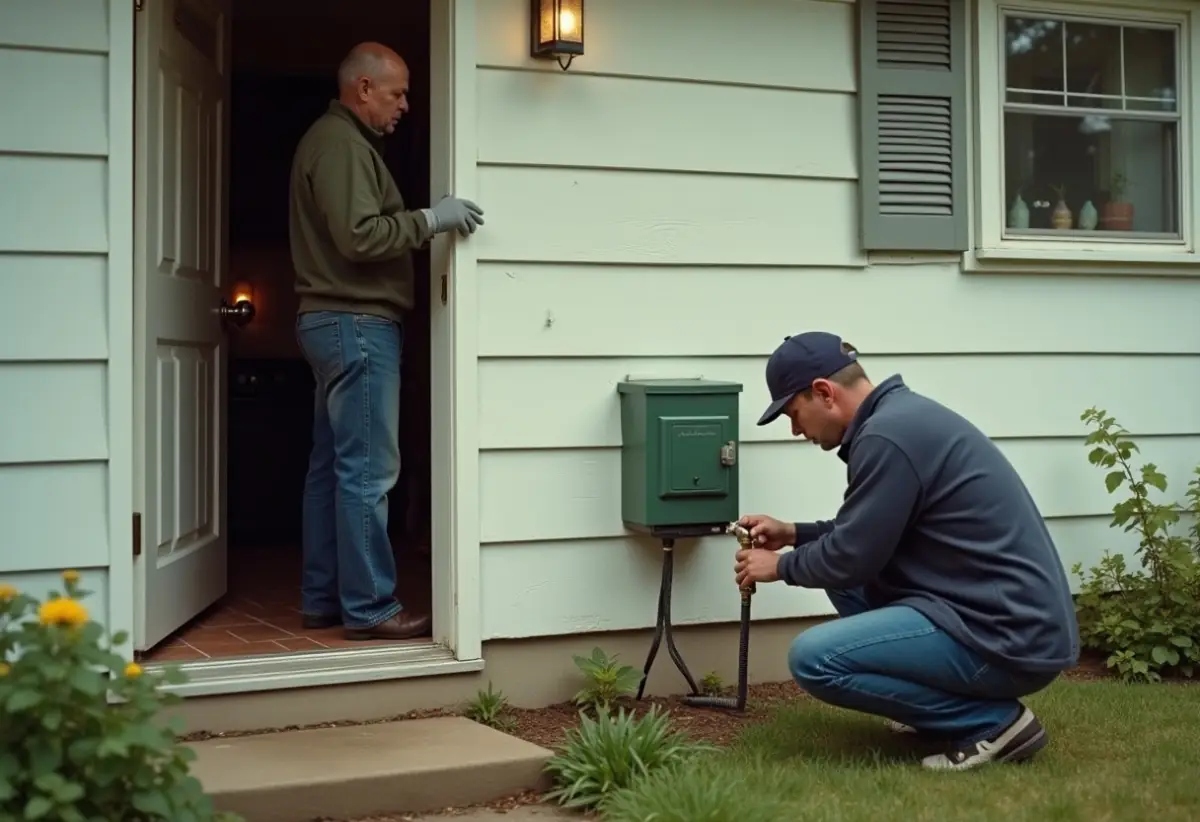
Turn off every fixture and water-using appliance, then watch the low flow indicator for a few minutes. If it turns, water is flowing somewhere. For slow leaks, follow the EPA WaterSense method: record the reading, use no water for two hours, and read again. If the meter changed at all, EPA says you probably have a leak.
- Shut off or pause every water user: taps, toilets, washer, dishwasher, irrigation timer, ice maker, water softener, and any evaporative cooler.
- Make sure no one in the house runs water during the test.
- Watch the low flow indicator for 2 to 5 minutes. Any rotation means flow.
- Write down the full reading, including the sweep hand position.
- Wait two hours with no water use. Overnight works too.
- Read the meter again and subtract. Convert the change to gallons and scale it to a day and a year using the table below.
This is the part most reading guides skip: what a small movement actually costs you. The table turns a two-hour change into daily and yearly gallons with straight arithmetic (two hours x 12 = one day; x 365 = one year).
| Meter change in a 2-hour no-use test | Gallons in 2 hours | Gallons per day | Gallons per year |
|---|---|---|---|
| 0.1 cubic foot (one tenth of a cu ft sweep) | 0.75 | about 9 | about 3,280 |
| 1 gallon (one tenth of a 10-gallon sweep) | 1 | 12 | 4,380 |
| 0.5 cubic foot | 3.7 | about 45 | about 16,380 |
| 1 cubic foot | 7.48 | about 90 | about 32,760 |
| 10 gallons (one full gallon-meter sweep) | 10 | 120 | 43,800 |
For scale, EPA WaterSense counts more than 9,300 gallons a year of leaks in the average home and says a faucet dripping once per second wastes more than 3,000 gallons a year. A meter that drifts just 1 cubic foot in two hours is losing roughly three times the average household’s annual leak volume.
Before you blame a pipe, rule out the usual quiet users. A toilet flapper that seeps is the most frequent cause; EPA suggests a few drops of food coloring in the tank, and color in the bowl after 10 minutes means a leak. Softeners that regenerate overnight and ice makers refilling will also move the dial. For context on which leaks show up most in homes, see our breakdown of how common plumbing leaks are.
Is the leak inside the house or in the service line?
Close the main shutoff valve on the house side of the meter, then watch the low flow indicator again. If it stops, the leak is inside the house: a fixture, a supply line, or a pipe in a wall or slab. If it keeps turning with the house valve closed, the leak is on the service line between the meter and your shutoff, which is usually the owner’s responsibility to repair.
- Indicator stops with main closed: leak is inside. Check toilets, then the water heater relief valve, then irrigation and outdoor spigots.
- Indicator keeps turning: leak is between meter and house. Call the utility to confirm, then a plumber for the buried line.
- Indicator is still but bills are high: ask the utility to test the meter and check whether readings were estimated.
If the meter confirms a leak but you cannot see one, the next step is locating it without tearing out walls. Acoustic listening, thermal imaging, and tracer gas are the tools a pro uses, covered in our guide to professional plumbing leak detection.
How we sourced this
We reviewed reading guides from US water utilities (City of San Diego; City of Blue Springs, Missouri; City of Mountain View, California) and the current EPA WaterSense Fix a Leak Week fact page, and cross-checked the cubic-foot conversion against the USGS conversion table. The San Diego visual glossary was used for register layout on Badger, Hersey, and Precision meters. Leak volumes in the two-hour test table and the 18,250 and 32,760 chart values are our own arithmetic from those published figures, labeled as such. We excluded manufacturer marketing claims and third-party blogs that did not cite a primary source. Sources were accessed in October 2026; meter designs and utility billing units vary, so confirm details with your provider.
Frequently asked questions
Which numbers on a water meter do I read?
Read every digit on the odometer from left to right, then add any fixed zeros printed beside it. On many cubic-feet meters the digits your utility bills are the left group, often on a white or outlined background, which counts hundreds of cubic feet (CCF). The right-hand digits and the sweep hand show smaller amounts the bill ignores but that you need for a leak test.
How many gallons is 1 CCF of water?
One CCF, also written HCF, is 100 cubic feet of water, which equals 748 gallons. The math comes from the USGS conversion of 7.48 gallons per cubic foot. Many utilities, including the City of San Diego, define one billing unit as one HCF. If your bill shows 8 units, you used about 5,984 gallons in that period.
What does the red triangle on a water meter mean?
The small red, blue, or black triangle, star, or wheel on the meter face is the low flow indicator, which utilities often call a leak detector or tattletale. It spins whenever any water passes through the meter, even a trickle too small to move the sweep hand much. If it turns while every fixture and appliance in the house is off, water is going somewhere.
How long should I watch my water meter to check for a leak?
Watch the low flow indicator for a few minutes first. If it is still, EPA WaterSense recommends a longer check: note the meter reading, use no water for two hours, then read it again. If the reading changed at all, you probably have a leak. The two-hour window catches slow toilet and irrigation leaks a short glance misses.
Is it normal for a water meter to move when no water is being used?
No. With every tap, toilet, appliance, irrigation zone, and water treatment system idle, the low flow indicator and sweep hand should not move. Common hidden users that cause movement are a toilet flapper leak, an ice maker, a water softener regenerating, or a leak on the service line. Rule those out before you assume a pipe leak.
Can I read my own water meter?
Yes. Homeowners can lift the meter box lid with a screwdriver or meter key and read the register, and many utilities publish reading guides for that purpose. The meter itself usually belongs to the utility, so do not remove the register, cut seals, or tamper with the AMI wire. Check the box for insects and water before reaching in.
How do I read a smart water meter?
A smart or AMI meter still has a physical register you can read like any dial or digital meter. The difference is the radio endpoint that sends readings to the utility automatically. Many utilities with AMI offer an online portal or app that shows hourly use, which makes continuous overnight flow, the signature of a leak, easy to spot.