Is It Normal for a Water Softener to Make Noise? Regeneration Sounds Explained, Step by Step
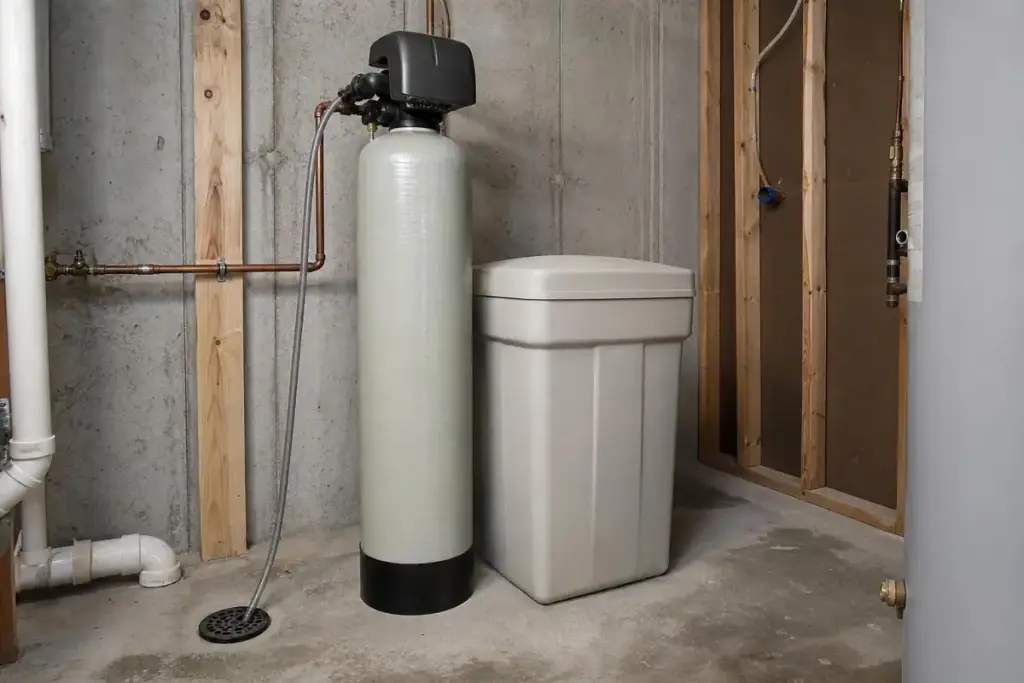
Yes, it is normal for a water softener to make noise during regeneration: a motor whir and click at each valve step, then rushing water to the drain. On a Clack WS1 that runs 57 to 99 minutes from a default 2:00 a.m. start. Constant running water or a motor that hums without moving is not normal.
What does a normal regeneration sound like, step by step?
A normal regeneration sounds like a short motor whir, then a few minutes of loud flow to the drain, a long quiet stretch, another loud burst, and a soft trickle into the salt tank. EcoWater’s ESD2800 series owner’s manual says that when a recharge starts “you hear the valve motor run,” and every valve below moves its piston with a small motor at each step change.
Clack prints fixed minutes; Fleck and EcoWater let the dealer set them, so read your display while a cycle runs.
| Step (what the valve does) | Clack WS1 downflow, normal backwash (Table 2) | Fleck 5600SXT downflow | EcoWater ESD2800 series | What you hear |
|---|---|---|---|---|
| Valve moves between steps | Motor drives the piston; Err 1001 if no motion is sensed | Motor turns the cam; error 0 if a move takes over 6 minutes | Both position indicators flash while moving | Whir of a few seconds, then a click as the valve seats |
| Backwash | 6, 8 or 8 min | BW, set 0 to 199 min | Settable 1 to 30 min, default by model | Loudest step: full flow at the drain line flow control rate |
| Brine draw and slow rinse | 45, 60 or 75 min | BD, set 0 to 199 min | Brine step, minutes remaining shown | Low hiss at the valve, slow drain flow |
| Second backwash | 3, 8 or 10 min | Only on double backwash units (blue cam 40609) | Bkwsh | Second loud burst |
| Fast rinse | 3, 4 or 6 min | RR, set 0 to 199 min | Settable 1 to 30 min | Loud flow, then a click back to service |
| Brine refill | Outside the 57 to 99 min totals; 0.5 gpm, treated water already flowing (prefill option runs it 2 hours before) | BF; a 60022-12 brine line flow control fills at 0.125 gpm | Fill, shown first in its indicator order | Trickle in the salt tank |
The three Clack columns are chosen by salt dose: under 7.5 lb per cubic foot of resin gives 57 minutes, 7.5 to 12 lb gives 80, over 12 lb gives 99. How often a cycle comes around is a separate question, covered in our guide to how often water softener regeneration should run.
The loud minutes are the backwash and fast rinse, when water leaves at the rate stamped on the drain line flow control (DLFC). Clack prints that rate as a 3-digit number on the part: a DLFC marked 017 (V3162-017) passes 1.7 gpm, so the 57-minute program sends about 12 x 1.7 = 20.4 gallons down the drain in its loud steps alone, before the slow rinse is counted.
Why is my water softener making noise at night, and how do I move the time?
A softener makes noise at night because 2:00 a.m. is the factory regeneration time on Clack WS1 controls and EcoWater ESD2800 units, picked because almost no water is drawn then. Clack’s manual says water drawn during a cycle is untreated, so a later start can put hard water in a morning shower.
- Clack WS1: hold NEXT and the up arrow 3 seconds, press NEXT past Hardness and Day Override to Step 4I (hour) and 5I (minutes).
- Pentair Fleck 5600SXT: hold Up and Down 5 seconds, press Extra Cycle to the RT screen and adjust. The 5600SXT Downflow service manual publishes no default hour, so the dealer’s setting is what you hear.
- EcoWater: press SELECT to “RECHARGE TIME” and move the start in 1-hour steps, checking AM or PM.
A cycle at an odd hour has manual-listed causes. Clack’s troubleshooting item 4 names a power outage, a wrong clock, or the “on 0” setting, which starts a regeneration 10 minutes after water use stops once capacity hits zero. A Fleck set to Meter Immediate also regenerates the moment capacity runs out.
Timer and metered units differ in when they start, not in loudness: a Fleck Time Clock Delayed control runs whenever the day count equals its day override, while a metered valve waits for its gallon capacity to run out. That difference matters most when the house is empty, which our page on whether to turn off a water softener on vacation works through by control type.
How much water goes down the drain at 4, 8 and 12 regenerations a month?
A household softener sends roughly 900 to 10,000 gallons a year down the drain, depending on gallons per cycle and cycles per month. EPA WaterSense’s water softener fact sheet says a typical unit uses 20 to 70 gallons per regeneration and some larger systems up to 200. The middle three rows use EcoWater’s published “water used during regeneration” at minimum salt dose, multiplied by rated capacity at that dose.
| Unit and input | Gallons per regeneration | 4 a month (gal/yr) | 8 a month (gal/yr) | 12 a month (gal/yr) |
|---|---|---|---|---|
| EPA typical, low end | 20 | 960 | 1,920 | 2,880 |
| EcoWater ESD2802R30: 2.4 gal per 1,000 grains x 7.8 (7,800 grains at 1.7 lb) | 18.7 | 899 | 1,797 | 2,696 |
| EcoWater ESD2800R25: 2.9 gal per 1,000 grains x 12.2 (12,200 grains at 2.4 lb) | 35.4 | 1,698 | 3,396 | 5,095 |
| EcoWater ESD2802R39: 4.5 gal per 1,000 grains x 12.0 (12,000 grains at 2.4 lb) | 54.0 | 2,592 | 5,184 | 7,776 |
| EPA typical, high end | 70 | 3,360 | 6,720 | 10,080 |
Formula: gallons per regeneration x regenerations per month x 12. Going from 4 to 12 cycles a month on the 10 x 47 inch ESD2802R39 adds 5,184 gallons a year. EPA’s guide says efficient softeners use 4 gallons or less per 1,000 grains removed; the ESD2802R39 sits just above that line at 4.5.
Which water softener noises are not normal?
A noise is abnormal when it lasts longer than the programmed cycle, comes with no regeneration on the display, or repeats at every step change. The causes in the table are the ones Clack’s WS1 and WS1.25 drawings and service manual and the Fleck 5600SXT manual list for each symptom.
| Sound | Cause the manual lists | What to do |
|---|---|---|
| Water running to the drain for hours, or in service | Clack item 13: power outage mid-cycle, damaged seal/stack, piston failure, loose drive cap. Fleck “drain flows continuously”: valve not positioning, foreign material, internal leak | Check the display for a regeneration in progress; if none, put the valve in bypass and book a seal and piston repair |
| Motor humming or buzzing with no movement | Clack Err 1001 (unable to sense motor movement) or Err 1002 (motor stalled); Fleck error 0 (drive took over 6 minutes) | Clack: hold NEXT and REGEN 3 seconds to resynchronize. Fleck: unplug and check cam switches and that the piston moves freely |
| Clicking that repeats all day | Fleck “control cycles continuously”: misadjusted, broken or shorted switch | Replace the switch, timer or complete power head |
| Bang in the pipes as a step changes | Flow stops or redirects when the piston moves; Clack and EcoWater rate valves for 20 to 125 psi | Read static pressure with a gauge on a hose bib; many local codes call for a pressure-reducing valve above 80 psi |
| Gurgling or sucking in the salt tank, salt level not dropping | Clack item 12: plugged injector, regenerant line air leak, drain line too long or too high, pressure under 25 psi | Clean the injector, check brine tube fittings, shorten the drain run |
| Slapping hose at the floor drain | EcoWater: water pressure “will cause it to whip during the backwash” | Tie or wire the hose at the drain point, keeping the air gap |
A tank that gurgles yet stays full of salt can also be a salt bridge, a crust with an empty pocket under it. Push a broom handle to the floor of the tank to find it, and our guide to water softener salt explains which salt types crust least.
Is the rushing noise at the drain line and air gap normal?
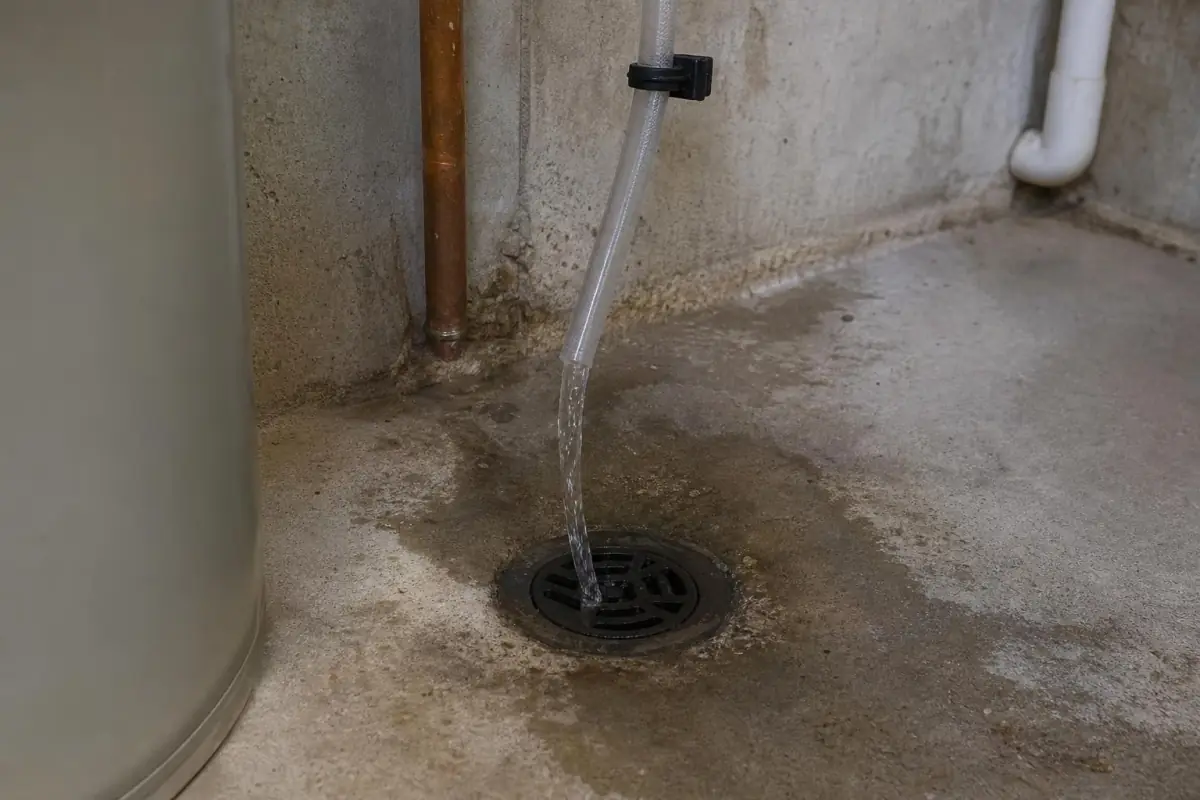
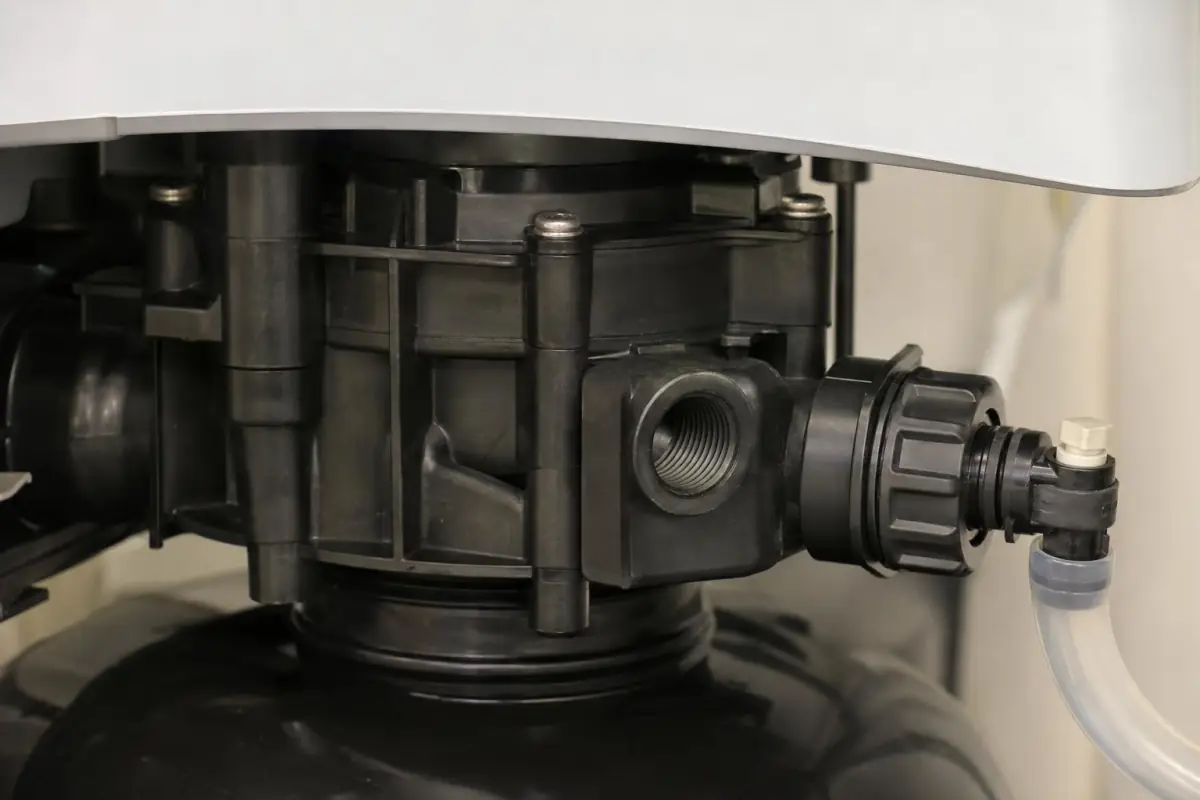
Yes, splashing at the air gap is the drain working as designed, and every manual requires that gap. The Fleck 5600SXT manual calls for an air gap of 2 times the drain line diameter with a 1 inch minimum, and EcoWater asks for at least 1-1/2 inches between the hose end and the drain so sewer water cannot siphon back.
Drain routing changes the sound and the cycle. EcoWater says not to raise the drain hose more than 8 feet above the floor because back pressure can cut backwash flow. Clack’s service manual sets a 1/2 inch minimum drain line and requires 3/4 inch for backwash flows over 7 gpm or runs longer than 20 feet, and lists a drain line “too long or too high” as a reason a valve fails to draw brine. Clipping a hose off a joist quiets vibration; never close the gap to silence the splash.
What if the softener never stops running?
A softener that runs past its total cycle time, 57 to 107 minutes on a Clack WS1 plus fill, is stuck: bypass it and call a water treatment dealer. Tell the dealer which control you have: a Clack WS1 has NEXT and REGEN buttons, and a Fleck SXT has an Extra Cycle button.
- Read the display: a moving step countdown means a cycle is still running, and a flashing clock means an outage, after which Clack finishes the remaining cycle time.
- Turn the bypass to stop water waste. On a Clack bypass, turning both handles so the arrows point toward each other isolates the softener while the house keeps water.
- Ask the dealer for a seal/stack and piston replacement on a Clack, or seals, spacers and piston on a Fleck 5600, which both manuals name for an internal leak.
If the unit stopped making noise and the water turned hard, the problem runs the other way; our checklist for a water softener not working starts with the bypass, salt and injector.
How we sourced this
Read: Clack WS1 and WS1.25 control valve manual (Tables 1 to 3, Installer Display Settings) and the Clack V3115-99 drawings and service manual (DLFC table, drain line rules, troubleshooting items 4 and 12 to 15); the Pentair Fleck 5600SXT Downflow service manual (control types, programming, troubleshooting, error codes); the EcoWater ESD2800 series owner’s manual (specifications, drain and air gap steps, recharge time); EPA WaterSense’s water softener fact sheet and guide. Computed: the annual drain water table and the loud-step gallons per DLFC rating. Left out: Culligan step times and any decibel figure, because no maker document read here publishes one, and code section numbers for pressure limits, whose text we could not open.
Frequently asked questions
Should a water softener make noise when no water is being used?
Only during a scheduled regeneration. Outside that window a softener in service is silent apart from the flow you cause at a tap. Running water heard with every fixture closed and no cycle shown on the display points to an internal leak past the piston seals, which both Clack and Fleck manuals list.
How long should water run to the drain during regeneration?
On a Clack WS1 downflow valve the loud full-flow steps total 12, 20 or 24 minutes inside a 57, 80 or 99 minute program. Flow is slower during the 45 to 75 minute brine and slow rinse step. Water still running after the program total plus fill is a fault.
Why does my water softener click every few minutes?
A Fleck or Clack control clicks as the motor drives the piston into each of 4 to 6 positions during a cycle. Clicking all day with no regeneration on the display matches the Fleck manual entry for a control that cycles continuously, caused by a misadjusted, broken or shorted switch in the power head.
Does a water softener hum all the time?
No. The Clack WS1 runs on a 15 VDC, 500 mA power supply and its motor turns only to change positions. A steady hum with no valve movement fits Clack Err 1001 or 1002, a stalled motor, or Fleck error 0, which appears when the drive takes longer than 6 minutes to reach the next position.