Water Softener Regeneration: How Often, How Long and What Happens (With a Days-Between Table)
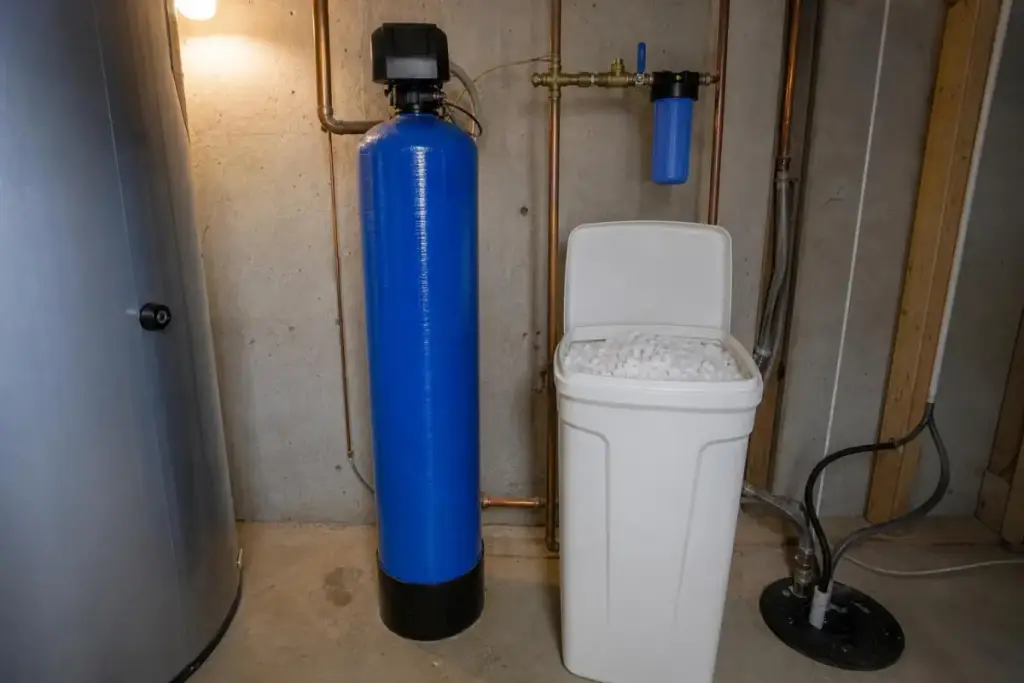
Water softener regeneration should happen when the resin is used up: divide grain capacity by daily gallons times hardness. A 32,000-grain unit serving 3 people on 15 gpg water regenerates about every 13.6 days, normally at 2 a.m., and a Clack WS1 cycle runs 57 to 99 minutes plus brine refill.
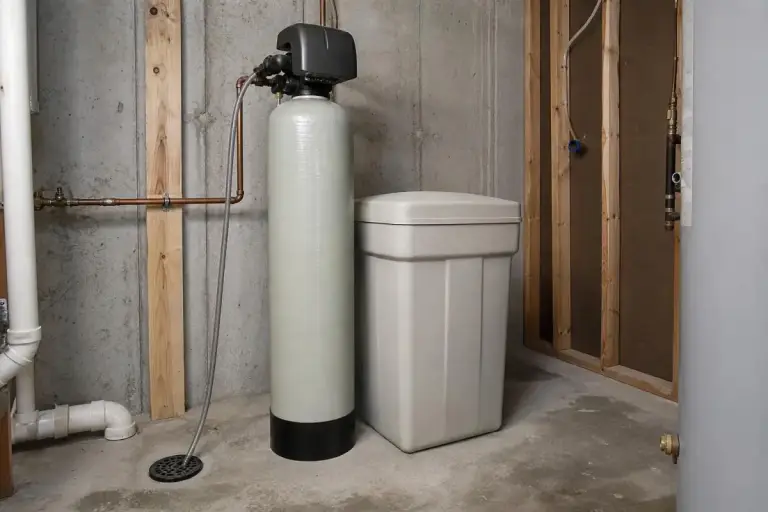
Regeneration is a brine wash: the valve backwashes the resin bed, pulls salt brine through it to strip off the calcium and magnesium, rinses and refills the brine tank. The Fleck 5600SXT and Clack WS1 manuals publish enough to check your own setting.
How often should a water softener regenerate? Do the division
A softener should regenerate every (grain capacity) divided by (gallons per day x hardness in gpg) days. Three inputs decide it.
- Grain capacity. The number on the tank label or model name: 24,000, 32,000, 48,000 grains. A.O. Smith’s C43 softener spec sheet shows why that number moves: 1.0 cubic foot of resin is rated 20,000 grains at 6 pounds of salt per cubic foot, 25,000 at 10 pounds and 30,000 at 15 pounds.
- Hardness in grains per gallon. Utility reports often give mg/L (or ppm) as calcium carbonate. Divide by 17.1: 171 mg/L is 10 gpg, 256 mg/L is 15 gpg, 342 mg/L is 20 gpg and 428 mg/L is 25 gpg. Our hardness figures by state give a starting number if you have no test.
- Gallons per day. The Water Research Foundation’s Residential End Uses of Water study (REU2016) measured an average of 138 gallons per household per day indoors, across homes averaging 2.65 people. That works out to 52.1 gallons per person per day, the figure used below.
Days of soft water per full regeneration, at nameplate capacity and before any reserve:
| Unit (grains) | Hardness (gpg) | 2 people (104 gal/day) | 3 people (156 gal/day) | 4 people (208 gal/day) |
|---|---|---|---|---|
| 24,000 | 10 | 23.0 days | 15.4 days | 11.5 days |
| 24,000 | 15 | 15.4 days | 10.2 days | 7.7 days |
| 24,000 | 20 | 11.5 days | 7.7 days | 5.8 days |
| 24,000 | 25 | 9.2 days | 6.1 days | 4.6 days |
| 32,000 | 10 | 30.7 days | 20.5 days | 15.4 days |
| 32,000 | 15 | 20.5 days | 13.6 days | 10.2 days |
| 32,000 | 20 | 15.4 days | 10.2 days | 7.7 days |
| 32,000 | 25 | 12.3 days | 8.2 days | 6.1 days |
| 48,000 | 10 | 46.1 days | 30.7 days | 23.0 days |
| 48,000 | 15 | 30.7 days | 20.5 days | 15.4 days |
| 48,000 | 20 | 23.0 days | 15.4 days | 11.5 days |
| 48,000 | 25 | 18.4 days | 12.3 days | 9.2 days |
Three adjustments give your real interval. First, nameplate ratings are usually quoted at the top salt dose; on the A.O. Smith figures, dropping from 15 to 6 pounds per cubic foot leaves two-thirds of the capacity, so multiply any row by 0.67 if your salt setting is low. Second, a metered control holds back a reserve: the Fleck SXT lets the installer set a safety factor from 0 to 50 percent or a fixed reserve volume, so the valve calls for regeneration before the bed is fully spent. Third, a day override caps the gap; on the Clack WS1 it can be set from 1 to 28 days, so a 46-day row will still regenerate every 28 days if that limit is on.
A unit that cycles far more often than its row predicts is mis-set or failing. Our guide to a softener that has stopped softening walks through brine draw, injector and resin faults in order.
How long does water softener regeneration take on a Clack WS1 and a Fleck 5600SXT?
A Clack WS1 downflow softener takes 57, 80 or 99 minutes, chosen automatically from the salt dose, plus a brine refill during which you already have soft water again. Clack’s WS1 and WS1.25 control valve manual (Table 2, normal backwash) lists each step:
| Clack WS1 downflow step | Under 7.5 lb salt/ft3 (3,501 to 6,000 grains per lb) | 7.5 to 12 lb/ft3 (2,501 to 3,500 grains per lb) | Over 12 lb/ft3 (1,700 to 2,500 grains per lb) |
|---|---|---|---|
| 1. Backwash (loosens the bed, flushes sediment) | 6 min | 8 min | 8 min |
| 2. Regenerate (brine draw and slow rinse) | 45 min | 60 min | 75 min |
| 3. Second backwash | 3 min | 8 min | 10 min |
| 4. Rinse (fast rinse, packs the bed) | 3 min | 4 min | 6 min |
| Total before fill | 57 min | 80 min | 99 min |
| 5. Fill (refills brine tank) | Length set by the pounds of salt programmed; Clack notes the system is already providing treated water during fill | ||
The “longer” backwash option (Table 3) stretches these to 65, 86 and 107 minutes.
The Fleck 5600SXT does not publish fixed times. Pentair’s 5600SXT Downflow service manual lets the dealer set each step, backwash (BW), brine draw (BD), rapid rinse (RR) and brine fill (BF), be set from 0 to 199 minutes. The display shows each step code and counts down its minutes, so step through once and add them up. The brine fill step can be checked against the parts list: the 60022-25 brine line flow control is rated 0.25 gpm, or 0.75 lb of salt per minute, so a 9 lb salt setting needs a 12 minute BF time; the 60022-12 control at 0.125 gpm (0.375 lb per minute) needs 24 minutes for the same dose.
Demand-initiated vs timer regeneration, and salt or potassium
A demand-initiated (metered) softener regenerates only after it has treated its calculated gallons, while a timer softener regenerates on a calendar whether or not the resin is spent. The Fleck SXT offers meter immediate, meter delayed, time clock delayed and day-of-week control; on meter delayed it divides unit capacity by feed hardness, subtracts the reserve and regenerates at the next set time once the gallons run out.
The 32,000-grain, 3-person, 15 gpg household in the table needs a cycle every 13.6 days; a timer set to every 7 days regenerates while about 49 percent of the bed is still unused, wasting roughly half of each cycle’s salt. California wrote demand control into law: Health and Safety Code section 116785 allows a self-regenerating softener that discharges to the sewer only if it “activates regeneration by demand control” and, for installs from January 1, 2002, carries a third-party rating of at least 4,000 grains of hardness removed per pound of salt.
That same household removes about 855,700 grains a year (156 gallons x 15 gpg x 365 days). On the A.O. Smith ratings, the 15 lb per cubic foot dose yields 2,000 grains per pound, or about 428 lb of salt a year (10.7 bags of 40 lb); the 6 lb dose yields about 3,333 grains per pound, or about 257 lb (6.4 bags). The low dose regenerates 1.5 times as often, so it trades some rinse water for about 171 lb less salt.
Potassium chloride regenerates a standard resin bed too, putting potassium on the resin instead of sodium; Morton sells its Potassium Chloride Pellets in 40 lb bags as 99 percent sodium free. Recheck the pounds-per-regeneration setting after a switch, and see our comparison of salt types, salt bridges and bag costs for prices.
Why softeners regenerate at 2 a.m., and can you use water during regeneration?
Many softeners regenerate at 2 a.m. because that is the factory default on Clack WS1 and EE controls. Clack’s manual says a system is typically set to regenerate when the household is asleep, and “if there is a demand for water when the system is regenerating, untreated water will be used.”
You can run water during regeneration on most single-tank systems, but it will be hard. The Fleck 5600SXT job sheet lists two valve builds, “Hard Water Bypass” and “No Hard Water Bypass”, and Clack sells no-hard-water-bypass valves (V3070FF and V3070FM). With a standard valve:
- Avoid hot water for the 57 to 99 minute window; every gallon drawn refills the water heater with untreated water.
- Size the reserve for your heaviest day. The Fleck SXT Timer Service Manual says a meter delayed reserve should keep treated water flowing between the moment capacity runs out and the programmed regeneration time.
How to manually regenerate a Fleck 5600SXT and a Clack WS1
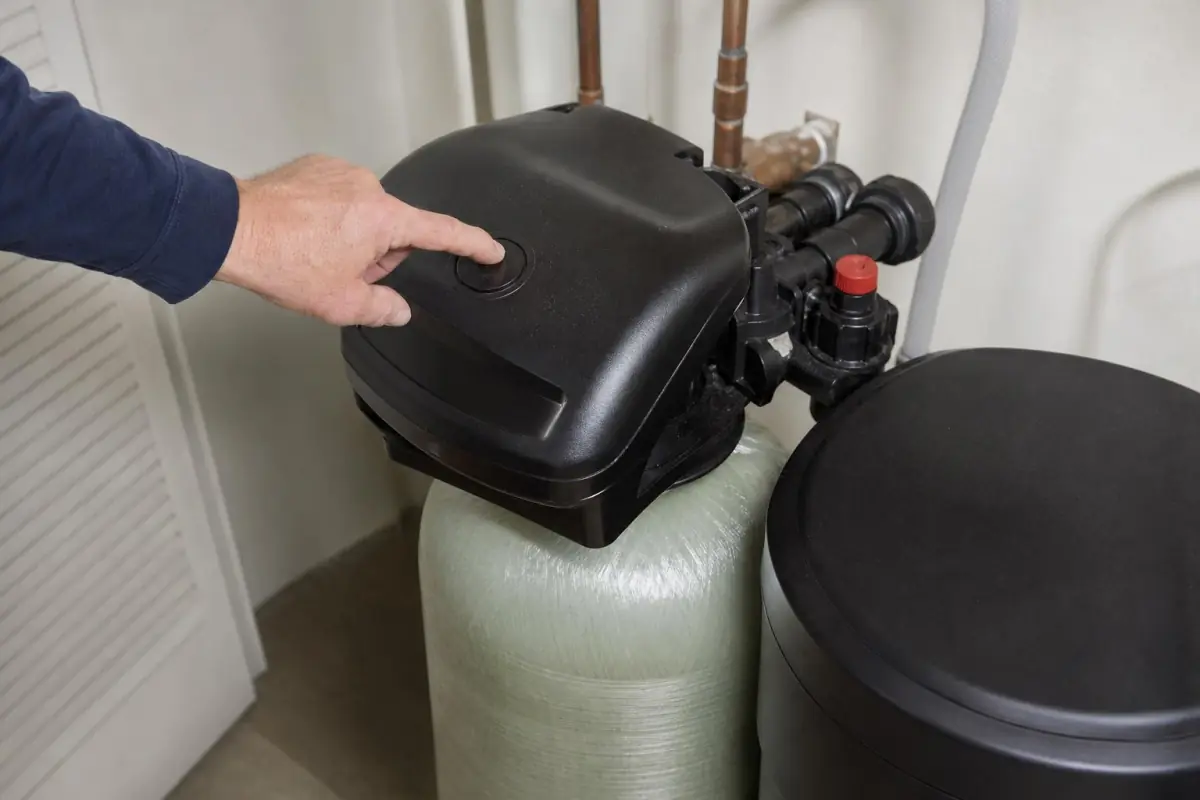
Hold the main button: 5 seconds on a Fleck 5600SXT (Extra Cycle) or 3 seconds on a Clack WS1 (REGEN) starts an immediate regeneration. Both valves also let you queue a cycle for tonight instead.
| Action | Fleck 5600SXT (SXT timer) | Clack WS1 / WS1.25 |
|---|---|---|
| Regenerate tonight at the set time | Press Extra Cycle once; the service icon flashes. Press again to cancel. | Press and release REGEN; “REGEN TODAY” flashes. Press again to cancel. |
| Regenerate right now | Hold Extra Cycle for 5 seconds; the valve drives to step 1, backwash. | Hold REGEN for 3 seconds. This cannot be canceled except by holding NEXT and REGEN together for 3 seconds to reset. |
| Skip to the next step | Press Extra Cycle once per step: brine draw, rapid rinse, brine refill, then service. | Press REGEN once per step. |
If an SXT valve takes longer than 6 minutes to reach the next position, the control throws error 0, a cam sense fault; the Fleck 5600 error code list covers that code and the rest.
Where brine discharge to the sewer is restricted
California sets state conditions and lets local sewer agencies limit or ban self-regenerating softeners. Under Health and Safety Code section 116786, a local agency may, by ordinance, limit or prohibit the installation of softeners that discharge to the community sewer, but only after findings, backed by an independent salinity study, that the limit is needed to meet regional water board requirements. Section 116787 goes further for one named district: the Santa Clarita Valley Sanitation District may require removal of all installed residential self-regenerating softeners after further findings.
Section 116785 also requires untreated water at outside hose bibs, with bypass valves allowed on older slab homes and condominiums. Outside California, any limit would come from your sewer utility, so ask it before installing a unit that drains brine to the sewer. Portable exchange tanks, regenerated off-site, are the alternative where a ban applies.
How we sourced this
Read: the Clack WS1/WS1.25 manual (Tables 1 to 3), Clack WS1CS and EE programming manuals, the Pentair Fleck SXT Timer and 5600SXT Downflow service manuals, the A.O. Smith C43 spec sheet, the WRF REU2016 summary (138 gallons per household per day, 2.65 people) and California Health and Safety Code sections 116785 to 116787. We computed the regeneration table, the chart, the brine fill minutes and the annual salt figures. Fleck publishes no default step times or regeneration hour, and we found no primary figure for gallons used per regeneration, so neither is given.
Water softener regeneration questions
Can I take a shower while my water softener is regenerating?
Yes on most single-tank valves, but the water is hard. The Clack WS1 manual says untreated water is used if there is demand during regeneration. Hot water drawn then refills the water heater with hard water, so it is better to wait the 57 to 99 minutes the cycle takes.
Why is my water softener regenerating every night?
Usually the hardness or capacity setting is wrong, or the clock is off. At 25 gpg, a 24,000-grain unit for 4 people runs out in about 4.6 days, so nightly cycles point to a hardness entry far above your real water, a day override set to 1, or a meter that is not counting.
Should I regenerate right after adding salt to an empty brine tank?
Not immediately. Clack tells owners of WS1-family valves to fill an empty brine tank with salt and wait at least 2 hours before regenerating, so the refill water has time to turn into brine. Then hold REGEN for 3 seconds and let the full cycle run.
What happens if the power goes out during regeneration?
A Fleck SXT saves its valve position and resumes from that step when power returns, keeping the time for at least 48 hours. A missed scheduled cycle is queued for the next regeneration time. The Clack WS1 keeps settings for up to 8 hours on its battery, after which only the time needs resetting.
How many gallons should a softener treat between regenerations?
Divide the grain capacity by your hardness in gpg. A 32,000-grain unit on 15 gpg water treats about 2,133 gallons before it is exhausted, less any reserve the control holds back. A metered Fleck or Clack valve counts down from that figure and shows the gallons remaining on its display.