Should You Turn Off Your Water Softener When on Vacation? Bypass, Regen and Restart
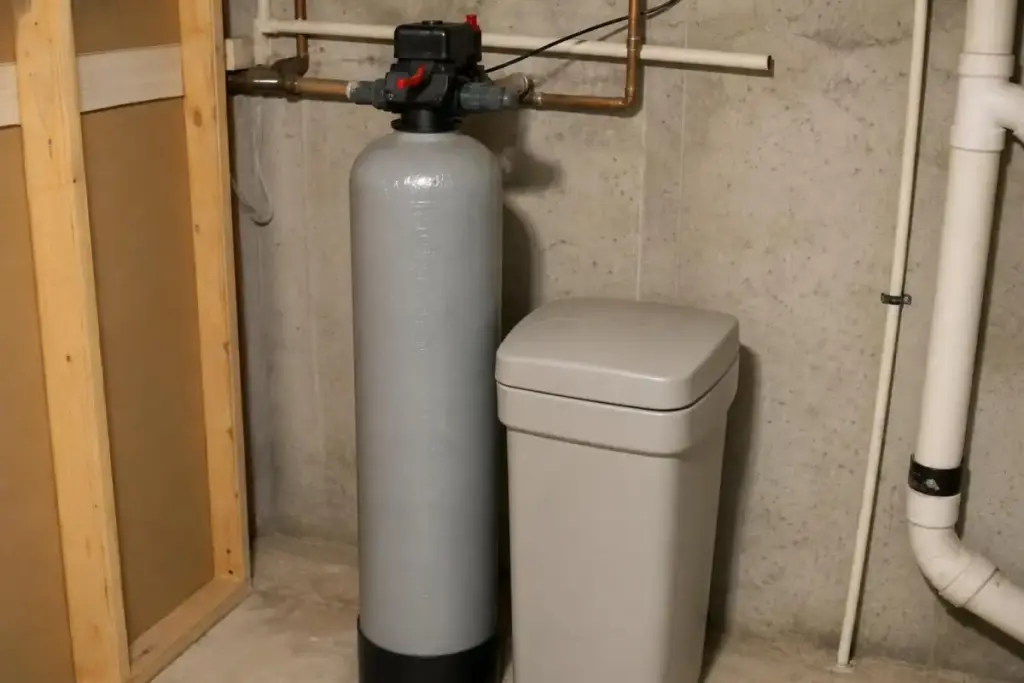
Should you turn off your water softener when on vacation? Not if it is metered: a demand softener counts gallons and sits idle in an empty house. Turn it off, by bypass or unplugging, if it runs on a timer, because a timer regenerates every 3 to 7 days whether anyone is home.
Is your softener metered or on a timer?
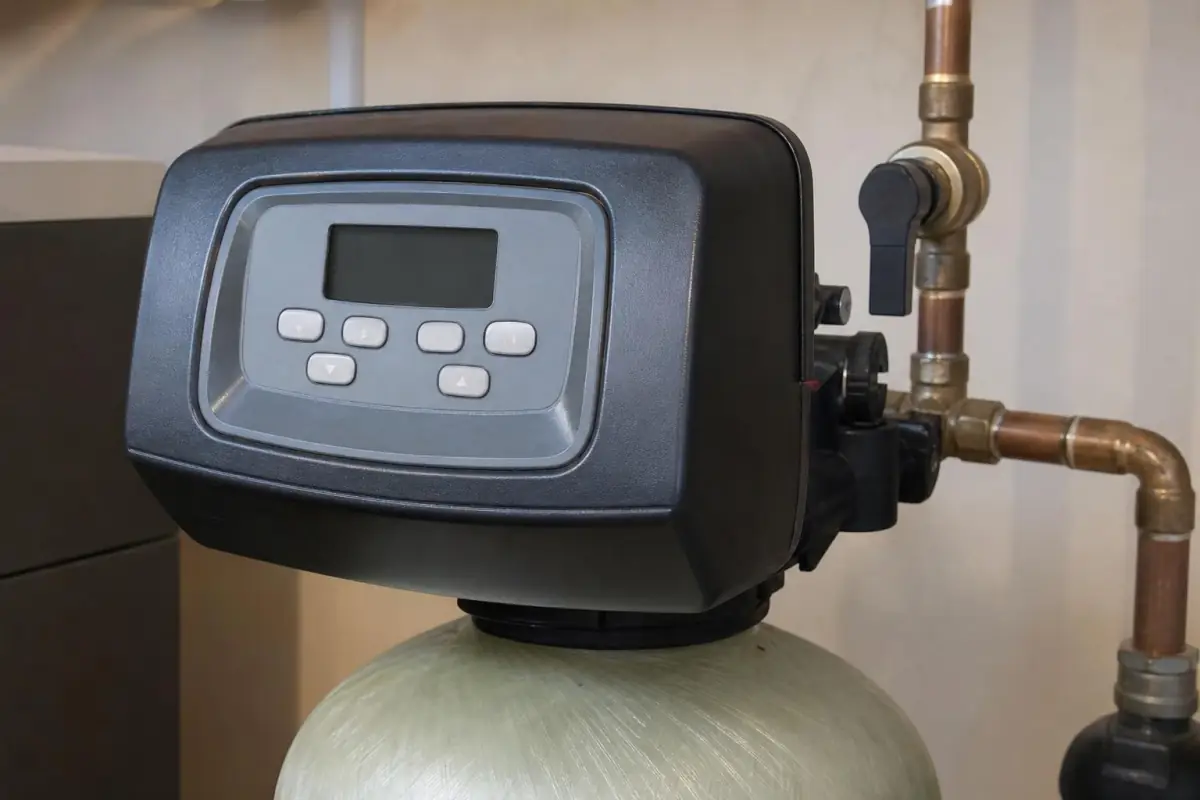
Your softener is metered if its display shows gallons remaining, and it is a timer if it shows only a clock and a days setting. On a Pentair Fleck 5600SXT, the service manual names three control types: Meter Immediate, Meter Delayed and Time Clock Delayed. The first two count down a gallon capacity; the third regenerates whenever the days since the last cycle equal the day override number.
On a Clack WS1, the WS1 and WS1.25 manual says a valve without a water meter can only act as a time clock. Look for a thin meter wire running into the control board: Clack’s service manual says that if no water meter wire is visible, a plug is installed, not a meter.
A third test needs no manual. Note the gallons-remaining figure, open a cold tap for 2 minutes, and read it again. A number that drops means demand control. GE’s support page says its SmartWater softeners regenerate on demand and “will just sit there” with nobody home, with one named exception: the GXSS17, a timed model.
The catch on metered units: day override
A metered softener still regenerates on vacation if its day override expires before you return. Fleck’s 5600SXT manual says a metered system “will regenerate regardless of usage” once the days since the last cycle equal the day override, which can be set from 1 to 99 days or OFF. Clack allows 1 to 28 days or oFF, and its manual says the two settings cannot both be off.
The decision rule: read the DO (Fleck) or Day Override (Clack) value before you pack. If it is longer than your trip, leave the unit alone. If it is shorter, expect one regeneration per override period, which costs one salt dose and one cycle of drain water, a far smaller bill than a timer unit runs up.
What a timer softener wastes while you are away
A timer softener running every 3 days can complete up to 5 regenerations during a 14-day trip. The table below multiplies that count by per-cycle figures published by manufacturers. Inputs: EcoWater’s ESD2800R25 manual (form 7396800, Rev. K) lists 2.9 gallons per 1,000 grains at its 2.4 lb minimum dose and 12,200 grains capacity, which is 35.4 gallons per regeneration. The 10 x 47 inch ESD2802R39 lists 4.5 gallons per 1,000 grains at 12,000 grains, which is 54.0 gallons. Salt runs from 2.4 lb (EcoWater minimum) to 15.6 lb, the top setting for the 1.0 cubic foot Direct whole house softener (part 37284).
| Timer schedule | Trip length | Max regenerations | Drain water (35.4 to 54.0 gal each) | Salt (2.4 to 15.6 lb each) |
|---|---|---|---|---|
| Every 3 days | 7 days | 3 | 106 to 162 gal | 7.2 to 46.8 lb |
| Every 3 days | 14 days | 5 | 177 to 270 gal | 12.0 to 78.0 lb |
| Every 7 days | 7 days | 1 | 35.4 to 54.0 gal | 2.4 to 15.6 lb |
| Every 7 days | 14 days | 2 | 70.8 to 108 gal | 4.8 to 31.2 lb |
Maximum regenerations equal trip days divided by the interval, rounded up, because a cycle can fall on the first night you are gone. The 78 lb worst case is almost two 40 lb bags, consumed by a house that used no soft water. Read the per-cycle salt setting off your own controller to place yourself in the range; the guide to how often a softener should regenerate shows how that dose links to capacity.
Unplugging stops this on a timer unit, and GE gives exactly that instruction for the GXSS17. Bypass leaves the controller powered, so its clock keeps counting days toward the next cycle; pull the plug as well if you want zero regenerations.
Which controllers have a vacation setting?
None of the four controller manuals checked for this article lists a vacation or holiday mode, so the choice comes down to the bypass and the plug.
| Control | How it triggers | Vacation setting | Runs while you are away? | How to stop it |
|---|---|---|---|---|
| Pentair Fleck 5600SXT | Meter Immediate, Meter Delayed or Time Clock | None listed | Timer: yes. Metered: only when DO (1 to 99 days) expires | Unplug, or turn the bypass to bypass |
| Clack WS1 / WS1.25 | Demand, time clock, or both | None listed | Only if Day Override (1 to 28) expires | Turn both red handles to point at each other |
| EcoWater ESD2800R25, ESD2802R30, ESD2802R39 | Demand | None; manual says one is not needed | No | Nothing required |
| GE SmartWater demand models | Demand | None; GE says nothing special is needed | No | Unplug if you want it fully off |
| GE GXSS17 | Timer | None | Yes | Unplug (GE support instruction) |
EcoWater’s ESD2800 manual states it plainly in a “Vacation Note”: its demand-controlled softeners regenerate only while water is used, so the unit “will not regenerate when you are away from home for extended periods.” Culligan and Kinetico controls are left out of the table because no owner’s manual for them could be opened to confirm a setting.
Bypass positions on a Clack WS1 head
The Clack WS1 bypass has 4 positions set by two red arrow-shaped handles, and only one of them, both handles pointing at each other, isolates the softener while still feeding the house. The Clack V3115-99 drawings and service manual also describes a diagnostic position (inlet handle with the flow, outlet handle to the center) and a shut-off position (inlet handle to the center, outlet handle with the flow) that cuts water to the house.
Push-pull stems and three-valve copper loops work differently; our guide to reading each type of bypass valve covers both, with the Fleck and GE positions.
If you shut the main water valve, bypass or unplug first
Closing the house main while the softener stays powered leaves a timer unit, or a metered unit whose day override runs out, free to start a cycle with no supply water to backwash, draw brine or refill the tank. Pentair’s 5600SXT manual says the valve system “should include all required safety components to prevent overflows” if power fails mid-regeneration, which is a reason not to leave a cycle running in an empty house. The order that avoids it: unplug the controller, turn the head to bypass, then close the main. Reverse it when you return.
Restarting the softener after the trip
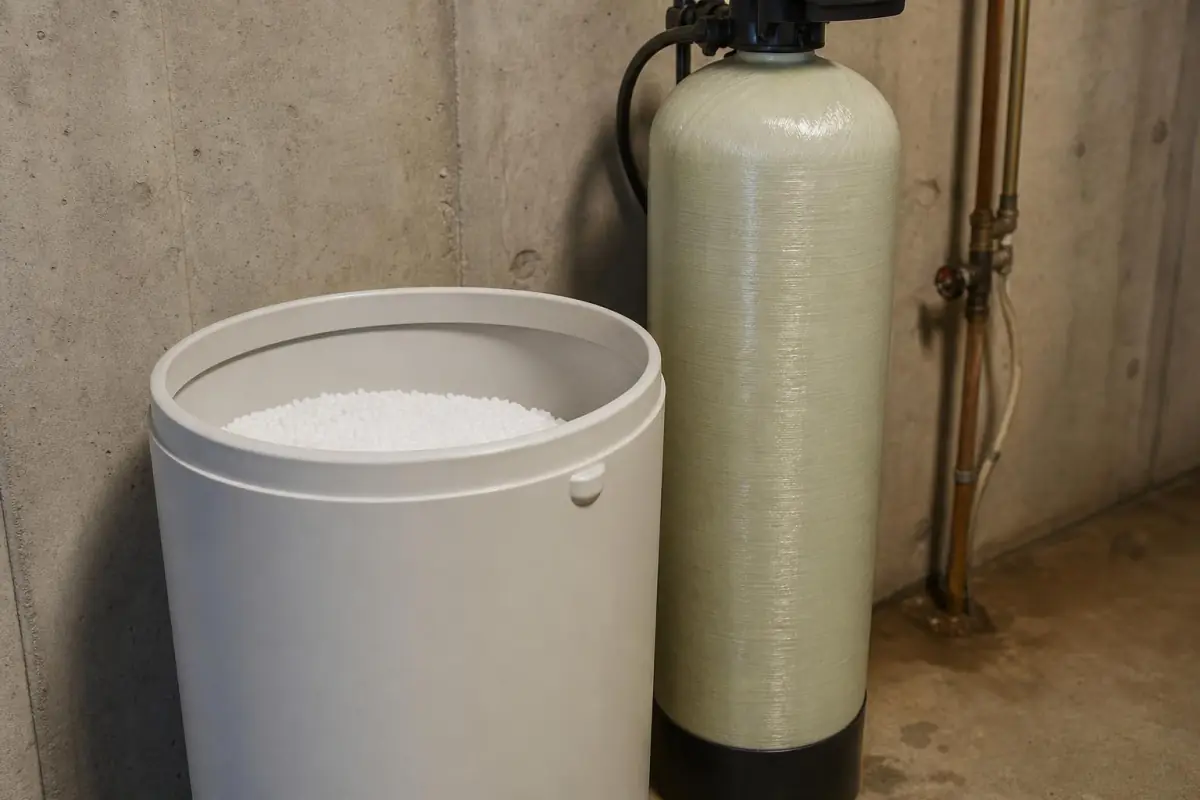
Restart in 5 steps: open the main, return the bypass to service slowly, reset the clock, check the salt, and run one manual regeneration if the unit sat bypassed or unplugged through a scheduled cycle. Fleck’s installation steps tell the installer to “slowly place the bypass in service position”.
Power loss resets differ by brand. The 5600SXT keeps time for at least 48 hours, stores its settings indefinitely, and queues a missed regeneration for the next programmed time, usually 1 day late. The Clack WS1 keeps all settings for up to 8 hours on its battery; after that only the time of day needs resetting. EcoWater warns that a flashing clock left unset makes recharges “occur at the wrong time of day.”
Manual regeneration buttons: hold Extra Cycle for 5 seconds on a Fleck SXT, hold REGEN for 3 seconds on a Clack WS1, hold RECHARGE for 3 seconds on an EcoWater ESD, or hold the GE button until “recharge now” flashes, which GE puts at about 2 hours to finish. Before that cycle, push a broom handle to the floor of the brine tank: a crust with an air gap under it is a salt bridge, the first thing to rule out if you get hard water after a trip. Refill with the type in the guide to which salt to refill with.
Does resin or brine go bad during a long absence?
No manual read for this article sets a maximum idle period for resin or brine, but EcoWater publishes a sanitizing routine you can reuse if water smells off after a long shutdown. Its ESD2800 series manual says bacteria could get into the unit “during shipping, storage, installing and operating,” and has owners pour about 3 oz (6 tablespoons) of household bleach into the brinewell, start a recharge, then run 50 gallons from a cold tap, which takes at least 20 minutes. Use your own maker’s dose: EcoWater’s ERR refiner manual calls for 1-1/2 oz instead.
Water softener vacation questions
Does a water softener use salt when no one is home?
A demand (metered) softener uses no salt while the house sits empty, because it regenerates only after counting gallons, unless its day override setting expires. A timer softener keeps regenerating on its calendar and draws a full salt dose each time, from about 2.4 lb up to about 15.6 lb per cycle on a 1 cubic foot unit.
Is it safe to unplug a water softener for two weeks?
Yes for the resin and the settings. A Fleck SXT keeps its configuration in non-volatile memory indefinitely and a Clack WS1 stores everything except the time of day permanently. Expect a flashing clock on return, and reset it, or the next regeneration runs at the wrong hour.
Will my softener regenerate if I shut off the main water valve?
A timer unit or a metered unit whose day override expires will still start a cycle on schedule, with no supply water to backwash or refill the brine tank. Unplug the controller or put the head in bypass before closing the main, then reverse the order when you get home.
Should I add salt before going on vacation?
Top the brine tank up to the maker’s fill line before you leave only if the unit stays in service. A bypassed or unplugged softener draws no brine, so the salt simply waits. On return, push a broom handle down to the tank floor to check for a salt bridge before trusting the level you see.
How do I know if my water softener has a vacation mode?
Check the manual’s programming section for a vacation, holiday or away entry. The Fleck 5600SXT and Clack WS1 manuals list none. The EcoWater ESD2800 series manual says a vacation setting is unnecessary because the demand control will not regenerate while nobody uses water.
How we sourced this
Read: Pentair Fleck 5600SXT downflow service manual; Clack WS1 and WS1.25 programming manual and V3115-99 drawings and service manual; EcoWater ESD2800 series owner’s manual (7396800 Rev. K, 6/2/25) and ERR refiner manual; Direct whole house softener manual (part 37284, Rev. A); GE Appliances vacation support note. Computed: gallons per regeneration from EcoWater’s gallons-per-1,000-grains figures, and the trip table from those inputs. Left out: Culligan and Kinetico settings, and any claim that closing the main damages a softener through pressure, which no manual read here states.