Can You Pump Sewage Uphill to a Septic Tank? Ejector vs Grinder Lift Math for 5, 10 and 20 ft
Yes, you can pump sewage uphill to a septic tank. A sewage ejector that passes 2 inch solids handles lifts to about 15 ft, a grinder pump covers 20 ft and more, and the code adds a check valve, a full-open valve, a vented gastight basin and, in some states, a bigger tank.
Ejector or grinder: which pump lifts sewage up to a septic tank?
Use a solids-handling sewage ejector first and a grinder only when the ejector’s curve cannot reach the lift. That order comes from Zoeller’s engineering brief TB0001, Pumping to Septic Tanks, which says passing solids “whole and intact” helps the tank separate them, while a grinder spinning at 3450 RPM with a cutter clearance as low as 0.004 in makes a slurry finer than most effluent filters catch.
The code sets the floor for both. Residential code section IRC P3007.6 requires any pump receiving a toilet to pass 2 inch spherical solids, lets grinder pumps use a discharge opening as small as 1 1/4 in, and Table P3007.6 sets a minimum of 21 gpm for a 2 in discharge pipe, 30 gpm for 2 1/2 in and 46 gpm for 3 in.
| Pump (maker document) | Type, hp, outlet | Flow at 10 ft | Shut-off head | Retail price, Nov 25, 2026 |
|---|---|---|---|---|
| Zoeller M267 (FM2789) | Ejector, 1/2 hp, 2 in NPT, 2 in solids | 85 gpm (115 at 5 ft, 45 at 15 ft) | 20.5 ft | $514.50 (267-0001, WebstaurantStore list) |
| Liberty LE51A (LE50-Series sheet) | Ejector, 1/2 hp, 2 in FNPT, 2 in solids | 118 gpm | 25 ft | $494.25 (PexUniverse) |
| Zoeller 803 Shark (FM2882) | Grinder, 1/2 hp, 1.25 in NPT | 31 gpm (22 at 20 ft) | 35 ft | $1,029.00 (803-0001, WebstaurantStore) |
| Zoeller 807 Shark (FM2882) | Grinder, 1 hp, 1.25 in NPT | 42 gpm (35 at 20 ft) | 55 ft | No dated price found |
| Liberty PRG101A (PRG-Series spec) | Grinder, 1 hp, 2 in NPT | Not tabulated; 28 gpm at 30 ft | 50 ft | $1,333.50 (PexUniverse) |
The two 1/2 hp ejectors cost about $500 and move 85 to 118 gpm at 10 ft but quit between 20.5 and 25 ft; the grinders cost about twice as much, move a third of the flow and reach 35 to 55 ft. A clear-water sump pump is not on the list because its impeller and open pit fail both P3007 tests, as our sump pump vs sewage ejector comparison lays out.
How much head does a 5, 10 or 20 ft lift need with 2 in pipe?
Total dynamic head is the vertical lift from the basin water level to the highest point of the discharge, plus friction in the pipe, and in 2 in PVC at the 21 gpm code minimum the friction adds less than 1 ft per 100 ft. The table below uses the Hazen-Williams equation with C = 150 for PVC, a 2.067 in inside diameter for Schedule 40, and straight pipe only; each check valve and elbow adds more, so take the valve’s own loss from its maker.
| Lift | 2 in pipe run | Friction at 21 gpm | TDH at 21 gpm | Zoeller 267 operating flow | Zoeller 803 operating flow | Meets 21 gpm? |
|---|---|---|---|---|---|---|
| 5 ft | 50 ft | 0.4 ft | 5.4 ft | 84 gpm at 10.2 ft | 34 gpm at 6.0 ft | Both, plus LE51A and PRG101A |
| 5 ft | 100 ft | 0.8 ft | 5.8 ft | 68 gpm at 12.1 ft | 34 gpm at 6.9 ft | Both, plus LE51A and PRG101A |
| 10 ft | 50 ft | 0.4 ft | 10.4 ft | 62 gpm at 12.9 ft | 30 gpm at 10.8 ft | Both, plus LE51A and PRG101A |
| 10 ft | 100 ft | 0.8 ft | 10.8 ft | 51 gpm at 14.2 ft | 30 gpm at 11.5 ft | Both, plus LE51A and PRG101A |
| 20 ft | 50 ft | 0.4 ft | 20.4 ft | About 4 gpm | 22 gpm at 20.4 ft | 803 barely; 805, 807 and PRG101A clearly; 267 fails |
| 20 ft | 100 ft | 0.8 ft | 20.8 ft | About 4 gpm | 21 gpm at 20.8 ft | 803 at the limit; 807 gives 34 gpm; 267 fails |
Operating flow is where each maker’s tabulated curve, interpolated in straight lines, crosses the pipe’s system curve. The 1/2 hp Zoeller 267 still delivers 51 gpm at a 10 ft lift through 100 ft of pipe, and its flow falls below the 21 gpm minimum only past a lift of about 16 ft. At a 20 ft lift the 267 sits 0.5 ft under its 20.5 ft shut-off and barely moves, so a 20 ft hill needs a Zoeller 805 or 807, a Liberty PRG101A, which still delivers 28 gpm at 30 ft, or a high-head ejector. The LE51A, with a 25 ft shut-off, is too close to its limit at 20 ft to trust without Liberty’s full curve.
Velocity matters at the tank end. At 21 gpm a 2.067 in bore runs at 2.0 ft per second, but the Zoeller 267’s 84 gpm at a 5 ft lift is 8.0 ft per second at the tank inlet.
What the discharge line needs between the basin and the tank
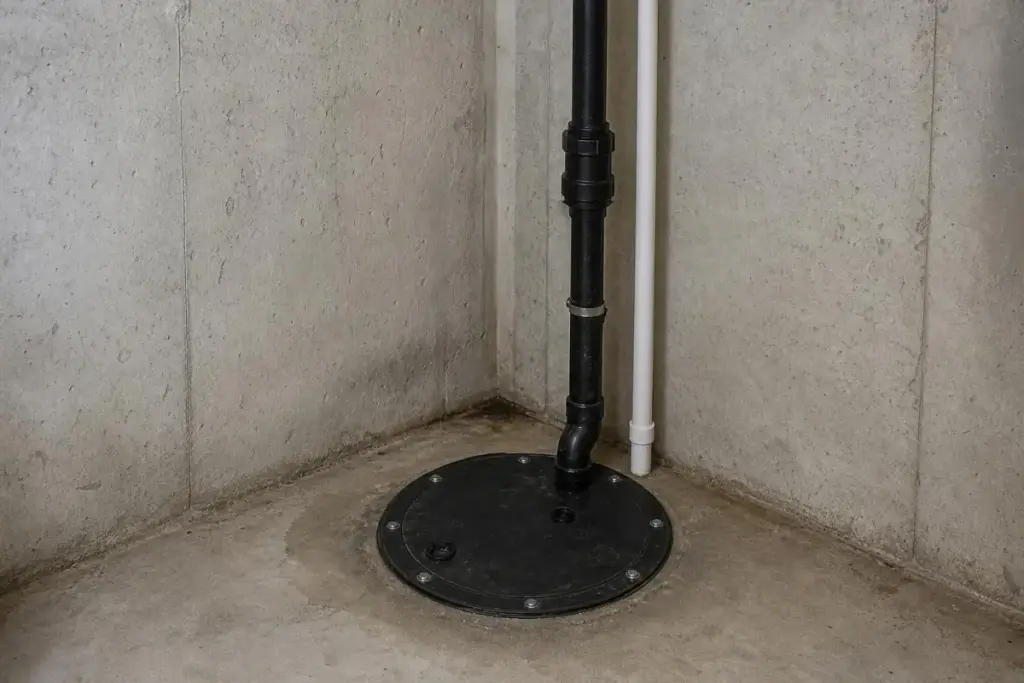
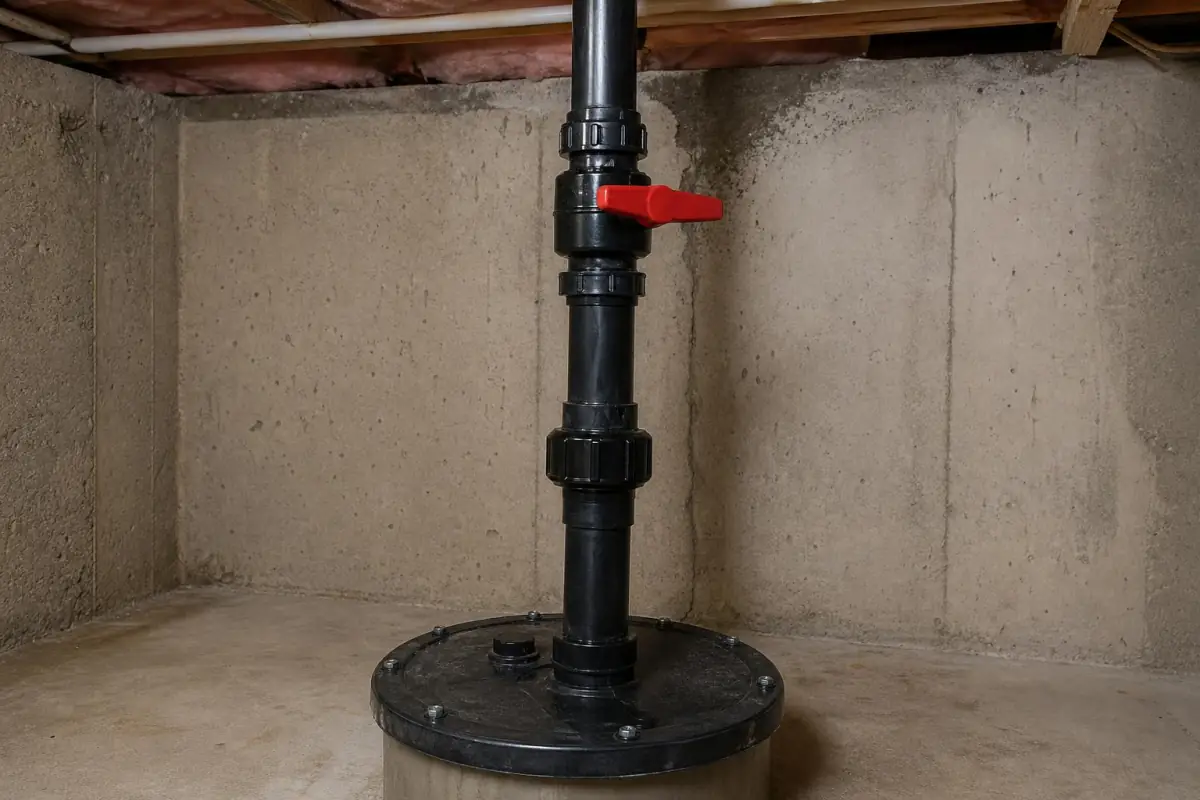
The line needs a check valve, then a full-open valve on the discharge side of it, both reachable above the sump cover or in an access pit if the pipe leaves below grade, per IRC P3007.2; IPC section 712 carries the same valve wording for buildings under the plumbing code. The basin must be at least 18 in across and 24 in deep with a gastight cover no more than 2 in below the floor, vented under IRC Chapter 31, and the pipe must be copper, copper alloy, CPVC, ductile iron, PE or PVC.
Each pump cycle is small compared with the tank. The Zoeller 267 switches on at 12 in and off at 4 in, and an 18 in basin holds about 1.1 gal per inch of depth, so each cycle sends roughly 8.8 gal; the Pumper column by Jim Anderson and Dave Gustafson caps an ejector dose at 5 percent of tank volume, which is 50 gal for a 1,000 gal tank. For the gravity side of the house, the basin vent ties into the same stack described in our explainer on how the building sewer and roof vent connect to a septic tank.
The model code text in P3007 does not require a high-water alarm, but onsite rules for pump tanks do. Texas rule 30 TAC 285.34(b)(1) requires an audible and visible high-water alarm on a power circuit separate from the pump, and Liberty sells the ProVore 380 grinder package with its ALM-2 alarm as model P382XPRG101/A2. Ask for that alarm on the raw sewage basin too, wired the same way.
Why pumped sewage stirs up the tank, and what Minnesota and North Carolina require
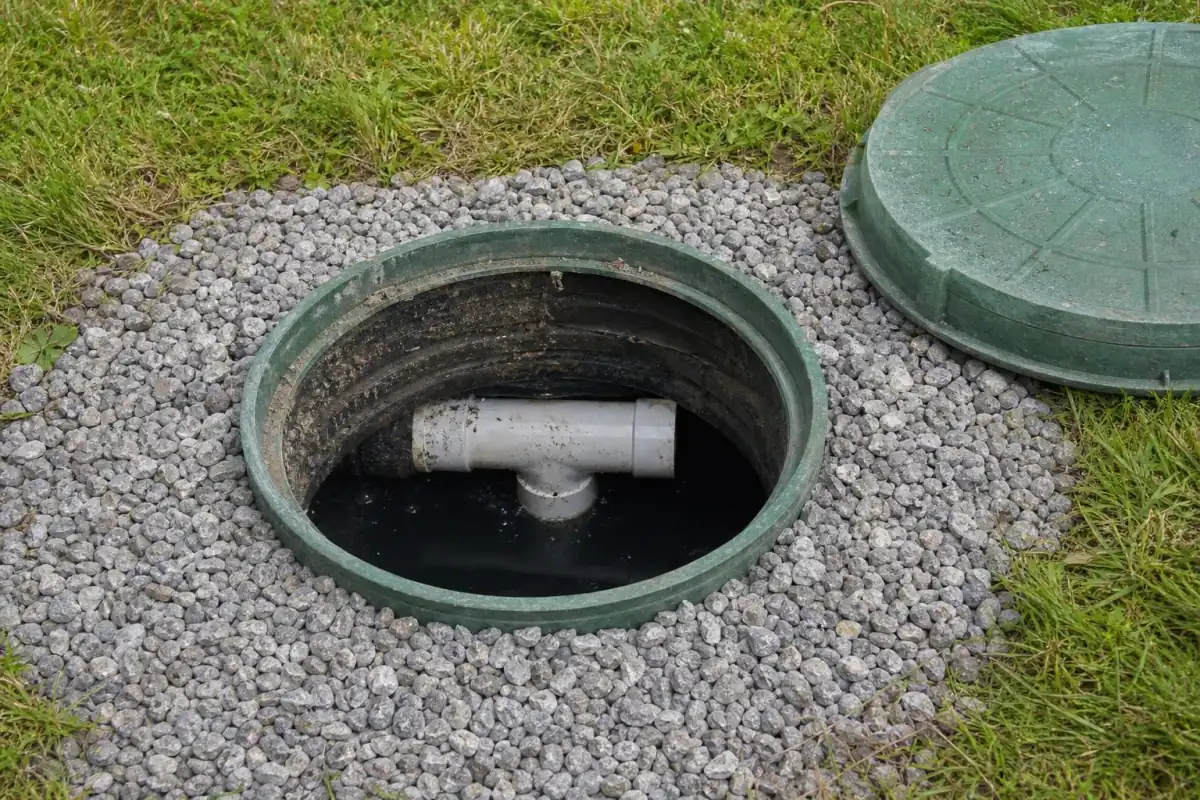
A pumped inlet raises the energy entering the tank, and Zoeller’s TB0001 says that energy “can disturb the settlement process” and raise BOD5 and TSS in the effluent sent to the drainfield. Its fixes are to pump up to grade ahead of the tank, transition to a larger gravity line to slow the flow, and consider a bigger tank, baffle walls, extra compartments or a fine effluent filter. At 84 gpm, moving from a 2 in pipe to 4 in Schedule 40 (4.026 in bore) cuts the entry speed from 8.0 to about 2.1 ft per second.
Two states write the extra tank into rule. Minnesota rule 7080.1930, subpart 3, requires a septic tank at least 50 percent larger than the standard size, with multiple compartments or multiple tanks, whenever an ejector or grinder pumps dwelling sewage to it, and recommends an effluent screen. North Carolina rule 15A NCAC 18E .0801(c) doubles the required tank capacity when a grinder or sewage lift pump sits before the tank, so a home that would need 1,000 gal needs 2,000 gal, and it drops the two-tanks-in-series option only if the pump discharges into 10 ft of 4 in pipe per the state plumbing code.
The surge hits the inlet baffle first, and TB0001 lists baffles, filters and pump-outs as the fixes when solids pass through, so have the pumper inspect the inlet baffle at every service. A slow drain right after a service is a different problem, covered in our piece on why a septic tank backs up right after a pump-out.
What an uphill sewage pump system costs, and the outage plan to ask for
The pump is the smaller line on the bill: $494 to $1,334 at the dated prices above, while the Today’s Homeowner cost page updated April 11, 2025 puts ejector jobs between $630 and $6,500 and grinder installs at $1,000 to $4,000 for the full job. Our guide to how a sewage ejector pump and its float cycle work covers the basin and float hardware itself.
When the power fails, the pump stops and the basin keeps filling at about 1.5 in per 1.6 gal flush in an 18 in basin. Ask the installer three things in writing: the shut-off head and flow at your TDH from the maker’s curve, whether your state onsite rule (Minnesota 7080.1930 or North Carolina 18E .0801, for example) enlarges your tank, and how the alarm and a generator inlet are wired so the alarm stays live when the pump breaker trips.
How we sourced this
We read Zoeller TB0001, FM2789 and FM2882, Liberty’s LE50-Series and PRG-Series sheets, IRC P3007 on UpCodes, Minnesota 7080.1930, North Carolina 15A NCAC 18E .0801, Texas 30 TAC 285.34 and the Pumper column of October 17, 2023. We computed friction with Hazen-Williams (C = 150, 2.067 in bore) at 21 gpm and crossed it with each maker’s curve. Retail prices were checked November 25, 2026. We left out fitting losses, a Liberty LE51A 20 ft flow point and a Zoeller 807 price, which we could not confirm.
Frequently asked questions
Can a septic tank sit higher than the house?
Yes, if the building sewer is pumped. The house drains by gravity into a sealed basin, and an ejector or grinder lifts the waste to the tank inlet. Zoeller’s TB0001 brief calls this never ideal and prefers moving the tank downhill, so ask whether regrading or a deeper tank is possible before buying a pump.
Can a grinder pump discharge into a septic tank?
It can where the state allows it. Minnesota rule 7080.1930 and North Carolina rule 15A NCAC 18E .0801 both name grinder pumps feeding a septic tank and require a larger tank in return. Zoeller warns the fine slurry settles poorly, so use a 2 inch solids ejector whenever its curve covers the lift.
How high can a sewage ejector pump lift?
A typical 1/2 hp residential ejector stops moving water at its shut-off head, 20.5 ft for the Zoeller 267 and 25 ft for the Liberty LE50 series. Useful flow ends several feet below that, so size for a lift at least 5 ft under shut-off or pick a higher head model.
What happens to an uphill sewage pump in a power outage?
The pump stops and the basin keeps filling. An 18 inch basin rises about 1.1 inches per gallon, so each 1.6 gallon flush adds roughly 1.5 inches. Stop flushing and running water, or install a generator inlet or a battery alarm before the outage.