Should You Insulate Cold Water Pipes? Condensation, Freezing and When It Pays
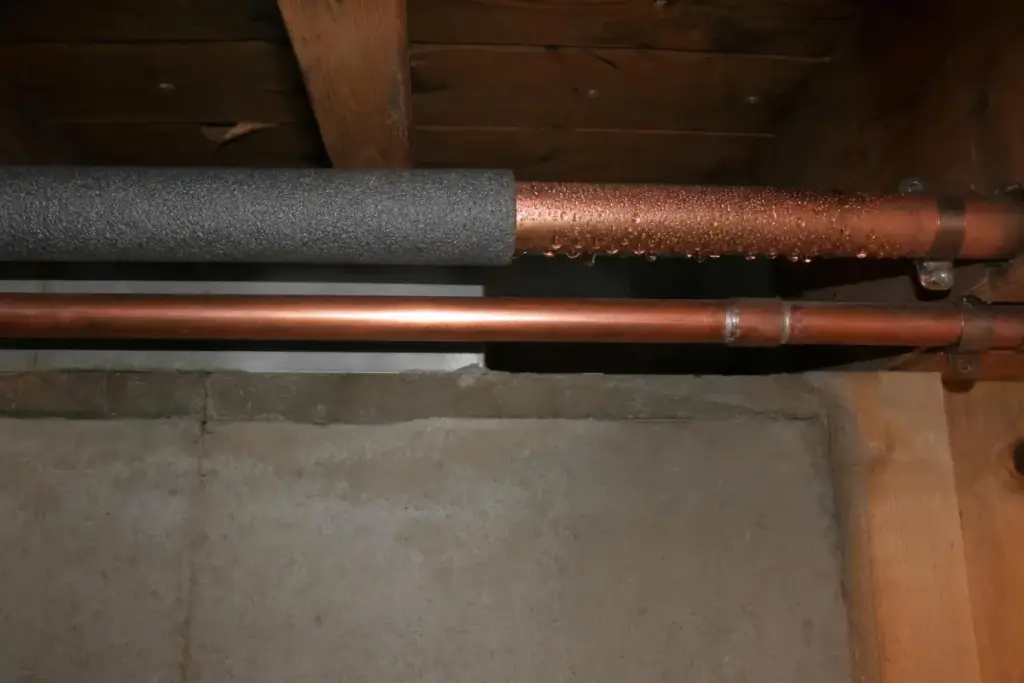
Should you insulate cold water pipes? Yes in two cases: the pipe sweats because its surface is colder than the air’s dew point, or it runs through a crawl space, garage, attic or exterior wall that can drop below 32°F. Elsewhere, a cold line in heated, dry air gains little from insulation.
The two-question test before you buy a single sleeve
Ask two things: is the pipe ever wet on the outside in humid weather, and does any foot of it pass through space that falls below 32°F? A yes to the first is a condensation job, solved with closed-cell foam whose seams are sealed. A yes to the second is a freeze job, where the 2021 IRC Section P2603.5 already says that in places with a winter design temperature of 32°F or lower, a water pipe “shall not be installed” in exterior walls, attics, crawl spaces or other freezing locations “unless adequate provision is made to protect it from freezing by insulation or heat or both.”
Two no’s mean the insulation is optional. A 3/4 inch cold line inside a heated wall that never drips has no code driver and no moisture problem.
When will a cold water pipe sweat? Dew point vs supply temperature
A pipe sweats whenever its surface is colder than the dew point, which the National Weather Service defines as the temperature air must be cooled to, at constant pressure, to reach 100% relative humidity. Right after a draw, a bare copper cold line sits close to the temperature of the water inside it, so the comparison that matters is dew point against supply water temperature.
Supply water swings by season and source. The City of East Moline Water Department, which draws from the Mississippi River, tells customers its winter water arrives at 34 to 38°F. Water from buried mains and wells runs warmer, so the table tests four supply temperatures: 38, 45, 50 and 55°F.
| Basement air | RH | Dew point | 38°F water | 45°F water | 50°F water | 55°F water |
|---|---|---|---|---|---|---|
| 65°F | 50% | 45.9°F | Sweats | Sweats | Dry | Dry |
| 65°F | 60% | 50.8°F | Sweats | Sweats | Sweats | Dry |
| 65°F | 70% | 55.0°F | Sweats | Sweats | Sweats | Borderline |
| 70°F | 50% | 50.5°F | Sweats | Sweats | Sweats | Dry |
| 70°F | 60% | 55.5°F | Sweats | Sweats | Sweats | Sweats |
| 70°F | 70% | 59.8°F | Sweats | Sweats | Sweats | Sweats |
| 75°F | 50% | 55.1°F | Sweats | Sweats | Sweats | Borderline |
| 75°F | 60% | 60.2°F | Sweats | Sweats | Sweats | Sweats |
| 75°F | 70% | 64.6°F | Sweats | Sweats | Sweats | Sweats |
Inputs: Magnus formula with the Alduchov and Eskridge coefficients (17.625 and 243.04°C), air temperature converted to Celsius and back. Check: the formula gives 59.7°F for 80°F air at 50% RH, against the 60°F the NWS example pairs with those conditions. “Borderline” means the pipe sits within 0.2°F of dew point, close enough that a slightly colder draw beads water.
The table shows why the question has no single answer. Of the 36 cells, 30 sweat and 2 are borderline. Only four stay dry: 50 and 55°F water in 65°F air at 50% RH, and 55°F water at 65°F and 60% or at 70°F and 50%. A Mississippi River town in January, with 38°F water, sweats in every row.
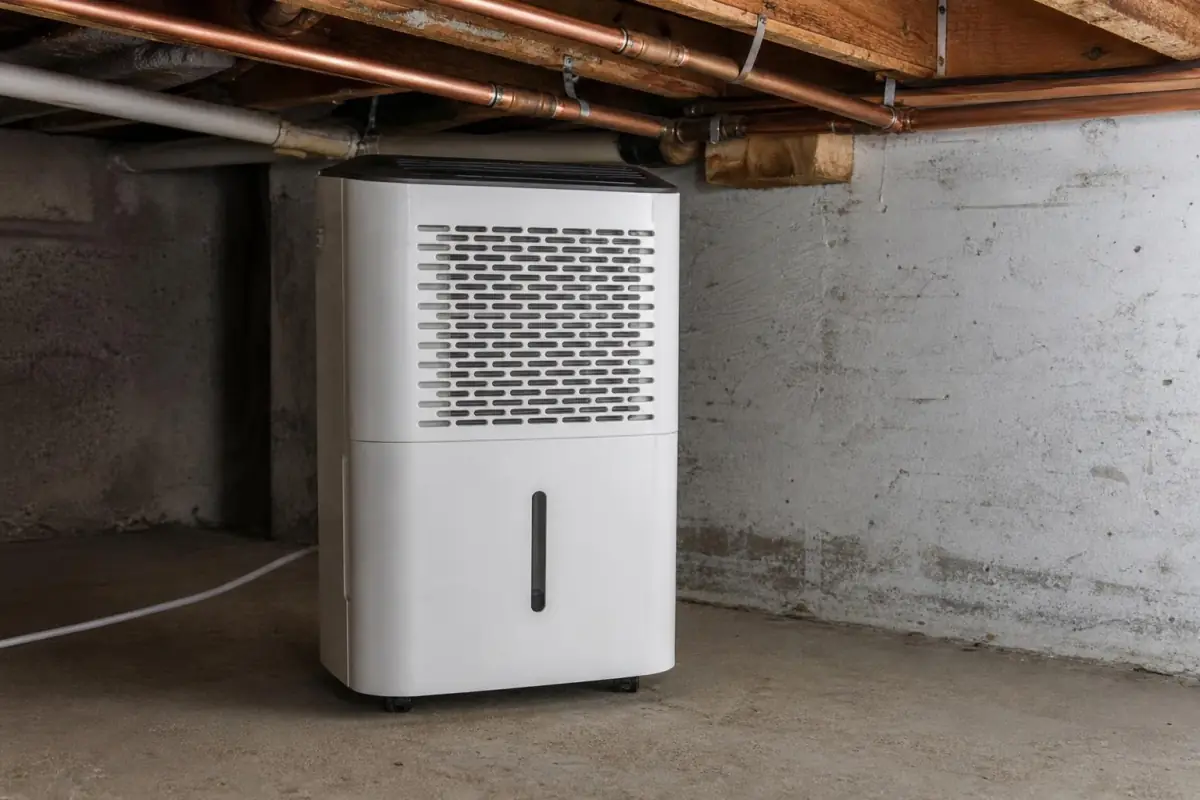
Dehumidifier or insulation: how far would you have to dry the air?
A dehumidifier stops sweating only if it pulls relative humidity below the level where the dew point drops under the pipe temperature, and for water at 45°F or colder that level is hard to hold. Dividing saturation vapor pressure at the pipe temperature by that at the air temperature gives the highest RH a bare pipe can tolerate:
| Basement air | Max RH, 38°F pipe | Max RH, 45°F pipe | Max RH, 50°F pipe | Max RH, 55°F pipe |
|---|---|---|---|---|
| 65°F | 37% | 48% | 58% | 70% |
| 70°F | 31% | 41% | 49% | 59% |
| 75°F | 26% | 34% | 41% | 50% |
The EPA mold guide asks for indoor humidity below 60%, ideally 30 to 50%, and in the same list tells homeowners to “cover cold surfaces, such as cold water pipes, with insulation.” Read the two tables together: with 55°F water in a 65 to 70°F basement, a dehumidifier set to 50% fixes the sweat by itself. With 45°F or colder water, holding a 70°F basement at 41% or less is a constant fight, and foam on the pipe is the cheaper, permanent fix. For the full sweat diagnosis, including how to tell condensation from a pinhole leak, see why your pipes are sweating.
Leaving a sweating line bare has a price. The drip lands on the same spot of a joist, subfloor or drywall ceiling every summer, and the EPA guide flags that kind of repeated wetting as the moisture source mold needs.
What insulation to use on a cold line, and why the seam matters more than R-value
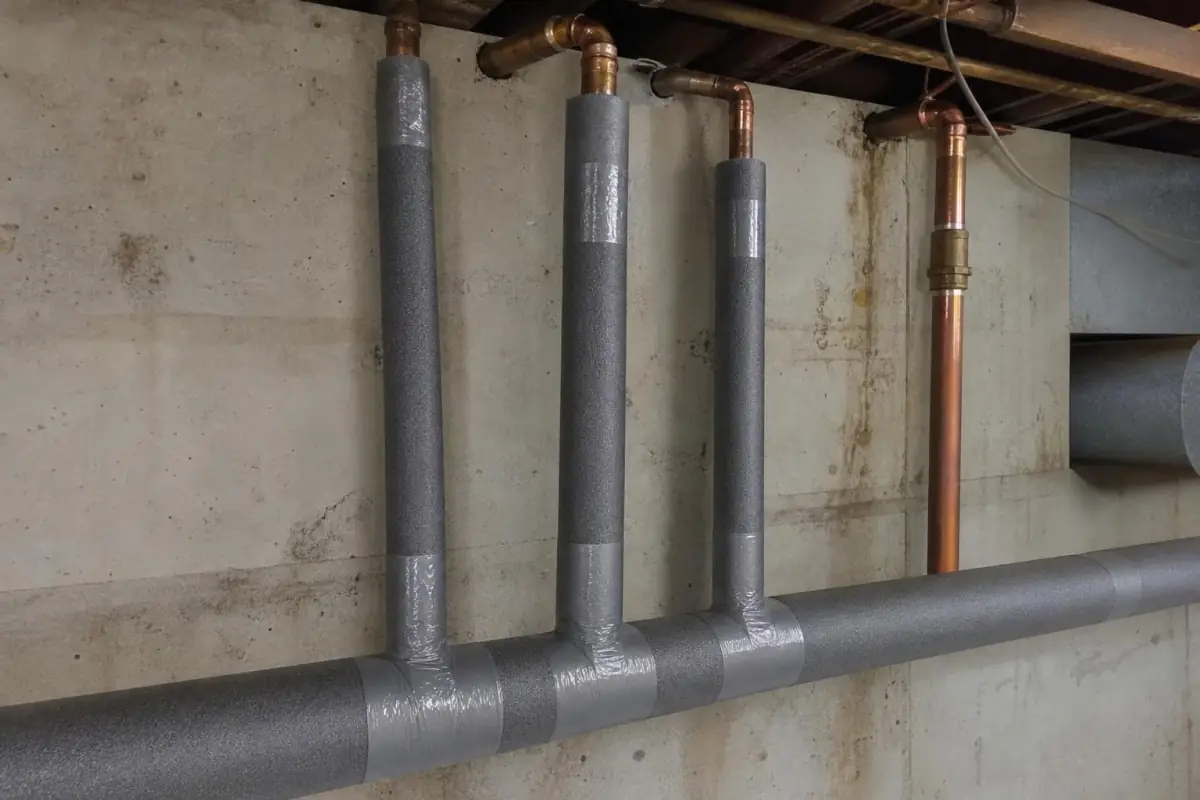
Use closed-cell foam, polyethylene or elastomeric rubber, sized to the pipe’s outside diameter, with every slit seam and butt joint sealed. Armacell’s AP Armaflex tube data sheet lists a water vapor permeability of 0.05 perm-inch for its 3/8 to 1 inch walls, which is why rubber tube is the condensation standard on chilled lines. Unjacketed fiberglass is the wrong choice here, because humid air passes through it and water forms against the cold metal out of sight.
| Product | Material | Wall | Fits | R-value (source) | Price seen Nov. 25, 2026 |
|---|---|---|---|---|---|
| AP Armaflex IPAPT05838 | Elastomeric rubber | 3/8 in | 1/2 in copper | R-2.6 (Armacell TDS) | No listing found |
| AP Armaflex IPAPT05812 (APT05812 unslit) | Elastomeric rubber | 1/2 in | 1/2 in copper | R-3.4 (Armacell TDS) | $14.99 to $17.56 per 6 ft |
| AP Armaflex IPAPT05834 | Elastomeric rubber | 3/4 in | 1/2 in copper | R-5.6 (Armacell TDS) | No listing found |
| AP Armaflex IPAPT05810 | Elastomeric rubber | 1 in | 1/2 in copper | R-7.2 (Armacell TDS) | No listing found |
| Frost King 5P10XB6 | Closed-cell polyethylene | 1/2 in | 1/2 in copper | R-3.3 (Zoro listing) | $107.52 per 54 pieces, about $1.99 per 6 ft |
| Frost King RS510XB/6 | Self-sealing rubber | 1/2 in | 1/2 in ID | Maker page lists none | No listing found |
| Molded fiberglass, plastic jacket | Fiberglass | 1 / 1.5 / 2 in | 3/4 in copper | R-4 / R-6 / R-8 (BRC, k = 0.25) | Tested product, not a retail item |
R-values on pipe insulation are not per inch: Armacell’s own table gives a 1 inch wall R-7.2 on 1/2 inch copper but R-7.0 on 3/4 inch, because curvature changes the math. Prices are Google Shopping listings from Voomi Supply, DK Hardware and similar sellers on November 25, 2026, and will move. Sizing a sleeve and mitering it at elbows is covered in our pipe insulation guide.
Does insulation stop cold pipes from freezing in a crawl space?
No, insulation only delays freezing; it never adds heat. The University of Illinois Building Research Council measured this in Research Report 96-1. In its attic field tests on 3/4 inch Type M copper, 1 inch of fiberglass (R-4) delayed a full ice blockage by 9.5 hours versus a bare pipe, 1.5 inches (R-6) by 23 hours, and a 2 inch (R-8) pipe never blocked before the weather warmed. In the freezer phase, hardware-store sleeves of 1/8 to 5/8 inch, about R-0.5 to R-2.5, bought 3 to 8 hours.
The report then states plainly that for any insulation level there are “abnormally low temperatures for extended periods” that make it ineffective. It recommends R-6 to R-8 for pipes in unconditioned spaces, quotes a 1994 North Carolina rule of R-6.5 for unconditioned attics, and warns that “a poor pipe insulation job could be more hazardous than no insulation at all,” because a bare gap cools first and freezes first. Compared against the product table, only the 1 inch Armaflex wall (R-7.2) reaches that band; a 1/2 inch polyethylene sleeve at R-3.3 sits below the R-4 pipe that still froze 9.5 hours after the bare one.
So in a vented crawl space or an exterior wall, foam buys a night, not a week. Seal the vents and rim joist gaps that blow air on the pipe, add heat cable on runs in spaces that stay below freezing for days, and see how to prevent frozen pipes for the drip and thermostat steps. How quickly a bare run plugs on one cold night is worked out in can pipes freeze overnight.
Does the energy code require insulating cold water pipes?
No: the IECC requires insulation on hot water piping only. In the 2021 IECC the rule is Section R403.5.2, not R403.5.3, which in that edition covers drain water heat recovery units. It requires R-3 on service hot water piping 3/4 inch and larger inside conditioned space, piping serving more than one dwelling, piping outside conditioned space, piping from the water heater to a distribution manifold, piping under a slab, buried piping and recirculation loops other than demand systems. The 2018 edition carried the same seven items as R403.5.3, as the Philadelphia permit FAQ PB_019 quotes. Cold lines enter the codes only through the IRC P2603.5 freeze rule above. Check your jurisdiction, because states amend both codes.
Cold water pipe insulation questions
Is it bad if cold water pipes sweat?
Yes, if the drip keeps landing in one place. A sweating line wets the same joist, subfloor or ceiling drywall every humid season, and the EPA mold guide names condensation on cold water pipes as a moisture source to stop by insulating the pipe and keeping humidity under 60 percent.
Can I use fiberglass on a cold water pipe?
Only with a sealed vapor jacket. Bare fiberglass lets humid air reach the cold metal, so water condenses inside the wrap and soaks it. Closed-cell elastomeric tube, which Armacell rates at 0.05 perm-inch, or polyethylene with glued or taped seams is the standard pick.
Should I insulate cold water pipes in a heated basement?
Only if they sweat. A heated basement holds cold lines well above 32 degrees F, so the only reason left is condensation. Check them on a humid July afternoon with a hygrometer, and if the pipe beads water at, for example, 70 degrees F and 60 percent humidity, sleeve it.
Does insulating cold water pipes save energy?
Very little. The energy savings from pipe insulation come from hot lines, which is why IECC Section R403.5.2 covers hot water piping only. A cold line in conditioned space slowly takes heat from the room, and the money case for wrapping it is drip damage avoided, not a lower utility bill.
Do PEX cold water lines need insulation?
The same two tests apply. PEX sweats whenever its outer surface falls below the dew point, and PEX in a crawl space or exterior wall still falls under IRC P2603.5, which calls for insulation or heat or both where the winter design temperature is 32 degrees F or lower.
How we sourced this
We read IRC 2021 Section P2603.5, the 2021 IECC residential chapter (hot water pipe insulation at R403.5.2), the Philadelphia PB_019 FAQ quoting 2018 IECC R403.5.3, University of Illinois BRC Research Report 96-1 (1996), the Armacell AP Armaflex tube technical data sheet (October 2021), Frost King’s product pages, the EPA mold guide, the NWS dew point page and East Moline’s winter water notice. We computed every dew point and maximum-RH cell with the Magnus formula. R-values for Frost King come from a retailer listing, because Frost King’s own pages publish none. We left out a summer supply temperature for any named utility and Armacell’s condensation-thickness tables, which we could not open.