Kitchen Sink Clogged on Both Sides? Find the Blockage Below the Tee
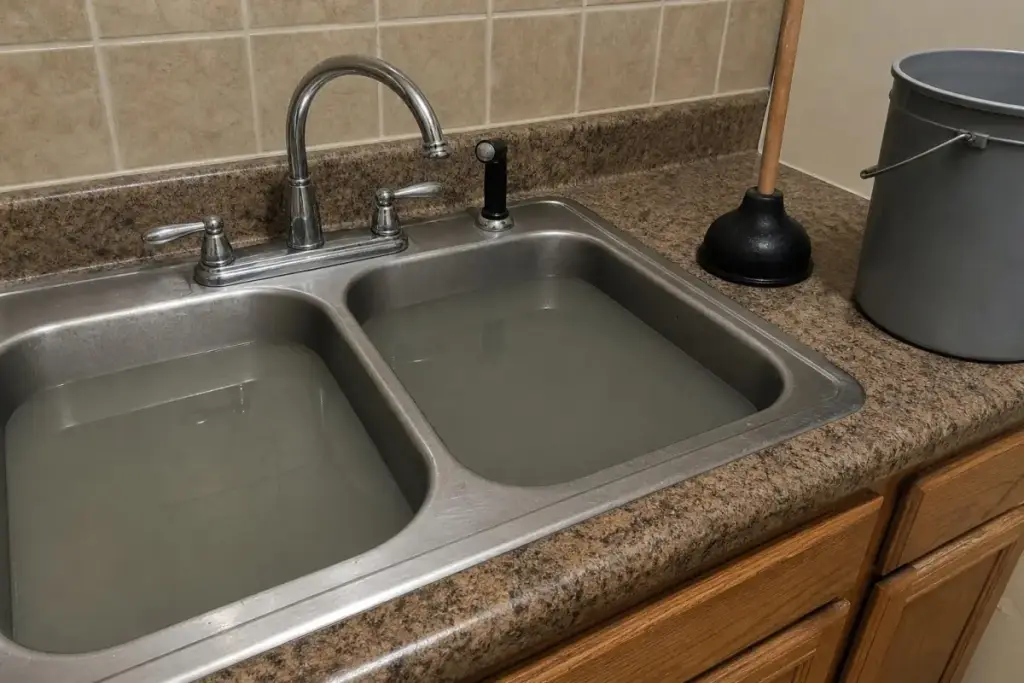
A kitchen sink clogged on both sides has its blockage at or past the shared tee: in the one P-trap that IPC Section 1002.1 lets both bowls share, the trap arm or the wall branch. Seal one drain and plunge the other, then pull the trap, then snake the arm. With a disposal, rule out the disposer first.
Where is the clog when both bowls of a double sink back up?
When both bowls hold water, the blockage sits downstream of the point where the two bowls join, because each bowl’s own tailpiece would only stop one side. A double sink is plumbed as one fixture: the International Plumbing Code trap rules let a two-compartment sink run on a single trap if one bowl is not more than 6 inches deeper than the other and the waste outlets are not more than 30 inches apart (IPC Section 1002.1).
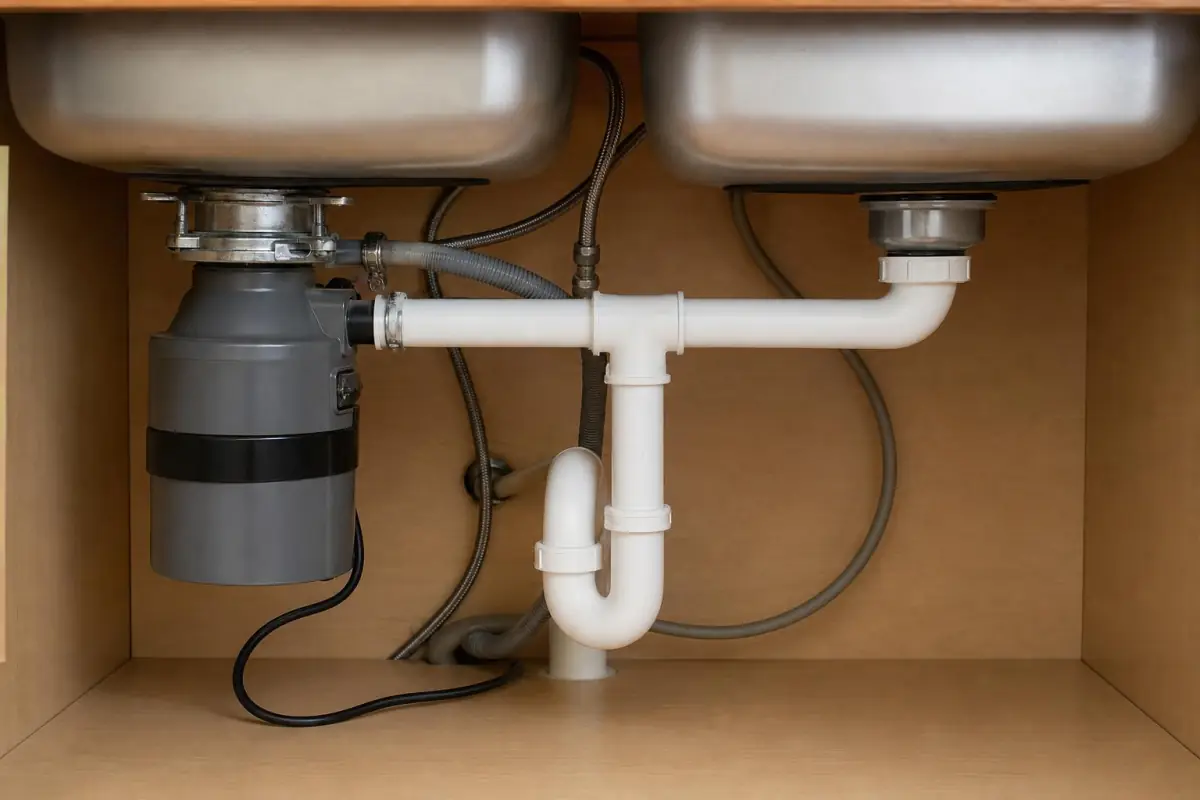
That gives four parts in series below the tee, and all four are shared: the tee itself, the P-trap holding its 2 to 4 inch water seal, the trap arm running to the wall, and the sanitary tee and branch inside the wall. A center outlet puts the tee between the bowls; an end outlet runs a horizontal continuous waste from one bowl to a tee under the other. The labeled kitchen sink drain diagram numbers every fitting if your cabinet looks different from the drawing below.
What does plunging one side tell you about the clog?
Plunging one bowl is a diagnostic test as much as a fix, because the water’s behavior in the second bowl and in other fixtures locates the blockage. Read each of the 6 results below against the second bowl, the trap and the other drains in the house.
| What you see | Where the clog is | Tool to use next |
|---|---|---|
| Plunging Bowl A with Bowl B open makes water jump in Bowl B | Below the tee: trap, arm or branch | Seal Bowl B and plunge again |
| Both bowls drop together after 20 to 30 seconds of plunging with Bowl B sealed | Soft grease or food plug in the trap or tee, now pushed through | Run hot tap water and watch both bowls |
| Sealed plunging moves nothing; trap comes off full of sludge | The P-trap | Bucket, channel-lock pliers, clean and refit |
| Trap is clean but water poured into the open arm stands | Trap arm, sanitary tee or wall branch | Hand spinner fed into the arm stub |
| Disposal bowl holds water, motor hums or is silent | Disposer jam or tripped overload, possibly plus a trap clog | 1/4 in hex wrench in the disposer’s bottom socket, then red reset button |
| Tub, shower or floor drain gurgles or rises while the sink runs | Main building drain, past the kitchen branch | Cleanout and a powered drum machine, usually a plumber |
The third and fourth rows split at the trap: if the trap comes off clean, the open trap arm test tells you whether 2 cups of water poured into the stub drain fast, slowly or not at all, which separates an arm clog from a vent or branch problem.
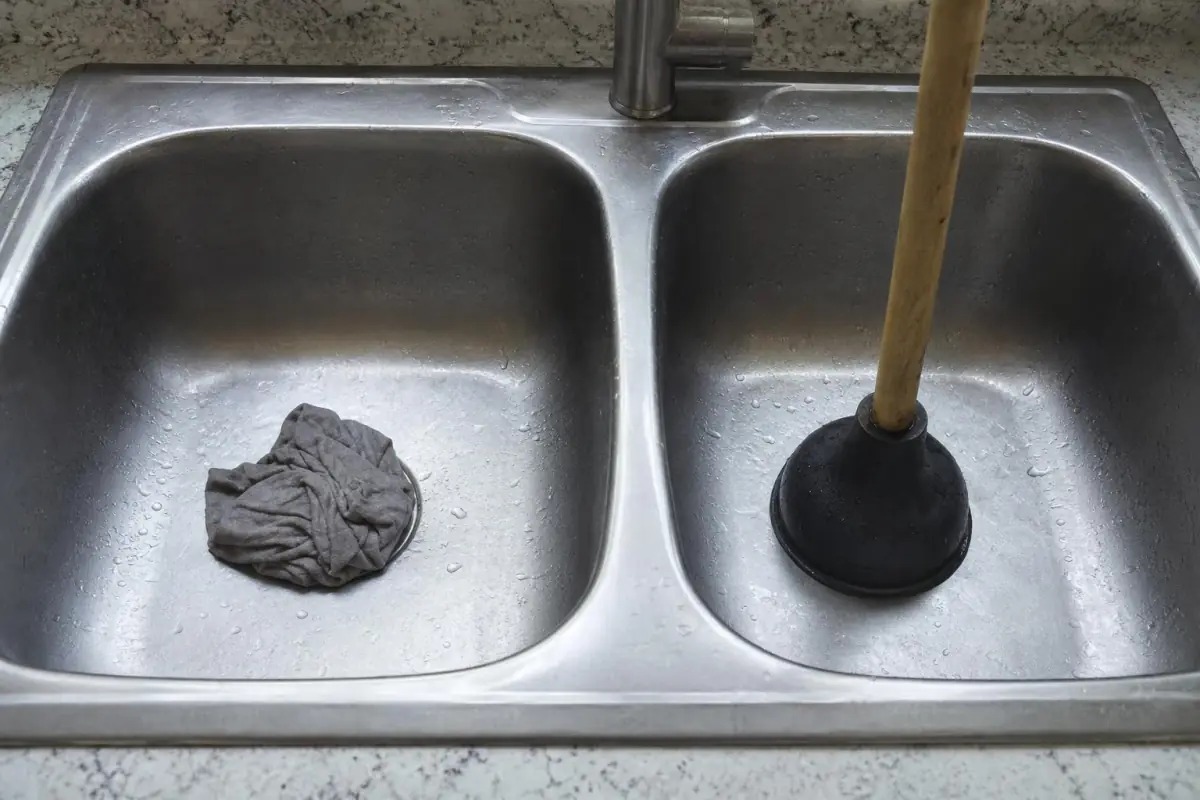
How much plunger force do you lose by leaving the second drain open?
Leaving the second strainer open throws away most of a plunger stroke, and the loss is larger than the “it halves the pressure” rule repeated online. The arithmetic below uses stated inputs, not measurements: a 5.5 inch cup (23.76 sq in of area), a 30 lb push, a 20 cubic inch stroke, and an open 1-1/2 inch strainer bore (1.77 sq in) treated as a sharp-edged orifice with a discharge coefficient of 0.61.
| Case | Calculation | Pressure at the tee | Share of sealed value |
|---|---|---|---|
| Bowl B sealed, 20 lb push | 20 / 23.76 | 0.84 psi | n/a |
| Bowl B sealed, 30 lb push | 30 / 23.76 | 1.26 psi | 100% |
| Bowl B sealed, 40 lb push | 40 / 23.76 | 1.68 psi | n/a |
| Bowl B open, slow stroke (0.6 s) | Flow 33 cu in/s, jet 0.48 m/s, orifice loss | 0.045 psi | 4% |
| Bowl B open, normal stroke (0.3 s) | Flow 67 cu in/s, jet 0.96 m/s | 0.18 psi | 14% |
| Bowl B open, hard stroke (0.15 s) | Flow 133 cu in/s, jet 1.92 m/s | 0.72 psi | 57% |
With Bowl B sealed, the trapped water cannot escape, so the full 1.26 psi from a 30 lb push lands on the clog. With Bowl B open, the pressure is capped by how hard the water must work to squirt out the other strainer, which at a normal 0.3 second stroke is 0.18 psi, about one seventh of the sealed figure, and the 20 cubic inches you displaced leave through Bowl B instead of shoving the plug. Water rising 0.09 inch in a 15 by 15 inch bowl adds only 0.003 psi of head. The decision rule: hold a stopper or a wet rag down hard on the second drain, and on a disposal sink plug the disposer opening, because the dishwasher hose and disposer chamber are a third escape path.
What order clears a double sink, with and without a disposal?
Work from the cheapest test to the deepest pipe, and start at the disposer when one is fitted, because a jammed grinder can hold the disposal bowl full while the trap below is also loaded. The reset and hex-key steps for a stuck disposal cover the 1/4 inch wrench socket and the overload button; cut power at the switch and breaker before any tool goes near the unit.
- Disposer (if fitted): power off, turn the flywheel with the 1/4 in hex wrench, press the reset button, restore power and run cold water while it grinds.
- Plunge with the other drain sealed: 3 to 4 inches of water over the cup, then 20 to 30 seconds of firm strokes before you check the level.
- Pull the P-trap: bucket under it, loosen both slip nuts by hand or with channel-locks, empty and scrub, refit with the washers facing the right way.
- Snake the arm: with the trap off, feed cable straight into the wall stub. RIDGID’s PowerClear drum literature rates its 1/4 inch cable for 3/4 to 1-1/2 inch lines, and the K-50 sectional listing rates 3/8 inch cable for 1-1/4 to 2 inch lines, so a grease-packed 2 inch branch calls for 3/8 inch cable or a powered drum.
The full order of drain-clearing methods adds the hot water and baking soda stages; on a sink that is clogged on both sides, those stages rarely reach a plug sitting in the trap arm behind the wall. Never plunge or pull the trap after pouring a caustic cleaner: SC Johnson’s Drano Max Gel label says never to use a plunger during or after use because the product may still be in a drain that did not clear, and warns that it may splash back from a disposal that is switched on.
Why does the dishwasher push water into the other bowl?
The dishwasher drain pump discharges into the disposer inlet or a wye on the sink tailpiece, both of which sit above the shared tee, so when the trap or arm is restricted the pumped water climbs out whichever strainer is lowest. The plumbing code’s Section 802.1.6 (NYC 2022 text, matching the IPC numbering) allows exactly those two connections, but only if the hose runs to a deck-mounted air gap or rises and is fastened to the underside of the counter or sink rim, which keeps sink water from flowing back into the dishwasher tub.
If dishwasher water appears in Bowl A only after a new disposer was installed, check the knockout first. InSinkErator’s replacement install guide tells installers to lay the disposer on its side, tap out the dishwasher knockout plug with a screwdriver and hammer, and fish the loose plug out of the grinding chamber; a plug left in place blocks the dishwasher hose completely and can flood the dishwasher.
Why do kitchen branches clog with grease more than other drains?
Grease is the leading cause of sewer blockages in the United States, and the kitchen branch is where it enters warm and leaves cold. In EPA’s 2004 Report to Congress on combined and sanitary sewer overflows (Chapter 4, Figure 4.11), utilities attributed reported blockage events to these causes, with grease named as coming from restaurants, homes and industrial sources:
| Reported cause of sewer blockage | Share of events |
|---|---|
| Grease | 47% |
| Grit, rock and other debris | 27% |
| Roots | 22% |
| Roots and grease together | 4% |
| If a household pours 1 tablespoon (14.8 mL) of pan fat a day, its yearly total is | 5.4 L, about 1.43 gallons |
The last row is arithmetic, not a survey: 365 days times 14.787 mL equals 5,397 mL. EPA describes the mechanism as grease that solidifies, reduces conveyance capacity and blocks flow, and coffee grounds and starch scraps stick to that coating inside the 1-1/2 inch trap and arm. Columbus, Ohio’s fats, oils and grease program charges a minimum $2,000 cost recovery per typical blockage incident attributed to improper grease disposal, which is why utilities tell residents to let fat solidify and put it in the trash.
When is the main line the problem, and what should a plumber cost?
The main line is the problem when a fixture outside the kitchen reacts to the sink: a tub that fills with gray water, a floor drain that rises, or a toilet that bubbles while the dishwasher pumps. A kitchen clog stops at the kitchen; a main-line clog backs water into the lowest drain in the house first, and roots, the cause of 22% of blockages in EPA’s Figure 4.11, live in that main line where a sink snake never reaches. Ask for a main-line cable job through the exterior or basement cleanout, not a sink snaking, and stop using every fixture until it is cleared.
For a kitchen-only clog, HomeAdvisor’s 2025 cost guide lists $110 to $215 to clear a kitchen sink, and Angi lists $100 to $250 with a $175 average; checked November 2026. Tell the dispatcher three facts up front: both bowls are full, whether a disposer and dishwasher are connected, and whether the trap is already off and clean, so the tech brings 3/8 inch cable or a drum machine instead of a plunger.
Double sink clog questions
Why does water come up in the other bowl when I run the disposal?
The disposer pushes its discharge into the shared tee. When the trap or arm below that tee is partly blocked, the water takes the open path and rises through the other 3-1/2 inch strainer opening. Clearing the trap or arm stops it, and a stopper in the plain bowl is only a temporary fix.
Can I use Drano when both sides of the sink are clogged?
You can, but you then give up the plunger. SC Johnson tells users never to plunge during or after Drano Max Gel because the product may still sit in a drain that did not clear. The label’s 15 to 30 minute wait then leaves caustic standing in two full bowls, which makes pulling the trap dangerous.
Should I plunge the side with the garbage disposal or the plain side?
Plunge the plain bowl and plug the disposer opening with its stopper or a wet rag held down by hand. The disposer chamber and its 1-1/2 inch outlet cannot hold a plunger seal well, and the plain strainer gives a flat rim for the cup.
How much does a plumber charge to unclog a double kitchen sink?
HomeAdvisor’s 2025 cost page lists $110 to $215 to clear a kitchen sink, and Angi lists $100 to $250 with a $175 average. A main line cleared through the cleanout costs more, so tell the dispatcher whether other fixtures back up.
Do both bowls need their own P-trap?
No. IPC Section 1002.1 lets a two-compartment sink share one trap when one bowl is not more than 6 inches deeper than the other and the outlets sit not more than 30 inches apart. A trap under each bowl feeding a shared trap is a banned double trap.
How we sourced this
Code text: IPC Section 1002.1 as summarized by the ICC Building Safety Journal and as printed in the NYC 2022 Plumbing Code Chapter 10, and Section 802.1.6 from NYC 2022 Chapter 8. Grease figures: EPA 2004 Report to Congress, Chapter 4, Figure 4.11. Manufacturer text: InSinkErator’s replacement install guide and SC Johnson’s Drano Max Gel label. Costs: HomeAdvisor and Angi cost pages dated 2025. The plunger pressure table is our own arithmetic from the stated inputs. No named source gave a verified per-household yearly grease volume, so the tablespoon row is labeled as arithmetic, and enzyme drain products are not recommended because no primary source quantified their effect on an existing clog.