Types of Kitchen Sinks: Mounts, Materials, and Bowls

Kitchen sinks divide three ways at once: by mount (undermount, drop-in, farmhouse, integrated), by material (stainless, composite, fireclay, cast iron, copper), and by bowl count, and each choice changes your counter and your budget.
Key Takeaways
- The four mounting styles are undermount (rim hidden under the counter), drop-in or top-mount (rim rests on the counter), farmhouse or apron-front (exposed front panel), and integrated (sink and counter are one piece).
- Stainless steel gauge measures thickness: a lower number is thicker, so 16 to 18 gauge is the durable premium range, per manufacturer specs from Ruvati and World CopperSmith; 16 gauge is about 0.0625 inch, 18 gauge about 0.050 inch.
- The most common kitchen sink is 33 inches wide by 22 inches front to back and fits a standard 36-inch base cabinet, per sink sizing guides.
- Standard bowl depth runs 8 to 10 inches, with deeper 9 to 10 inch bowls now popular for large cookware.
- Sink prices by material run about $200 to $2,500 for the fixture alone, from composite granite at the low end to fireclay at the high end, per 2026 cost guides from Angi and HomeGuide.
- Single-bowl sinks now outsell double-bowl models because one large basin fits sheet pans and stockpots a divider would block.
What are the main types of kitchen sinks?
Kitchen sinks are classified three ways at the same time: by how they mount to the counter, by what they are made of, and by how many bowls they hold. Any real sink is a combination of all three, for example a 16-gauge stainless undermount single-bowl, or a white fireclay farmhouse. Choosing well means matching the mount to your countertop, the material to how you cook and clean, and the bowl layout to what you wash. Bowl layout matters even more in commercial kitchens, where 3 compartment sink requirements govern sizing, drains, and health code compliance.
These choices are separate from the pipes below. This guide covers the sink itself; for the P-trap, drain, supply lines, and disposal under the basin, see our guide to kitchen sink plumbing. Pick the sink first, because its mount and weight decide what the counter and cabinet have to support.
How do kitchen sink mounting styles differ?
Mount is set by how the sink meets the countertop, and it is the choice that most affects installation. The four styles are drop-in (top-mount), undermount, farmhouse (apron-front), and integrated. Drop-in works with any counter and is the easiest to fit; undermount and integrated need a solid surface; farmhouse needs a special cabinet cut for its exposed front.
| Mount style | Countertop fit | Cleanup | Relative cost | Best for |
|---|---|---|---|---|
| Drop-in (top-mount) | Any counter, including laminate and tile | Rim traps crumbs and grime along the edge | Lowest, easiest install | Budgets, DIY, laminate counters, easy swaps |
| Undermount | Solid counters only (granite, quartz, solid surface) | Wipe crumbs straight in; no rim to trap dirt | Higher; needs clips and a sealed edge | Stone counters and a clean, modern look |
| Farmhouse (apron-front) | Needs a cabinet cut for the exposed front panel | Front edge close to you; less counter reach | Highest; special cabinet and often reinforcement | Statement kitchens, large single bowls, heavy use |
| Integrated | Molded as one piece with the counter | One surface, no joints or seams to scrub | High; tied to the countertop material | Solid-surface and quartz counters, one-piece look |
Drop-in is the default swap because it drops into an existing hole from above and rests on the counter by its rim, so it needs no solid substrate. Undermount hides the rim under the counter and is fastened with clips and adhesive, which is why it pairs with stone. An integrated sink is molded from the same material as the countertop, giving one continuous surface with no seam to catch water.
Which kitchen sink material should you choose?
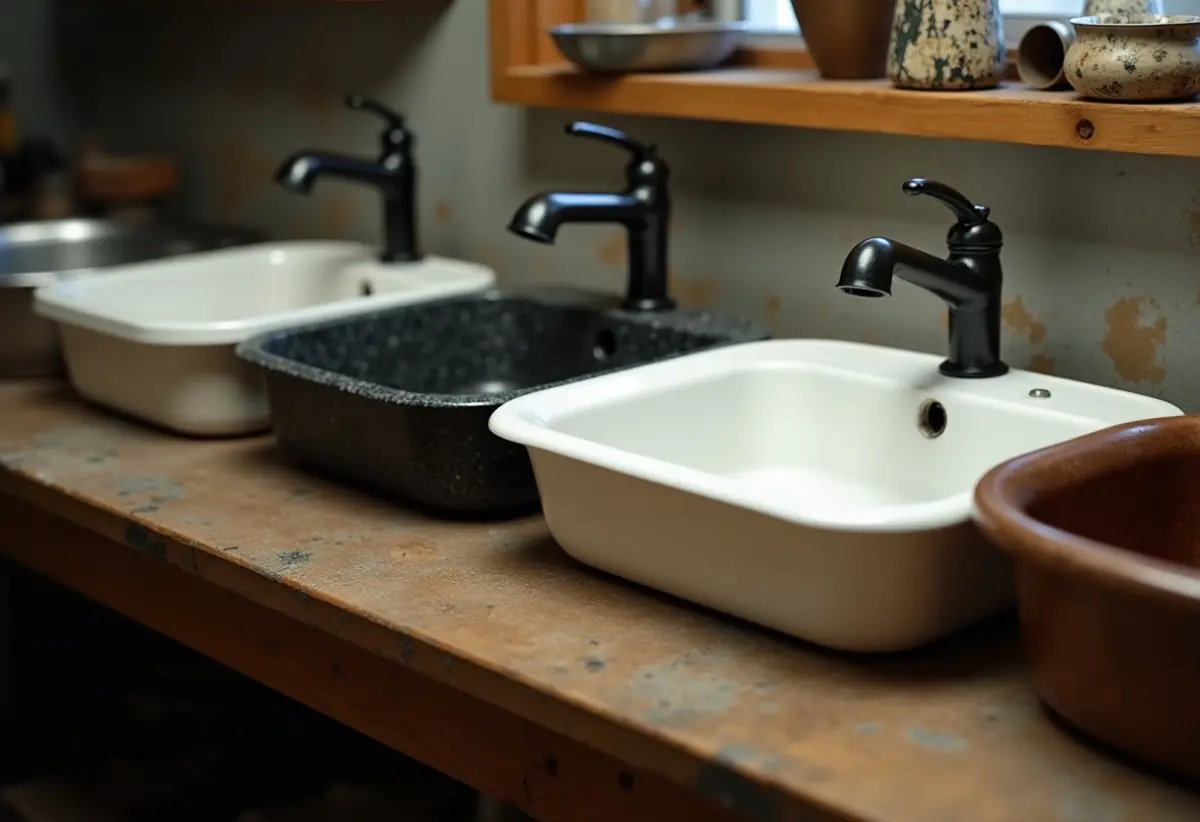
Material decides durability, noise, price, and care. The five common options are stainless steel, composite granite (a quartz or granite and resin blend), fireclay, cast iron with a porcelain enamel coating, and copper. Stainless is the most popular and forgiving; fireclay and cast iron are the hardest but can chip; copper is soft and develops a patina. The table compares them.
| Material | Durability | Noise | Fixture price | Care |
|---|---|---|---|---|
| Stainless steel | Dents but never cracks or chips; 16 to 18 gauge resists dings | Loud unless sound-deadened with pads and undercoating | $300 to $800 | Wipe with the grain; shows water spots and scratches |
| Composite granite | Resists scratches, stains, and heat; will not rust | Quiet; the dense composite absorbs sound | $200 to $800 | Rinse and dry; avoid harsh abrasives on the finish |
| Fireclay | Very hard glazed surface; can chip under a heavy drop | Quiet; thick ceramic body deadens sound | $1,200 to $2,500 | Non-abrasive cleaners; heavy, so it needs support |
| Cast iron enamel | Hard enamel resists heat and scratches; can chip and then rust | Quiet; the iron mass absorbs sound | $400 to $1,500 | Avoid abrasive pads that dull the enamel; very heavy |
| Copper | Soft and dents; naturally antimicrobial and rust-proof | Quiet; a softer metal that rings less than steel | $300 to $1,500 | Let the patina form; avoid acids and abrasives |
Stainless steel is the safe default: it is light, cannot chip, and takes abuse. Composite granite is the low-maintenance upgrade that hides spots. Fireclay and cast iron give a classic look and a quiet, scratch-resistant surface, but their weight and chip risk are the tradeoffs. Copper is a design choice for people who want a living finish rather than a factory-perfect one.
What does stainless steel gauge mean?
Gauge is the thickness of the steel, and the number runs backward: a lower gauge means thicker, more rigid metal. A 16-gauge sink is about 0.0625 inch thick, an 18-gauge sink about 0.050 inch, per manufacturer specifications from Ruvati and World CopperSmith. For a residential kitchen, 16 to 18 gauge is the durable premium band; thinner 20 to 22 gauge flexes, dents, and rings more.
Thicker steel resists denting from dropped pans and feels more solid, but past 16 gauge the gains are small and the price climbs. Gauge is only part of quality: sound-deadening pads, an undercoating spray, and the steel grade (304 with chromium and nickel resists corrosion) matter as much as raw thickness. A well-made 18-gauge 304 sink outperforms a thin, poorly finished 16-gauge one.

Single, double, or low-divide: which bowl layout fits?
Bowl count decides how you use the sink day to day. A single bowl is one large basin; a double bowl splits it into two, often 50/50 or 60/40; a low-divide sink has a half-height wall between two bowls. Single-bowl models now outsell double because one wide basin fits sheet pans, cutting boards, and stockpots that a full divider blocks.
A double bowl lets you separate tasks, washing on one side and rinsing or drying on the other, which suits homes that hand-wash dishes or lack a dishwasher. A low-divide sink is the compromise: the short partition keeps a soaking or prep zone while still letting a large pan lie flat across the top. Match the layout to how you actually work, not to habit.
- Single bowl: one large basin, best for big cookware and busy prep; pairs well with a tall pull-down faucet.
- Double bowl (50/50 or 60/40): two separate basins for wash-and-rinse or dishwashing plus disposal side.
- Low-divide: a half-height wall keeps two zones but accepts oversized pans across the top.
Whatever layout you pick, the faucet has to match the bowl depth and reach; a deep single bowl wants a high-arc spout. See our guide to types of faucets for pairing a spout to your sink.
How deep and how big should a kitchen sink be?
The most common kitchen sink is 33 inches wide by about 22 inches front to back, sized for a standard 36-inch base cabinet, per sink sizing guides. Bowl depth runs 8 to 10 inches, and deeper 9 to 10 inch bowls are popular now because they hold large pots and hide dirty dishes. Depth is limited by the drain and disposal clearance below.
Sink size is capped by the cabinet under it: a 30-inch single bowl needs a 33-inch cabinet or wider, and a 33-inch double bowl wants a 36-inch cabinet at minimum. A deeper bowl also lowers the drain, which can crowd a garbage disposal or a P-trap. If you are building or gutting the room, plan the sink size and drain height during the kitchen plumbing rough-in so the cabinet, drain, and disposal all fit.
What does each sink type mean for your counter and plumbing?
The mount and weight of a sink set what the countertop and cabinet must do, while the drain location stays roughly the same. Drop-in sinks work with any counter because the rim carries the load. Undermount and integrated sinks need a solid counter (stone, quartz, or solid surface) that can be sealed to the sink and carry its weight from below.
Heavy materials are the other constraint. Cast iron and fireclay sinks weigh enough that a farmhouse or large undermount install often needs the base cabinet reinforced or a support cradle added, which can add $100 to $300 to the job, per 2026 cost guides. Farmhouse sinks also require a cabinet modified for the exposed apron front. The drain and supply hookups themselves are the same across sink types, so swapping a sink rarely moves the pipes; our guide to how to install a kitchen sink covers mounting the basin and reconnecting the drain and supply.

How much does a kitchen sink cost?
Budget for two numbers: the sink and the labor. The fixture runs about $200 to $800 for composite granite, $300 to $800 for stainless, $400 to $1,500 for cast iron enamel, $300 to $1,500 for copper, and $1,200 to $2,500 for fireclay, per 2026 cost guides from Angi and HomeGuide. Standard installation adds $200 to $600 in labor, while a farmhouse sink can add $300 to $1,500.
The mount drives most of the labor difference. A drop-in swap into an existing hole is the cheapest to fit. Undermount adds clips, adhesive, and a sealed edge. Farmhouse is the priciest because the cabinet is cut for the apron and a heavy fireclay or cast iron basin may need reinforcement, adding $100 to $300. Cutting a new countertop opening for a different sink shape adds cost on top of that.
Which kitchen sink is right for you?
Start with the counter and cabinet you already have. With laminate or tile, a drop-in stainless single bowl is the affordable, no-drama pick. With granite or quartz, an undermount looks cleaner and wipes down faster. For a statement kitchen and heavy daily use, a fireclay or cast iron farmhouse earns its price if your cabinet can carry the weight.
Then match the material and bowl to how you cook. Choose 16 to 18 gauge if you go stainless, composite granite if you want low upkeep and quiet, and a single or low-divide bowl if you wash big cookware. Confirm the sink fits your base cabinet, that the drain and disposal clear the deeper bowl, and that the faucet reach suits the basin before you buy.
How we sourced this
Price ranges are drawn from 2026 remodeling cost guides published by Angi (sink installation cost) and HomeGuide (farmhouse sink cost): composite granite $200 to $800, stainless $300 to $800, cast iron enamel $400 to $1,500, copper $300 to $1,500, and fireclay $1,200 to $2,500 for the fixture, with $200 to $600 standard labor, $300 to $1,500 for a farmhouse install, and $100 to $300 for cabinet reinforcement on heavy sinks. Stainless gauge figures (16 gauge at about 0.0625 inch, 18 gauge at about 0.050 inch, and the lower-number-is-thicker rule) come from manufacturer and fabricator specifications from Ruvati and World CopperSmith. Standard sizing (33 by 22 inches, 36-inch base cabinet, 8 to 10 inch depth) and the single-bowl-outsells-double trend come from published sink sizing guides read for context. Mount and material classifications are reported as standard industry categories. Prices vary by brand, finish, and region and are given as ranges, not fixed figures. Pipe and drain connections are covered in our linked plumbing guides rather than duplicated here.
Frequently asked questions
What are the main types of kitchen sinks?
Kitchen sinks are classified three ways at once: by mount (undermount, drop-in or top-mount, farmhouse or apron-front, and integrated), by material (stainless steel, composite granite, fireclay, cast iron enamel, and copper), and by bowl layout (single, double, or low-divide). A real sink combines all three, for example a stainless undermount single-bowl.
What is the difference between undermount and drop-in kitchen sinks?
A drop-in or top-mount sink drops into a hole from above and rests on the counter by a visible rim, which suits any countertop and installs the easiest. An undermount sink mounts to the underside of the counter so the rim is hidden and you wipe crumbs straight into the bowl. Undermount needs a solid surface like granite or quartz and costs more to fit.
What does stainless steel sink gauge mean?
Gauge measures the thickness of the steel, and a lower gauge number means thicker, more rigid metal. A 16-gauge sink is about 0.0625 inch thick, while an 18-gauge sink is about 0.050 inch, per manufacturer specifications. For a residential kitchen sink, 16 to 18 gauge is the durable premium range; thinner 20 to 22 gauge dents and rings more easily.
What is the most common kitchen sink size?
The most common kitchen sink is 33 inches wide by about 22 inches front to back, sized to fit a standard 36-inch base cabinet used across North American homes. A 30-inch single bowl fits a 33-inch cabinet or wider. Standard bowl depth runs 8 to 10 inches, with deeper 9 to 10 inch bowls now popular for large cookware.
Which kitchen sink material is the most durable?
Fireclay and cast iron enamel resist scratches and heat best, but their hard glaze can chip if you drop something heavy. Stainless steel dents but will not crack or chip and is the easiest to live with. Composite granite resists scratches, stains, and heat well and hides water spots. Copper is soft and develops a living patina rather than staying bright.
Is a single or double bowl kitchen sink better?
Single-bowl sinks now outsell double-bowl models because one large basin fits sheet pans and stockpots that a divider blocks. A double bowl lets you wash on one side and rinse or stack on the other, which suits homes that hand-wash a lot. A low-divide sink splits the difference with a half-height wall that keeps a work zone while accepting big items.
How much does a kitchen sink cost?
The sink itself runs about $200 to $800 for composite granite, $300 to $800 for stainless steel, $400 to $1,500 for cast iron enamel, $300 to $1,500 for copper, and $1,200 to $2,500 for fireclay, per 2026 cost guides from Angi and HomeGuide. Standard installation adds $200 to $600 in labor; a farmhouse sink can add $300 to $1,500.
Do heavy sinks need extra cabinet support?
Yes. Cast iron and fireclay sinks are heavy enough that a farmhouse or large undermount installation often needs the base cabinet reinforced or a support cradle added, which can add $100 to $300 to the job, per 2026 cost guides. Stainless steel and composite are light enough to hang on standard undermount clips without extra bracing.