Sump Pump Check Valve: Do You Need One, Where It Goes and Which Type (With Drainback Math)
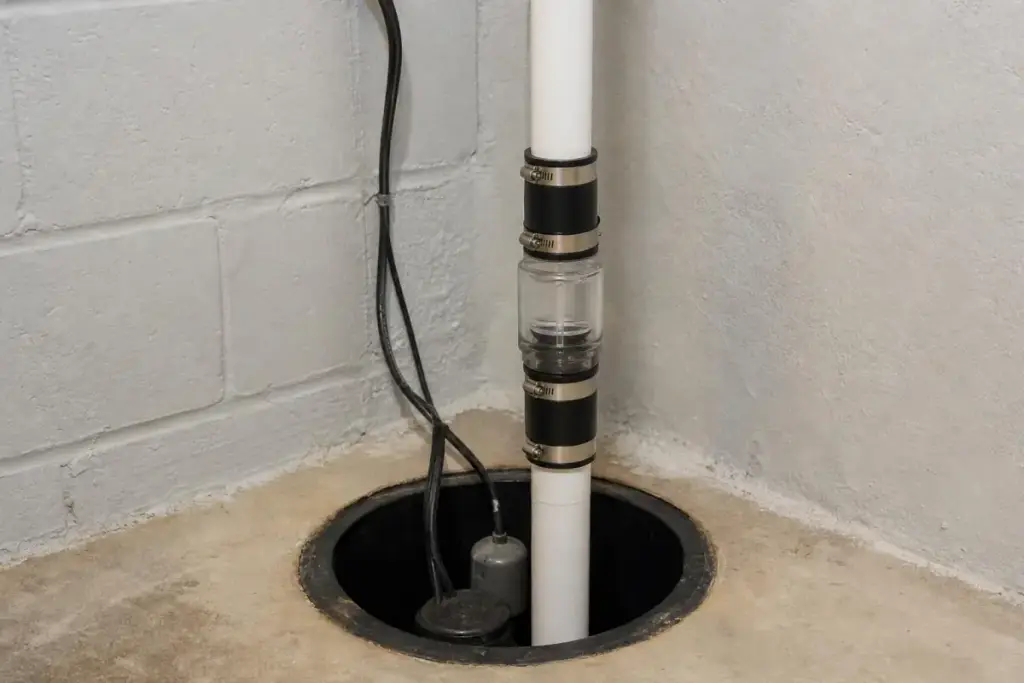
Yes, a sump pump check valve belongs on almost every basement sump: Zoeller and Liberty both call for one. It goes on the discharge pipe just above the pit, flow arrow pointing away from the pump, with a union below it and a small vent hole drilled between pump and valve.
Does a sump pump need a check valve, or is it optional?
Both big residential pump makers treat it as part of the install. Zoeller’s installation instructions FM2895 for Models 63 and 95 list “DO install a check valve and a union in the discharge line” as item 6, and Liberty’s 250 and 280 Series manual (7035000) says a check valve “is required just above or in place of the union.” Boshart’s knowledge base notes it is not mandated by code in every area, so the code your inspector enforces, plus local amendments, settles the legal question.
Skipping the valve holds up in a narrow set of cases: a riser of 4 ft or less feeding a wide pit, where the 0.42 gallon of drainback in 1-1/2 in pipe barely moves the water line, or a pump whose own manual says it has an integral check valve and tells you not to add a second. In a small pit with a vertical float, the arithmetic below shows the valve stops being optional.
How many gallons fall back into the pit without one?
Every foot of vertical riser holds a fixed volume that falls back the moment the pump stops. We computed it from the nominal inside diameters in Charlotte Pipe’s PVC product brochure: 1.380 in for 1-1/4 in Schedule 40, 1.610 in for 1-1/2 in and 2.067 in for 2 in. Gallons per foot equal the bore area times 12 in, divided by 231 cubic inches per gallon. Only the vertical rise counts; a horizontal run sloped away from the house empties outdoors either way.
| Vertical rise, pump to high point | 1-1/4 in Sch 40 (0.078 gal/ft) | 1-1/2 in Sch 40 (0.106 gal/ft) | 2 in Sch 40 (0.174 gal/ft) | Water-line jump, 14 in pit, 1-1/2 in pipe |
|---|---|---|---|---|
| 4 ft | 0.31 gal | 0.42 gal | 0.70 gal | 0.63 in |
| 7 ft | 0.54 gal | 0.74 gal | 1.22 gal | 1.11 in |
| 10 ft | 0.78 gal | 1.06 gal | 1.74 gal | 1.59 in |
| 13 ft | 1.01 gal | 1.37 gal | 2.27 gal | 2.06 in |
Those gallons matter against how much water the pump removes per cycle. Liberty’s Table 1 sets the Model 257 vertical float to turn on at 7 in and off at 4 in, a 3 in swing, and the manual allows that pump in a pit as narrow as 10 in. A straight-walled 10 in pit holds 0.34 gal per inch, so the pump moves about 1.02 gal per cycle, and 10 ft of 1-1/2 in riser returns 1.06 gal. The drainback alone lifts the water 3.1 in, past the turn-on point, so the pump restarts on its own water with nothing flowing in.
The same 1.06 gal is about 53% of a Model 257 cycle in a 14 in pit but only 14% of a Model 251 cycle in an 18 in pit, where Liberty sets the float at 11 in on and 4 in off. Zoeller’s FM2895 service checklist lists “check valve stuck or none installed in long distance line” and “sump pit too small” under a pump that starts and stops too often. If you are chasing a sump pump that keeps running or restarting, watch the pit for 60 seconds after shutoff: a fast rise with no inflow points at the valve.
Where does the check valve go on the discharge pipe?
It goes above the pump near the floor line, with a vent hole under it and a union for pump removal. Zoeller and Liberty agree on the order but not on the hole size.
| Document | Check valve position | Vent (weep) hole | Union and shutoff |
|---|---|---|---|
| Zoeller FM2895, Models 63 and 95 | Unicheck “preferably just above the basin” | About 3/16 in (5 mm), below the check valve and the pit cover; with a Unicheck, level with the top of the pump | Union required; gate or ball valve supplied by installer per code |
| Liberty 7035000P, 250 and 280 Series | Just above, or in place of, the union | 1/8 in, just above the pump’s discharge outlet | Union just above the floor; gate valve after the check valve |
| Boshart knowledge base | 8 in above the pump discharge up to about 12 in above the floor | Below the valve, for pumps without built-in air lock protection | Not specified |
Both makers already put an air bleed in the pump: Zoeller in the housing opposite the float, Liberty in the base. Zoeller still recommends the extra hole and says a stream of water from it during each run is normal. Without it, trapped air can keep a pump from pushing water past a closed flapper, the classic sump pump that hums but moves no water. Zoeller says to clean the hole periodically.
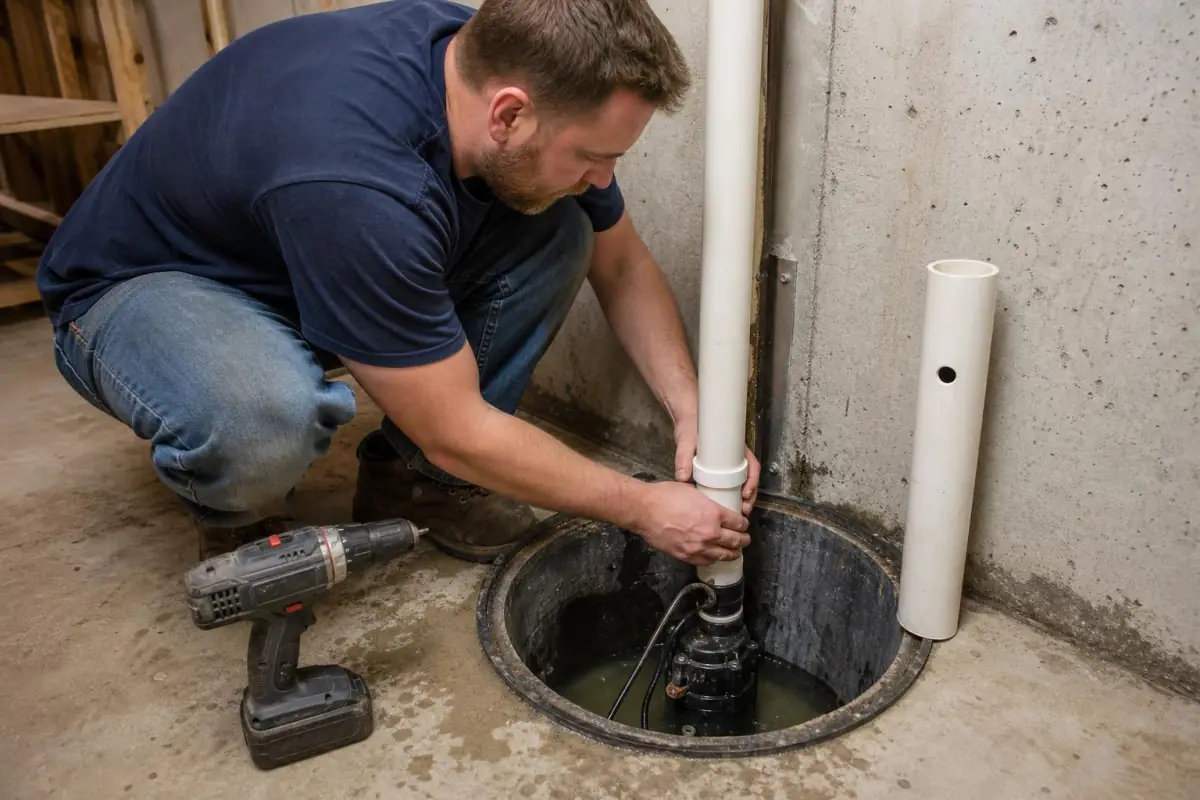
Installing a sump pump check valve in 7 steps
The sequence below follows the Liberty and Zoeller manuals; the full sump pump installation walkthrough covers the pit, float and discharge termination.
- Unplug the pump. Liberty tells you to hand-tighten the discharge pipe into the pump, because over-tightening can crack the housing.
- Drill the vent hole low on the riser: 1/8 in for Liberty, about 3/16 in (5 mm) for Zoeller, angled down into the pit.
- Fit the union or rubber slip coupling just above the floor so the pump lifts out without cutting pipe.
- Set the valve with the cast flow arrow pointing away from the pump, which is straight up on a vertical riser.
- Glue solvent-weld ends with primer and cement to ASTM F 656 and ASTM D 2564, the pair Charlotte Pipe specifies, or snug hose clamps evenly.
- Add a gate or ball valve above the check valve if Liberty’s layout or your local code calls for one.
- Fill the pit with a hose and watch two cycles: the riser should stay full and the pit should not climb after shutoff.
Which type of sump pump check valve: swing, quiet spring or union?
Most sump valves are flapper (swing) valves; the choice is between gravity closing and spring closing, clear or opaque, and rubber clamped unions or glued ends. Prices are retailer listings checked in November 2026.
| Valve and maker part | Closing and body | Ends | Listed price | Noise behavior |
|---|---|---|---|---|
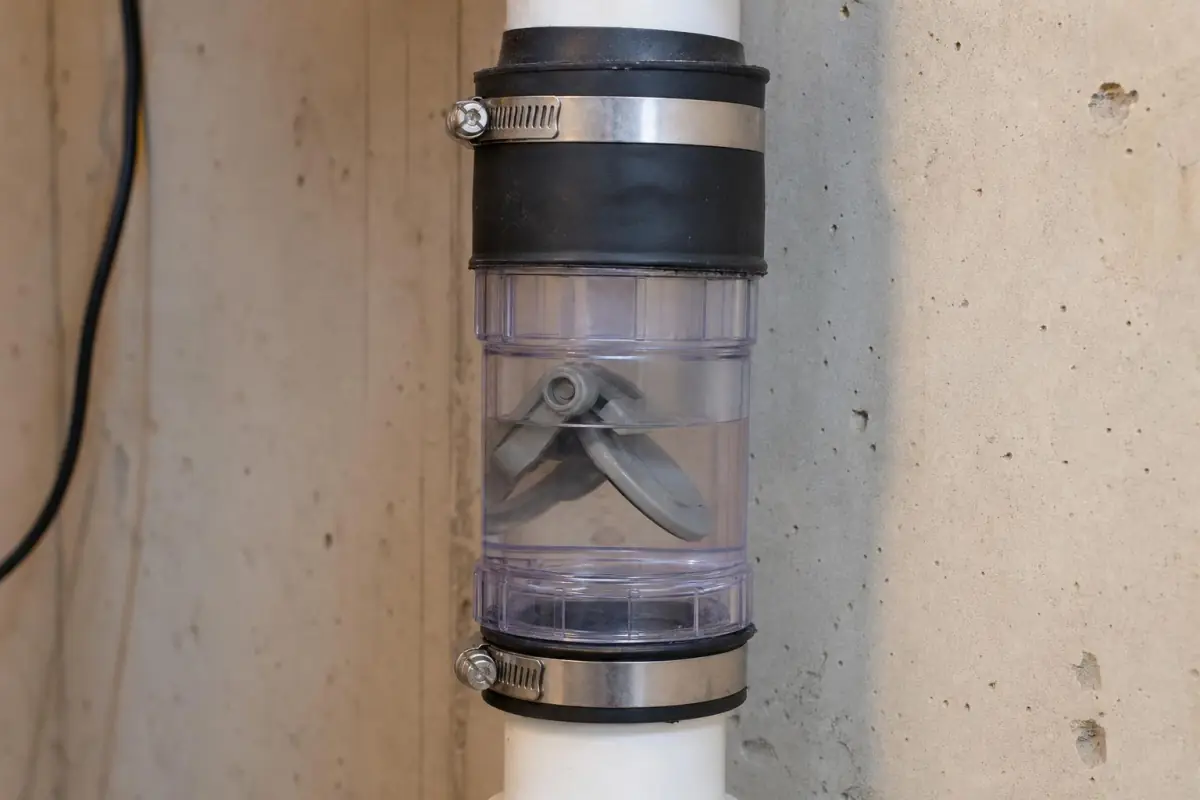
| Zoeller 30-0181 Unicheck | Full-flow gravity flapper, PVC | 1-1/4 or 1-1/2 in slip x slip rubber unions, stainless clamps | $28.09, F.W. Webb | Gravity close can thump; listing rates the clamped unions at 4.3 psi, 10 ft of head |
| Zoeller 30-0041 Clear Quiet | Spring-loaded hinged flapper, clear body | 1-1/2 in solvent weld with unions | $34.50, SupplyHouse.com | Spring closes before flow reverses; rated 50 psi (115 ft) |
| Zoeller 30-0241 Quiet | Spring-loaded flapper, white body | 1-1/2 in solvent weld x hose clamp | $31.50, SupplyHouse.com | Same quiet closing, no view of the flapper |
| Little Giant CV-114/112 (599059) | Flapper, ABS | Flexible PVC slip x slip for 1-1/4 or 1-1/2 in pipe | $21.55, SupplyHouse.com | Closing type not stated by Little Giant |
| Little Giant CVBV-2 (599160) | Check valve plus ball shutoff in one PVC body | 2 in IPS compression | No retail price checked | Not stated; saves fitting a separate shutoff |
Zoeller’s 30-0041 product page credits a 1/2 lb spring for closing the flapper as the pump shuts down. The 4.3 psi figure on the 30-0181 listing equals 10 ft of water, so on a tall lift a glued valve with a 50 psi rating is the safer pick. Little Giant’s check valve catalog runs from 1-1/2 in to 3 in. For the mechanics behind each design, see how swing, spring, ball and lift check valves differ.
Why does the check valve thump when the pump shuts off?
The thump is water hammer: the column in the riser reverses, picks up speed and slams the flapper onto its seat. Boshart explains that a flat-seat gravity valve gives the flapper the longest travel, so the water gains the most momentum, while its ABS valves use a 15 degree angled seat to shorten that travel and soften the hit. A spring-assisted valve such as the Zoeller 30-0041 closes as flow slows, before reversal, which Zoeller says eliminates the noise. Boshart also notes that a gravity valve mounted lower, inside the basin, is quieter but harder to reach for service.
How to pipe a check valve with a battery backup pump
Give each pump its own check valve before the two lines join. Liberty’s duplex instructions in manual 7035000P say a check valve on each discharge, ahead of the common line, “is necessary to prevent the recycling of fluid from one pump to the other.” The same hydraulics apply to a primary pump and a DC backup sharing one 1-1/2 in riser, the setup Zoeller’s FM2895 recommends you consider for power outages. With a single valve above the tee, the running pump pushes water down through the idle one and back into the pit.
Sump pump check valve questions
Can a sump pump check valve be installed backward?
Yes, and a backward valve stays shut against the pump, so the pump runs, heats up and moves no water. Confirm the cast arrow points away from the pump before you glue or clamp anything. A clear body such as the Zoeller 30-0041 lets you watch the flapper lift on the first test cycle.
How long does a sump pump check valve last?
None of the maker documents we read publishes a service life. Zoeller asks for a system inspection and test at least every three months, and Liberty places a gate valve after the check valve so it can be opened and cleaned. Replace the valve when it leaks back, chatters or will not seat after cleaning.
Should the check valve sit inside the pit or above the cover?
Zoeller prefers its Unicheck just above the basin, and Liberty puts the union just above the floor with the check valve at or above it. Boshart says a gravity valve set lower inside the basin sounds quieter but is harder to service. Either way the vent hole stays below both the valve and the cover.
Does a check valve stop the outdoor discharge line from freezing?
No. The valve keeps the vertical riser full, and that standing water sits indoors. An outdoor run that slopes away from the house drains by gravity after each cycle with or without a check valve. A buried line that dips and holds water can still freeze and needs regrading.
What size check valve does a sump pump need?
Match the pump outlet and never go smaller. Liberty 250 and 280 Series pumps have a 1-1/2 inch threaded discharge, and both Zoeller and Liberty warn against discharge pipe smaller than the pump outlet. Most residential valves, including the Zoeller 30-0181 and Little Giant CV-114/112, accept 1-1/4 or 1-1/2 inch pipe.
How we sourced this
We read Zoeller installation instructions FM2895 (Models 63 and 95, rev. 0823), Liberty Pumps manual 7035000P (250 and 280 Series), Charlotte Pipe’s PVC brochure and Schedule 40 submittal, Zoeller’s 30-0041 product page, Little Giant’s check valve catalog, Boshart’s sump check valve knowledge base and retailer listings at F.W. Webb and SupplyHouse.com. Drainback volumes are our arithmetic from Charlotte’s nominal inside diameters; pit volumes assume straight walls, so tapered basins will differ slightly. We left out a Flotec quiet valve and a true ball-type sump check because we could not confirm a part number and price from the maker or a named retailer.