Reverse Osmosis Not Filling Tank: 6 Pressure Numbers to Check With a Tire Gauge

A reverse osmosis system not filling its tank is almost always a pressure problem. Take three readings: house feed pressure of at least 40 psi, empty-tank air of 5 to 10 psi depending on the maker, and a full tank near two-thirds of feed pressure. Whichever number is off names the part.
Two gauges do the job. A standard tire gauge reads the tank at the air valve under the blue cap on its lower half, the method in iSpring’s RO owner’s manual, Ver 02/2020. A hose-thread gauge on a hose bib reads line pressure. Because the bladder separates air from water, the air valve reading on a full tank equals the water pressure inside it.
Which six pressure readings tell you why the RO tank won’t fill?
Six readings, taken in order, separate a supply fault from a tank fault from a valve fault. Targets come from APEC’s Ultimate RO-90 owner’s manual, Ver 4.0, its Essence (ROES series) manual, the iSpring manual and a shut-off valve spec sheet.
| Reading | How to take it | Target | If it’s off |
|---|---|---|---|
| 1. Line pressure | Hose gauge, no water running in the house | APEC standard units 40 to 85 psi; iSpring warranty 45 to 70 psi on non-pump units | Under 40 psi: slow fill, slow shut-off. Under 30 psi: may never shut off |
| 2. Empty-tank air | Close feed, open RO faucet until flow stops, gauge the air valve | APEC 5 to 7 psi (4 gal tank ships at 5, 14 gal at 7); iSpring T32M 7 to 10 psi | Low: one fast glass, then a trickle |
| 3. Full-tank pressure | Gauge the air valve after the drain stops | About 57 to 74% of feed on APEC’s 4 gal tank (next section) | Far lower with the drain still running: production or delivery blocked |
| 4. ASO shut-off | Close tank valve, listen at the drain 3 to 5 minutes | Closes near two-thirds of line pressure, 40 psi at 60 psi feed, plus or minus 20% | Drain keeps running: ASO or check valve failed |
| 5. Check valve | Feed off, tank valve open, drain line off the saddle | No water from the drain line | Tank water drains out: replace check valve |
| 6. Booster switch (pumped units) | Tank gauge when the pump stops | iSpring switch restarts the pump below 20 psi, stops it at 35 psi | Pump runs 24/7: reset tank air to 7 to 10 psi |
Stop at the first miss. A 35 psi house supply explains a half-full tank on its own, so clear reading 1 before buying valves. The shut-off figure is from the spec sheet for WECO’s ASV-14QWX automatic shut-off valve, rated 30 to 100 psi.
How full should the tank get at your line pressure?
An RO tank never fills to its label size, and on 40 psi water it stops near half. APEC’s manuals print two charts: gallons stored at each feed pressure, and tank pressure at each gallon level. Joining them gives the reading a full tank should show on your gauge, a figure none of the top-ranking guides we read prints.
| Feed | 4 gal tank holds | Full-tank reading | Share of feed | 14 gal tank |
|---|---|---|---|---|
| 40 psi | 1.9 gal (about 50%) | about 23 psi* | 57% | 6.1 gal at 20 psi |
| 50 psi | 2.5 gal (about 70%) | 36 psi | 72% | 7.8 gal at 30 psi |
| 60 psi | 2.8 gal (about 88%) | about 44 psi* | 74% | 9.0 gal at 40 psi |
| 70+ psi | 3.1 gal (almost 100%) | above 50 psi | over 71% | 9.7 gal at about 47 psi* |
*Straight-line interpolation between the two nearest points on APEC’s chart. APEC notes the 4 gal size is shell volume; the bladder holds about 3.2 gal even at 80 to 90 psi.
So 2.8 gal on 60 psi water is a healthy fill, not a fault. The two-thirds valve rule predicts 27, 33, 40 and 47 psi for those four feed pressures, close to APEC’s 14 gal figures. A full-tank reading near the table, inside the valve’s 20% tolerance, with the drain stopped, means the system works as designed.
Where does the water stop on its way to the tank?
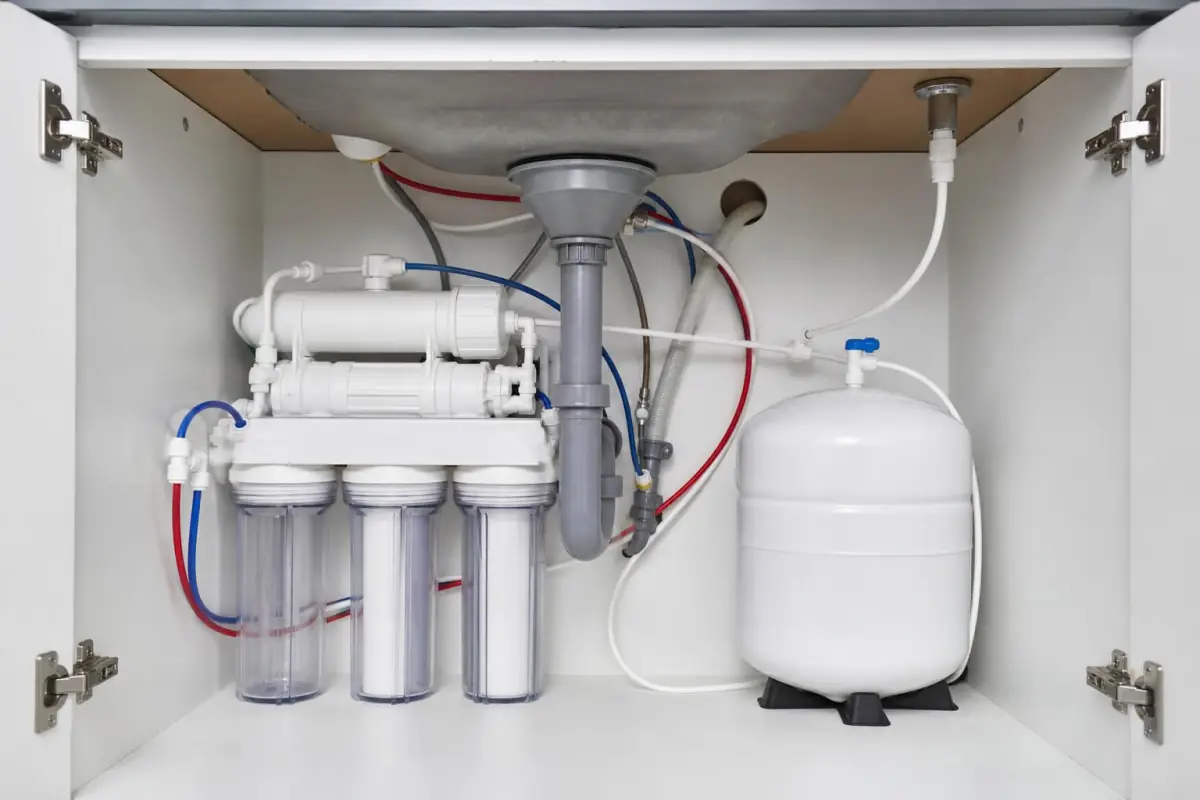
Water passes five control points between the cold-water valve and the tank, and each can hold back the fill.
The ASO valve is the part owners rarely find. On APEC’s 5-stage units it carries four tubes: white C1 IN from stage 3, white C2 OUT to the membrane, clear C3 from the check valve and clear C4 to the stage 5 tee. APEC lists a swapped ASO connection as a cause of no water at the faucet. Permeate pump units drop the ASO valve, because the pump doubles as the shut-off.
Is the shut-off valve or the check valve stopping the fill?
APEC’s manual gives a two-step test that settles it in about 10 minutes when the drain runs for hours and the tank stays light.
- Draw 2 to 3 glasses so the system starts making water.
- Close the tank ball valve a quarter turn to mimic a full tank, plus any ice maker line.
- Wait 3 to 5 minutes. If the drain stops, both valves work.
- If not, leave some water in the tank, pull the black drain line off the saddle, turn off the cold feed and open the tank valve.
- Water from the drain line means the check valve leaks. No water means the ASO valve is the bad part.
Pressure skews this test. APEC says a unit fed under 40 psi shuts off slowly, with the drain running 6 to 7 hours, and under 30 psi may never shut off. Repeat the test after fixing reading 1.
The 4 to 1 figure belongs to the drain side, not the shut-off valve. Pure Water Products puts drain flow at about four times the membrane rating when sizing the flow restrictor. Our arithmetic: 1 GPD equals 2.63 ml per minute, so four times production is 526 ml/min for a 50 GPD membrane, 789 for 75 GPD and 1,052 for 100 GPD, against chart sizes of 420 or 525, 525 or 800, and 800. Fitting a 100 GPD membrane behind a 50 GPD restrictor runs the system lean, which the same source says hurts water quality and membrane life. Our page on the RO waste water ratio explains why chasing 1 to 1 on a tank unit backfires.
Which part do you replace, and how long until you know it worked?
Most fixes take one part and a 2 to 3 hour refill wait.
| Cause | Fix and part | Confirm after |
|---|---|---|
| Tank valve closed | Handle in line with the yellow tube (iSpring) | 2 hours |
| Feed needle valve partly shut | Open fully, counterclockwise (APEC) | 2 to 3 hours |
| Crimped tubing | Straighten or recut the 1/4 inch line | At once, by faucet flow |
| Low air charge | Drain tank, bike pump to the maker figure | One refill |
| Ruptured bladder | Won’t hold 6 psi empty: new tank (iSpring T32M) | One refill |
| Clogged prefilters | APEC Essence 6 to 12 months, Ultimate 12 months, iSpring 6 months | Refill back to 2 to 3 hours |
| Fouled membrane | APEC 2 to 4 years (Essence) or 3 to 5 years (Ultimate) on city water; iSpring 2 to 3 years or under 90% TDS rejection | Refill time plus TDS meter |
| Failed check valve | Replace (iSpring ACV1K, elbow on the membrane pure port) | Repeat the shut-off test |
| Failed ASO valve | Replace the 4-way valve, matching tube colors | Drain stops 3 to 5 minutes after closing tank valve |
Prefilters are the cheap first move when each refill takes longer. APEC says a stage 1 sediment cartridge that turns brown in 1 to 3 months means heavy sediment and a shorter interval. The same three stages sit in a plain under-sink water filter, but only an RO unit loses tank volume when they clog, because every psi they drop comes off membrane pressure.
What if house pressure is the real cause?
A reading under 40 psi puts a standard RO unit outside its rating, and no part swap fixes that. APEC rates standard units for 40 to 85 psi, permeate pump units for 30 to 85 psi and booster pump units for 0 to 30 psi, and its RO-90 manual lists anything under 60 psi as a cause of slow fill. iSpring calls for its APR70 regulator above 70 psi.
First confirm the low reading is the house, not one fixture. If the hose bib reads 55 psi but the kitchen tap is weak, our guide to low water pressure at the kitchen faucet covers the angle stop and kinked 3/8 inch supply checks; a half-closed angle stop starves the RO too, since APEC’s feed adapter mounts on that stop. If the whole house reads 35 psi, a permeate pump unit is rated from 30 psi, and an iSpring booster model lifts feed to about 80 psi at the membrane. Our explainer on how a reverse osmosis system works covers what the membrane removes and 2026 installed costs.
How we sourced this
We read APEC’s Essence (Ver 3.0), Ultimate RO-90 (Ver 4.0) and RO-PUMP manuals, iSpring’s owner’s manual (Ver 02/2020 and 03/2019), the WECO ASV-14QWX spec and Pure Water Products’ restrictor article. Starred pressures are interpolations between points in APEC’s charts; ml per minute figures use 3,785 ml per gallon and 1,440 minutes per day. The two-thirds rule comes from a valve spec, not a membrane maker. We left out output figures at pressures other than 60 psi and did not read NSF/ANSI 58 itself.
RO tank fill questions owners ask
How long should a reverse osmosis tank take to fill?
APEC says its 50 GPD Essence units make about 1.8 gallons per hour at 60 psi and 77 degrees F, filling the 4 gallon tank in 2 to 3 hours. Its 90 GPD RO-90 needs 1 to 1.5 hours. iSpring says a drain still running after 4 hours signals a fault.
Why does water keep running to the drain while the tank stays empty?
The membrane is making water that never reaches the tank. Check that the tank valve handle sits in line with the yellow tube, look for a crimped product line, and match the four ASO valve tubes to the manual diagram before buying parts.
How do I know the RO tank bladder is ruptured?
Drain the tank fully, then pump air into the valve on its lower half. WECO says a working tank will charge and hold about 6 psi, so a tank that will not hold a charge has a ruptured bladder and needs replacing, such as iSpring part T32M.
Can I add air to an RO tank with a bike pump?
Yes. iSpring says a standard bicycle pump works. Shut the feed water, open the RO faucet until the tank is empty, then pump in short bursts and check with a tire gauge until it reads 5 to 7 psi for APEC or 7 to 10 psi for iSpring.
Why does the first glass come out fast and then slow to a trickle?
Low air charge pushes out only the first glass or two. APEC lists low pre-charge as a cause of sluggish flow and says to raise it to 5 to 7 psi on an empty tank. A tank that has not finished filling gives the same trickle.