Can PEX Be Buried Underground? Rules, Depth and Maker Limits
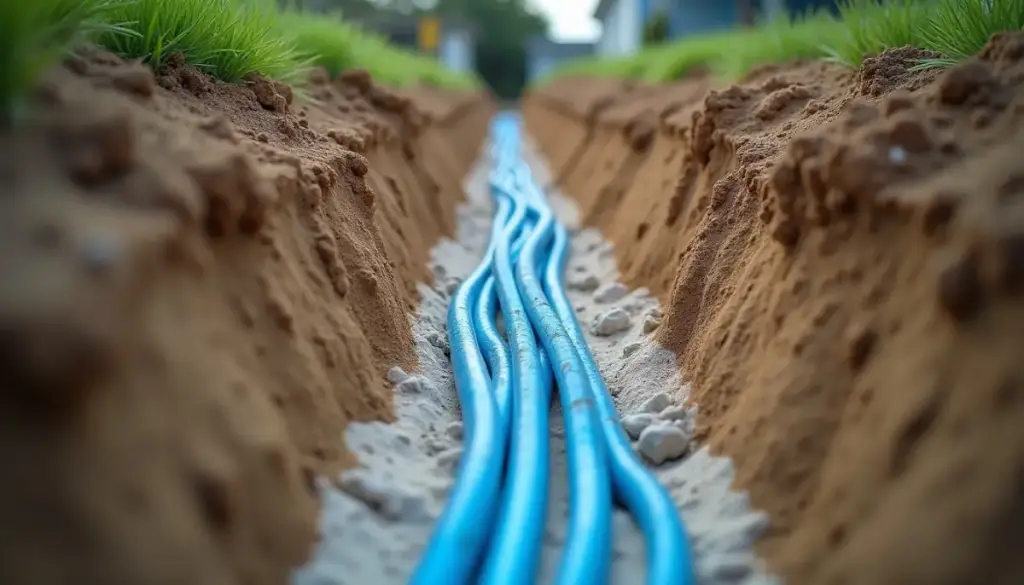
Yes, PEX can be buried underground as a water line when the tubing is listed to ASTM F876 or AWWA C904, lies at least 12 inches deep and 6 inches below the frost line, rests on rock-free bedding and stays out of contaminated soil.
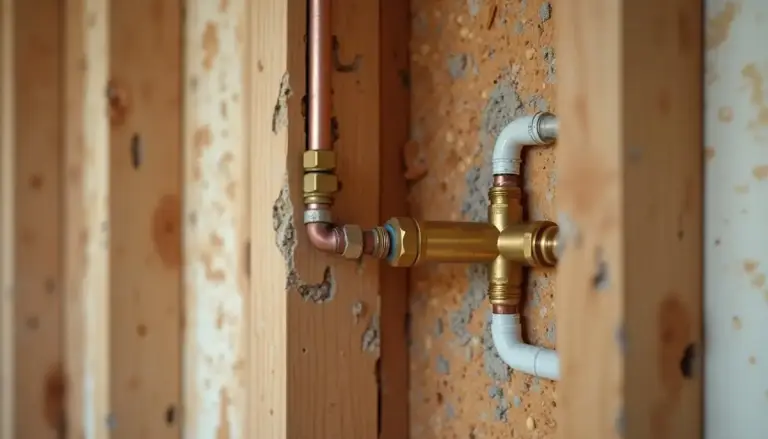
Code allows the pipe, then hands the details to the maker: IPC Section 605.16.2 and IRC Section P2906.10.2 both require mechanical joints to follow the manufacturer’s instructions. Burial approval does not split by type either, so a reader comparing the variants in our explainer on what PEX is can note that Uponor (PEX-a), Viega and Zurn (both PEX-b) all publish burial rules.
Which buried PEX jobs are allowed, and which document says so?
Eight of these nine situations are allowed with conditions, and contaminated soil, barred by IPC 605.1 and IRC P2906.1, is the one refusal.
| Situation and verdict | Code and PPI | Uponor | Viega | SharkBite and Zurn |
|---|---|---|---|---|
| Direct burial in soil. Allowed | IPC Table 605.3 and IRC Table P2906.4 list PEX to ASTM F876, AWWA C904 or CSA B137.5, with NSF 61 and at least 160 psi at 73°F | Approved. Stable, continuous support with no hollows, lumps or rocks | “May be used underground.” Stable, continuous trench base, no blocking | SharkBite PEX-b: approved for direct burial. Zurn: 12 to 18 in cover for light traffic, 24 in for heavy |
| In the ground under a slab. Allowed | PPI: bury in sand or pea gravel, clear of rebar, mesh and the slab. Full-length sleeve not needed unless local code says so | Approved. Compact 4 to 6 in over the pipe | Continuous runs, snaked in a smooth trench. Connections outside the slab or in an access box | Zurn: avoid fittings there, protect any you cannot avoid. SharkBite: silent on under-slab runs |
| Through a slab. Allowed, sleeved | IPC 305.1: sheathing at least 0.025 in thick that lets the pipe move. PPI: non-metallic sleeve or PVC bend guide | 0.025 in HDPE wrap, PE tape, closed-cell insulation or PVC elbow | Sleeve every entry, exit and expansion joint. Dip below cut joints | Zurn: sleeve 6 in into the slab and 6 in above it (1 1/4 to 2 in guide). SharkBite: check local code |
| Through a foundation wall. Allowed, sleeved | IPC 305.3 and IRC P2603.4: relieving arch or sleeve two pipe sizes larger. PPI: rigid sleeve out to undisturbed soil | Follow local code for added sleeving | Rigid sleeve (Schedule 40 PVC or equal) across over-excavation deeper than 12 in | Zurn: rigid sleeve to undisturbed soil, sealed inside. SharkBite: silent |
| Service line to the street. Allowed | IRC P2603.5 and IPC 305.4: 12 in deep and 6 in below frost. IPC 603.2 and IRC P2906.4.1: 5 ft from a sewer not built of listed sewer material | Meets AWWA C904, 1/2 to 3 in. SDR9 compression fittings to AWWA C800 with insert stiffeners at the corporation or curb stop | “May be used” for water service piping. Compact 6 in over the tube | SharkBite: approved to AWWA C904. Zurn: no double or S bends at the curb stop |
| Rocky fill. Allowed with bedding | IRC P2604.3 and IPC 306.3: no rocks, broken concrete or frozen chunks until 12 in of tamped cover | Granular base. Backfill particles 3/4 in maximum. No plastic clays, silts or sharp rock | Dig 6 in below tube level, fill with coarse sand or pea gravel | Zurn: 6 in extra in loose rock or solid rock, 4 in in unstable soil. SharkBite: silent |
| Soil with solvents or fuels. Not allowed | IPC 605.1 and IRC P2906.1 prohibit it. Chemical analysis where suspected. PPI: do not install | Do not install. Analyze soil or groundwater if suspected | Do not install where soil “is or may become” contaminated | Zurn: inspect first, not recommended near hazardous waste or petroleum tanks. SharkBite: silent |
| Sun before burial. Limited | ASTM F876 digit sets the rating. PPI: each maker publishes its limit | 30 days (PEX-a) | 6 months for tubing, 15 days for polymer fittings | SharkBite PEX-b 6 months, PEX-a 1 month. Zurn up to 6 months |
| Fittings below grade. Maker specific | Follow the maker (IPC 605.16.2). The IPC Chapter 6 and IRC Chapter 29 text we read has no PEX fitting rule for slabs | ProPEX EP and LF brass approved below grade and in slab | Press: no wrap. Crimp: silicone tape at least 0.020 in thick, part 15320 | Zurn: no XL brass or CR as below-grade service fittings. SharkBite: silent |
The code column sets the minimum and the maker columns add the workmanship, so a job has to satisfy both. Where SharkBite reads “silent”, its PEX-b spec sheet and PEX FAQ give burial approval in a sentence or two and send readers to local code for sleeves.
What depth, slack and test pressure does a 60 foot PEX service line need?
With a 36 inch frost line, a 60 foot PEX service line sits at 42 inches, gets about 7.5 inches of slack and takes an 80 to 90 psi test on a 60 psi supply. Those numbers are arithmetic on the rules below, for one hypothetical job.
- Read the print line. Look for ASTM F876 or AWWA C904 plus an NSF 61 mark. Under IPC 605.3, service pipe not certified for water distribution must end at or before the full open valve at the building entrance.
- Set the depth. Take the deeper of 12 inches or frost depth plus 6 inches, so 36 + 6 = 42 inches here. Get the frost figure from the building department, and check our page on how deep water lines are buried for utility minimums that run deeper.
- Keep clear of the sewer and septic. Hold 5 feet of earth from a sewer not built of listed sewer material. IPC 603.2.1 bars service pipe in, under or above cesspools, septic tanks, drainage fields and seepage pits.
- Snake the pipe. The Zurn PEX Plumbing Installation Guide (ZMKTG370-04) calls for 1/8 inch per running foot, so 60 x 1/8 = 7.5 inches of slack. Viega asks for a slight S-shape. Neither allows blocking under the tube.
- Test before backfill. Uponor sheet IS_01356_1018 says typically 20 psi above working pressure, or 80 psi on a 60 psi supply. Zurn says about 50 percent above operating pressure, or 90 psi, for at least 1 hour, with air bled first.
- Backfill in stages. Compact 6 inches of clean material over the tube, then continue until 12 inches of tamped, rock-free cover sits on the pipe, as IRC P2604.3 requires.
Hiring this out? Ask the plumber to put the frost depth, the tube’s ASTM print line and the test pressure in writing, and ask whether the open trench needs an inspection. Stop and get a soil analysis if the route passes an old fuel tank or a known spill.
How long can PEX sit in sunlight before it goes in the trench?
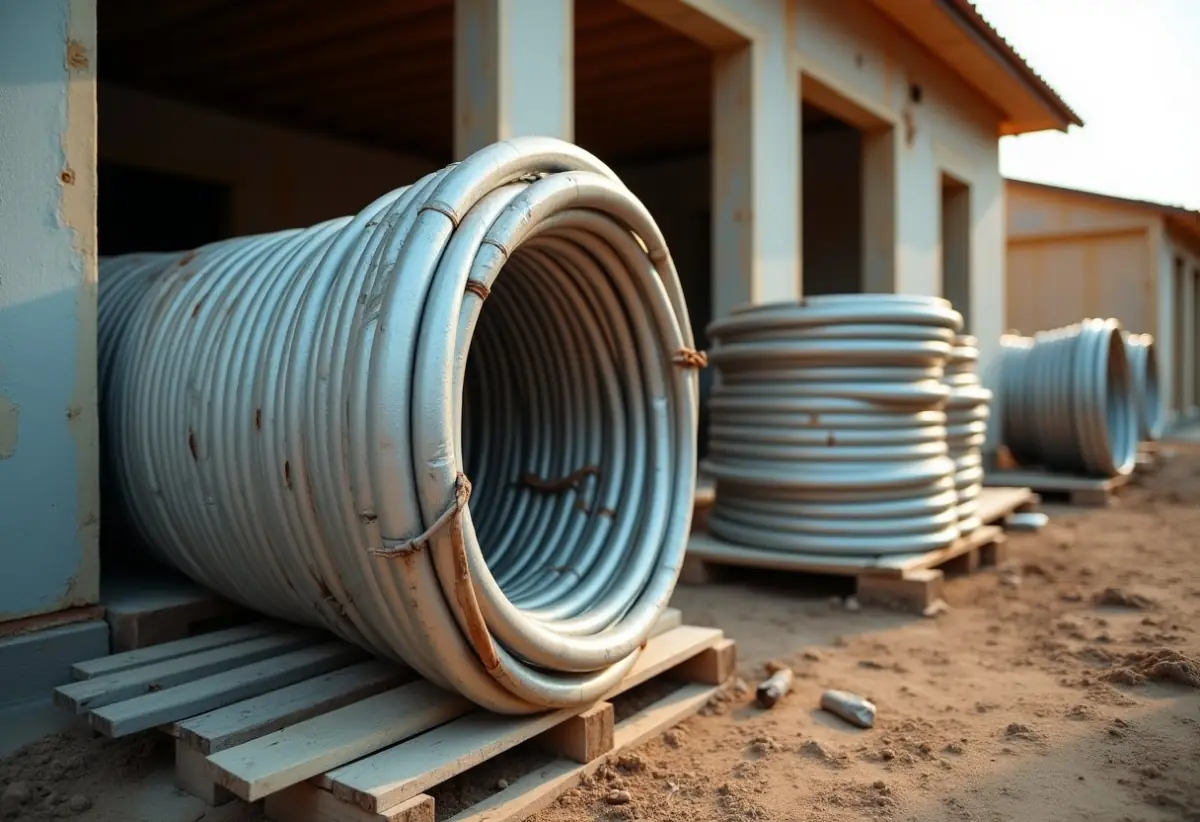
PEX can take as little as 15 days for some polymer fittings, 30 days for Uponor PEX-a and 6 months for tubing printed PEX 5306, and that clock accumulates. The figure is not universal: PPI TN-32 leaves “X days” blank for each maker to fill.
| Product | Maximum UV exposure | Maker’s document |
|---|---|---|
| Uponor PEX-a | 30 days | Complete Design Assistance Manual, 8th ed. |
| Viega PureFlow PEX (PEX 5306) | 6 months | Installation Manual IM-PF 724596 |
| Viega PureFlow Press polymer and Crimp Polyalloy fittings | 15 days combined | IM-PF 724596 |
| SharkBite PEX-b (PEX 5306) | 6 months | PEX-b spec sheet |
| SharkBite PEX-a (PEX 5106) | 1 month | White PEX-a spec sheet |
| Zurn PEX | Up to 6 months, keep covered | ZMKTG370-04 and Form 370-060 |
The second digit of the printed code is the rating: 1 means 1 month, 2 means 3 months and 3 means 6 months or more, per ASTM F876. PPI’s UV presentation explains that those months are Central Arizona sunlight, with a 6 month claim tested at 218 MJ, and that a month near Phoenix may equal 2 to 3 months elsewhere. None of the maker documents we read grants a longer limit for cloudier states.
Add up every day the coil sat outdoors and every day the tube lay in an open trench, because TN-32 warns that UV damage is invisible to the eye. For stubs above a slab, Chapter 9 of the PPI PEX design guide calls for an opaque covering such as black polyethylene right after the pour and advises against duct tape. SharkBite’s FAQ says PEX is not approved for continuous UV, so burial ends the clock but an exposed run above grade never qualifies.
Why is contaminated soil the one hard no for buried PEX?
Contaminated soil is a hard no because IRC P2906.1 and IPC 605.1 prohibit service pipe in soil with solvents, fuels or organic compounds that cause permeation, and those chemicals can reach the drinking water. Where such conditions are suspected, both codes require a chemical analysis, and where they exist, approved alternate materials or routing.
The EPA’s 2002 issue paper on permeation and leaching shows the scale. After a 10 gallon gasoline leak onto a road, a plastic service line held 1,300 µg/L of benzene against a 5 µg/L limit, 260 times over, after 40 hours of stagnation. A Montana polyethylene line reached 527 µg/L. Those incidents involved polyethylene and polybutylene, and the paper does not test PEX, but Uponor’s manual names permeation as the risk for its own PEX-a.
Termiticide-treated soil is a separate case: Uponor approves AquaPEX there with open ends capped, no contact with petroleum-based products and the gap at the slab sleeve sealed with latex caulk, silicone or polyurethane foam. Our rundown of PEX pipe problems covers the failures that show up after installation rather than in the trench.
Where do Uponor, Viega and Zurn disagree on buried PEX?
The three makers disagree most on fittings in concrete, which is why the document for your exact tube and fitting controls. Uponor approves ProPEX EP and LF brass in a slab. Viega says fittings in a slab should only be repairs, wrapped in silicone tape. Zurn’s residential guide allows protected insert fittings in or under concrete, while its 1 1/4 to 2 inch commercial guide says “DO NOT EMBED ANY FITTINGS IN THE CONCRETE SLAB”.
Sleeve thickness differs too. The Viega pocket guide accepts a 0.022 inch wall, while Uponor and IPC 305.1 say 0.025 inch, so buying 0.025 inch or thicker satisfies all three. The IRC’s 8 mil sheathing rule in P2603.3 applies only to metallic pipe, so on an IRC job the maker’s figure is the operative one.
At a foundation, Viega waives the rigid sleeve for 12 inches or less of well-compacted over-dig, while PPI and Zurn specify one out to undisturbed soil, so a rigid sleeve on every job meets both. The crimp, clamp and expansion joints themselves are covered in our guide to how to plumb with PEX.
Frequently asked questions
Does buried PEX need a sleeve along its whole length?
No, Chapter 9 of the PPI guide says a full-length sleeve is not required under a slab unless local code asks for one. Sleeves are required at slab entry and exit points and at foundation walls. Direct burial instructions from Uponor, Viega and Zurn rely on clean bedding rather than conduit, though Uponor notes that some jurisdictions require extra sleeving.
Can you bury PEX crimp rings and fittings in dirt?
Yes, usually with a wrap. Viega requires self-fusing silicone tape at least 0.020 inch thick on crimp fittings and rings. Zurn lists foam insulation, several layers of plastic film or a heat shrink sleeve, and tape must never touch the tube. Viega Press and Uponor ProPEX fittings need no such wrap in the documents we read.
Can PEX run under a driveway or road?
Yes, Viega’s pocket guide allows PureFlow PEX under a roadway when it is buried to the local minimum frost depth using normal direct burial practice. Zurn recommends at least 24 inches of cover under heavy traffic. Viega also says cover must be enough that expected traffic loads will not deform the tube, so ask the local inspector.
Should buried PEX be pre-insulated?
Only where local code or freeze risk calls for it, because burial below the frost line is the code’s protection. If you do choose a pre-insulated product, Uponor recommends at least 1 inch of insulation for below-grade use because of static soil loads, and it offers up to 2 inches. PPI notes that some local codes require insulation under slabs.
Can PEX come up out of the ground to a hose bib?
Not unprotected. PPI says PEX should not be installed outdoors unless buried in earth or properly protected from direct and indirect UV, and SharkBite does not approve it for outdoor use. Any stub above grade needs a UV-blocking sleeve or insulation approved by the tube maker.
How we sourced this
We read the 2021 IPC and IRC plumbing chapters as adopted by Colorado on UpCodes, Uponor IS_01356_1018 (2018) and CDAM 8th edition (a radiant manual whose handling rules cover its PEX-a), Viega IM-PF 724596 (03/26) and PG-PF 724998, Zurn ZMKTG370-04 (05/16) and 370-060 (07/18), SharkBite spec sheets and FAQ (archived copy), PPI Chapter 9, TN-32 and its UV presentation, and EPA’s 2002 paper. We computed the depth, slack, test pressures and benzene ratio. Left out for lack of a primary document: rodent damage to buried PEX, a ServicePEX UV figure, SharkBite under-slab fitting rules and UPC text. Local amendments vary.