Sewer Jetter for Pressure Washer: Kits, Nozzles, PSI and GPM
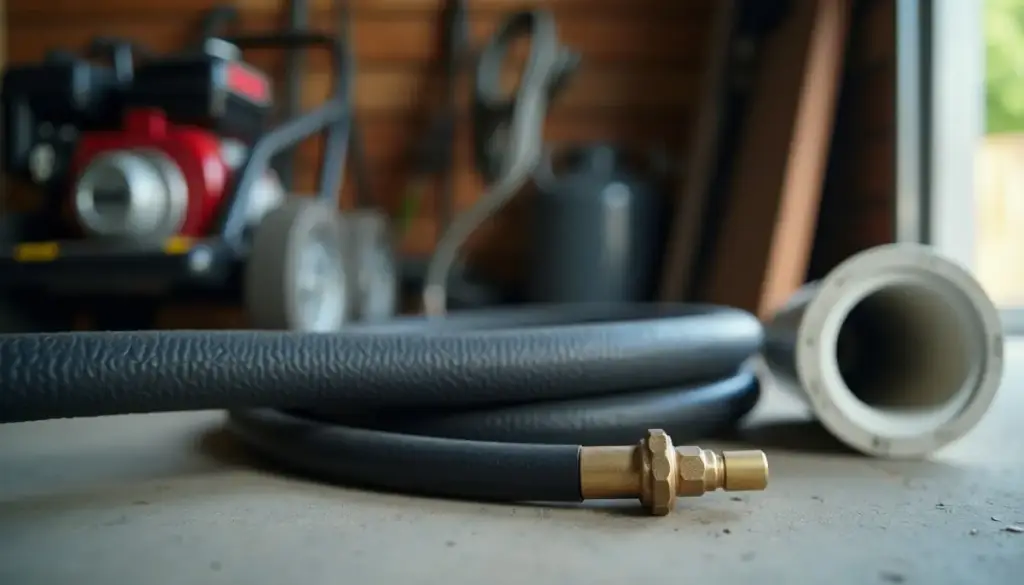
A sewer jetter for a pressure washer clears 1-1/2 to 4 inch drains only when flow (GPM), nozzle orifice and hose match the washer, and GPM decides how far the hose pulls itself.
Key Takeaways
- Flow drives a jetter: General Pipe Cleaners rates its electric JM-1450 at 1.7 GPM for 1-1/2 to 4 inch lines and its gas JM-3000 at 4 GPM for 3 to 10 inch lines.
- RIDGID’s electric KJ-1750 runs 1,750 PSI at 1.4 GPM for 1-1/4 to 4 inch drains, while the gas KJ-2200 runs 2,200 PSI at 2.4 GPM for lines up to 6 inches.
- The MTM Hydro 43.5002 Jetter Genie kit is rated 4,000 PSI and 4.5 GPM with a 100 foot, 1/4 inch hose, and Kleen-Rite’s listing says it will not work properly with consumer-grade electric washers.
- Nozzle numbers equal GPM at 4,000 PSI. A 3,200 PSI, 2.5 GPM gas washer needs about a size 2.8 to 3.0 nozzle.
- MTM Hydro limits its kit to pipes in good, sturdy condition. Never pull the trigger before the nozzle is inside the pipe, and never jet through a toilet.
- A CAM Spray catalog pairs about 2 GPM with pipes up to 4 inches and 3 GPM with pipes up to 6 inches.
How does a sewer jetter nozzle work?
A sewer jetter nozzle splits the pressure washer’s flow into one forward jet and several rear-facing jets. The rear jets push against the water behind them, which drags the hose up the pipe without you shoving it. The forward jet cuts into the clog, and the backward spray scrubs the pipe wall and flushes the loosened grease and sludge back toward the opening.
Weak rear jets leave the hose sitting at the cleanout fitting. Retail rotating nozzles, such as the Dultmeier size 5.5 rotating nozzle with a 1/4 inch FPT inlet and a 3,000 PSI cap, use three back jets.
Which nozzle styles come in a kit?
Retail kits commonly bundle several heads (button nose, rotating, corner, mushroom or spring types, per a Walmart kit listing). Each head does a different job, so pick by clog type, not by looks.
- Button nose (penetrating): one strong forward jet plus rear jets. The default for grease and soft blockages.
- Rotating: the jets spin, so the spray sweeps the full pipe circumference. Better for grease coating the wall than for a hard plug.
- Corner or flexible: a short or sprung body that bends through tight fittings like a 1-1/2 inch P-trap arm.
- Root or milling style: sold for root work, but a washer’s 1.2 to 4.5 GPM rarely has the flow to make it cut.
Is GPM or PSI more important for a sewer jetter?
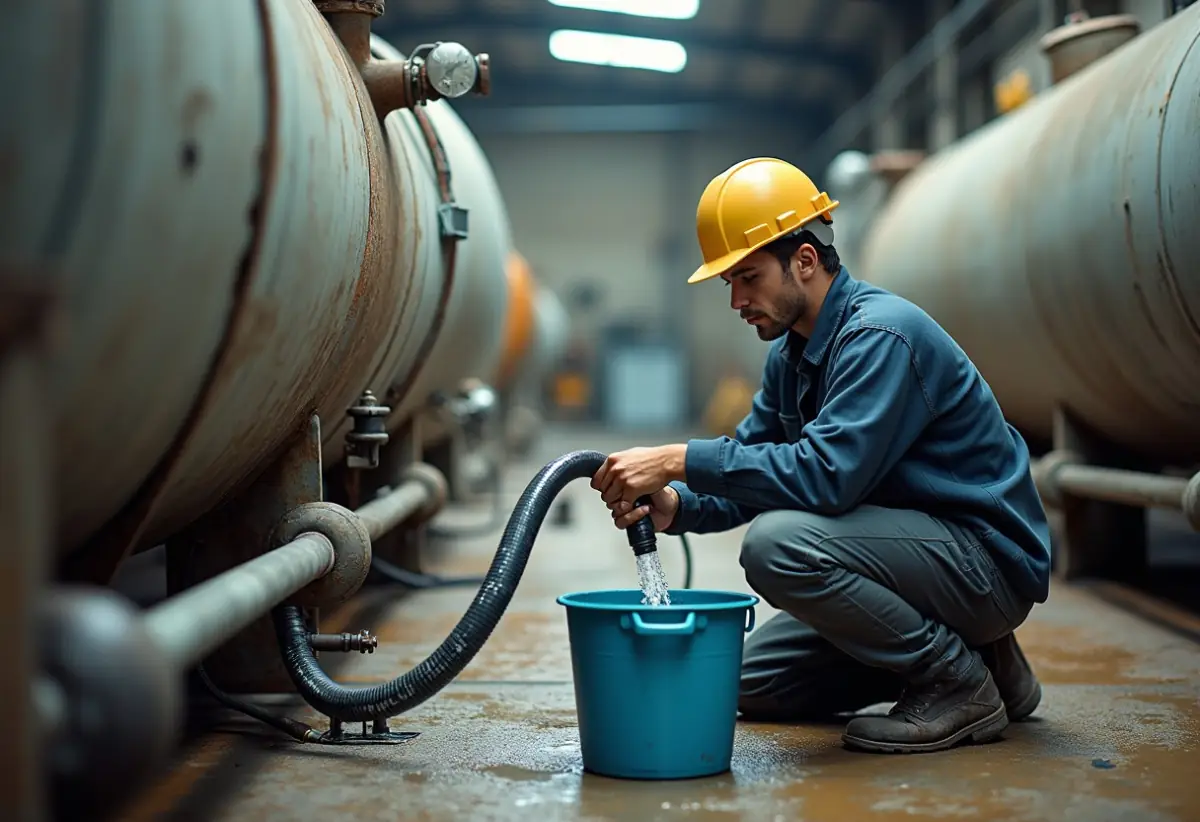
GPM is more important for a sewer jetter. Pressure breaks the clog face, but flow powers the rear jets that pull the hose and flushes debris out of the line. Professional jetter makers hold pressure near 3,000 PSI and add flow to clean bigger pipes, which tells you where the cleaning power really sits.
Professional machines make the case. The General Pipe Cleaners lineup holds pressure at 3,000 PSI from the JM-2900 to the JM-3080 while flow climbs from 4 to 8 GPM, and pipe capacity climbs with it, up to 8 inch lines. The JM-2512 Typhoon actually drops pressure to 2,500 PSI to deliver 12 GPM for large lines.
The CAM Spray sewer and drain catalog sizes by flow too: about 2 GPM for pipes up to 4 inches, 3 GPM up to 6 inches and 4 to 8 GPM up to 8 inches.
What PSI and GPM does a pressure washer need to run a sewer jetter?
A pressure washer needs about 2 GPM to run a sewer jetter in a 4 inch line and can get by on 1.2 to 1.5 GPM in 1-1/2 to 2 inch kitchen, lavatory and laundry drains. Most kit hoses are rated well above any home washer’s PSI, so flow is the limit. Gas washers in the 2.5 GPM class are the practical floor for main-line work.
Real examples: the Ryobi RY142300 electric runs 2,300 PSI at 1.2 GPM, and the Westinghouse WPX3200 gas unit runs 3,200 PSI at 2.5 GPM, per a side-by-side spec listing. Multiply PSI by GPM and the gas unit scores 8,000 cleaning units to the Ryobi’s 2,760.
The 1.2 GPM electric is not hopeless. RIDGID builds its KJ-1750 electric jetter at only 1.4 GPM and rates it for 1-1/4 to 4 inch drains, per the RIDGID KJ-1750 page. The difference is a nozzle and hose matched to that flow, plus a pulse feature that helps the hose work around bends.
Which sewer jetter kit hose, length and fittings should you buy?
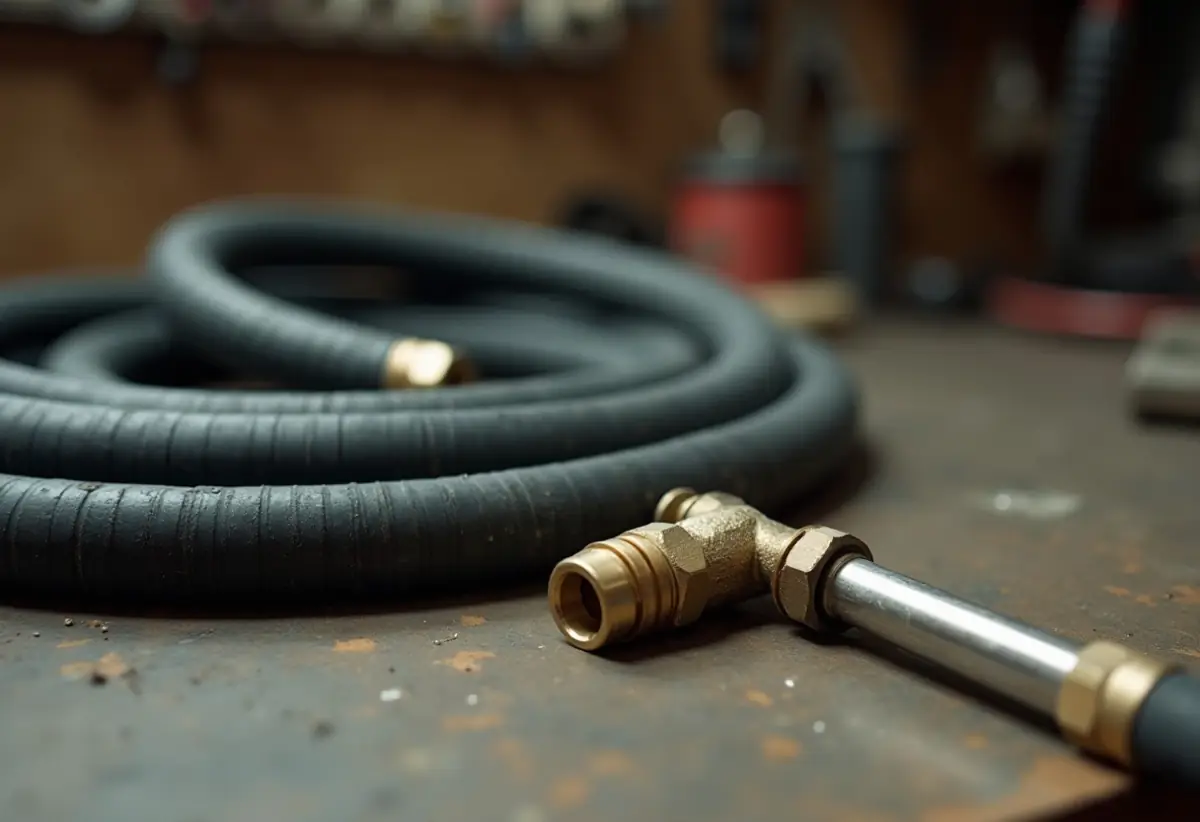
Buy the shortest hose that reaches the clog from your cleanout, in 1/4 inch size for 3 and 4 inch lines and a smaller trap-size hose for 1-1/2 and 2 inch drains. Confirm the kit’s adapter matches your washer outlet, usually an M22 thread or a 3/8 inch quick connect. Jetter hose is sold in 1/8, 1/4, 3/8 and 1/2 inch sizes, per General Pipe Cleaners.
Length is a trade. Retail kits run 25, 50, 100 and up to 200 feet, and every extra foot of small-bore hose eats pressure before the water reaches the nozzle. A 25 foot kit sold at Lowe’s lists 3,600 PSI working pressure, while many 100 foot kits advertise 5,800 PSI, both far above what any home washer makes.
| Kit or hose | Hose size | Length | Inlet fitting | Max PSI | Rated flow or nozzle size |
|---|---|---|---|---|---|
| MTM Hydro 43.5002 Jetter Genie | 1/4 in | 100 ft | 3/8 in male quick connect; M22 male to 3/8 in MNPT adapter | 4,000 | 4.5 GPM |
| RIDGID 67332 KJ-1750 with trap hose | 1/4 in | 100 ft | Machine reel | 1,750 (machine) | 1.4 GPM |
| RIDGID 63882 KJ-2200-C jet hose | 1/4 in | 110 ft | Machine reel, H-30 cart | 2,200 (machine) | 2.4 GPM |
| General JM-1450 reel | 1/8 to 1/2 in options | 150 ft reel | Removable reel | 1,500 (machine) | 1.7 GPM |
| Dultmeier size 5.5 rotating nozzle | Fits 1/4 in hose end | Nozzle only | 1/4 in FPT inlet | 3,000 | Size 5.5 |
| Dultmeier size 5.0 rotating nozzle | Fits 3/8 in hose end | Nozzle only | 3/8 in FPT inlet | 4,000 | Size 5.0 |
Nozzles carry female pipe threads (1/4 inch FPT is the common kit size), so the hose end needs a matching male thread and PTFE tape. Retail reviews also report kits arriving without the washer adapter, so check the parts list on delivery.
How do you size a sewer jetter nozzle orifice to your pressure washer?
Size a sewer jetter nozzle by its number, which is the flow in GPM at 4,000 PSI. Nozzle number equals your washer’s GPM times the square root of 4,000 divided by its PSI. A 2,300 PSI, 1.2 GPM Ryobi works out to about 1.6, and a 3,200 PSI, 2.5 GPM Westinghouse to about 2.8. Then round up a little to cover hose loss.
We checked the rule against a real listing. The Zoro Select size 6.5 sewer nozzle (0.06 inch orifice) lists 7.27 GPM at 5,000 PSI and 2.91 GPM at 800 PSI. Run 6.5 through the square-root rule at those pressures and you get 7.27 and 2.91, a match to the hundredth.
Hose friction pushes the right size up. Sewer Jet Gazette works a 3,000 PSI, 3.0 GPM washer feeding 100 feet of 1/4 inch hose to an ideal orifice near 3.6, against 3.46 from the bare formula. For professional-grade nozzles it divides by 0.8 to cover manufacturing tolerance, which lands near 4.5. Suttner advises sizing sewer nozzles for the most flow possible.
| Washer or case | PSI | GPM | Formula nozzle number | Pick |
|---|---|---|---|---|
| Ryobi RY142300 (electric) | 2,300 | 1.2 | 1.58 | 1.5 to 2.0, short runs only |
| Westinghouse WPX3200 (gas) | 3,200 | 2.5 | 2.80 | 3.0 |
| Sewer Jet Gazette example, 100 ft of 1/4 in hose | 3,000 | 3.0 | 3.46 | 3.6 (4.5 for pro-grade) |
| MTM Jetter Genie kit ceiling | 4,000 | 4.5 | 4.50 | Kit limit, do not exceed |
Too small an orifice forces pressure above the washer’s rating and sends the pump into bypass, which heats the water in the pump. Too large and pressure collapses, so the rear jets lose their pull.
What pipe sizes can a pressure washer sewer jetter clear, and when do you need a pro?
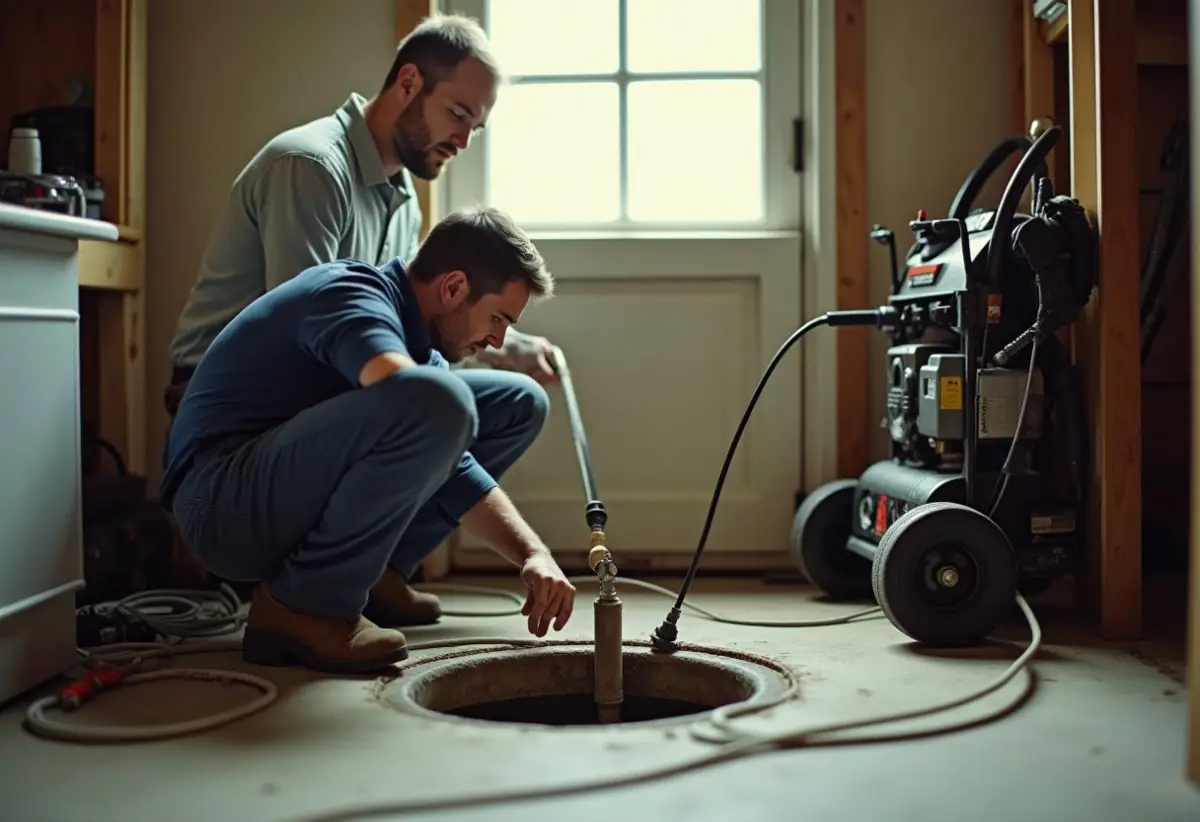
A pressure washer sewer jetter clears grease, soap scum and soft sludge in 1-1/2 to 4 inch lines, the same range RIDGID assigns its 1.4 GPM KJ-1750. It does not cut root masses, remove hard scale from cast iron or clean 6 inch and larger mains. Those jobs call for 4 to 12 GPM professional jetters, often after a cable machine.
- Good fit: kitchen lines with grease buildup, laundry drains with lint and soap, 3 inch branch lines, a 4 inch house drain with sludge in a sound pipe.
- Pro territory: roots in clay or Orangeburg, tuberculated cast iron, and any 6 to 10 inch line. General rates its JM-3000 for 3 to 10 inch lines at 4 GPM and its JM-3080 for 8 inch lines at 8 GPM.
For roots, cable first and jet second. Our guide on how to snake the main sewer line covers cutter selection, and the drain snake vs hydro jetting breakdown explains which clog each tool beats. When the line needs a full wall scour, professional hydro jetting brings the flow a washer cannot.
How do you use a sewer jetter kit step by step?
Use a sewer jetter kit from a cleanout, never a toilet. Put on eyewear, feed the nozzle and at least a few feet of hose into the pipe, then start the washer and squeeze the trigger. Let the rear jets pull the hose, work the clog in short passes, and flush with water before pulling the hose out under low flow.
- Locate the nearest sewer line cleanout upstream of the clog and open the cap slowly, since a backed-up line can spill.
- Put on safety glasses or a face shield, gloves and boots. The rear jets spray back toward you at full pump pressure.
- Thread the nozzle onto the hose with PTFE tape, then connect the hose to the washer through the kit adapter (M22 or quick connect).
- Remove the washer’s spray wand or use the kit’s short trigger gun. Turn on the garden-hose supply and purge air.
- Feed the nozzle and several feet of hose into the cleanout by hand before any pressure. Never start the washer with the nozzle outside the pipe.
- Start the washer, squeeze the trigger and let the hose pull itself forward. Guide it, do not force it.
- At the clog, pulse forward and back in short strokes so the forward jet cuts and the rear jets flush.
- Once water drains freely, run a fixture upstream for a few minutes to carry the debris out.
- Release the trigger, shut off the washer, then pull the hose. Rinse the hose and nozzle and cap the cleanout.
Stop and call a plumber if the nozzle hangs at the same distance on three tries, if water comes back brown with clay or rust chips, or if the line backs up again within weeks. Those point to a broken pipe or roots, not grease. MTM Hydro limits its kit to pipes in good, sturdy condition, so camera clay, Orangeburg or old cast iron before jetting it.
How we sourced this
In October 2026 we reviewed live search results for jetter kits and nozzle sizing, then took specs from General Pipe Cleaners, RIDGID product and retailer pages, Kleen-Rite (MTM Hydro), Dultmeier, Zoro, a CAM Spray catalog and Sewer Jet Gazette. Ryobi and Westinghouse washer specs come from a retail spec comparison. We left out kit prices and any spec we could not confirm. Sizing-table nozzle numbers are our calculations, checked against Zoro’s size 6.5 data.
Frequently asked questions
Can I use any pressure washer as a sewer jetter?
Most gas pressure washers in the 2.5 GPM class can drive a jetter kit, but many consumer electrics struggle. MTM Hydro says its Jetter Genie kit will not work properly with consumer-grade electric washers. An electric unit like the Ryobi RY142300 at 1.2 GPM can clear a kitchen or laundry line with a matched small nozzle, though it lacks the flow to pull long hose runs.
Is PSI or GPM more important for a sewer jetter?
GPM matters more. Flow powers the rear jets that pull the hose up the pipe, and flow carries broken grease and sludge back to the opening. A CAM Spray catalog pairs roughly 2 GPM with pipes up to 4 inches and 3 GPM with pipes up to 6 inches. Suttner advises sizing a jetter nozzle for the most flow your machine allows.
What size sewer jetter nozzle do I need?
Match the nozzle number to your washer. The number equals the flow in GPM at 4,000 PSI, so nozzle number equals GPM times the square root of 4,000 divided by your PSI. A 3,200 PSI, 2.5 GPM washer lands near a 2.8 nozzle. Sewer Jet Gazette suggests going slightly larger to cover hose friction losses.
Can a pressure washer sewer jetter clear tree roots?
Not reliably. Washer kits run 1.2 to 4.5 GPM, while the General Pipe Cleaners JM-3080 trailer-style class runs 8 GPM at 3,000 PSI for lines up to 8 inches. Fine hair roots may flush loose, but a root mass usually needs a cable machine with a cutter head first, then a professional jetter to scour the pipe walls.
Can I use a sewer jetter in a toilet?
No. The rear jets spray backward at full pump pressure, and in a toilet they blast dirty water out of the bowl at your face. The porcelain trap also has tight bends a stiff jetter hose cannot pass safely. Pull the toilet and work from the closet flange, or better, go in from the main or branch cleanout.
How far will a pressure washer jetter hose go?
Kit hoses are sold in 25, 50, 100 and up to 200 foot lengths. Usable reach depends on flow, because every foot of small-bore hose costs pressure. RIDGID ships its KJ-1750 electric jetter with a 100 foot by 1/4 inch trap hose at 1.4 GPM, a useful benchmark for what a 1.2 to 1.5 GPM electric washer can push.
Will a sewer jetter damage old pipes?
It can. MTM Hydro limits its Jetter Genie kit to pipes and drains in good, sturdy condition. Cracked clay, offset joints and cast iron with thin walls or heavy scale can break apart under a pressure jet. Run a camera first on clay, Orangeburg or original cast iron, and stop if the nozzle keeps hanging at one spot.