Outdoor Shower Plumbing: Supply, Drain, and Freeze-Proofing
Outdoor shower plumbing comes down to three parts: a backflow-protected supply that drains before frost, an ASSE 1016 anti-scald valve capped at 120°F once hot water is added, and a drain your local code accepts.
Key Takeaways
- The 2021 IPC, Section 412.3, requires a pressure-balance, thermostatic or combination shower valve meeting ASSE 1016 or ASME A112.18.1, with a limit stop set so water stays at or below 120°F.
- IRC Section P2902.4.3 requires a vacuum breaker on every hose bibb, including one feeding a shower through a Y splitter.
- PEX UV ratings run 0, 1, 3 or 6 months under the code PPI describes; Uponor rates white AquaPEX for 1 month, so sunlit runs belong in copper.
- The DOE Building America Solution Center says uninsulated pipes in unconditioned space begin to freeze around 20°F.
- Angi’s 2026 data puts a professionally installed dry well at $1,334 to $5,139, with a $3,110 national average.
- Arizona (R18-9-711) and Texas (30 TAC 210.83) let home greywater systems under 400 gallons per day run without agency sign-off.
What does outdoor shower plumbing include?
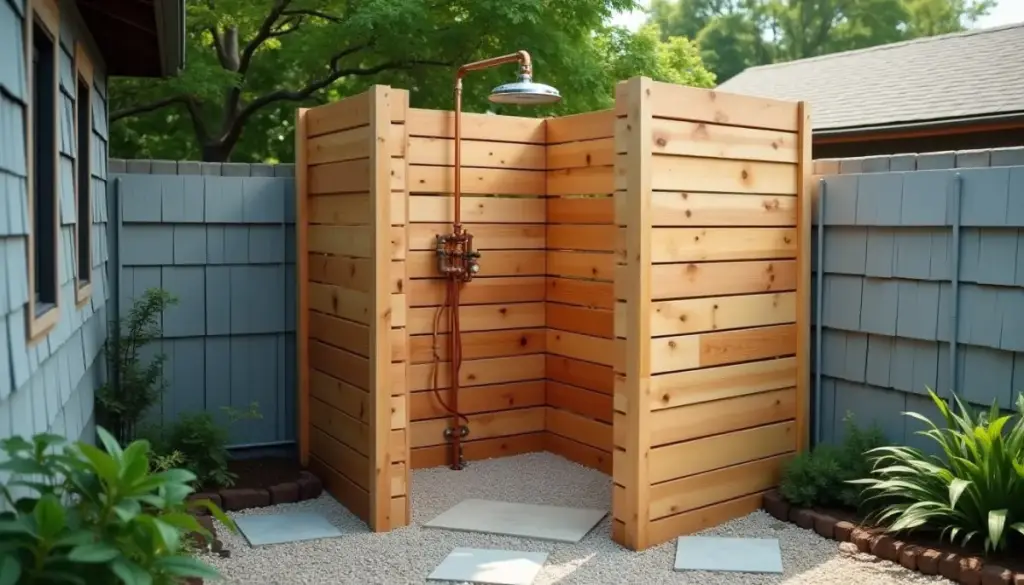
Outdoor shower plumbing includes a cold supply, an optional hot supply, a mixing valve, a riser and head, and a drain. In any climate that sees frost, it also needs a way to empty every pipe outside the heated envelope. The diagram shows the common layout: shutoffs indoors, lines pitched toward a low-point drain, and a gravel dry well under the floor.
The valve, riser and head match an indoor shower; for valve heights and drain sizes, see our indoor shower plumbing diagram. Outside, sunlight, frost and drainage change the design.
How do you plumb an outdoor shower for cold and hot water?
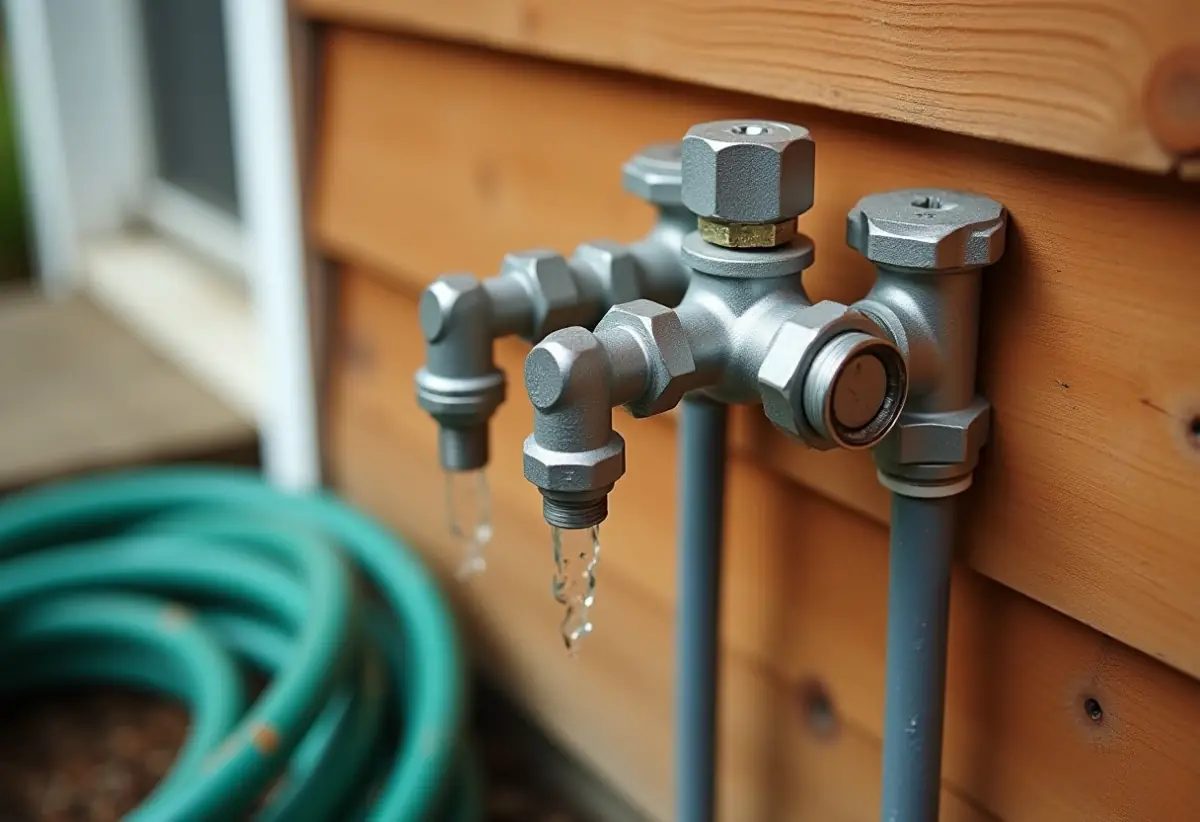
There are three common supply setups. A cold-only shower runs off a Y splitter on an existing hose bib. A hot and cold shower can draw from a hot hose bib set beside the cold one, which This Old House says makes hookup easy. The cleanest build runs dedicated hot and cold lines from inside the house to a wall or post valve.
- Hose bib with a Y splitter (cold only). No new pipe. IRC Section P2902.4.3 requires a vacuum breaker on every hose connection, so add an ASSE 1011 unit if the faucet lacks one. Woodford lists the 34H at $23.20 (February 2026) for non-freezing areas; its 34HD drains after about 3 counterclockwise turns.
- Hot and cold hose bibs. A second bibb teed off the water heater’s hot line. It is a hose connection too, so it needs the same vacuum breaker.
- Dedicated hot and cold runs. Two lines leave the heated space through the rim joist and pitch downhill to an ASSE 1016 valve at the shower.
If the tie-in is a frost-free sillcock, mind the pressure limit. Woodford’s instruction sheet says its ASSE 1019 faucets “shall not be subjected to more than (12) hours of continuous water pressure,” so close the faucet after each use. For a new tie-in point, see our guide to installing an outdoor faucet, which covers the 1-1/8 inch hole and stem length.
Which shower valve does code require for outdoor shower plumbing?
If the shower mixes hot and cold water, plan for the same valve rule as an indoor shower. The 2021 International Plumbing Code, Section 412.3, calls for pressure-balance, thermostatic or combination valves conforming to ASSE 1016/ASME A112.1016/CSA B125.16 or ASME A112.18.1/CSA B125.1, with a limit stop adjusted so water does not exceed 120°F. Older IPC editions carried this rule as Section 424.3.
ASSE 1070 is a different standard. It covers point-of-use temperature limiting devices at sinks, lavatories and tub fillers, not the control valve on a shower, so an ASSE 1070 device does not replace an ASSE 1016 shower valve.
- Pressure-balance (Type P). Holds the hot-to-cold ratio when pressure on one side drops.
- Thermostatic (Type T). Senses and holds outlet temperature, useful on a long hot run.
- One body, both options. Delta lists its R10000-PFT-PX rough-in body at $116.50; it accepts Delta’s pressure-balance cartridge or its TempAssure 17T thermostatic cartridge.
Set the limit stop at install: run full hot, read the outlet with a thermometer, and rotate the stop until it reads 120°F or less. Recheck each spring.
What pipe should you use for outdoor shower plumbing?
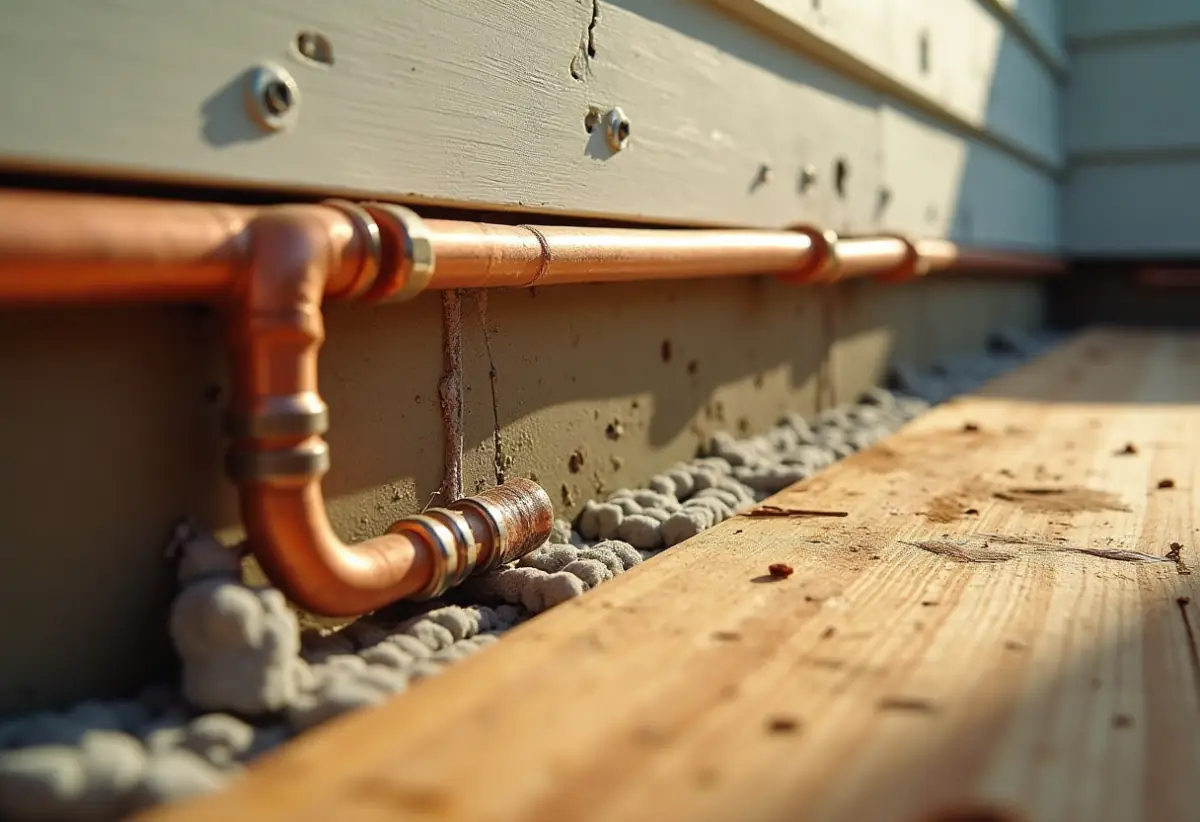
Use copper for anything in the sun, and keep PEX inside walls, under decking, in conduit or behind UV-blocking insulation. PEX carries a UV rating, and the material designation code that PPI describes grades it at 0, 1, 3 or 6 months of sunlight. Uponor rates its white AquaPEX for 1 month and its red and blue pipe for 6 months.
That UV exposure is cumulative, so days a coil sat in the yard before install count against the rating. A permanent outdoor shower uses up even a 6 month rating in its first summer, which is why the exposed riser, shower arm and valve connections should be copper or brass.
Strap concealed PEX at close intervals so it cannot sag. A sag is a low spot, and a low spot holds water through winter.
How do you keep outdoor shower plumbing from freezing?
Put the shutoffs inside heated space and make every outdoor pipe drain to one low point. The DOE Building America Solution Center notes uninsulated pipes in unconditioned space begin to freeze around 20°F. IRC Section P2903.10 requires an inside stop-and-waste valve for an outdoor faucet unless a frostproof stem reaches heated space, and the same logic protects shower supplies.
- Stop-and-waste valves indoors. One per line, each with a bleed cap to let air in.
- Continuous pitch. Run both lines downhill from the wall to the valve with no dips, which is also how a frost-free faucet drains itself.
- A low-point drain cock. Tee it in below the mixing valve so the valve body and both lines empty to one spot.
- A removable head. Unscrew it and store it inside for winter.
For a cold-only shower, a frost-free sillcock does most of this work. Woodford stocks the Model 17 in 4 to 24 inch lengths with an ASSE 1019 backflow device built in, and Woodford states the faucet will not rupture from freezing when the valve is shut and the hose is removed. Leave a Y splitter or hose on it and the barrel cannot drain.
Where should an outdoor shower drain go?
An outdoor shower drains to one of three places: a gravel dry well or bed, a greywater irrigation system, or the house sewer. Shower water counts as greywater under the state codes we reviewed, so two offices decide which option you may use: your state greywater rules and your county environmental health department, which sets setbacks from wells and septic systems.
Gravel dry well
Size the dry well from the water it must absorb. A WaterSense showerhead flows no more than 2.0 gallons per minute, so a 10 minute shower sends about 20 gallons (roughly 2.7 cubic feet) into the ground. Clay takes that slowly, so run a percolation test first.
Angi’s 2026 dry well cost data puts materials at $50 to $250 for gravel, $90 to $650 for a plastic unit and $300 to $4,500 or more for concrete, with a percolation test at $150 to $1,000.
Greywater rules in four states
- California: greywater falls under Chapter 15 of the California Plumbing Code. Only qualifying clothes washer systems skip the construction permit, per Greywater Action’s transcription of the code, so a shower branched drain usually needs one.
- Arizona: the Type 1 general permit (R18-9-711) covers systems under 400 gallons per day with no notice to ADEQ, if water stays on the property.
- Texas: 30 TAC 210.83 allows systems under 400 gallons per day without TCEQ authorization, with no overflow onto the ground.
- Oregon: DEQ general permit 2401 allows subsurface irrigation only, with 4 feet of separation to groundwater.
Greywater Action advises low-sodium, boron-free soaps, because salt and borax build up in soil and damage plants. Our greywater system guide compares the state paths in depth.
House sewer
A sewer connection needs a trap, freeze protection and a permit, per home inspection guidance. It is the usual fallback where your county bars discharge to soil.
How do you winterize an outdoor shower, step by step?
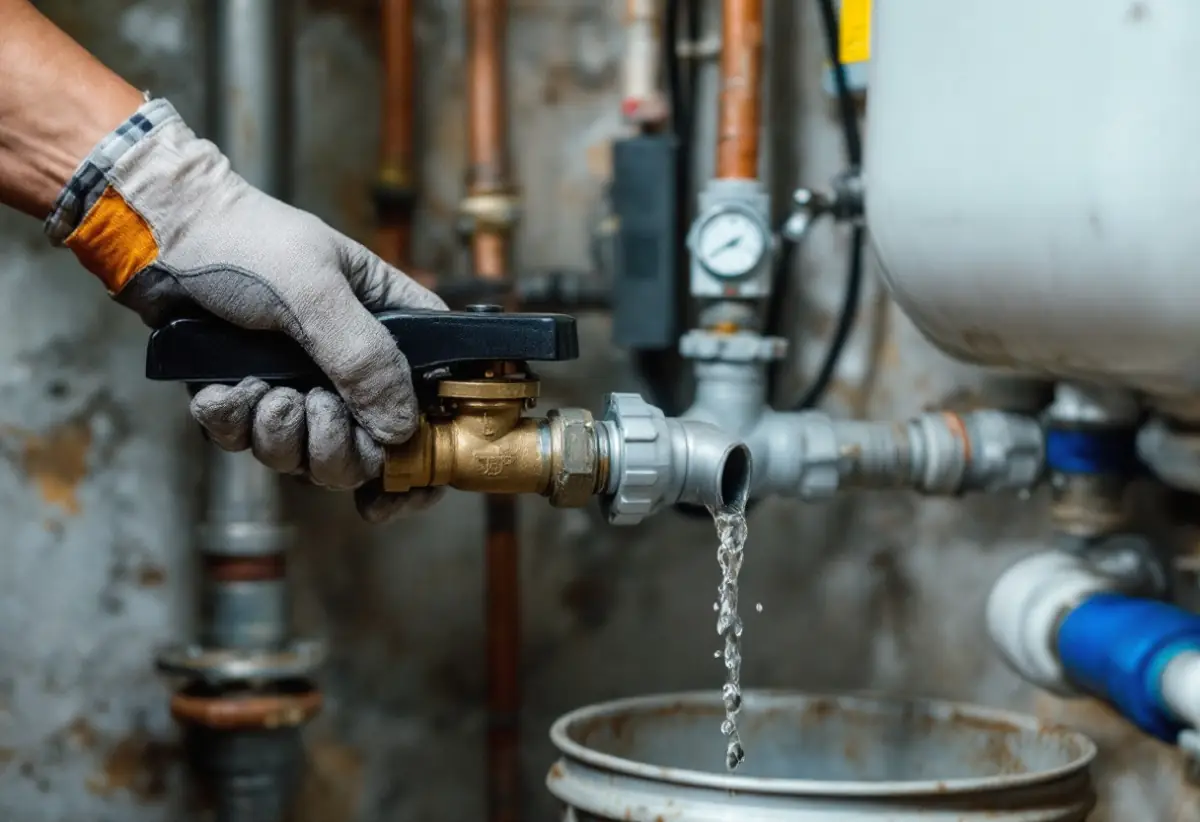
Winterize before outdoor lows approach 20°F, the point where DOE notes uninsulated pipes start to freeze. Close the water off indoors, let air in, and leave every outdoor section open so nothing traps water. With stop-and-waste valves and a low-point drain cock in place, it takes eight steps.
- Close the indoor stop-and-waste valves on the hot and cold shower lines.
- Open the outdoor mixing valve to the midpoint so both the hot and cold sides drain.
- Open the low-point drain cock and leave it open.
- Open the bleed caps on the indoor valves so air replaces the water.
- Unscrew the shower head and any handheld hose and store them indoors.
- Take the Y splitter and hose off the hose bib so a frost-free barrel can empty.
- Tag the indoor valves so nobody reopens them.
- In spring, close the drain cock and bleed caps, reopen the indoor valves and recheck the 120°F limit stop.
How much does outdoor shower plumbing cost?
HomeCostCalc’s September 2026 estimator puts a typical US outdoor shower at $1,460 to $9,960 all in. Drainage often costs more than supply, because Angi’s 2026 data puts an installed dry well at $1,334 to $5,139. A cold-only shower off an existing hose bib can cost little more than a vacuum breaker, a Y splitter and the fixture.
Bars are scaled to the top of each range against the $9,960 maximum.
| Component | Option | Code or standard | Cost (source) |
|---|---|---|---|
| Cold tie-in | Frost-free anti-siphon sillcock, such as Woodford Model 17, with a Y splitter | ASSE 1019; IRC P2903.10 stem rule | $200 to $600 pro replacement; frost-free about $350 average (HomeAdvisor) |
| Hose backflow | Woodford 34H, 34HD or 50H hose vacuum breaker | ASSE 1011; IRC P2902.4.3 | From $23.20 list (Woodford, February 2026) |
| Mixing valve | Delta R10000-PFT-PX body with a pressure-balance or TempAssure 17T cartridge | ASSE 1016 or ASME A112.18.1; 120°F limit stop (2021 IPC 412.3) | $116.50 body list (Delta); $350 to $650 installed upgrade (Fixr) |
| Exposed piping | Copper riser and arm; PEX only where shaded or sleeved | PEX UV rating of 1, 3 or 6 months (PPI code; Uponor) | Plumber labor at $50 to $200 per hour (Fixr) |
| Winter shutoff | Indoor stop-and-waste valves plus a low-point drain cock | IRC P2903.10 | Plumber labor at $50 to $200 per hour (Fixr) |
| Drain, simple | Gravel or plastic dry well | County health and stormwater rules; percolation test | $50 to $250 gravel or $90 to $650 plastic materials; $1,334 to $5,139 installed (Angi) |
| Drain, reuse | Branched greywater drain to mulch basins | CPC Chapter 15; ADEQ R18-9-711; 30 TAC 210.83 | $800 to $3,000 installed (Greywater Action) |
| Drain, sewer | Trapped connection to the building drain | Trap, freeze protection and permit | Permit fee set by your city or county |
How we sourced this
We reviewed about 40 ranking pages for “outdoor shower plumbing” and “how to plumb an outdoor shower” in October 2026 and cited 17 sources, led by ICC and IRC code text, ASSE scope documents, Woodford, Delta, Uponor and PPI documents, DOE, EPA WaterSense, Angi, HomeAdvisor, Fixr, Greywater Action and state greywater rules. We could not verify a frost-proof outdoor shower valve model, so none is named, and we excluded unsourced contractor cost figures. Setbacks vary by county, so we name the office to call.
Frequently asked questions
Can an outdoor shower drain into the ground?
Often yes, but the answer depends on your state greywater rules and county health department. Many homes send shower water to a gravel dry well or mulch basin. Arizona’s Type 1 permit and Texas rule 30 TAC 210.83 allow small home greywater systems without agency sign-off, while California handles shower greywater under Chapter 15 of its plumbing code, and branched drains there usually need a permit.
Does an outdoor shower need a mixing valve?
A cold-only shower does not, because there is nothing to mix. Once you add hot water, the 2021 International Plumbing Code, Section 412.3, calls for a pressure-balance, thermostatic or combination valve meeting ASSE 1016 or ASME A112.18.1. The valve needs a limit stop set so water at the head does not exceed 120 degrees F.
Can you hook an outdoor shower to a hose bib?
Yes, and it is the simplest setup. Thread a Y splitter onto the hose bib, add a hose vacuum breaker, and run a hose or short pipe to a shower head. IRC Section P2902.4.3 requires vacuum breaker protection on every hose connection. Turn the water off at the faucet after each use, because Woodford limits its ASSE 1019 faucets to 12 hours of continuous pressure.
How do you keep an outdoor shower from freezing?
Put the hot and cold shutoffs inside heated space, pitch every outdoor pipe toward one low-point drain, and open that drain before the first hard freeze. The DOE Building America Solution Center notes that uninsulated pipes in unconditioned space begin to freeze around 20 degrees F. Remove the shower head and any hose, and leave the drains open all winter.
Can you use PEX for an outdoor shower?
Yes, as long as the PEX is shaded. PEX carries a UV rating of 0, 1, 3 or 6 months of cumulative sunlight under the industry code PPI describes, and Uponor rates its white AquaPEX for 1 month. Run PEX inside walls, under decking or in conduit, and switch to copper for the exposed riser and shower arm.
Do you need a permit for an outdoor shower?
A hose-fed shower with no new piping usually needs no permit. A permit is common when you add a hot water line, tap supply pipes inside the house, connect the drain to the sewer, or build a greywater branched drain. Call your building department for the supply side and your county environmental health office for any drain that discharges to soil.