Hot Water Heater Keeps Tripping Breaker: Power-Off Element Tests
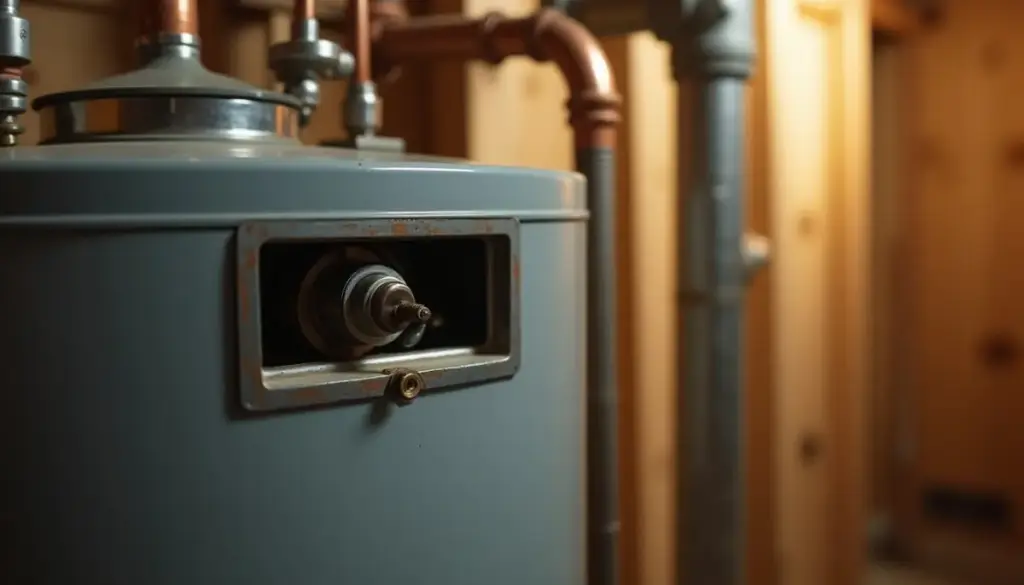
A hot water heater that keeps tripping the breaker usually has an element shorted to the tank, a scorched wire connection or a breaker too small for the element. With power off, a 4500 W, 240 V element should measure 12.8 ohms across its terminals and infinite to the tank.
What should a 3000, 3500, 4500 or 5500 W element measure, and what breaker does it need?
Each row is arithmetic from the wattage and voltage on the heater’s rating plate: amps are W divided by V, ohms are V squared divided by W, and the breaker is the next standard size at or above 125% of the amps.
| Element | Volts | Amps | Ohms | 125% of amps | Minimum breaker | Copper wire |
|---|---|---|---|---|---|---|
| 3,000 W | 240 V | 12.50 A | 19.20 | 15.63 A | 20 A | 12 AWG |
| 3,500 W | 240 V | 14.58 A | 16.46 | 18.23 A | 20 A | 12 AWG |
| 4,500 W | 240 V | 18.75 A | 12.80 | 23.44 A | 25 A | 10 AWG |
| 5,500 W | 240 V | 22.92 A | 10.47 | 28.65 A | 30 A | 10 AWG |
| 3,000 W | 208 V | 14.42 A | 14.42 | 18.03 A | 20 A | 12 AWG |
| 3,500 W | 208 V | 16.83 A | 12.36 | 21.03 A | 25 A | 10 AWG |
| 4,500 W | 208 V | 21.63 A | 9.61 | 27.04 A | 30 A | 10 AWG |
| 5,500 W | 208 V | 26.44 A | 7.87 | 33.05 A | 35 A | 8 AWG |
The 125% comes from NEC Section 422.13, which covers fixed storage heaters of 120 gallons or less. EC&M’s code quiz says the 2023 edition sized the branch circuit at 125% of the rating and the 2026 edition calls the heater a continuous load outright. States adopt editions on their own schedule, with local amendments.
The wire column follows the Branch Circuit Sizing and Wire Size Guide in Rheem manual AP11058, based on NEC Table 310-16 at 75°C: 20 A with 12 AWG, 25 A and 30 A with 10 AWG. Its 3,000 W and 4,500 W rows match this table at both voltages. It has no 3,500 W or 5,500 W row, so those rows apply its breaker and wire pairings. It has no 35 A row, so the 8 AWG figure rests on the 2 x 35 A with 8/2 AWG pairing on the Stiebel Eltron Tempra spec sheet.
The common “4500 W needs 30 A” line overstates the minimum. At 240 V the calculation lands on 23.44 A, so 25 A with 10 AWG satisfies 125%, and that is what Rheem lists. A 30 A breaker on 10 AWG is also common: a study-guide summary of NEC 422.11(E) caps protection at 150% of an unmarked appliance’s rating, here 28.1 A, and allows the next standard size. A maximum marked on your rating plate overrides that.
Three thresholds help when a reading is off. At 240 V, an element measuring under 12 ohms pulls more than 20 A, under 9.6 ohms more than 25 A, and under 8 ohms more than 30 A.
How do you prove 240 V is off before touching the element terminals?
Prove it with a two-probe meter at the heater, because Rheem’s element replacement sheet requires verifying with a volt meter that power is disconnected, and a panel label can be wrong.
- Switch the double-pole breaker off and tape it.
- Check the meter on a known live 120 V outlet, set to an AC volts range that covers 240 V.
- Open the junction box or upper access panel without touching bare metal.
- Measure L1 to L2, L1 to ground and L2 to ground. All three must read 0 V.
- Check the meter on the same outlet again, which shows the 0 V readings came from a working meter.
Any voltage in step 4 with the breaker off means a mislabeled or miswired circuit. Close the cover and hand it to an electrician, and do not use a non-contact tester as the only check. Without a meter rated for 240 V, stop here and hire an electrician for these readings.

Where do the probes go on a two-element tank?
The probes go at five points, all with the power off and the wires pulled from the element under test, so the meter cannot read a parallel path through the thermostat.
Rheem’s AP11058 gets you to these points: remove the jacket access panel and insulation, and leave the thermostat’s protective cover on where a model has one. Label each wire by position first. Use the lowest ohms range for B and D and the highest for C and E.
Point A is the shortcut. On a cold tank, L1 to L2 at the heater side of the junction box shows one element’s ohms through the ECO and upper thermostat. Near 0 ohms means a short inside the heater, and OL on a cold tank means an open ECO or a burned-out element. OL on a fully hot tank is normal, since both thermostats have opened.
C and E are the ground test. The coil is insulated from its metal sheath, so a healthy element shows OL, or infinite, from each of its 2 terminals to the flange. Any number at either terminal fails it, even a high one.
The ECO check is separate: after pressing the red RESET button, each pair of ECO terminals should show near 0 ohms. Rheem places this control above the element against the tank surface, where it breaks the power circuit when water overheats. Never jumper it. A popped ECO alone leaves the breaker on, which is the path covered in our guide to no hot water with the breaker still on.
Instant trip, trip after minutes, trip on reheat, trip after a new part: what does each prove?
The timing separates a short from an overload, because a healthy 5500 W element at 22.92 A stays under a 30 A breaker on its own. Reset once at most, note the timing, then take readings with the power off.
| When it trips | What that proves | Reading that confirms it |
|---|---|---|
| Instantly at reset | Fault current from a short or ground path, not overload. | B or D near 0 ohms, or any number at C or E. If all pass, disconnect the heater at the junction box: feed wire to ground near 0 ohms puts the short in the house wiring. |
| After minutes of heating | Overload or heat at the breaker’s thermal side: amps too high, or a loose lug cooking the breaker. | B or D under the table value, a breaker smaller than its row, or a plate marked for simultaneous elements. If those are fine, an electrician’s clamp should show W divided by V, 18.75 A per leg for 4500 W. Normal amps plus a trip means the breaker or its lug. |
| Only during reheat, after a long draw | A fault tied to one element, or one that appears only when hot. The upper element runs first; the lower takes over once the upper thermostat is satisfied. | Repeat C and E immediately, tank hot: an element can show OL cold and a number hot. An early trip in recovery points to the upper element, a late trip to the lower. |
| Right after a new element or thermostat | The circuit held before, so suspect the new part or the reassembly: wrong voltage, pinched wire, dry fire. | B or D against the rating plate row: 7.87 ohms is a 208 V, 5500 W element. Test each loose wire end to the tank: any number means a pinched conductor. A number at C or E after a fill that left air in the tank points to a dry fire. |
Rheem’s replacement sheet says to hold a hot faucet open during refill and close it only after constant flow without air, since an improperly filled tank damages the element. A replacement must match flange, gasket type, wattage and voltage, and comes out with a 1-1/2 inch socket on a screw-in element or 3/8 inch on a four-bolt. Use those specs when you swap the failed element.
Check every connection during the same inspection. At the breaker, junction box, thermostat and element, a loose lug shows as browned insulation, melted thermostat plastic or a wire that moves under a finger. Rheem’s startup checklist in AP11058 asks for connections tight and the unit properly grounded.
Which wrong parts push a 240 V circuit past its breaker?
Parts rated for 208 V are the worst mismatch, because power rises with the square of voltage: a 5500 W, 208 V element on a 240 V supply makes 7,322 W at 30.5 A.
| Installed part | Ohms | Supply | Real watts | Real amps | Result |
|---|---|---|---|---|---|
| 5500 W, 208 V element | 7.87 | 240 V | 7,322 W | 30.5 A | Over a 30 A breaker |
| 4500 W, 208 V element | 9.61 | 240 V | 5,991 W | 25.0 A | At the limit of 25 A |
| 5500 W, 240 V element | 10.47 | 240 V | 5,500 W | 22.9 A | 92% of 25 A, fails 125% |
| Two 4500 W elements at once | 6.40 | 240 V | 9,000 W | 37.5 A | Over a 30 A breaker |
| 4500 W, 240 V element | 12.80 | 208 V | 3,380 W | 16.25 A | No trip, slow recovery |
The last row is within 5 W of Rheem’s ProTerra spec sheet, which says a 4.5 kW element falls to 3.375 kW on 208 V. Non-simultaneous wiring, as labeled on A.O. Smith’s residential wiring diagram, is what holds two 4500 W elements to 18.75 A. If this is the second failed element on a leaking tank, price a new heater against gas and electric running costs before buying a third.
When does a tripping water heater breaker need a licensed electrician?
An electrician is required once B through E all pass and the breaker still trips, because the fault is then in the circuit. Rheem’s AP11058 says the branch circuit, overcurrent device and disconnect must be provided by a qualified electrician, and it tells owners to refer repairs of wiring, thermostats and elements to qualified service personnel. A meter reading with the power off is not a repair, but your warranty or state may limit who replaces parts.
- Scorched breaker or panel lug: ask for a breaker type listed on the panel door label and an inspection of the bus. A breaker that fits the slot may not be listed for that panel.
- Feed wire near 0 ohms to ground: ask for the 240 V run to be insulation-tested from panel to junction box.
- Circuit smaller than its table row: a move from 20 A on 12 AWG to 25 A or 30 A needs new 10 AWG. Never change the breaker alone.
- Aluminum branch wiring: the Rheem guide lists copper sizes only.
- Flood or water in the wiring compartment: Rheem says keep power off until qualified personnel check the heater.
Ask for 3 figures in writing: voltage at the heater under load, amps on each leg, and the breaker’s size and type. Compare them against the first table.
Why don’t these numbers apply to tankless or heat pump units?
Tankless and heat pump units carry their own breaker specifications, so use the maker’s sheet instead of this table. Rheem’s ProTerra hybrid spec sheet lists a 30 A breaker and 21 maximum amps on models such as the PROPH50 T2 RH400-SO, with a 4,500 W element and 5,000 W total unit wattage.
Stiebel Eltron’s Tempra sheet lists 1 x 50 A on the Tempra 12 Plus at 240 V, 2 x 50 A on the 24 Plus and 3 x 50 A on the 36 Plus, each breaker on its own wire run. Our page on electric tankless breaker and panel sizing lists the service each model needs.
How we sourced this
We read Rheem Use and Care Manual AP11058 Rev. 10 (a double-element manual whose wiring section cites both the NEC table and the Canadian Electrical Code), Rheem’s tune-up kit sheet, the ProTerra and Tempra spec sheets, and EC&M’s Section 422.13 coverage; the A.O. Smith wiring label was seen only as a manual excerpt. We did not read the NFPA 70 text directly, and Section 422.11(E) comes from a study-guide summary. All amps, ohms, breaker minimums and wrong-part figures are our arithmetic; nothing was bench-tested. We found no maker document printing a pass value for the element-to-tank test, so the OL rule rests on the coil’s insulation and common trade practice. Trip times and repair costs had no primary source and were left out.
Other breaker questions from electric tank owners
Can a bad thermostat trip the breaker on a water heater?
Yes, when a thermostat terminal shorts to its bracket or the tank. With the power off and the wires off, test each terminal to bare tank metal and expect OL. Stuck contacts are different, because they overheat the water and open the ECO without raising the 18.75 A draw of a 4500 W element.
Can I install a bigger breaker to stop the trips?
No. Rheem’s guide stops at 30 A for 10 AWG copper, so a 40 A breaker on that wire removes its protection, and a shorted element still heats the circuit. Find the fault first. Moving from 25 A to 30 A on existing 10 AWG depends on the rating plate.
Why does the red reset button pop while the breaker stays on?
The ECO senses tank temperature, not current, so it can open while the breaker sees a normal 18.75 A load on a 4500 W unit. Rheem manual AP11058 says a technician must investigate the cause before the heater returns to service.
How many times should I reset a tripping water heater breaker?
Once. A second trip is your evidence, so leave the breaker off, prove 0 V at the heater and take readings A through E while the tank is still hot. Every extra reset sends fault current through the same lugs, element and 10 AWG wire without telling you anything new.
Can sediment in the tank make the breaker trip?
Not by raising amps, because draw is set by volts and ohms, and a scaled 4500 W element still measures about 12.8 ohms. Buried elements run hotter, though, and a sheath that cracks from that heat creates a ground fault, which shows as a number at reading C or E.