Low Water Pressure in Kitchen Faucet: Find the Cause in 10 Minutes
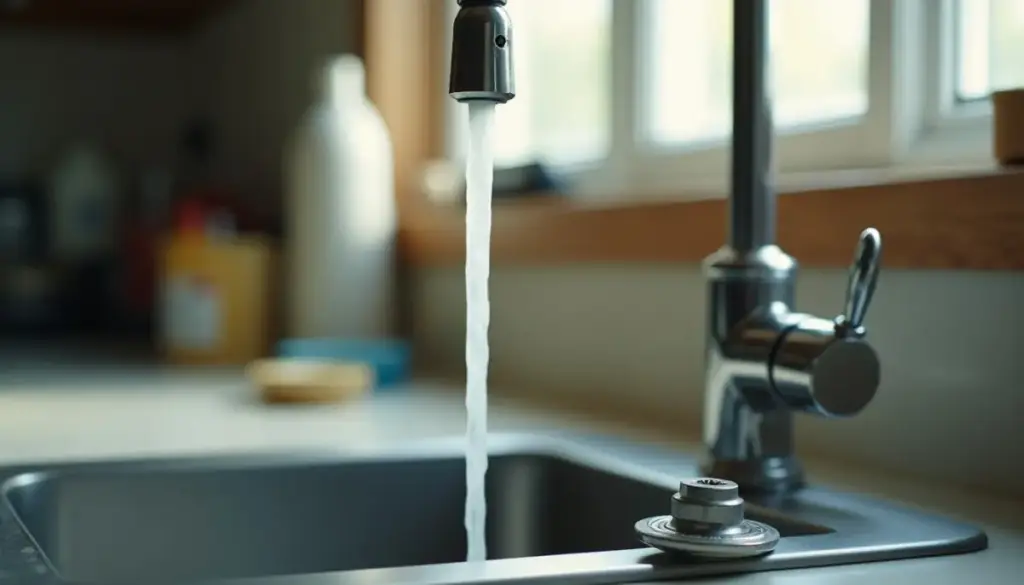
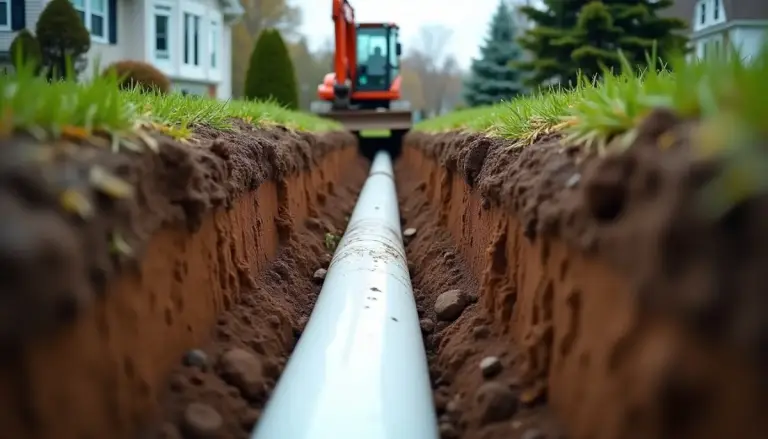
Low water pressure in kitchen faucet only, with the rest of the house fine, is a fixture restriction: aerator, spray head, angle stop, supply line or cartridge. A bucket and stopwatch tell you which in 10 minutes.
Key Takeaways
- Federal law caps kitchen faucets and kitchen replacement aerators made after January 1, 1994 at 2.2 gpm at 60 psi, per 10 CFR 430.32(o).
- California and Colorado hold kitchen faucets to 1.8 gpm at 60 psi, with an optional temporary boost to 2.2 gpm that must reset to 1.8, per the California Plumbing Code and C.R.S. 6-7.5-105.
- A 1-gallon jug fills in about 27 seconds at 2.2 gpm and about 33 seconds at 1.8 gpm (our math from those limits), so a fill that takes far longer than the rated time confirms a restriction.
- Moen’s low-flow test is to unthread the pull-down spray head and run the bare hose. Weak flow from the hose points to the cartridge, per Moen Solutions.
- Pre-2009 Moen single-handle kitchen faucets take the 1225 cartridge ($35.88 on Moen.com, October 28, 2026); Delta single-handle DIAMOND faucets take the RP50587 ($61.68 on Delta.com).
- If every fixture is weak, look upstream. IPC Section 604.8 requires a pressure-reducing valve where static pressure exceeds 80 psi, and a failing one weakens every tap.
Why is there low water pressure in my kitchen faucet only?
Low water pressure in a kitchen faucet only means something between the angle stop and the spout tip is blocking flow. The pattern tells you which part. Weak hot and cold together points to the aerator, spray head or whole cartridge. Weak on one side only points to that side’s stop, supply line or cartridge port. Weak at every tap means the house supply.
| Symptom | Likely cause | 10-minute test | Fix |
|---|---|---|---|
| Both sides weak, sudden, after a water main repair | Grit packed in the aerator or spray head screen | Unscrew the aerator, run the faucet bare | Rinse the screen, soak scale in white vinegar, or replace |
| Both sides weak, pull-down faucet, bare spout no better | Clogged spray head | Moen method: towel on hose, unthread head, run bare hose | Clean or replace the spray head |
| Bare hose also weak, both sides | Cartridge inlet ports clogged or worn | Bucket test at the angle stop (below) | Replace cartridge: Moen 1225 or Delta RP50587 on common models |
| One side weak at kitchen only | Partly closed angle stop or kinked 3/8 in. supply line | Open the stop fully, check the line for flat spots | Open stop, replace a kinked line or a stuck multi-turn stop |
| Hot weak at every fixture | Water heater inlet valve, sediment or fittings | Compare hot and cold at a tub spout | Open the heater’s cold inlet valve fully, flush, call a plumber if no change |
| Every tap weak, hot and cold | Failing pressure-reducing valve or partly closed main | Gauge on a hose bib, all water off | Open the main fully; adjust or replace the PRV |
Our full guide to low water pressure causes across the whole house covers galvanized pipe, hidden leaks and utility problems.
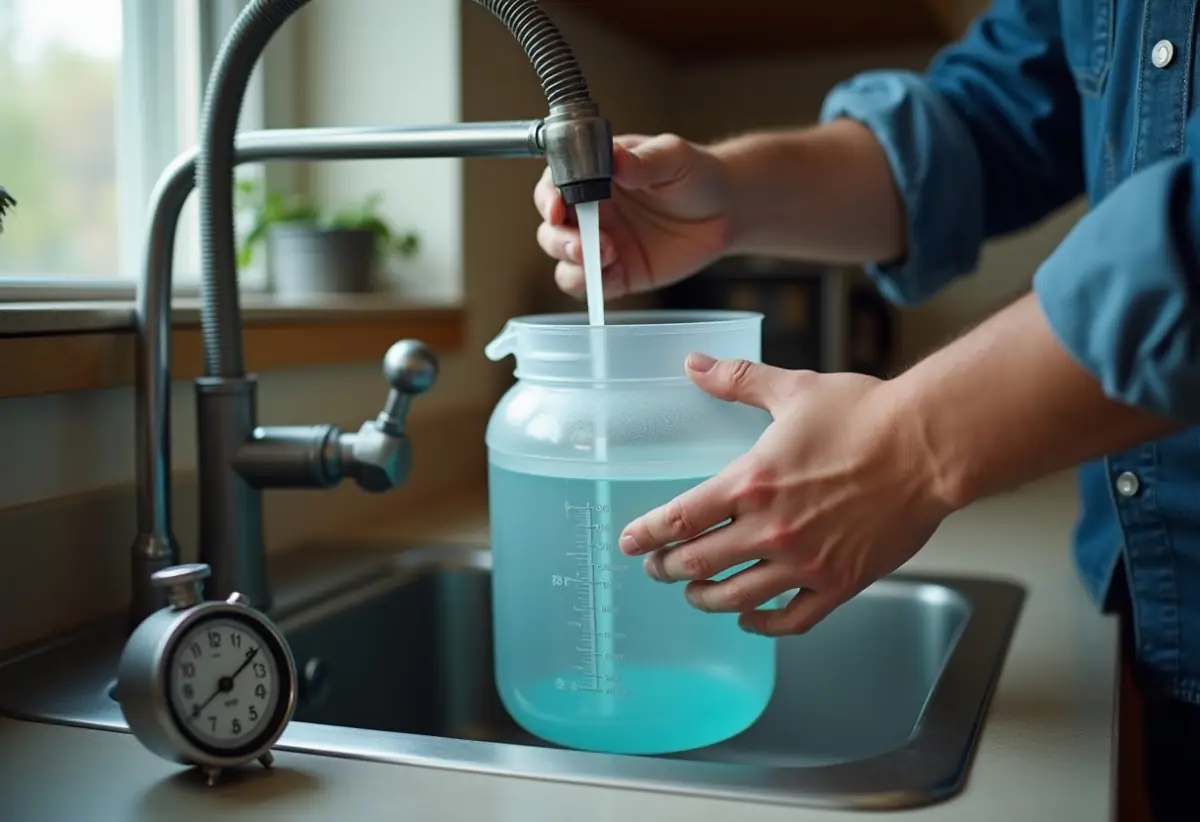
How do you measure kitchen faucet flow with a bucket and stopwatch?
Hold a 1-gallon jug under the faucet, open it fully, and time the fill. Divide 60 by the seconds to get gallons per minute. A healthy faucet rated 2.2 gpm fills the jug in about 27 seconds, a 1.8 gpm faucet in about 33 seconds, and a 1.5 gpm aerator in 40 seconds.
- Dock the spray head on stream. Open full cold and time the fill to the 1-gallon line, then repeat on full hot.
- Compute gpm as 60 divided by seconds. Write down both sides.
| Rated flow | Where you see it | Seconds to fill 1 gallon |
|---|---|---|
| 2.2 gpm | Federal maximum, most US kitchen faucets | 27.3 |
| 1.8 gpm | California and Colorado kitchen faucets | 33.3 |
| 1.5 gpm | WaterSense bathroom faucet limit, some low-flow kitchen aerators | 40.0 |
| 1.0 gpm | A restricted faucet, for comparison | 60.0 |
Ratings are set at 60 psi, so a house at 45 psi reads lower even with a clean faucet. Compare hot against cold and before against after each fix.
Sources for the chart: 10 CFR 430.32(o), California Plumbing Code Section 420.2, C.R.S. 6-7.5-105 and EPA WaterSense. WaterSense labels bathroom faucets only.
Is a clogged aerator causing low water pressure in your kitchen faucet?
A clogged aerator is the first suspect whenever both hot and cold are weak at one faucet. Unscrew it counterclockwise (looking up from below), run the faucet bare for 30 seconds, then time your jug again. A much faster bare fill convicts the aerator.
- Plug the drain. Unscrew the aerator by hand. If scale has seized it, wrap the jaws of slip-joint pliers in tape so you do not mar the finish.
- Pick out grit, then soak the screen and insert in white vinegar to loosen scale. Rinse and reassemble.
- Read the flow number stamped on the side (1.5, 1.8 or 2.2 gpm). Buy the replacement at the same rating and thread.
Thread size matters. Neoperl lists the regular male aerator thread as 15/16 in.-27, and junior and tom thumb sizes are smaller, so bring the old one to the store. On many pull-downs the spray face does the aerator’s job. Our faucet aerator guide covers sizes, flow stamps and swaps in detail.
Why does a pull-down faucet have low pressure?
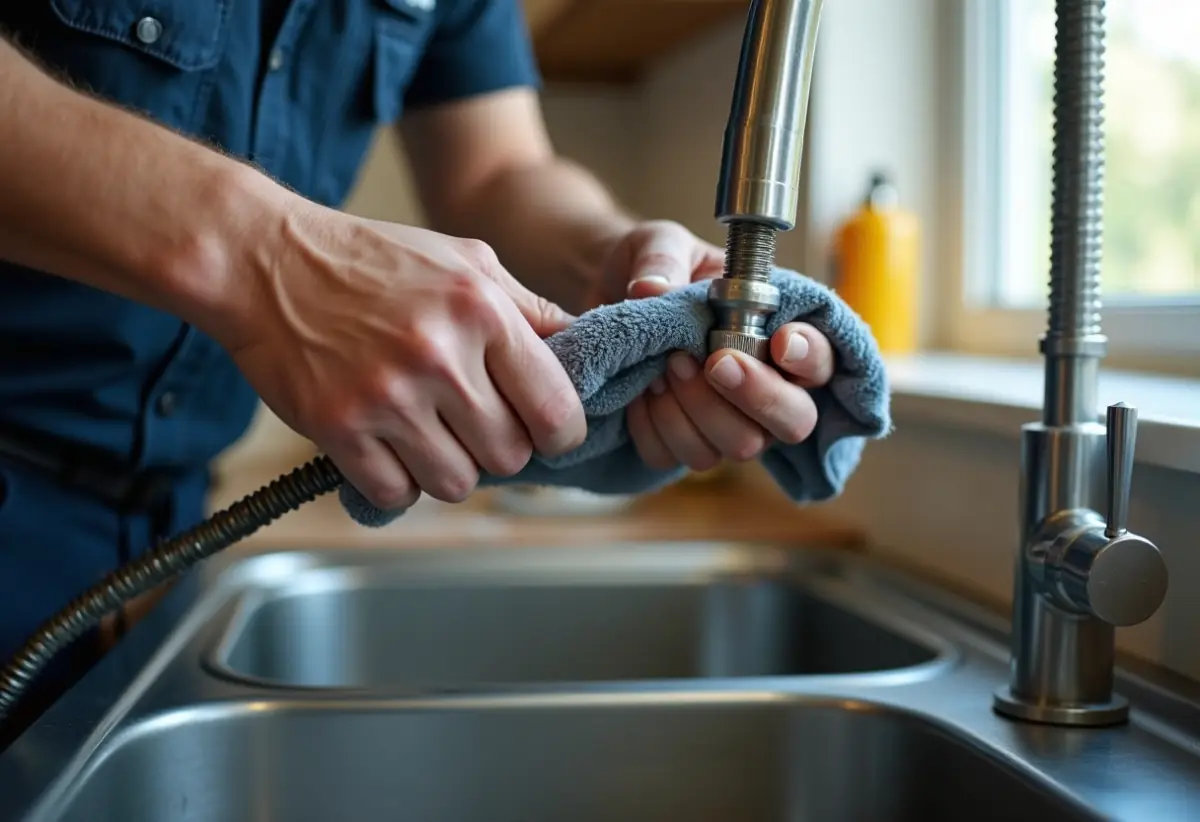
A pull-down faucet usually loses pressure in the spray head, where a small screen and the spray face catch grit before it reaches the sink. Moen’s published test isolates it in one step: wrap a towel around the hose, unthread the spray head, and run water from the bare hose. Strong flow from the hose means the head is clogged. Weak flow means the problem is further upstream.
- Shut the faucet off. Pull the spray head out and hold the hose with a towel so it cannot snap back into the spout.
- Unthread the spray head from the hose by hand.
- Aim the bare hose into the sink or jug and turn the faucet on slowly.
- Strong flow: clean the head. Rinse any screen or washer at the threaded joint, scrub the rubber nozzles on the spray face, and soak the face in vinegar if it is crusted.
- Weak flow from the bare hose on both sides: Moen’s guidance is to replace the cartridge. If only a separate side spray is weak, Moen says to replace the side spray.
Globe Union, which makes Glacier Bay faucets, publishes the same remove-the-head, test-the-hose sequence in its low-pressure support article. Also check the hose for a kink at its under-sink counterweight.
Is the angle stop, supply line or cartridge the problem?
Do a bucket test at the angle stop to split the supply from the faucet. Shut the stop, disconnect the supply line from the stop, aim the open stop into a bucket and crack it open. A hard, full stream means the stop and house pipe are fine, so the restriction is in the supply line or faucet. A weak stream means the stop itself is clogged or half closed.
- Turn both angle stops clockwise to close. Open the faucet to relieve pressure.
- Set a bucket under the stop. Loosen the compression nut on the supply line at the stop (most kitchen stops have a 3/8 in. compression outlet).
- Hold the line into the bucket and open the stop a little.
- A quarter-turn stop is open when the handle runs parallel to the pipe. A multi-turn stop is open when it turns counterclockwise until it stops; old multi-turn washers can come loose and block flow, and replacing the stop is the fix.
- Look along each braided or PEX supply line for flat spots or a kink behind the disposal. Replace a kinked line rather than bending it back.
If the stops pass and the bare hose is still weak, the cartridge is clogged. Moen’s kitchen guide ties the 1225 to single-handle kitchen faucets made before 2009, identified by a U-shaped copper retaining clip, and its instructions call for a 90-degree turn with the kit’s plastic twisting tool before you pull it. Delta’s single-handle DIAMOND faucets use the RP50587, a 2-1/2 in. tall cartridge listed at $61.68 on Delta.com on October 28, 2026. Our kitchen faucet cartridge replacement guide covers Moen, Delta, Kohler and Pfister part numbers.
Why is my kitchen faucet low pressure after replacing it?
A new kitchen faucet that runs weak almost always caught debris during the install, or its supply lines are kinked or the stops were not reopened all the way. Cutting into a supply, turning an old stop or utility main work all shake loose scale and sand.
- Remove the spray head or aerator, then run the faucet bare, hot and cold, for a minute to flush the lines.
- Confirm both stops are fully open. Turning a stop during the install often leaves it half shut.
- Check that the new supply lines are not kinked where the faucet body sits on the counter.
- Read the faucet’s spec sheet. A model sold for California or Colorado is built to 1.8 gpm, about 18 percent less than the 2.2 gpm federal cap, and it will feel weaker than a faucet made before the January 1, 1994 federal cutoff.
After a city main break or hydrant flushing, run a tub spout or hose bib until the water runs clear before you open the kitchen faucet, so grit lands somewhere easier to clean than a cartridge.
Why is only the hot water low pressure at the kitchen sink?
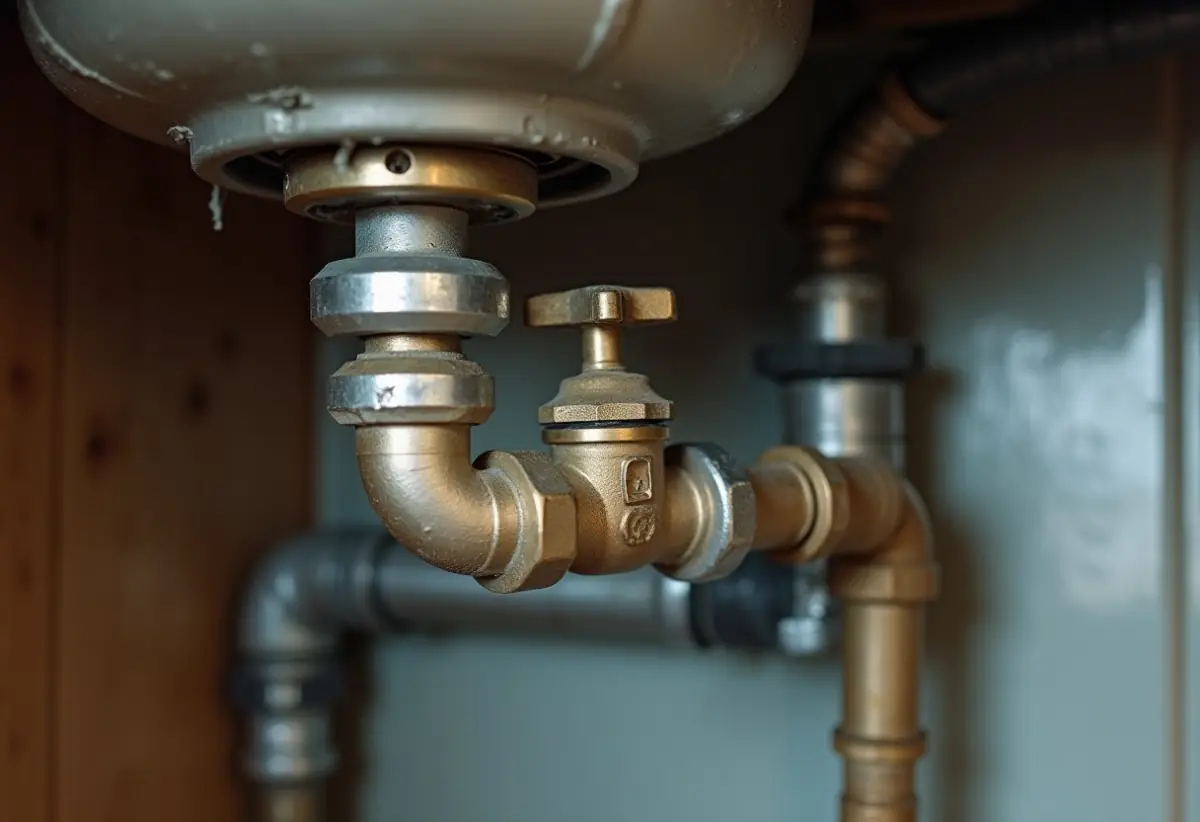
Hot-only weakness means a restriction on the hot side, and the pattern tells you where. If hot is weak only at the kitchen and cold is fine, check the hot angle stop, the hot supply line and the hot inlet of the cartridge. If hot is weak at every faucet in the house, the water heater or its piping is restricting flow, not the kitchen faucet.
- Kitchen only, hot weak: open the hot stop fully, check the hot line, bucket-test the hot stop, then inspect the cartridge’s hot inlet port for grit.
- Whole house, hot weak: on a tank heater, confirm the shutoff valve on the cold inlet line is fully open. Sediment in the tank and clogged fittings at the heater outlet are the next suspects.
On a tankless heater, check the manual for an inlet water filter screen to clean before calling a plumber.
When is low kitchen faucet pressure really a whole-house problem?
It is a whole-house problem when every fixture, hot and cold, runs weak at the same time. Screw a $10 to $15 pressure gauge onto a hose bib near the main, shut off all water inside, and open the bib. Normal residential pressure is 40 to 60 psi. Below 40 psi, the fix is at the main, meter valve or PRV.
- Read the gauge with all water off (static pressure). Note it.
- Check that the main shutoff is fully open, especially after recent plumbing work.
- If your home has a pressure-reducing valve (a bell-shaped valve near the main), a slow or sudden drop everywhere often means it is failing. The IPC requires one where static pressure exceeds 80 psi.
Our guide to normal water pressure for a house explains what each gauge reading means and when to adjust a PRV.
How we sourced this
We consulted 14 sources and cite 9. Flow limits come from 10 CFR 430.32(o) as published by Cornell LII, California Plumbing Code Section 420.2, C.R.S. 6-7.5-105 and EPA WaterSense. Pressure thresholds come from IPC Section 604.8. Troubleshooting steps come from Moen Solutions and Globe Union support articles. Cartridge part numbers and prices come from Moen.com and Delta.com (October 28, 2026), and the aerator thread from Neoperl. Fill times are our arithmetic. We excluded contractor blogs, forums and any check-valve detail we could not confirm in a maker manual.
Frequently asked questions
Why is my kitchen faucet water pressure low but the rest of the house is fine?
Because the restriction sits at the kitchen fixture, not in the house supply. Check the cheapest suspects first, starting with a scaled or grit-packed aerator, then the pull-down spray head, a partly closed angle stop, a kinked 3/8 inch supply line and finally a clogged cartridge. Running the faucet with the aerator off settles the first suspect in under two minutes.
Why does my pull-down kitchen faucet have low pressure?
Usually the spray head is clogged. Moen’s test is to wrap a towel around the hose, unthread the spray head and run water from the bare hose. Strong flow from the hose means the head or its screen is the problem. Weak flow from the hose points Moen owners to the cartridge, and a weak side spray alone means replacing the side spray.
Why is my new kitchen faucet low pressure after replacing it?
Most often, debris knocked loose during the install is caught in the new aerator or spray head, so remove both and flush the lines into a bucket. Check that both angle stops are fully open and the new supply lines are not kinked. A faucet sold for California or Colorado is also built to 1.8 gpm, below the 2.2 gpm federal limit.
Can a bad cartridge cause low water pressure in a kitchen faucet?
Yes. Scale and grit lodge in the cartridge inlet ports, and a worn cartridge can restrict flow on hot, cold or both sides. Confirm it with a bucket test at the angle stop first. Pre-2009 Moen single-handle kitchen faucets take the 1225, priced at $35.88 on Moen.com, and Delta single-handle DIAMOND faucets take the RP50587.
Why is only the hot water low pressure at my kitchen sink?
If hot is weak only at the kitchen, the hot angle stop, hot supply line or hot side of the cartridge is restricted. If hot is weak at every faucet, look at the water heater, starting with the shutoff on its cold inlet line and sediment in the tank. Cold-only weakness at one sink points to the cold stop or cold line.
Can I remove the flow restrictor from my kitchen faucet?
You can usually swap the aerator, but federal rules cap kitchen faucets and kitchen replacement aerators at 2.2 gpm at 60 psi, and Colorado law caps kitchen replacement aerators at 1.8 gpm. Removing the restrictor entirely can also make the stream splash. A 2.2 gpm aerator in your faucet’s thread size is the legal upgrade where state rules allow it.