Gas Pipe Sizing Chart: How to Read It Correctly
A gas pipe sizing chart tells you the most gas each pipe size can carry over a set length: find your longest run, use that one row, and pick the column that covers each section’s load.
Key Takeaways
- The standard residential chart is IFGC Table 402.4(2): Schedule 40 metallic pipe, natural gas, under 2 psi inlet, 0.5 in. w.c. pressure drop, 0.60 specific gravity.
- Convert load first. IFGC Appendix A divides rating plate Btu/h by 1,000 Btu per cubic foot, so a 100,000 Btu/h furnace is 100 cfh.
- Under the longest length method (IFGC 402.4.1), one length, meter to the most remote outlet, sets the row for every section.
- CSST is sized by EHD from the maker’s table, and propane uses separate tables that read in thousands of Btu/h, such as Table 402.4(28).
- After sizing, IFGC 406.4 requires a test at 1-1/2 times working pressure, never below 3 psig, held at least 10 minutes in a single family home.
What does a gas pipe sizing chart actually tell you?
A gas pipe sizing chart lists the maximum flow, in cubic feet of gas per hour (cfh), that each nominal pipe size delivers over a given length without losing more pressure than the table allows. Each chart is locked to one gas, pipe material, inlet pressure, pressure drop and specific gravity. Swapping in black iron pipe changes those inlet assumptions, so check black iron pipe sizing and uses before sizing your run.
The 2021 International Fuel Gas Code carries 37 numbered capacity tables, 402.4(1) through 402.4(37), per Chapter 4 of the 2021 IFGC as adopted in the Seattle Fuel Gas Code. Appendix A uses Table 402.4(2) for its steel pipe example.
Check the header first. Table 402.4(1) looks identical but uses a 0.3 in. w.c. drop, so 1/2 inch pipe at 10 feet shows 131 cfh there versus 172 cfh in Table 402.4(2). Gas piping falls under the fuel gas code, not the International Plumbing Code, so the adopted IFGC or IRC Section G2413 governs.
How do you convert appliance BTUs to cubic feet per hour?
Divide each appliance’s maximum Btu/h input, taken from its rating plate, by the heating value of your gas. IFGC Appendix A works every example at 1,000 Btu per cubic foot, so 40,000 Btu/h becomes 40 cfh. IFGC 402.2 says to add up the maximum input of every appliance served and size for all of them running at once, unless a diversity of load can be established.
IFGC Appendix A, Section A102.1, says the average Btu per cubic foot in your area comes from the serving gas supplier. The U.S. Energy Information Administration lists 1 cubic foot of natural gas at 1,036 Btu. Dividing by 1,000 instead of 1,036 gives a slightly higher cfh figure, which errs toward a bigger pipe.
- Adding an appliance later? IFGC 401.4 makes you recheck the existing piping for the new total load.
- Adjust above 2,000 feet. IFGC 402.2 requires the flow rate to be adjusted for altitude where the installation sits above 2,000 feet elevation.
How do you read a natural gas pipe sizing chart with the longest length method?
Measure the piping from the point of delivery to the most remote outlet, pick the table row equal to or longer than that length, then size each section by the total cfh flowing through it using that same row, per IFGC 402.4.1.
- Confirm the table header matches your gas, pipe material, pressure and pressure drop.
- Measure from the meter outlet to the farthest appliance outlet along the pipe path.
- On runs with four or more fittings, add equivalent lengths from Appendix A Table A102.2.
- Round up to the next longer row. A 58 foot run reads the 60 foot row, never the 50 foot row.
- For each section, add the cfh of every appliance downstream of it.
- Move across that row to the first column that equals or exceeds the section’s load. That is the nominal pipe size.
Table A102.2 puts a screwed 90 degree elbow at 1.55 feet of 1/2 inch pipe, 2.06 feet of 3/4 inch and 2.62 feet of 1 inch. A screwed tee is 3.10, 4.12 and 5.24 feet for the same sizes.
The branch length method in IFGC 402.4.2 sizes the main run the same way but lets each remaining branch use its own length from the point of delivery to its most remote outlet.
| Length (ft) | 1/2 in (0.622 ID) | 3/4 in (0.824 ID) | 1 in (1.049 ID) | 1-1/4 in (1.380 ID) | 1-1/2 in (1.610 ID) |
|---|---|---|---|---|---|
| 10 | 172 | 360 | 678 | 1,390 | 2,090 |
| 20 | 118 | 247 | 466 | 957 | 1,430 |
| 30 | 95 | 199 | 374 | 768 | 1,150 |
| 40 | 81 | 170 | 320 | 657 | 985 |
| 50 | 72 | 151 | 284 | 583 | 873 |
| 60 | 65 | 137 | 257 | 528 | 791 |
| 80 | 56 | 117 | 220 | 452 | 677 |
| 100 | 50 | 104 | 195 | 400 | 600 |
Excerpt of IFGC Table 402.4(2), Schedule 40 metallic pipe, natural gas, inlet under 2 psi, 0.5 in. w.c. drop, 0.60 specific gravity. Capacity in cubic feet of gas per hour.
What size gas pipe do a furnace, water heater, range and dryer need?
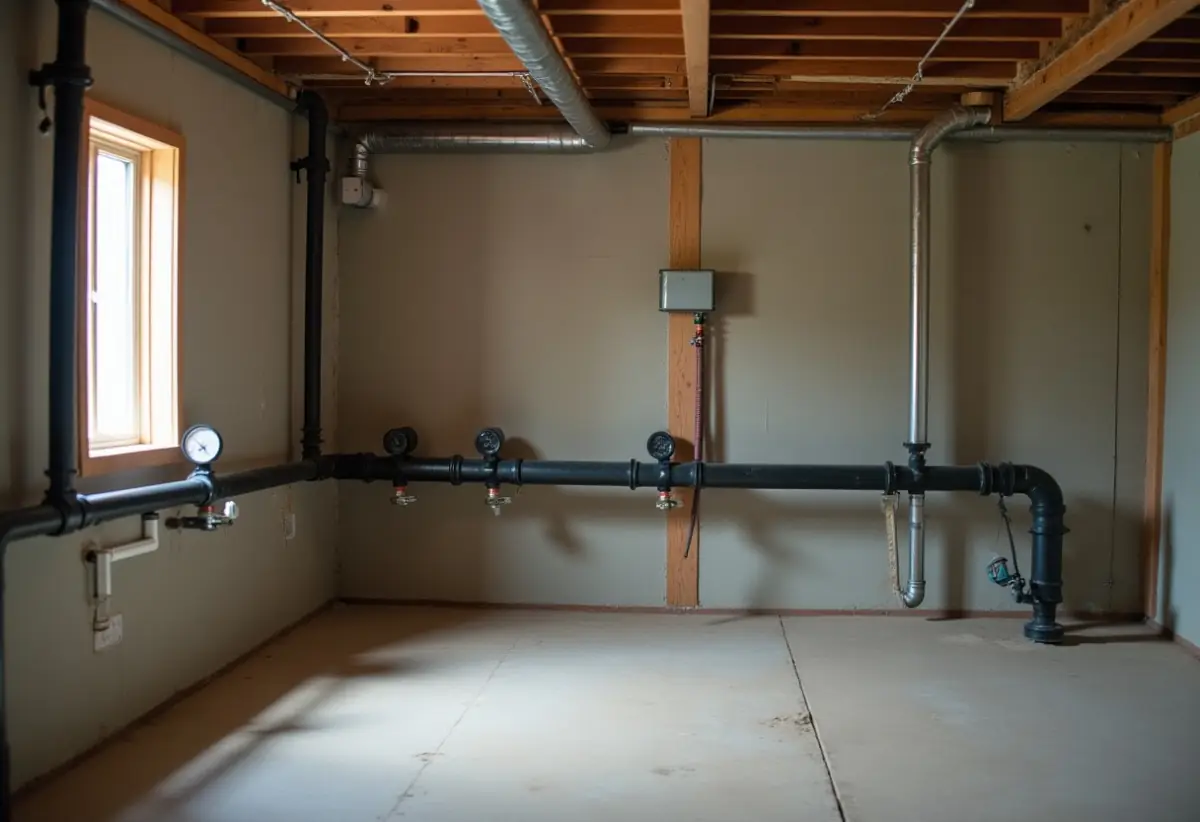
For a house with a 100,000 Btu/h furnace, a 40,000 Btu/h water heater, a 65,000 Btu/h range and a 22,000 Btu/h dryer, a 60 foot longest run calls for 1 inch pipe off the meter, 3/4 inch down the trunk and to the furnace, and 1/2 inch drops to the other three. The total load is 227 cfh at 1,000 Btu per cubic foot.
The inputs are illustrative, so use your own rating plates. With the dryer as the most remote outlet, 52 feet of pipe plus three 3/4 inch screwed elbows at 2.06 feet each comes to 58.2 feet, so every section reads the 60 foot row of Table 402.4(2), where 1/2 inch carries 65 cfh, 3/4 inch 137, 1 inch 257 and 1-1/4 inch 528.
| Section | Appliances served | Load (cfh) | Size from 60 ft row | Row capacity (cfh) |
|---|---|---|---|---|
| Meter to furnace tee | All four | 227 | 1 in | 257 |
| Furnace drop | Furnace | 100 | 3/4 in | 137 |
| Trunk past furnace | Water heater, range, dryer | 127 | 3/4 in | 137 |
| Water heater drop | Water heater | 40 | 1/2 in | 65 |
| Trunk past water heater | Range, dryer | 87 | 3/4 in | 137 |
| Range drop | Range | 65 | 1/2 in (zero margin) | 65 |
| Dryer drop | Dryer | 22 | 1/2 in | 22 needed, 65 available |
Watch the range drop. At 65 cfh it uses the full 1/2 inch capacity. Had the pipe measured 55 feet, the same three elbows push the developed length to 61.2 feet, the 70 foot row applies, and 1/2 inch pipe carries only 60 cfh, so the range drop has to go to 3/4 inch. Our cost to run a gas line for a stove guide covers per-foot pricing, and the flue side is in our water heater venting requirements guide.
How is CSST sized differently from black iron gas pipe?
Corrugated stainless steel tubing is sized by Equivalent Hydraulic Diameter (EHD), not nominal pipe size, and the corrugations cost capacity. IFGC 402.3 allows the maker’s listed tables, and generic Table 402.4(15) covers natural gas at under 2 psi and a 0.5 in. w.c. drop. Higher EHD means more capacity.
At 30 feet in that table, EHD 19 carries 55 cfh, EHD 25 carries 112 cfh, EHD 31 carries 218 cfh and EHD 39 carries 442 cfh. Compare 3/4 inch Schedule 40 at 199 cfh.
The table already includes four 90 degree bends and two end fittings. Note 1 adds 1.3 feet per extra bend or fitting, so six extra bends add 7.8 feet. EHD numbers differ between brands, so size from the guide for the brand you install, such as Gastite or TracPipe, and never mix one maker’s table with another’s tubing. Our overview of who is licensed to do gas line plumbing covers who may install CSST and black iron in the first place.
How does a propane gas line sizing chart differ?
Propane tables use a different gas, pressure and unit. IFGC Table 402.4(28) covers Schedule 40 pipe on undiluted propane at an 11.0 in. w.c. inlet, a 0.5 in. w.c. drop and a specific gravity of 1.50, for piping between the second stage or single stage regulator and the appliance. It reads in thousands of Btu per hour, so you skip the cfh conversion.
1/2 inch pipe carries 291,000 Btu/h at 10 feet on propane versus about 172,000 Btu/h on natural gas, because propane packs more energy per cubic foot.
| Length (ft) | 1/2 in | 3/4 in | 1 in | 1-1/4 in |
|---|---|---|---|---|
| 10 | 291 | 608 | 1,150 | 2,350 |
| 30 | 160 | 336 | 632 | 1,300 |
| 50 | 122 | 255 | 480 | 985 |
| 100 | 84 | 175 | 330 | 677 |
Excerpt of IFGC Table 402.4(28), undiluted propane, capacity in thousands of Btu per hour.
Do not convert a propane load to cfh and read it off Table 402.4(2). The natural gas tables assume 0.60 specific gravity, and Appendix A Table A102.4 shows the multiplier at 1.50 specific gravity is 0.63, a 37 percent capacity cut. Use the propane table and let your propane supplier set the regulator stages.
What mistakes make a gas line sizing chart give the wrong answer?
Most sizing errors come from reading the right table the wrong way, with the wrong length, column, header or units. An undersized line starves appliances at full fire. IFGC Appendix A notes residential appliances need about 5 in. w.c. at the inlet so the appliance regulator can deliver about 3.5 in. w.c. to the burner.
| Mistake | What the code text says | Effect |
|---|---|---|
| Sizing each drop by its own short length | 402.4.1 uses one length, meter to the most remote outlet, for every section | Picks a shorter row and overstates capacity |
| Adding every branch length into one total | Length runs along one path, point of delivery to the most remote outlet | Inflated length, oversized pipe, wasted money |
| Reading the bore as the nominal size | Tables list nominal size with actual ID (1/2 in = 0.622, 3/4 in = 0.824) | A measured 0.824 in bore read as a 1 in column |
| Using the 0.5 in. w.c. table when the design calls for 0.3 | Table 402.4(1) is 0.3, Table 402.4(2) is 0.5 | 1/2 in at 10 ft rated 172 cfh instead of 131 |
| Reading propane in cfh | Table 402.4(28) is in thousands of Btu/h | Wrong column in every section |
| Using a black iron table for CSST | 402.3 points to the listed maker’s tables | Undersized tubing |
Do you need a permit and pressure test after sizing the gas pipe?
Usually, yes. New gas piping typically needs a permit, and IFGC 406.1 requires visual inspection and a pressure test before the system goes into service. Section 406.4.1 sets the test at 1-1/2 times the proposed maximum working pressure, but not less than 3 psig, and Section 406.4.2 sets at least 10 minutes in a single family dwelling.
- Clear debris from the pipe (406.1.6), leave joints exposed (406.3) and cap off any appliance rated below the test pressure (406.3.3).
- Pressurize with air, nitrogen, carbon dioxide or an inert gas, never oxygen (406.2).
- Use a manometer or a gauge with full scale no more than five times the test pressure, so 15 psi maximum for a 3 psig test (406.4).
- Hold for the required time. Larger systems need 1/2 hour per 500 cubic feet of pipe volume, capped at 24 hours (406.4.2).
- Treat any pressure drop as a leak until another cause is proven (406.5).
For new branches added to an existing system, IFGC 406.1.3 requires testing only the new branch, with the tie-in joint checked by leak-detecting fluid. Local amendments exist (Seattle amends 406.1.2), so confirm the numbers with your inspector.
How we sourced this
Every capacity cell, section number and test requirement comes from the 2021 International Fuel Gas Code text as published in the 2021 Seattle Fuel Gas Code (Chapter 4 and Appendix A), checked in October 2026. The natural gas conversion factor comes from the U.S. EIA. A City of Pleasanton handout reproducing the matching 2007 California table was consulted, not cited. We excluded charts that do not state their conditions, brand CSST tables we could not read, and a propane per-cubic-foot heating value we could not confirm. The worked example uses illustrative appliance inputs.
Frequently asked questions
How many BTUs can a 1/2 inch gas line carry?
Under IFGC Table 402.4(2), 1/2 inch Schedule 40 pipe on natural gas at a 0.5 in. w.c. drop carries 172 cubic feet per hour at 10 feet, 95 at 30 feet, 65 at 60 feet and 50 at 100 feet. At 1,000 Btu per cubic foot that is roughly 172,000, 95,000, 65,000 and 50,000 Btu/h.
How many BTUs can a 3/4 inch gas line carry?
The same table gives 3/4 inch Schedule 40 pipe 360 cubic feet per hour at 10 feet, 199 at 30 feet, 137 at 60 feet and 104 at 100 feet. On natural gas rated at 1,000 Btu per cubic foot, that is about 360,000 Btu/h on a short run and about 104,000 Btu/h at 100 feet.
What size gas line do I need for 200,000 BTU?
200,000 Btu/h is 200 cubic feet per hour at 1,000 Btu per cubic foot. In Table 402.4(2), 3/4 inch pipe covers it only to 20 feet (247 cfh). 1 inch pipe covers it to 90 feet (207 cfh) but falls short at 100 feet (195 cfh), where 1-1/4 inch pipe (400 cfh) takes over.
Do you measure gas pipe length from the meter or from the appliance?
From the point of delivery, which on most homes is the outlet of the utility meter. Under the longest length method in IFGC Section 402.4.1, you measure the piping path from that point to the most remote outlet and use that single length to size every section of the system.
Can I use a natural gas pipe sizing chart for propane?
No. Propane has its own tables, such as IFGC Table 402.4(28) for Schedule 40 pipe at 11.0 in. w.c. inlet, 0.5 in. w.c. drop and a specific gravity of 1.50. That table reads in thousands of Btu per hour, not cubic feet, so you enter the appliance Btu/h directly.
How long does a gas line pressure test have to hold?
IFGC Section 406.4.2 sets at least 10 minutes for a single family dwelling, and Section 406.4.1 sets the test pressure at 1-1/2 times the maximum working pressure but never below 3 psig. Any drop on the gauge counts as a leak unless another cause is shown. Local amendments can be stricter.