Why Does My Hot Water Run Out So Fast?
Hot water runs out fast most often because the tank is too small for your peak hour, a lower electric element has failed, or a broken dip tube or sediment is eating usable capacity.
Key Takeaways
- Ruud says tank water heaters have about 70% usable capacity, so a 50-gallon tank holds roughly 30 to 35 gallons of truly hot water.
- DOE Energy Saver counts 10 gallons of hot water per shower and says to match first hour rating to peak hour demand.
- At the 2.5 gpm federal showerhead maximum (EPA WaterSense), our math gives a full 50-gallon tank about 18 minutes of shower.
- A dead lower element leaves only the top of an electric tank hot, roughly 6 minutes of shower on a 50-gallon unit by our math.
- Perfection Corp. produced more than 23 million dip tubes between 1993 and 1996 that could break down inside the tank, per PM Magazine.
- HomeAdvisor puts element replacement at $200 to $300 and a dip tube at $25 to $175.
Why does my hot water run out so fast?
Hot water runs out fast for one of nine reasons, and the first three cover most homes: a heater too small for the busiest hour, a failed lower element or thermostat on an electric unit, and a broken dip tube. Sediment, low settings, winter inlet water, stacked demand, weak gas burners and crossed connections fill out the list.
Ranked from most common and easiest to check:
- Undersized heater: first hour rating below your busiest hour.
- Failed lower element or thermostat: electric only, the bottom of the tank never heats.
- Broken dip tube: cold inlet water mixes in at the top.
- Sediment: scale takes up volume and buries the lower element.
- Low thermostat or mixing valve: cooler water means the shower pulls more of it.
- Cold winter inlet water: more hot needed in every mix.
- Simultaneous demand: shower, dishwasher and washer at once.
- Gas burner problems: slow recovery between showers.
- Crossed connections: cold bleeding into the hot line.
No hot water at all is a different fault. Our guide to troubleshooting no hot water on gas and electric heaters covers pilot, breaker and upper element failures.
How many minutes of hot water should a tank give you?
A healthy 50-gallon tank should give one person about 18 minutes of shower at 2.5 gallons per minute, or about 22 minutes at 2.0 gpm, before the water fades. That figure uses Ruud’s 70% usable-capacity rule and a shower mixed to 105°F from a 120°F tank. If you get well under half that, something is wrong.
Usable hot water is about 70% of tank size, per Ruud’s tank water heater guide, because cold refill water dilutes the rest. Divide usable gallons by the hot share of shower flow.
- Usable gallons: 50 gallons x 0.70 = 35 gallons.
- Hot share of the shower: (105°F shower minus 50°F inlet) / (120°F tank minus 50°F inlet) = 55 / 70 = 0.79.
- Hot draw at 2.5 gpm: 2.5 x 0.79 = 1.96 gallons of tank water per minute.
- Minutes: 35 / 1.96 = about 18 minutes.
The federal showerhead limit is 2.5 gpm and WaterSense-labeled heads use no more than 2.0 gpm, per the EPA WaterSense showerhead page.
Chart assumptions: 70% usable capacity (Ruud), 120°F tank, 50°F inlet, 105°F shower, one shower at a time, and no reheating during the shower. Gas heaters reheat faster during use and will beat these figures. This is our calculation, not a manufacturer test.
Is your water heater too small for your household?
Your water heater is too small if its first hour rating sits below your peak hour demand. The DOE defines first hour rating as the gallons of hot water a heater can supply per hour starting from a full tank, and it is printed on the yellow EnergyGuide label. Tank size alone misleads, because recovery speed counts too.
The DOE Energy Saver sizing page gives a worksheet. Count the hot water used in your busiest hour at 10 gallons per shower, 2 per shave, 4 for hand washing or food prep, 6 for a dishwasher and 7 for a clothes washer. Its worked example lands at 66 gallons, which needs a heater rated 66 gallons or more in its first hour.
| Morning peak hour (example) | DOE gallons per use | Count | Gallons |
|---|---|---|---|
| Shower | 10 | 3 | 30 |
| Shaving | 2 | 1 | 2 |
| Hand washing or food prep | 4 | 2 | 8 |
| Dishwasher | 6 | 1 | 6 |
| Clothes washer | 7 | 1 | 7 |
| Peak hour demand | 53 |
A growing family can outrun a tank that worked for years. Our water heater sizing guide walks through tank and tankless choices once you know the gap.
Why does hot water run out after 5 minutes on an electric heater?
Hot water that runs out after about 5 minutes on an electric heater usually means the lower element or lower thermostat has failed. The upper element still heats the top of the tank, so you get a short burst of hot, then lukewarm, then cold. Our estimate puts a 50-gallon tank with a dead lower element at roughly 6 minutes of shower.
Most electric tanks use two elements that never run together. The upper thermostat sends power to the upper element until the top of the tank reaches set point, then hands power down to the lower thermostat, which heats the bulk of the water. If the lower element burns out, the hand-off goes nowhere. Only water above the upper element, often described as the top third of the tank, gets hot.
- Hot gallons left: 50 / 3 = about 17 gallons.
- Usable share: 17 x 0.70 = about 12 gallons.
- Minutes at 2.5 gpm: 12 / 1.96 = about 6 minutes.
If the upper element fails instead, the lower one never gets power and you get no hot water at all. Our guide to testing and replacing a water heater element covers the ohmmeter test and the swap in detail.
Can a broken dip tube or sediment make hot water run out quickly?
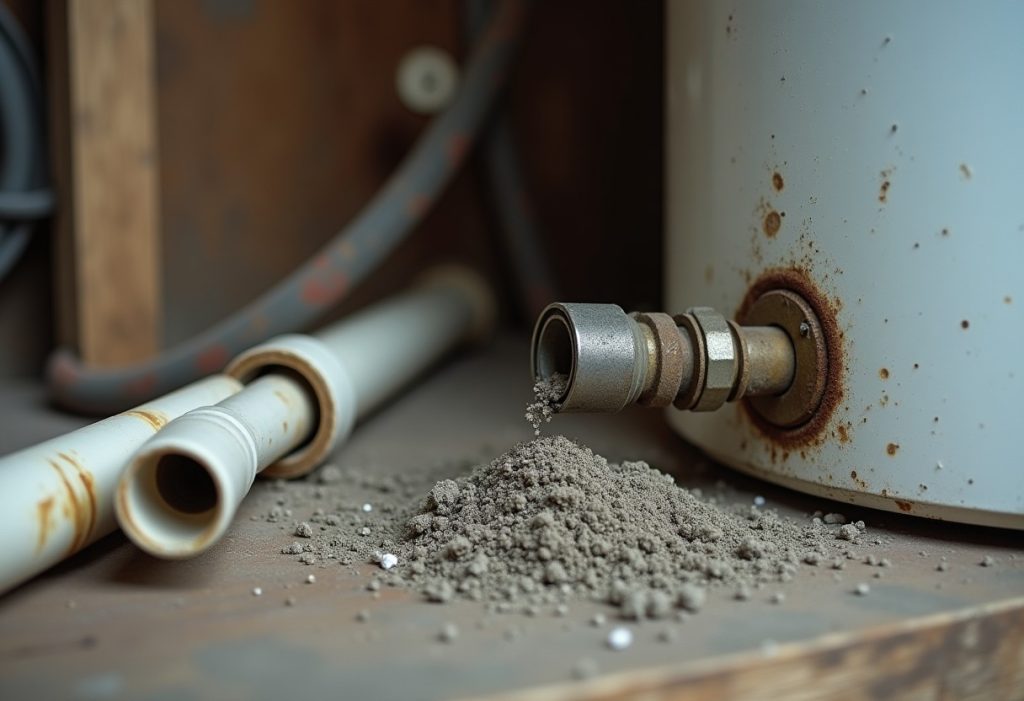
Yes, both can. A broken dip tube lets cold inlet water enter at the top of the tank, right where hot water leaves, so the shower turns lukewarm early even though the tank is heating normally. Sediment takes up space at the bottom, buries the lower element on electric units and insulates the burner on gas units, cutting both capacity and recovery.
The dip tube is a plastic pipe that carries incoming cold water to the bottom of the tank. When it cracks, that water short-circuits to the outlet. The biggest known failure ran in the 1990s, when Perfection Corp. made more than 23 million polypropylene dip tubes between 1993 and 1996 that could break down inside the tank, according to PM Magazine.
The giveaway is white or gray plastic flakes in aerators and showerhead screens.
Sediment is the slow version. Hard water drops calcium and magnesium as it heats. Gas tanks rumble or pop. On electric tanks a buried lower element can overheat and fail, which brings back the five-minute shower.
Why does a new water heater run out of hot water fast?
A new water heater runs out of hot water fast for four common reasons: the thermostat or a mixing valve is set low, the new unit has a lower first hour rating than the old one, the inlet and outlet were connected backward, or an electric element was dry-fired before the tank filled. Most are quick to correct.
- Low setting. If the tank sits at 110°F instead of 120°F, a 105°F shower needs 92% hot water instead of 79%. On a 50-gallon tank at 2.5 gpm, that cuts about 18 minutes to about 15.
- Mixing valve. A thermostatic mixing valve at the outlet set too low acts like a low thermostat. Set correctly with a hotter tank, it stretches capacity.
- Lower first hour rating. Same tank gallons does not mean same hot water per hour. Compare EnergyGuide labels.
- Swapped connections. Cold piped to the hot outlet enters at the top, while hot is drawn up through the dip tube from the bottom.
- Dry-fired element. Powering an electric tank before it fills can burn out an element in seconds.
Our breakdown of how long a water heater takes to heat up lists first-heat times for gas and electric units
Do winter, back-to-back showers or gas burner trouble make it worse?
Yes, all three shorten your hot water, by very different amounts. Colder winter inlet water trims shower time by roughly 8% in our math. Back-to-back showers leave the second person only what the first did not use plus what the heater recovered. A gas burner that fires weakly does little to the first shower but slows recovery so much that later showers come up short.
With a 60°F inlet, a 105°F shower takes 75% hot water from a 120°F tank. With a 40°F inlet it takes 81%. On a 50-gallon tank at 2.5 gpm, that is about 19 minutes in summer versus about 17 in winter.
Stacked demand hits harder. A dishwasher at 6 gallons and a washer at 7, per DOE, take nearly half of a 40-gallon tank’s usable 28 gallons.
Recovery is where gas and electric part ways. By our math a 4,500 watt element recovers about 26 gallons per hour at a 70°F rise (15,354 Btu per hour divided by 583 Btu per gallon). Rheem lists 40.4 gallons per hour at a 90°F rise for its 40,000 Btu PROG50-40N gas tank, which works out to more at a smaller rise. A dirty burner, low gas pressure or failing gas valve drags that down.
How do you test which cause you have?
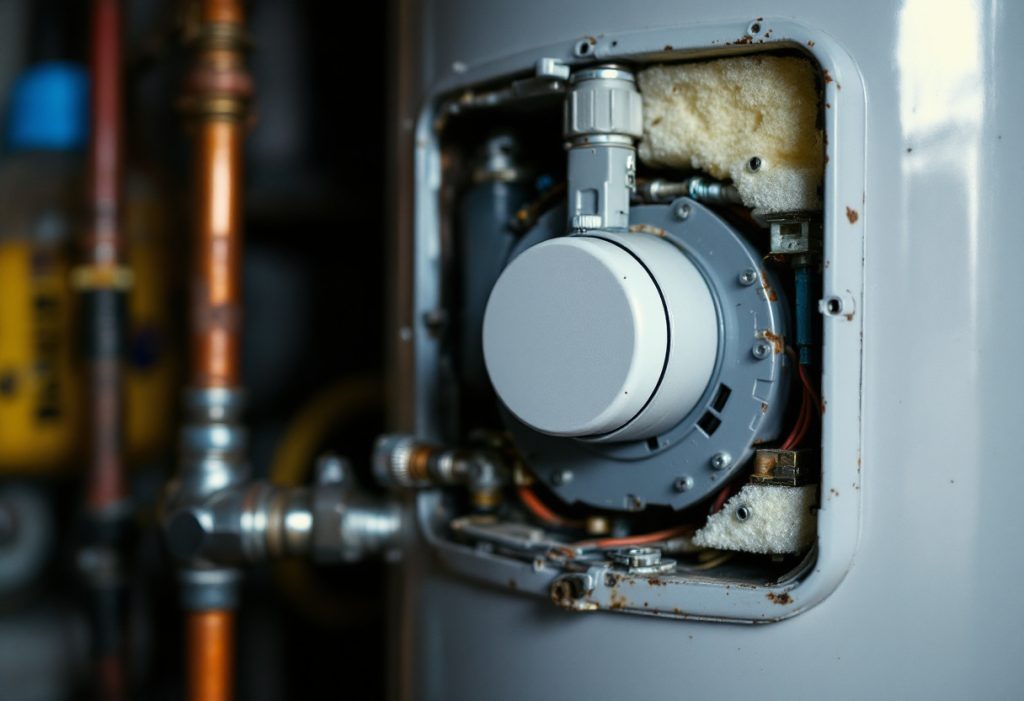
Test in order of effort: time a shower from a full tank, check the tap temperature, look for plastic in aerators, run the crossover test, then test elements. You need at most a kitchen thermometer, a timer and a multimeter. The table matches each symptom to its likely cause, test and fix.
| Symptom | Likely cause | Simple test | Fix |
|---|---|---|---|
| Fine alone, short when the family showers back-to-back | Undersized heater or stacked demand | Compare DOE worksheet peak hour gallons to the first hour rating | Stagger use, lower-flow heads, or a larger unit |
| Hot for about 5 minutes, then cold, on an electric tank | Failed lower element or lower thermostat | Resistance test on the lower element with power off | Replace element or thermostat |
| Warm, never fully hot, plastic flakes in screens | Broken dip tube | Check aerators and showerhead screens for plastic bits | Replace dip tube and flush lines |
| Rumbling or popping, shrinking supply over months | Sediment buildup | Drain a bucket from the drain valve, look for grit | Flush the tank, descale or replace element |
| Tap reads well under 120°F after running 2 minutes | Low thermostat or mixing valve | Thermometer in a glass at the nearest hot tap | Raise set point or adjust mixing valve |
| Hot tap still flows with the heater’s cold supply shut | Crossed connection or failed shower cartridge | Close the heater’s cold valve, open a hot tap, watch for flow | Replace the faulty cartridge or mixing faucet |
| Gas unit slow to recover, yellow or lazy flame | Dirty burner, low gas pressure, gas valve | Check the flame through the sight glass for mostly blue | Burner cleaning or gas valve service by a pro |
For the electric element check, follow this sequence.
- Turn off the breaker and confirm no voltage at the element terminals with a tester.
- Remove the access panel and insulation and disconnect one element wire.
- Set a multimeter to ohms and touch both element screws. Resistance equals volts squared divided by watts, so a 4,500 watt, 240 volt element should read about 12.8 ohms (240 x 240 / 4,500).
- An open or infinite reading means the element is dead. Any continuity from a screw to the tank body also means replace it.
What does it cost to fix hot water that runs out fast?
Most fixes for hot water that runs out fast cost a few hundred dollars or less. HomeAdvisor lists element replacement at $200 to $300, thermostat replacement at $150 to $200, a dip tube at $25 to $175 and a tank flush around $200. An undersized heater is the expensive one, because the only true fix is a larger or different water heater.
Adjusting a thermostat or mixing valve is free. HomeAdvisor lists a gas control valve at about $350 and a thermocouple at about $150. Its water heater repair cost guide puts the national average repair at $616, with most homeowners paying $228 to $1,017. Prices vary by region, and gas work may need a permit depending on local code.
How we sourced this
We reviewed the top-ranking pages for “hot water runs out fast” in October 2026, then took every figure from a primary or first-party source: DOE Energy Saver for first hour rating and per-use gallons, Ruud for the 70% usable-capacity rule, EPA WaterSense for showerhead flow limits, PM Magazine for the 1990s dip tube failure and HomeAdvisor for repair costs. Shower-minute, recovery-rate and element-resistance figures are our own arithmetic, shown in full with assumptions. We excluded contractor blog claims we could not trace to a source.
Frequently asked questions
Why does my hot water run out after 5 minutes?
On an electric heater, a 5-minute shower is the classic sign of a failed lower element or lower thermostat. Only the top of the tank heats, about 6 minutes on a 50-gallon unit at 2.5 gpm by our math. On gas units, check sediment, the dip tube and the thermostat setting.
How long should hot water last in a 40-gallon tank?
A full 40-gallon tank should give about 14 minutes of shower at 2.5 gpm and about 18 minutes at 2.0 gpm. That assumes Ruud’s 70% usable-capacity rule, a 120°F tank, a 50°F inlet and a 105°F shower. Gas units reheat during use and stretch those times somewhat.
Why does my new water heater run out of hot water so fast?
A new heater usually comes up short because the thermostat or mixing valve is set low, the inlet and outlet pipes were swapped, an electric element was dry-fired before the tank filled, or the new unit has a lower first hour rating. Compare EnergyGuide labels and check the tap temperature first.
How do I know if my water heater element is bad?
Turn off the breaker, confirm no voltage, disconnect one wire and test the element with a multimeter set to ohms. A 4,500 watt, 240 volt element should read about 12.8 ohms. An open reading, or any continuity between a terminal screw and the tank body, means the element needs replacing.
Can sediment cause hot water to run out quickly?
Yes. Hard water sediment settles at the bottom, takes up volume and can bury the lower element on electric units until it overheats and fails. On gas units it insulates the burner and slows recovery. Rumbling sounds and grit in drained water are the usual signs.
How do I know if my dip tube is broken?
Look for white or gray plastic flakes in faucet aerators and showerhead screens. Water that goes lukewarm fast but never fully cold is another sign. A known batch of more than 23 million defective tubes dates to 1993 through 1996, per PM Magazine.
Will turning up the water heater make hot water last longer?
Yes, within limits. A hotter tank means the shower mixes in less of it, so a 50-gallon tank at 120°F lasts about 18 minutes at 2.5 gpm versus about 15 at 110°F. Above 120°F, scald risk rises, so pair a higher setting with a thermostatic mixing valve.
How long does it take to get hot water back after it runs out?
It depends on how fast the heater recovers. By our math a 4,500 watt electric element recovers about 26 gallons per hour at a 70 degree rise, so a drained 50 gallon electric tank needs well over an hour to fully reheat. Gas units recover faster, while sediment or a weak burner slows recovery on any tank.


