Well Pump Not Working: Troubleshoot It in Order
A well pump not working is usually a power, pressure switch or control box fault, so check the double-pole breaker, switch contacts and capacitor before paying anyone to pull the pump.
Key Takeaways
- Franklin Electric’s 2026 AIM manual allows 10 percent voltage variation, so a 230 V pump needs 207 to 253 V.
- Franklin’s typical submersible breakers are 15 A for a 1/2 HP 230 V motor, 20 A for 3/4 HP and 25 A for 1 HP.
- Amtrol sets Well-X-Trol tanks 2 psig below cut-in, the 38 psig factory charge for a 40/60 switch.
- Square D Pumptrol switches come in 20-40, 30-50, 40-60 and 50-70 psi ranges, with an optional M4 low-pressure cut-off.
- Per Franklin, a motor plus drop cable reading under 0.50 megohm to ground has damaged insulation.
- Franklin limits single-phase motors up to 3/4 HP to 300 starts per 24 hours, and 1 to 5.5 HP motors to 100.
Why is my well pump not working, and what order should I check?
A well pump that is not working fails at one of six points, so test from the house toward the well. Check the breaker and voltage, then the pressure switch, then the control box on a 3-wire pump, then the pressure tank, then the water level, and only then the motor and drop cable. That order runs from free checks to the one that needs the pump pulled. Before pulling the motor, rule out a stuck check valve, since check valve failure can mimic several of those same symptoms. Diagnosing a suspected check valve issue often overlaps with questions about well water during an outage, worth a quick read before grabbing tools.
Franklin Electric’s 60 Hz AIM Manual, 2026 edition (hosted by Nebraska’s Department of Water, Energy and Environment) lists the same suspects under “motor does not start,” from wrong voltage and tripped breakers to a bound pump and a damaged cable or motor.
| Symptom | Likely cause | Test | Fix | DIY? |
|---|---|---|---|---|
| No water, pump silent, breaker tripped | Short in motor or cable, or bound pump | Reset once. If it trips again, megohm test the leads | Locate fault, repair or replace | Reset only |
| No water, breaker on, no click at switch | Pitted contacts or clogged 1/4 inch sensing port | Voltage across closed contacts | Clean points or replace switch | Yes, power off |
| Switch closed, 230 V at load side, pump silent or humming | Start capacitor or relay in a 3-wire control box | Ohmmeter on capacitor at R x 1,000 | Replace capacitor kit or box | Yes, power off |
| Pump clicks on and off every few seconds | Waterlogged tank or check valve stuck open | Tank air charge with the tank drained | New tank or check valve | Partly |
| Pump runs nonstop, weak pressure | Low well level, drop pipe leak or worn pump | Shut off, let well recover, measure levels | Lower or replace pump | No |
| Overload trips while running | Hot control box, bad box, motor or cable | Box hot to the touch, then amp readings | Shade box or repair | Partly |
| Amps 3 to 6 times normal, then trip | Sand-bound or misaligned pump | Clamp ammeter on each lead | Pull pump and clear it | No |
Causes and tests follow Franklin’s troubleshooting chart. The DIY column is our judgment for a homeowner with a multimeter.
Is a tripped breaker or low voltage keeping the well pump from turning on?
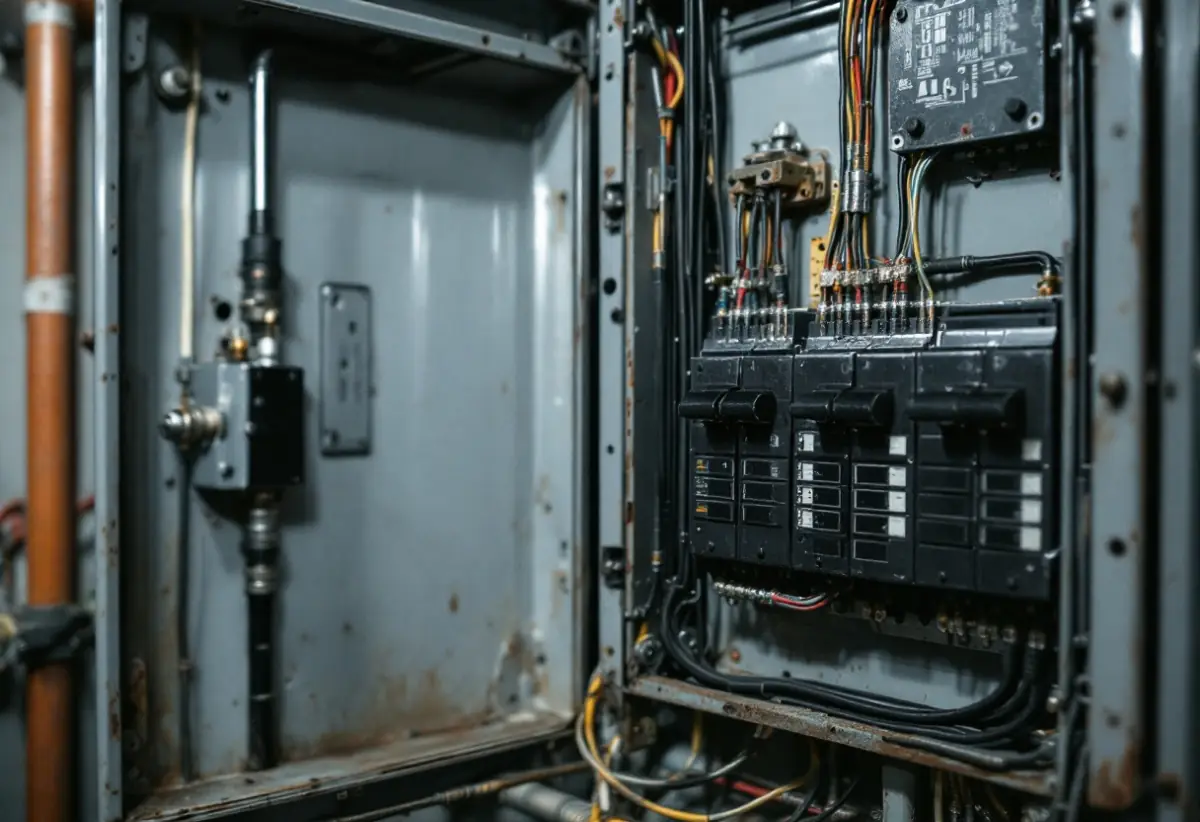
Power is the first suspect when a well pump is not turning on. Most residential submersibles run on 230 V through a double-pole breaker, and Franklin’s AIM manual says line voltage must be within 10 percent of the motor rating. For a 230 V motor, that is 207 to 253 V, read at L1 and L2 of the pressure switch with the pump off.
Reset a tripped well breaker once. A second trip within seconds points to a short in the motor, splice or drop cable, or to a bound pump. Do not keep resetting it.
Check the breaker against the motor nameplate. Franklin’s 4-inch single-phase table lists these typical submersible sizes:
- 1/2 HP, 230 V (2-wire 244505 or 3-wire 214505): 15 A
- 3/4 HP, 230 V (244507 or 214507): 20 A
- 1 HP, 230 V (244508 or 214508): 25 A
- 1/2 HP, 115 V (244504 or 214504): 30 A
Franklin lists the NEC maximum beside each typical size. Never exceed the NEC column.
Is the pressure switch the reason the well pump will not start?
The pressure switch closes at cut-in and opens at cut-out, so burned contacts or a blocked sensing port leave the pump off while the gauge sits below cut-in. Square D’s 9013 Pumptrol catalog lists 20-40, 30-50, 40-60 and 50-70 psi ranges, each with a 20 psi spread, on a 1/4 inch NPSF connection.
Franklin’s test is voltage across the contact points with power on. “Improper contact of switch points can cause voltage less than line voltage,” the AIM manual says. The fix is to clean the points or replace the switch.
- Note the gauge. Below cut-in with the contacts open means the switch is not sensing pressure.
- Kill the breaker and pull the switch cover.
- Look for black, pitted or welded contacts. Welded contacts keep a pump running past cut-out.
- Remove the switch and clear the 1/4 inch port and its nipple of sediment or ice.
- Restore power and read load-side voltage with the pump running. It should hold steady except for a slight dip at start.
Tapping the housing to get the pump going only proves the contacts are bad, so replace the switch. A side lever means a low-pressure cut-off version such as Square D’s M4 form. Our well pump pressure switch guide covers adjustment and replacement.
How do you test the control box on a 3-wire well pump?
Only 3-wire submersibles have an above-ground control box, and its start capacitor and relay are next once full voltage reaches it. Franklin’s 230 V QD boxes carry a 59 to 71 MFD start capacitor at 1/2 HP (box 280 105 4915), 86 to 103 MFD at 3/4 HP and 105 to 126 MFD at 1 HP, all rated 220 V.
Two-wire pumps hide the starting switch inside the motor, and Franklin says restarting one within 5 seconds of a power loss may trip its overload. Our guide to types of well pumps shows how to tell which you have.
Franklin’s QD box ohmmeter tests, with power off:
- Start capacitor. R x 1,000 across the terminals. The pointer should swing toward zero, then back to infinity.
- QD relay triac. R x 1,000 between Cap and B should read infinity.
- QD relay coil. R x 1 between L1 and B should read zero ohms.
Franklin calls these tests “not conclusive,” since a capacitor can pass and still have lost capacitance. A clamp ammeter settles it. The red lead should spike at start and drop within one second. No spike means a failed start capacitor or relay. Capacitor 275 464 105 ships as kit 305 207 905. Franklin also rates the box for 14°F to 122°F, out of direct sun.
Is a waterlogged pressure tank making the well pump short cycle?
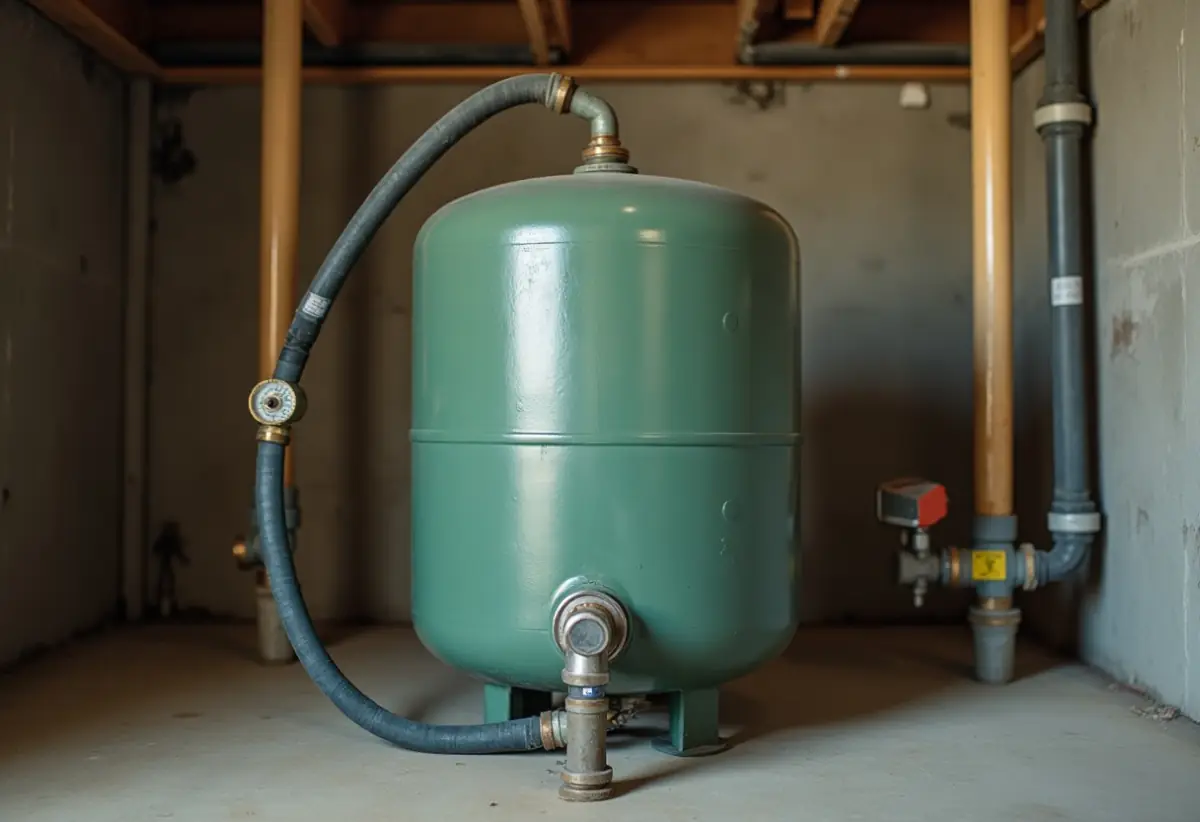
A pump that clicks on and off every few seconds usually has a waterlogged pressure tank, one of four causes on Franklin’s “motor starts too often” list. Amtrol’s Well-X-Trol manual sets the air charge 2 psig below cut-in with the tank drained, which is 38 psig for a 40/60 switch and 28 psig for 30/50.
Franklin says excessive cycling damages motor splines and bearings and overheats the motor, and it wants every run to last at least one minute.
Chart source: Franklin Electric AIM Manual, 2026 edition, “Frequency of Starts” table for encapsulated motors. At 300 starts a day, a 1/2 HP pump averages one start every 4.8 minutes. A pump cycling every 20 seconds uses that up in 100 minutes.
Amtrol adds a warning most guides skip. Do not add air to a tank that has lost its charge or shows outside corrosion, because re-pressurizing “could result in rupture or explosion.” Amtrol says only licensed professionals should recharge tanks, and calls for a relief valve set at 125 psig or more. Our well pressure tank guide covers sizing and replacement.
Could a dry well or low water table be why there is no water from the well?
A pump that runs nonstop with weak or no pressure may be pumping faster than the well recovers. Franklin lists “low water level in well” under both “motor starts too often” and “motor runs continuously.” The check is to shut off the pump, let the well recover, and measure static and drawdown levels from the wellhead.
Franklin’s fixes are to throttle the pump output or set the pump lower, but not lower if sand may clog it. A worn pump or leaking drop pipe looks the same. Franklin’s test is to lower the switch setting. If the pump then shuts off, worn parts are likely.
Run-dry protection is cheap insurance. Square D’s M4 cut-off opens the contacts if system pressure is lost “for any reason, a low water condition for example,” and stays off until someone resets it.
How do you check a submersible well pump motor with an ohmmeter?
Two readings at the control box or pressure switch tell you whether the motor and cable deserve a pull. Franklin wants both before the pump comes out. First, insulation resistance to ground with a megohmmeter at 500 V. Second, winding resistance between leads with an ohmmeter. Open the breaker and disconnect all motor leads first.
| Insulation test condition | In well? | Megohms |
|---|---|---|
| New motor, no drop cable | No | 200.0 or more |
| Used motor fit to reinstall | No | 10.0 or more |
| New motor plus drop cable | Yes | 2.0 or more |
| Motor in good condition plus cable | Yes | 0.50 to 2.0 |
| Insulation damage, locate and repair | Yes | Less than 0.50 |
On a 3-wire motor, measure yellow to black (main) and yellow to red (start). Franklin lists the main winding at 4.2 to 5.2 ohms for 1/2 HP 230 V, 3.0 to 3.6 at 3/4 HP and 2.2 to 2.7 at 1 HP, with start windings at 16.7 to 20.5, 10.7 to 13.1 and 9.9 to 12.1 ohms. Two-wire motors read line to line with the same main values.
Add the cable. Franklin gives 0.338 ohm per 100 feet of distance for 12 AWG copper, so a 1/2 HP 3-wire motor on 250 feet should read about 5.0 to 6.0 ohms main at the box. Low means a shorted winding. High means an open winding or bad splice.

Can frozen pipes or a cold pump house stop a well pump?
Yes. Ice in the pressure switch nipple or the pipe to the tank blinds the switch, so the pump stays off or runs against a frozen line. Amtrol says not to expose a Well-X-Trol to freezing temperatures, and Franklin says a control box below 14°F loses starting torque and overload protection.
Shut off the breaker first, then warm the nipple and exposed pipe with a hair dryer, never an open flame near plastic. Restore power and watch the gauge climb to cut-out. Insulate the pipe run and switch tube, and keep the pump house above freezing.
When should you call a pump contractor, and what does a new well pump cost?
Call a licensed pump contractor when the breaker, switch, control box and tank check out but the motor tests fail, or when the amps say the pump is bound. Pulling a submersible means lifting the pump, drop pipe, wire and water column out of the casing.
Franklin’s control box voltage checks require power on, and its manual warns that contact with hazardous voltage could cause death or serious injury. If you are not comfortable taking live readings, stop at the breaker reset.
HomeAdvisor puts the national average for a well pump replacement at $1,897, with a typical range of $974 to $2,821. Our well pump replacement cost guide breaks the job into parts and labor.
How we sourced this
We read the top-ranking pages for “well pump not working” and “no water from well,” then took every technical value from primary documents. Those are the Franklin Electric AIM Manual (60 Hz, 2026 edition), the Amtrol Well-X-Trol manual (part 9015-868, 06/19) and the Square D 9013 Pumptrol catalog (RP19080108). Cost figures are HomeAdvisor national data. We left out lifespan claims and part prices we could not tie to a primary source.
Frequently asked questions
Why is my well pump not turning on?
Check four things in order. A tripped double-pole breaker, burned pressure switch contacts, a failed start capacitor or relay in a 3-wire control box, then a damaged motor or drop cable. Franklin Electric’s AIM manual also lists a sand-bound pump, which draws 3 to 6 times normal amps until the overload trips.
How do I reset my well pump?
Switch the well breaker off and back on once. If the pressure switch has a side lever, it is a low-pressure cut-off model such as the Square D M4 option, and lifting the lever restarts the pump. Watch the gauge. If pressure does not climb, let go, because the pump may be running a dry well.
Why does my well pump keep turning on and off?
Franklin Electric lists four causes for a motor that starts too often, a waterlogged tank, a check valve stuck open, a leak, and a pressure switch fault. Franklin caps single-phase motors up to 3/4 HP at 300 starts a day, so a pump cycling every few seconds is wearing itself out.
How do I know if the well pump or the pressure switch is bad?
Measure voltage on the load side of the closed pressure switch. Franklin’s AIM manual says it should match line voltage, within 10 percent of the motor rating, with only a slight dip at start. If full voltage reaches the control box and the pump still will not run, test the box and then the motor windings.
Can a well run dry and stop the pump?
Yes. Franklin Electric’s chart lists low water level as a cause of a pump that runs continuously, since the pump may exceed well capacity. Shut it off, let the well recover, and have static and drawdown levels measured from the wellhead. A Square D M4 switch opens its contacts when pressure is lost.
How much does it cost to replace a well pump?
HomeAdvisor puts the national average at $1,897, with most homeowners paying $974 to $2,821. Pump type, depth, and whether the drop pipe, wire or tank also need replacing drive the spread. Rule out the breaker, switch, capacitor and tank before you approve pulling a submersible.