Water Hammer Arrestor: What It Is, Types, and How to Size One
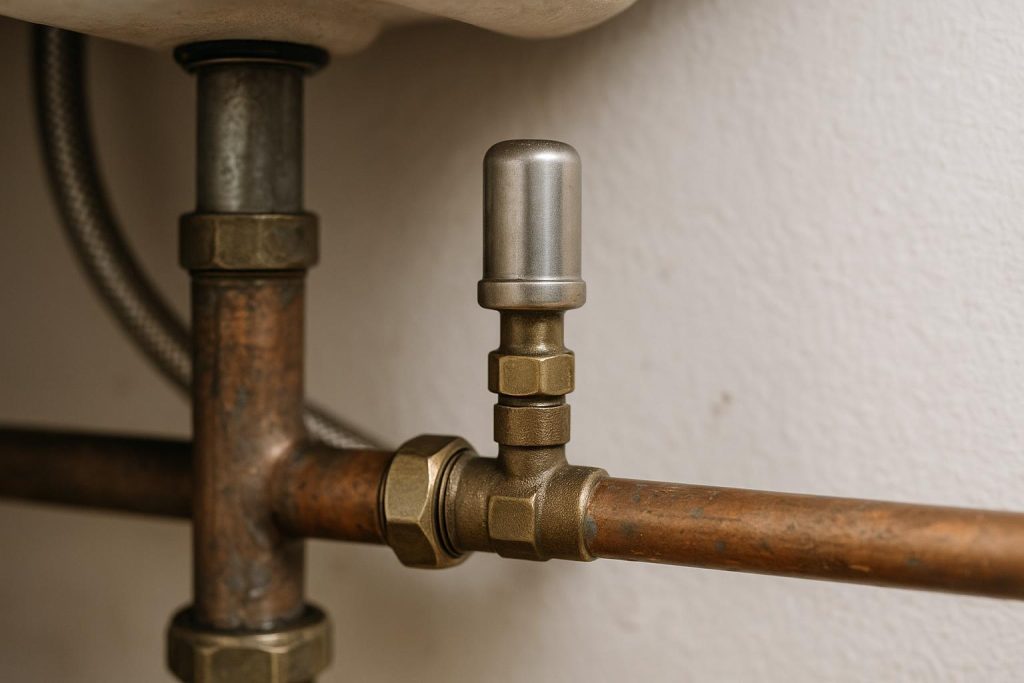
A water hammer arrestor absorbs the pressure spike a fast-closing valve creates, using a sealed air cushion (ASSE 1010) that, unlike an old air chamber, never waterlogs.
Key Takeaways
- Water is nearly incompressible, so stopping it fast sends a shock wave forward; by the Joukowsky equation the surge adds roughly 60 to 64 psi for every 1 ft/s of flow velocity you kill instantly.
- An ASSE 1010 arrestor seals its air or gas cushion behind a piston, so it works for years with no maintenance; an old capped-pipe air chamber slowly waterlogs and quits.
- The PDI-WH201 standard sizes arrestors by letter, A through F, matched to fixture-unit load, from 1 to 11 units (A) up to 155 to 330 units (F).
- Install the arrestor as close as possible to the offending valve; PDI places branch arrestors near the last fixture and requires a second one on branches over 20 feet.
- If your static pressure tops the 80 psi limit in IPC 604.8, the fix is a pressure reducing valve, not an arrestor.
- A mini washing-machine arrestor is the common retrofit and usually runs $10 to $40; a full branch unit costs more (retail 2026).
- Arrestors only fix the spike from a quick-closing valve; loose pipes or high pressure need a different fix, so confirm how to fix water hammer first.
What is a water hammer arrestor?
A water hammer arrestor is a small sealed device that absorbs the pressure surge created when moving water is stopped suddenly. It contains a compressible cushion of air or gas, held behind a piston or a bellows, that gives the shock wave somewhere to expand into instead of slamming the pipe walls and joints. The device installs on the supply line near whatever valve is causing the bang.
Water hammer itself is that loud knock or thud you hear when a washing machine, dishwasher, or solenoid valve shuts off. The arrestor does not stop the valve from closing fast; it cushions the energy that closure releases. Modern units are compact, often the size of a shotgun shell or a soda can, and thread or solder into the line.
How does a water hammer arrestor absorb the pressure spike?
It works because water is nearly incompressible. When a fast valve slams shut, the column of water behind it is still moving and has nowhere to go, so its momentum converts to a pressure spike that travels back up the pipe as a shock wave. The arrestor’s sealed air cushion is compressible, so it takes that spike, deflects, and releases it in a controlled way.
The size of that spike is real physics, not guesswork. The Joukowsky equation says the pressure rise equals the fluid density times the pressure-wave speed times the change in velocity. For household water that works out to roughly 60 to 64 psi added for every 1 ft/s of flow velocity you stop instantly. A branch flowing at a typical 6 to 8 ft/s can therefore spike several hundred psi above static in a fraction of a second.
Those numbers are theoretical maximums for instant closure on a rigid pipe, so real spikes run lower, but they show why the shock dwarfs your everyday supply pressure. A single arrestor sized for the branch soaks up that peak before it can rattle the piping loose or fatigue a solder joint.
What types of water hammer arrestors are there?
There are two arrestor families plus one related pressure fix. Sealed piston arrestors built to ASSE 1010 are the current standard and stay charged for the life of the system. Old-style air chambers are the DIY predecessor that waterlogs over time. And a pressure reducing valve is not an arrestor at all, but it is the correct answer when high pressure, not a fast valve, is the cause.
The table below lines up the common solutions so you can match the device to your situation. Name-brand mini arrestors from makers like Sioux Chief and Watts fall into the sealed-piston category and carry the ASSE 1010 mark.
| Solution | How it works | Maintenance | Where used | Best for |
|---|---|---|---|---|
| Piston arrestor (ASSE 1010) | Sealed air or gas cushion behind an O-ring piston absorbs the spike | None; charge is isolated from water | At an appliance or on a branch line | Permanent, code-recognized fix |
| Air chamber (old style) | Capped vertical stub of pipe traps a pocket of air as the cushion | Must drain the system to recharge | Older homes, DIY installs | A stopgap only; it waterlogs |
| Mini washing-machine arrestor | Small sealed piston unit that threads onto the hose bib or box | None | Washer, dishwasher, ice maker | Fast retrofit at one appliance |
| Pressure reducing valve | Throttles incoming pressure down to a set point (not a shock absorber) | Adjust or replace if it drifts | On the main after the meter | When high static pressure is the cause |
The split that matters most is sealed versus open. An air chamber holds air in direct contact with the water, so that air slowly dissolves into the supply and the chamber fills with water, or waterlogs, and stops cushioning. An ASSE 1010 arrestor keeps its cushion behind a seal, so it never mixes with the water and never waterlogs.
Where do you install a water hammer arrestor?
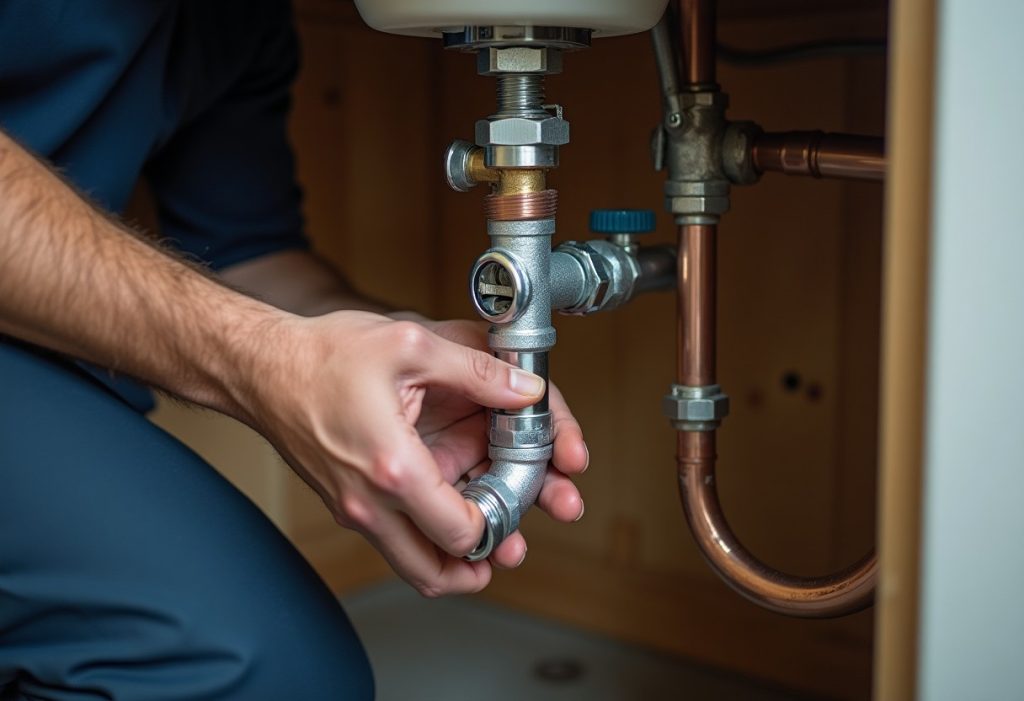
Install the arrestor as close as possible to the valve causing the hammer, because the shock wave is strongest right at the point of quick closure. For a washing machine or dishwasher that means at the appliance shutoff or on the hose-bib box. For a whole branch, the PDI standard places the arrestor near the end of the run, between the last two fixtures served.
Branch length changes the plan. PDI-WH201 says a single arrestor covers a branch up to 20 feet long; past that, the run needs a second unit to control the wave along its full length. Fast-closing solenoid valves on appliances are the usual trigger, so if you are mapping which shutoffs and plumbing valve types feed a noisy line, start at the appliances.
- Identify the fixture whose valve closes fastest, usually a washer, dishwasher, or icemaker solenoid.
- Shut off water to that branch and open a low faucet to drain the line.
- Fit the arrestor as close to that valve as the piping allows, on the same branch it serves.
- For a branch longer than 20 feet, add a second arrestor further along the run.
- Restore water and cycle the valve; the knock should be gone or much quieter.
How do you size a water hammer arrestor?
Size an arrestor by adding up the fixture units on the branch it protects, then matching that total to the PDI-WH201 letter sizes. The standard assigns each size a fixture-unit range, from Size A at the low end to Size F for large commercial mains. A single home appliance almost always falls in Size A or a mini unit rated for one fixture.
Here are the PDI-WH201 size classes and their fixture-unit capacities, as published in manufacturer sizing charts that certify to the standard.
| PDI size | Fixture units | Typical use |
|---|---|---|
| A | 1 to 11 | Single appliance or small branch |
| B | 12 to 32 | Small group of fixtures |
| C | 33 to 60 | Bathroom group or larger branch |
| D | 61 to 113 | Multiple groups |
| E | 114 to 154 | Large residential or light commercial |
| F | 155 to 330 | Commercial mains |
For most homeowners the math is simple: one washer or dishwasher is a low fixture-unit load, so a mini arrestor or a Size A covers it. You only climb the letters when you are protecting a whole bank of fixtures on one branch, which is more common in commercial work.
When does an arrestor fix water hammer, and when is the cause something else?
An arrestor fixes water hammer only when the noise comes from a fast-closing valve. That is the specific problem it is built for: the sharp spike when a solenoid or quarter-turn valve stops flow in a fraction of a second. If that is your cause, the right-sized arrestor near the valve usually silences it for good.
Two other causes look like water hammer but need different fixes. High static pressure amplifies every closure, and the answer there is a pressure reducing valve to bring pressure under the 80 psi ceiling in IPC 604.8. Loose or unsecured pipes that bang against framing need strapping and cushioned clamps, not an arrestor. Before you buy, work through how to fix water hammer to pin down which cause you actually have.
How much does a water hammer arrestor cost?
A mini washing-machine arrestor, the type that threads onto the hose bibs behind the appliance, commonly costs $10 to $40 at retail in 2026. A full branch-line arrestor that solders or screws into the pipe runs more, roughly $15 to $60 for residential sizes, with larger commercial units costing more again. The part is cheap relative to the damage repeated hammer can do.
Labor is the variable. A DIY hose-bib arrestor takes minutes and no tools beyond a wrench. A plumber adding an in-line arrestor behind a wall or on a soldered branch will charge for access and the joint, so bundling it with other work keeps the added cost small. Either way it is a low-cost fix compared with chasing loose pipes or replacing fatigued joints later.
How we sourced this
Arrestor performance and the sealed-versus-waterlogging distinction are drawn from ANSI/ASSE Standard 1010, Performance Requirements for Water Hammer Arresters. Sizing letters A through F and their fixture-unit ranges, plus the placement and 20-foot branch rule, come from PDI Standard WH201 and manufacturer charts certified to it (Watts, Zurn, J.R. Smith). The pressure ceiling is IPC Section 604.8. The surge magnitude uses the standard Joukowsky equation for pressure rise on rapid valve closure; the per-fixture figures are theoretical maximums for instant closure and real spikes run lower. Cost ranges are 2026 US retail figures. We did not rely on contractor blogs for any standard or code figure, and code adoption varies by jurisdiction, so confirm local requirements with your AHJ.
Frequently asked questions
What does a water hammer arrestor do?
A water hammer arrestor absorbs the pressure spike that forms when a fast-closing valve stops moving water instantly. It holds a sealed cushion of air or gas behind a piston that compresses to soak up the shock wave, then returns to position. That keeps the surge from banging through the pipes and stressing joints, valves, and fixtures.
What is the difference between an arrestor and an air chamber?
An old-style air chamber is just a capped stub of vertical pipe holding trapped air. Over months that air dissolves into the water and the chamber waterlogs, so it stops working. An ASSE 1010 arrestor seals its air or gas cushion behind a piston with O-rings, isolated from the water, so it stays charged for years with no maintenance.
Where do you install a water hammer arrestor?
Install it as close as possible to the fast-closing valve causing the problem, which for a washing machine or dishwasher means right at the appliance shutoff. On a branch line the PDI standard says to place the arrestor near the last fixture, and to add a second one if the branch runs longer than 20 feet.
How do I size a water hammer arrestor?
Size it by adding up the fixture units on the branch it protects, then matching that total to the PDI-WH201 letter sizes. Size A covers 1 to 11 fixture units, up through Size F at 155 to 330. Most single appliances such as a washer or dishwasher use the smallest A or a mini arrestor rated for that one fixture.
Do I need an arrestor for a washing machine?
Often yes. Washing machines and dishwashers use fast-acting solenoid valves that close in a fraction of a second, which is the classic trigger for water hammer. A mini washing-machine arrestor that threads onto the hose bibs, or a tee arrestor behind the box, is the common retrofit and usually costs $10 to $40.
Will an arrestor fix water hammer from high pressure?
Not reliably. If your static pressure is above the 80 psi ceiling in IPC Section 604.8, the real fix is a pressure reducing valve, not an arrestor. Loose pipes that rattle need strapping. An arrestor solves the specific spike from a fast-closing valve, so confirm the cause first before you buy one.
Do water hammer arrestors wear out?
ASSE 1010 sealed arrestors are designed for continuous service without maintenance, but the O-rings on a piston type can eventually lose their charge after many years or thousands of cycles. There is no gauge to check them; if hammer returns after an arrestor was working, a failed or undersized unit is a likely cause and replacement is straightforward.