Shower Head Flow Restrictor Removal: Steps by Brand

Shower head flow restrictor removal means unscrewing the head, lifting out the washer and screen, then prying out the plastic insert behind them, if your model has a removable one. Many do not: Kohler and Delta document built-in parts, and an open 4 gpm head costs 60% more per shower than 2.5 gpm.
Bucket test first: is the restrictor what limits your shower?
Often it is not, and a 1-gallon container with a phone timer settles the question. Open the valve fully, fill the container from the head, and divide 60 by the seconds it took: a gallon in 30 seconds is 2.0 gpm. Compare your result with the rate stamped on the head and the floors in this table.
| Stamped rate | Seconds per gallon at full rate | Floor at 45 psi | Floor at 20 psi |
|---|---|---|---|
| 1.8 gpm (California cap) | 33 s | 1.35 gpm, 44 s | 1.08 gpm, 56 s |
| 2.0 gpm (WaterSense cap) | 30 s | 1.5 gpm, 40 s | 1.2 gpm, 50 s |
| 2.5 gpm (federal cap) | 24 s | None in the federal text | None in the federal text |
The floors are 75% of rated flow at 45 psi and 60% at 20 psi, from sections 3.1.3 and 3.1.4 of the WaterSense showerhead specification and footnote 2 of California Title 20 Table H-5. Those psi figures are flowing pressure, so a gauge reading taken with every tap closed will run higher than what the head actually sees.
Next, take the head off and time a gallon from the bare arm, the check in Moen’s Posi-Temp low-flow article. Three results are possible:
- Head meets its row, bare arm far stronger. The restrictor is doing its job. Removal is a comfort choice, priced in the cost table further down.
- Head below its floor, bare arm strong. That points to a clog. Kohler’s guide 1141989-2 has you pry up and clean the screen washer, and its MasterShower sheet 112766-2 clears the 3 orifice holes in the flow control with a toothpick. Moen says to clean the head and replace it if needed.
- Bare arm weak too. No restrictor is holding you back. Moen’s flow FAQ blames low water pressure, a blockage or a faucet malfunction, and its Posi-Temp article ends at a new cartridge if there is still no flow. Our low water pressure diagnosis starts with a gauge reading against the normal 40 to 60 psi.
Which brands design the restrictor to come out? Delta, Moen and Kohler documents
None of the 3 makers’ documents we opened gives removal steps, and Kohler’s two showerhead guides rule removal out. The answer changes by model family within a brand.
| Maker and document | Where it sits, and built to come out? | What the maker says |
|---|---|---|
| Delta fixed heads: 75554C and 75641 Q&A | Location not stated. Possible, advised against | “Possible” but “we strongly advise against it”: can damage the unit, voids the warranty, “may result in a painful showering experience” |
| Delta hand showers: RP52589 Q&A | “Built inside of the hand held wand for all hand held showers.” No | “No way to remove” it on RP52589PN, rated 1.75 gpm at 60 psi; any modification voids the warranty |
| Moen: Moen Solutions FAQ | A regulator in the head. Removability not stated | “Pressure compensating flow regulator”; “removal of this will actually diminish performance” |
| Kohler rain heads K-13688 to K-13696, K-45200 to K-45202: guide 1141989-2 | Inlet, behind the screen washer. No | “Do not attempt to remove the flow control” |
| Kohler MasterShower: 1993 sheet 112766-2 | Ball joint, behind the inlet screen. No | “Press fit into place and cannot be removed” |
| Kohler 23126T-9 column (Asia-Pacific): install sheet | Hand shower inlet, part 20. Fitted at install | Put the restrictor in “if needed” |
Read that table as a stop list. The two Kohler showerhead families and Delta’s RP52589 are not jobs to attempt. Delta’s answers differ by date: its 2017 reply on 75554C calls removal possible on heads and hand helds, while its 2024 RP52589 replies say built in, so call Delta at 800-345-3358 with your model number first. On a Moen regulator, removal is the opposite of a fix by Moen’s own account.
We could not open a Grohe or Speakman document on restrictor removal, so neither has a row. Ask their customer service with the model number from the head or box.
What 10 CFR 430.32(p) and California Title 20 say about an owner removing one
Neither text mentions an owner: both set limits on showerheads as manufactured. 10 CFR 430.32(p) caps any showerhead made after January 1, 1994 at 2.5 gpm at 80 psi flowing pressure. Moen traces the limit to the 1992 Energy Policy Act.
The same paragraph explains why inserts resist you. The flow-restricting insert must be “mechanically retained at the point of manufacture” so that 8.0 pounds of force or more is needed to pull it, about the weight of a gallon of water. It carves out heads where removal “would cause water to leak significantly from areas other than the spray face,” which tells you some bodies are built around the part.
California’s Title 20 section 1605.3(h)(5) sets 1.8 gpm at 80 psi for heads manufactured on or after July 1, 2018, and 2.0 gpm for the two years before. EPA WaterSense labels heads at 2.0 gpm or less, and its specification bars instructions that override the maximum flow rate. Maintenance instructions must show how to return the head to its intended rate, which may be why labeled heads ship with no removal steps.
Silence in these texts is not permission. Delta says most plumbing codes cap showering flow and that removal could take a device out of compliance, and local amendments vary. Before a rental turnover, a rebate claim or a sale inspection, ask your building department which code edition applies.
Steps for a fixed head with a loose insert, and where to stop
- Close the shower valve and lay a towel over the drain.
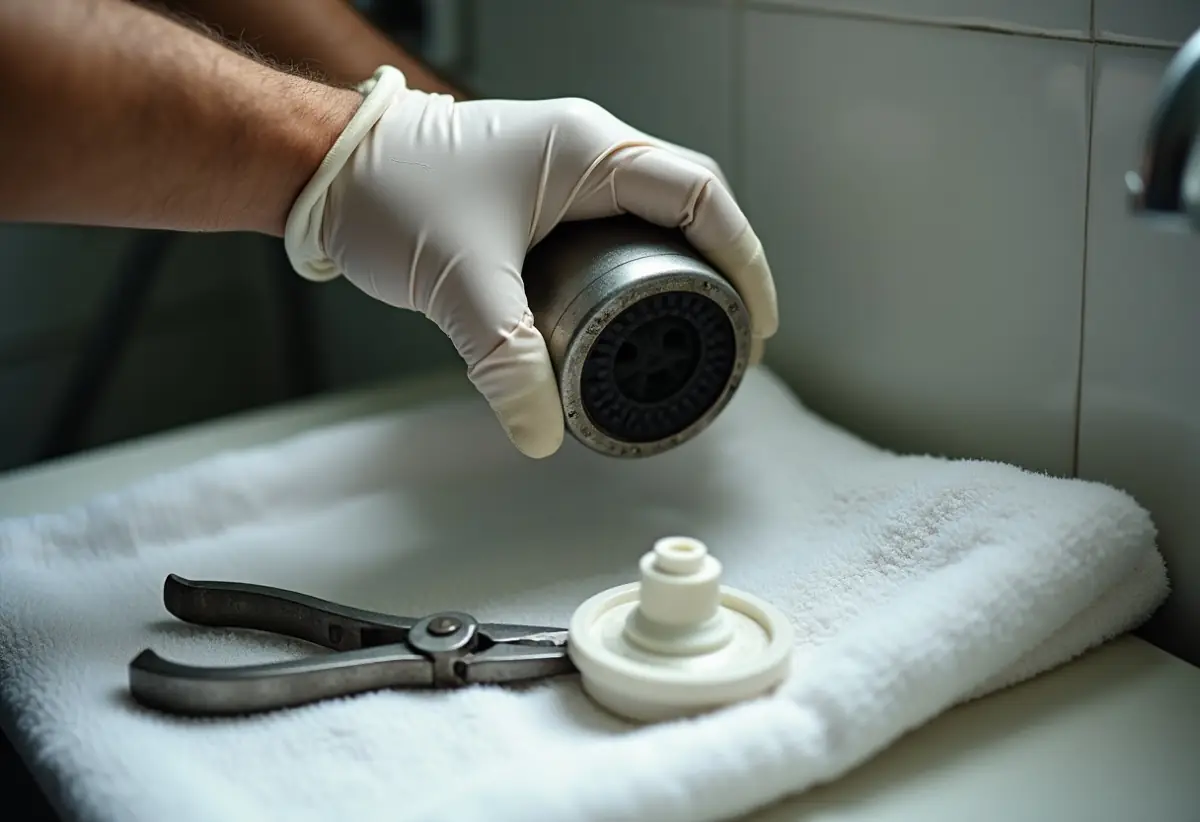
- Wrap the head nut in a rag, hold the arm with a second tool so torque stays out of the wall, and turn the nut counterclockwise.
- Pry up the edge of the washer with a thin-bladed screwdriver, the method in Kohler 1141989-2. Note which way it faced, since Kohler’s screen washer goes back with the tapered end out.
- Look into the inlet. A molded flow control with orifice holes, like the 3 on Kohler’s MasterShower, or no separate part means built in. Clean it and put the head back.
- If a separate insert shows, grip it with needle-nose pliers and pull straight. Expect to need 8 pounds of force or more. If it will not move, stop: Delta warns of damage to the unit.
- Bag the insert with the model number written on it, so the head can return to its stamped rate.
- Reinstall the screen and washer, then wrap the arm threads and tighten as in our shower head replacement steps.
- Run the shower. Water leaking from the body rather than the spray face is the failure 10 CFR 430.32(p) anticipates, so put the insert back. If dry, repeat the bucket test to learn your real open flow.

What removal costs: gallons, Btu and dollars per 10-minute shower at 1.8, 2.0, 2.5 and 4 gpm
A 10-minute shower at an open 4 gpm uses 40 gallons and costs $1.41 on an electric tank or $0.86 on gas, against $0.88 and $0.54 at 2.5 gpm. The 4 gpm row is an illustration, not a measurement. Every column scales in a straight line, so swap in your own bucket-test result.
| Flow, 10 minutes | Btu into the water | Water and sewer | Electric tank: energy, total | Gas tank: energy, total |
|---|---|---|---|---|
| 1.8 gpm, 18 gal | 7,506 | $0.20 | 2.39 kWh, $0.64 | 12.1 cu ft, $0.39 |
| 2.0 gpm, 20 gal | 8,340 | $0.22 | 2.66 kWh, $0.71 | 13.4 cu ft, $0.43 |
| 2.5 gpm, 25 gal | 10,425 | $0.28 | 3.32 kWh, $0.88 | 16.8 cu ft, $0.54 |
| 4 gpm, 40 gal | 16,680 | $0.45 | 5.31 kWh, $1.41 | 26.8 cu ft, $0.86 |
Heat: a 105 F shower from 55 F supply water is a 50 F rise on the whole volume, at 8.34 Btu per gallon per degree. Efficiency: 92% electric and 60% gas, close to the federal floors for a 40 gallon medium-draw tank in 10 CFR 430.32(d), which work out to 0.92 and 0.58. Standby loss is left out.
Prices: electricity at 18.16 cents per kWh, the EIA US residential average for August 2026; gas at $15.34 per thousand cubic feet, EIA’s 2025 residential average, at 1,037 Btu per cubic foot. Water and sewer run $11.15 per 1,000 gallons, which is EPA’s $2.9 billion in bills divided by its 260 billion gallons on the WaterSense showerhead page.
Over a year, one person taking one 10-minute shower a day and going from 2.5 to 4 gpm adds 5,475 gallons, about $193 on electric or $117 on gas. EPA credits a WaterSense head with saving an average family 2,700 gallons a year, so one person with a pulled restrictor burns through about twice that. Starting from a 1.8 gpm California head, the increase is 8,030 gallons and $283 or $172.
How fast does a 40 gallon water heater run out at 4 gpm?
About 12 minutes on a 40 gallon electric tank by our arithmetic, compared with about 20 minutes at 2.5 gpm. Back-to-back 10-minute showers fall from 2 to 1.2.
| Shower flow | Hot water drawn | Minutes until the tank runs out | 10-minute showers in a row |
|---|---|---|---|
| 1.8 gpm | 1.38 gpm | 31 | 3.1 |
| 2.0 gpm | 1.54 gpm | 27 | 2.7 |
| 2.5 gpm | 1.92 gpm | 20 | 2.0 |
| 4 gpm | 3.08 gpm | 12 | 1.2 |
The inputs come from one real tank. A.O. Smith lists the 40 gallon ENT-40 with 4,500 W elements and a 53 gallon first hour rating. One 4,500 W element makes about 21 gallons an hour at a 90 F rise, which leaves roughly 32 gallons of stored hot water, 80% of the nameplate. A 105 F shower from a 120 F tank and 55 F supply is 77% hot water: (105 minus 55) divided by (120 minus 55). Treat the minutes as estimates, since recovery runs faster at a smaller rise.
Gas tanks recover faster than electric ones, and our guide to water heater reheat times gives the wait by tank type. Raising the tank above 120 F to stretch the supply trades the shortage for scald risk, so read our water heater temperature guide before turning that dial.
Does removal upset a pressure-balance valve?
No document we read says removal does, but none tests a valve with an open head either. Moen’s instruction sheet INS2153C sets floors: Posi-Temp and CFG valves for heads rated 1.5 gpm or higher, ExactTemp and ioDigital for 2.5 gpm or higher, Moentrol for 1.3 gpm or higher. Taking a restrictor out moves flow away from those floors, and the same page lists heads at 2.5 gpm maximum, so a 4 gpm head sits outside what Moen lists.
Check temperature after any change at the head. Run the shower full hot, hold a thermometer in the stream, and adjust the limit stop if it reads over 120 F, the ceiling INS2153C gives. The swap in the other direction carries the clearer warning: a 1.75 gpm head on an ExactTemp valve falls under Moen’s 2.5 gpm rating.
More flow with the restrictor in place: a 2.5 gpm head instead of 1.75
Swapping a 1.75 gpm head for a 2.5 gpm one adds 43% more flow with no prying and no lost warranty. Delta says it offers showerheads from 1.75 to 2.5 gpm and does not offer a replaceable restrictor to raise the rate. Check your state first: California’s Title 20 limit for heads made since July 2018 is 1.8 gpm.
Frequently asked questions
Does removing a flow restrictor raise water pressure?
It raises flow, not supply pressure. A gauge on a hose bib reads the same psi before and after, because the restrictor only limits gallons per minute at the head. On Moen heads with a pressure compensating regulator, Moen says removal will actually diminish performance.
Is it illegal to remove a flow restrictor from a shower head?
We cannot give a legal answer. The federal and California limits we read are written about showerheads as manufactured and do not mention owners. Delta says most plumbing codes set maximum flow rates, and local amendments vary, so ask your building department before a rental turnover or sale inspection.
Will removing the restrictor void the warranty?
On Delta heads, yes. Delta customer care says on its 75641 and 75554C product pages that removal will void the warranty, and its RP52589 answer says any modification does. The Moen and Kohler documents we read do not address warranty terms for removal, so ask the maker before you pry.
Can I drill out a restrictor that will not come out?
No document we read gives a drilling method. Kohler describes the MasterShower flow control as press fit and not removable, and Delta warns that removal can damage the unit. A 2.5 gpm replacement head is the cleaner way to add flow when the insert stays put.
How do I know if my shower head has a restrictor?
Assume it does if it was made after January 1, 1994, when the 2.5 gpm federal limit began. Look for a rate stamped on the head, then lift the inlet washer. You will see a separate insert, a molded flow control, or nothing, which means the part sits elsewhere, as in a Delta hand shower wand.
How we sourced this
We read 10 CFR 430.32, California Title 20 section 1605.3, the EPA WaterSense specification, Delta product Q&A answers, Moen Solutions articles and INS2153C, three Kohler documents, A.O. Smith’s ENT-40 listing and EIA price tables. Cost and run-out figures are our arithmetic from those inputs; nothing was installed or tested. Grohe and Speakman removal documents could not be found, so both were left out.