How Much Water Does a Shower Use?
How much water does a shower use? The average American shower uses 15.8 gallons over 7.8 minutes at 2.1 gpm, and a 10-minute shower uses 18 to 25 gallons on any legal showerhead.
Key Takeaways
- The Water Research Foundation’s 2016 Residential End Uses of Water study (REU2016) measured an average shower of 15.8 gallons, 7.8 minutes long, at 2.1 gallons per minute.
- Federal law caps new showerheads at 2.5 gpm measured at 80 psi under 10 CFR 430.32(p), so a 10-minute shower tops out near 25 gallons on a compliant head.
- EPA WaterSense labels showerheads that use no more than 2.0 gpm, and the California Energy Commission has capped showerheads sold in California at 1.8 gpm since July 1, 2018.
- EPA puts a full bathtub at about 70 gallons, so a shower only uses more than a full bath after about 28 minutes at 2.5 gpm.
- Using EPA and EIA figures, an average shower costs about 56 cents with an electric water heater and about 34 cents with gas, with heating energy the bigger share on electric.
- An average REU2016 household takes 12.4 showers a week, which works out to about 28 gallons a day and 645 showers a year.
How much water does a shower use on average?
The average shower uses about 15.8 gallons of water. That figure comes from the Water Research Foundation’s REU2016 study, which logged water meters in real homes and found the typical shower lasted about 7.8 minutes at a measured 2.1 gallons per minute. Your number depends on two things only, the flow rate of your showerhead and how long the water runs.
The arithmetic is simple. Flow rate times minutes equals gallons, so 2.1 gpm times 7.8 minutes comes to 16.4 gallons, close to the study’s measured 15.8 gallons per shower (the measured average is a little lower because many people throttle the valve or pause the water). The Alliance for Water Efficiency’s summary of REU2016 reports all three figures.
How many gallons does a 10-minute shower use?
A 10-minute shower uses between 15 and 25 gallons on any showerhead sold legally in the US today. At the federal maximum of 2.5 gpm it uses 25 gallons, at the WaterSense level of 2.0 gpm it uses 20 gallons, and at California’s 1.8 gpm cap it uses 18 gallons. A pre-1994 head with no flow cap can use far more.
| Showerhead flow rate | 5 minutes | 10 minutes | 15 minutes |
|---|---|---|---|
| 2.5 gpm (federal maximum, 10 CFR 430.32) | 12.5 gal | 25 gal | 37.5 gal |
| 2.1 gpm (REU2016 measured average) | 10.5 gal | 21 gal | 31.5 gal |
| 2.0 gpm (EPA WaterSense maximum) | 10 gal | 20 gal | 30 gal |
| 1.8 gpm (California, Washington limit) | 9 gal | 18 gal | 27 gal |
| 1.5 gpm (common low-flow WaterSense model) | 7.5 gal | 15 gal | 22.5 gal |
Every cell is flow rate times minutes. A 15-minute shower on a 2.5 gpm head, for example, is 2.5 times 15, or 37.5 gallons, more than double the REU2016 average shower.
The 2.5 gpm rating is measured at 80 psi, and many homes run lower static pressure than that, so real flow is often below the stamped number. A head clogged with scale also flows less, which is one reason to clean a shower head before you blame the head itself for weak pressure.
What is the legal limit on showerhead flow?
The federal limit is 2.5 gallons per minute at 80 psi for any showerhead made after January 1, 1994, under the Department of Energy rule at 10 CFR 430.32(p). EPA’s voluntary WaterSense label requires 2.0 gpm or less. California and several other states go further, and California’s 1.8 gpm cap has applied to showerheads sold there since July 1, 2018.
The federal text reads that maximum water use “shall be 2.5 gallons per minute (9.5 liters per minute) when measured at a flowing pressure of 80 pounds per square inch gage,” per 10 CFR 430.32 as published by Cornell’s Legal Information Institute. Showerheads made before 1994 have no cap, which is why old heads in long-owned homes can run far above 2.5 gpm.
EPA WaterSense certifies heads at 2.0 gpm or less that also meet minimum spray-force and coverage requirements, so a labeled head should not feel like a weak mist. California’s Title 20 appliance efficiency regulations phased in 2.0 gpm on July 1, 2016, then 1.8 gpm on July 1, 2018. Washington also sets 1.8 gpm, and Colorado adopted 2.0 gpm in 2014. Other states have adopted their own limits, so check your state before you buy online.
Multi-outlet setups break the per-head math. A rain head plus a handheld plus body sprays can add up well past 2.5 gpm if they run at once, and DOE’s definition of a showerhead for these systems has changed more than once since 2020. Read the combined flow rating, and see our guide to shower head types for how rain, handheld and multi-function heads compare.
How much water does a shower use compared with a bath?
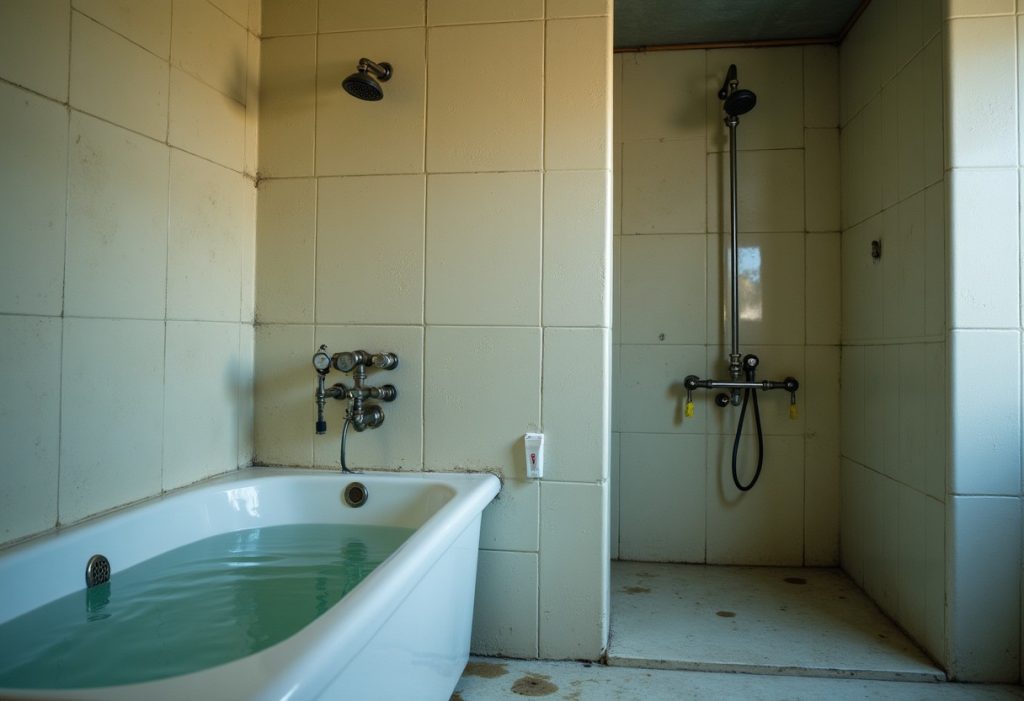
A typical shower uses far less water than a full bath. EPA WaterSense puts a full bathtub at about 70 gallons, against 15.8 gallons for the average REU2016 shower. Even at the 2.5 gpm federal maximum, a shower has to run about 28 minutes before it matches a full tub, and at 1.8 gpm the break-even stretches to nearly 39 minutes.
The 70-gallon figure comes from EPA’s WaterSense “Shower Power” material, which also notes that a five-minute shower uses 10 to 25 gallons. Most people do not fill a tub to the overflow, so a real bath often uses less than 70 gallons. Half a tub, about 35 gallons, still equals a 14-minute shower at 2.5 gpm.
The break-even rule is 70 divided by your flow rate, so 35 minutes at 2.0 gpm. Halve it for a half-filled tub.
How much does a shower cost in water and energy?
An average 15.8-gallon shower costs about 56 cents with an electric water heater and about 34 cents with a gas water heater, using national average prices. Water and sewer run about 18 cents of that. Heating the water costs about 38 cents on electric and about 16 cents on gas, so on electric the energy costs more than the water itself.
Here are the assumptions, stated so you can swap in your own bill:
- Water and sewer price. EPA WaterSense says universal WaterSense showerheads would save more than $2.9 billion in utility bills and more than 260 billion gallons a year. Dividing $2.9 billion by 260 billion gallons gives about $0.0112 per gallon, or about $11.15 per 1,000 gallons combined. Local rates vary.
- Temperature rise. We assume a mixed shower temperature of 105°F and cold supply water at 55°F, a 50°F rise applied to the full volume. Heating 1 gallon by 1°F takes about 8.34 Btu.
- Heater efficiency. We assume 92% for an electric resistance tank and 60% for a standard gas tank.
- Energy prices. Electricity at 18.2 cents per kWh, the 2026 US residential average in EIA’s October 2026 Short-Term Energy Outlook. Natural gas at $15.34 per thousand cubic feet, the 2025 US residential average in EIA’s natural gas price series, at about 1,036 Btu per cubic foot.
The math for the average shower runs like this. 15.8 gallons times 8.34 Btu times 50°F equals 6,589 Btu. On electric, 6,589 divided by 3,412 Btu per kWh is 1.93 kWh, divided by 0.92 efficiency is 2.10 kWh, times $0.182 is $0.38. On gas, 6,589 divided by 0.60 is 10,982 Btu, or 0.0106 thousand cubic feet, times $15.34 is $0.16. Water and sewer add 15.8 times $0.0112, or $0.18.
| Shower | Water and sewer | Heating, electric | Total, electric | Heating, gas | Total, gas |
|---|---|---|---|---|---|
| Average shower, 15.8 gal (REU2016) | $0.18 | $0.38 | $0.56 | $0.16 | $0.34 |
| 10 min at 1.8 gpm, 18 gal | $0.20 | $0.44 | $0.64 | $0.19 | $0.39 |
| 10 min at 2.5 gpm, 25 gal | $0.28 | $0.60 | $0.88 | $0.26 | $0.54 |
| 15 min at 2.5 gpm, 37.5 gal | $0.42 | $0.91 | $1.33 | $0.39 | $0.80 |
Scaled to a year, an REU2016 household taking 12.4 showers a week takes about 645 showers. At 56 cents each that is about $360 a year on electric, or about $219 at 34 cents on gas. Our energy figure lines up with EPA, which says the average family saves 2,700 gallons and more than 330 kWh a year with WaterSense heads, about 0.12 kWh per gallon against our 0.13.
How much of a household’s water goes to showers?
Showers account for roughly one fifth of indoor water use in American homes. REU2016 found showers tied with faucets as the second largest indoor use, at 11.1 gallons per person per day or 19% of indoor use, behind toilets at about 24%. For the average household that comes to about 28 gallons of shower water a day.
The household figure is arithmetic from REU2016’s own numbers. 12.4 showers a week times 15.8 gallons is 195.9 gallons, divided by 7 days is 28.0 gallons a day. Against the study’s average indoor use of 138 gallons per household per day, that is about 20%.
| Indoor end use (REU2016) | Share of indoor use | Note |
|---|---|---|
| Toilets | About 24% | 33.1 gallons per household per day |
| Showers | About 19% | 11.1 gallons per person per day |
| Faucets | About 19% | 26.3 gallons per household per day |
| Clothes washers | About 17% | Falling as front loaders spread |
| Leaks | About 12% | Concentrated in a minority of homes |
EPA WaterSense uses a slightly different figure, saying showering is “nearly 17 percent” of residential indoor use, or nearly 40 gallons a day for the average family. The gap comes from different household sizes and data vintages, so treat 17% to 20% as the honest range. For the full breakdown of every fixture, see our residential water use report, and for what a normal monthly total looks like, our guide to home water usage.
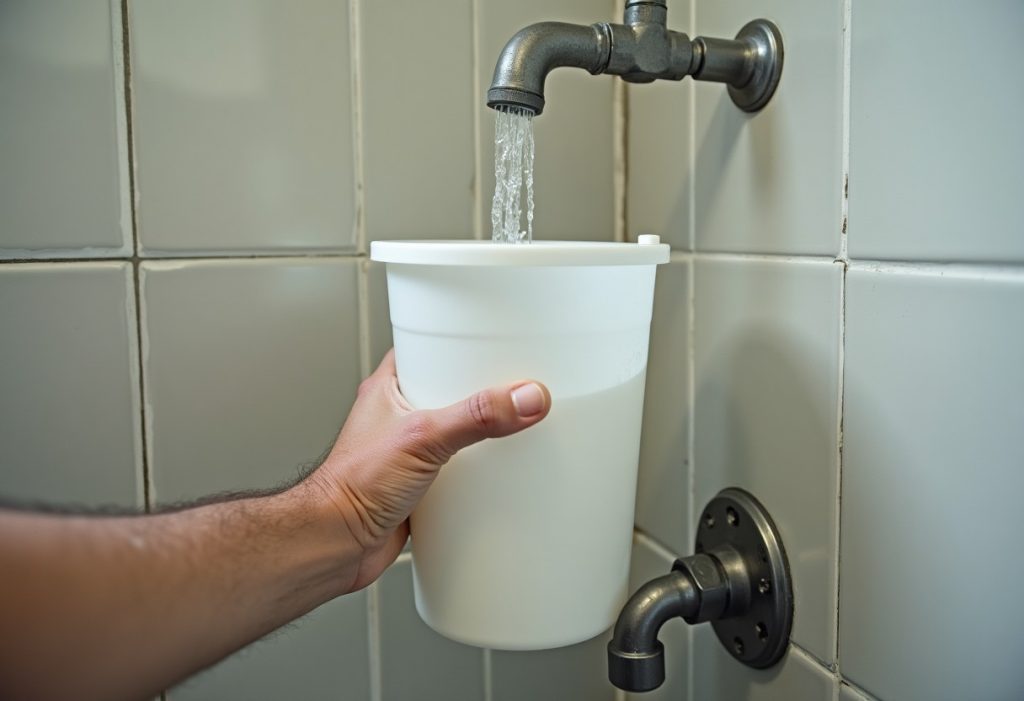
How do you measure how much water your own shower uses?
You can measure your shower’s real flow in under a minute with a bucket and a phone timer. Time how long the shower takes to fill a 1-gallon container at full flow, then divide 60 by the seconds. A 24-second fill means 2.5 gpm, a 30-second fill means 2.0 gpm, and a 40-second fill means 1.5 gpm. Multiply by your shower length.
- Turn the shower to the position you actually use, at full flow.
- Hold a 1-gallon container (or a marked bucket) under the head and start a timer.
- Stop the timer when the container hits the 1-gallon mark.
- Divide 60 by the seconds to get gallons per minute.
- Multiply gpm by your usual minutes to get gallons per shower.
If your measured flow is well below the rating and pressure feels weak, mineral scale in the nozzles or a clogged flow restrictor is the usual cause. If it is well above 2.5 gpm, the head is likely older than 1994 or its restrictor has been removed.
Shortening the shower saves as much as swapping the head. Cutting 2 minutes off a 2.1 gpm shower saves 4.2 gallons each time, about the same as dropping from 2.5 to 2.0 gpm on an 8-minute shower (4 gallons).
Do low-flow showerheads really save water and money?
Yes, and the savings scale with how far your current flow sits above the new head’s rating. EPA says WaterSense showerheads can save the average family more than 2,700 gallons and more than 330 kWh a year. Our own check lands close, an REU2016 household cutting 0.5 gpm over 645 showers of 7.8 minutes saves about 2,515 gallons a year.
At our assumed $0.0112 per gallon for water and sewer, 2,515 gallons is about $28 a year in water alone. Add the heating energy on an electric water heater, about 0.133 kWh per gallon at 18.2 cents, and the total rises to roughly $89 a year. EPA’s own estimate is $70 a year in combined water and electricity savings for the average family.
The savings shrink if your current head already measures near 2.0 gpm. Run the bucket test first, then decide.
How we sourced this
We consulted 11 sources and cite 8: the Water Research Foundation REU2016 figures as reported by the Alliance for Water Efficiency and the study’s published summary tables, 10 CFR 430.32(p), EPA WaterSense showerhead, statistics and archived Shower Power pages, the California Energy Commission Title 20 regulations, and EIA’s October 2026 Short-Term Energy Outlook and natural gas price series. REU2016 summaries disagree slightly on shower length (7.7 versus 7.8 minutes), and we use 7.8. Cost figures are our arithmetic from the named inputs and are national averages, not a quote for any utility. We excluded vendor savings calculators and figures we could not trace to a primary source. State limits outside California were checked against secondary sources and may change. Data reviewed October 2026.
Frequently asked questions
How much water does a 5-minute shower use?
A 5-minute shower uses 7.5 to 12.5 gallons on a showerhead sold legally in the US. At the 2.5 gpm federal maximum it uses 12.5 gallons, at the 2.0 gpm WaterSense level it uses 10 gallons, and at California’s 1.8 gpm cap it uses 9 gallons. EPA WaterSense gives a range of 10 to 25 gallons, which allows for older, higher-flow heads.
How many gallons does a 10-minute shower use?
A 10-minute shower uses 25 gallons at the 2.5 gpm federal maximum, 21 gallons at the 2.1 gpm average flow measured in REU2016, 20 gallons on a 2.0 gpm WaterSense head, and 18 gallons at California’s 1.8 gpm limit. Multiply your showerhead’s gpm rating by 10 to get your own number.
Is it better to take a bath or a shower to save water?
A shower almost always uses less water. EPA WaterSense puts a full bathtub at about 70 gallons, while the average REU2016 shower uses 15.8 gallons. A shower only matches a full tub after about 28 minutes at 2.5 gpm or about 35 minutes at 2.0 gpm. A half-filled tub, roughly 35 gallons, equals a 14-minute shower at 2.5 gpm.
How much does a 10-minute shower cost?
At national average prices a 10-minute shower on a 2.5 gpm head costs about 88 cents with an electric water heater and about 54 cents with gas. That assumes $11.15 per 1,000 gallons for water and sewer derived from EPA figures, a 50 degree temperature rise, and EIA’s 18.2 cents per kWh and $15.34 per thousand cubic feet prices.
Is a 15-minute shower too long?
It uses about twice the water of an average shower. A 15-minute shower uses 37.5 gallons at 2.5 gpm and 27 gallons at 1.8 gpm, against 15.8 gallons for the average 7.8-minute shower measured in REU2016. On an electric water heater it costs about $1.33 at national average prices, so a long daily shower adds up over a year.
How much water does the average person use per day indoors?
REU2016 measured average indoor use of 52.1 gallons per person per day and 138 gallons per household per day. Showers account for about 11.1 gallons per person per day, tied with faucets for second place behind toilets. Outdoor watering is extra and can more than double household use in dry climates.
Does a rain shower head use more water?
Not by rule. A single rain head is held to the same 2.5 gpm federal maximum as any other showerhead, and many carry 2.0 or 1.8 gpm ratings. Water use climbs when a rain head runs alongside a handheld or body sprays, because each outlet adds flow. Check the combined flow rating for multi-outlet systems before you buy.