Can You Use Drain Cleaner in a Garbage Disposal? What Makers Say
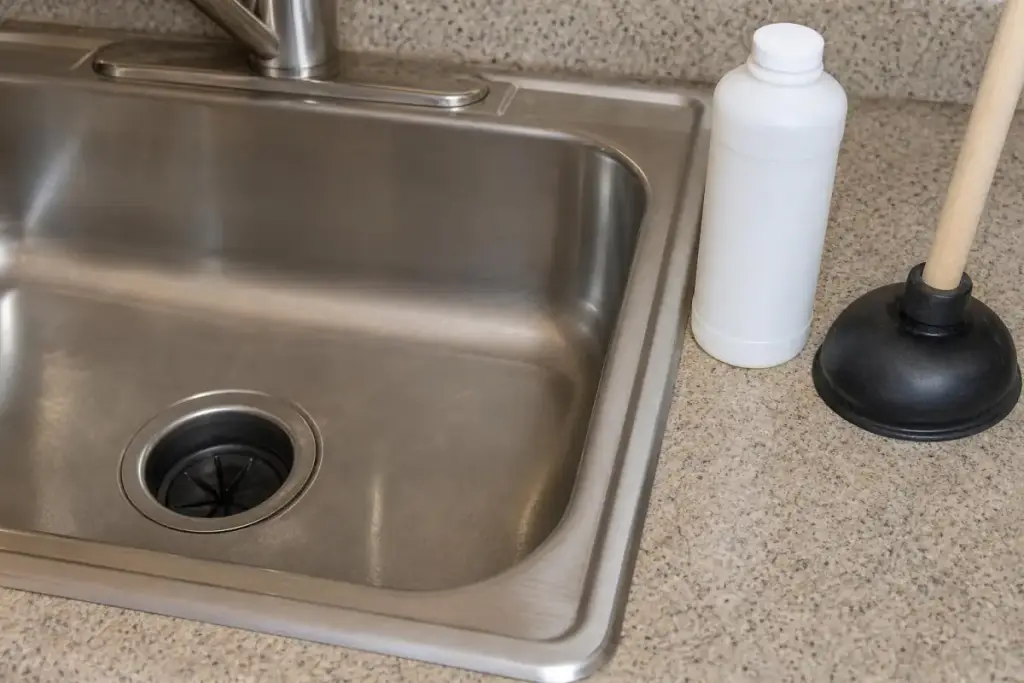
Drain cleaner in a garbage disposal gets two opposite answers in print: Moen and Waste King say never put lye or chemical drain cleaners in the disposer and void all warranties if you do, while Drano Max Gel’s label calls itself safe for garbage disposals. The disposal maker’s rule should win.
What do the InSinkErator, Waste King and Moen manuals say about chemical drain cleaners?
All 3 disposal makers say keep chemical drain cleaner out, and 2 tie it to the warranty. The table quotes each document beside 4 drain cleaner labels.
| Source | Exact wording on disposals | Verdict |
|---|---|---|
| Moen Solutions article | “NEVER put lye or chemical drain cleaners into the garbage disposal, as they cause serious corrosion of metal parts. If used, resulting damage can be easily detected and all warranties are void.” | Never, warranty void |
| Waste King WLC-100 manual, page 2 | The same “NEVER put lye or chemical drain cleaners into the disposer” sentence, plus “drain cleaner” on its list of materials that “may be expelled by a waste disposer” | Never, warranty void |
| InSinkErator Installation, Care and Use manual | “Do not put the following into a disposer: clam or oyster shells, caustic drain cleaners or similar products, glass, china, or plastic…” | Do not put in |
| Drano Max Gel, 32 fl oz label | “USES: safe for garbage disposals, bathroom, kitchen and other drains like laundry sinks.” | Safe |
| Liquid-Plumr FAQ | “Yes. This product is safe to use in your garbage disposal… flush the product with the disposal running.” For Pro-Strength Hair Clog Eliminator: “No, do not use this clog remover in your garbage disposal.” | Split by bottle |
| Jones Stephens Drain Strike (93% sulfuric acid) spec sheet | “DO NOT use in toilets, stainless steel sinks, garbage disposals, dishwashers or washing machines.” | Never |
| Drano FlowGuard Enzymatic Build-Up Remover, 30 oz label | “Safe for garbage disposals, bathroom, kitchen, other drains and safe for toilets” | Safe, maintenance only |
Read the Moen and Waste King rows side by side: the 2 sentences match except for “garbage disposal” versus “disposer,” so the same warranty clause covers both brands. The decision rule is short. If the disposal is still inside its warranty term, the disposal manual outranks any bottle, because the manual is the document that decides your claim.
Why does a Drano label say “safe for garbage disposals” when Moen says never?
The 2 documents answer different questions. A drain cleaner label promises the formula will not harm the drain; the Moen and Waste King warn that lye corrodes the metal parts inside the grind chamber and that the damage “can be easily detected” at a warranty inspection.
The ingredient list settles which side applies to your bottle. The Liquid-Plumr Urgent Clear SDS (issued 6/25/2025) lists sodium hydroxide at 1 to 5% and names “LYE” among its synonyms. The Drano Max Gel label says it “Contains sodium hydroxide, sodium hypochlorite, and sodium silicate.” Lye is the word the Moen and Waste King use, so any bottle with sodium hydroxide in Section 3 of its SDS falls under their “never.”
The Liquid-Plumr instruction to “flush the product with the disposal running” also collides with the Waste King safety list, which names drain cleaner among materials that may be expelled by a waste disposer. Spinning a plate at full speed in a liquid that both Clorox SDS sheets put at about pH 13 is the risk that list points at. If you go ahead anyway, switch on only after the drain is clear and the wait time printed on the bottle has passed.
What is in each bottle, according to its SDS?
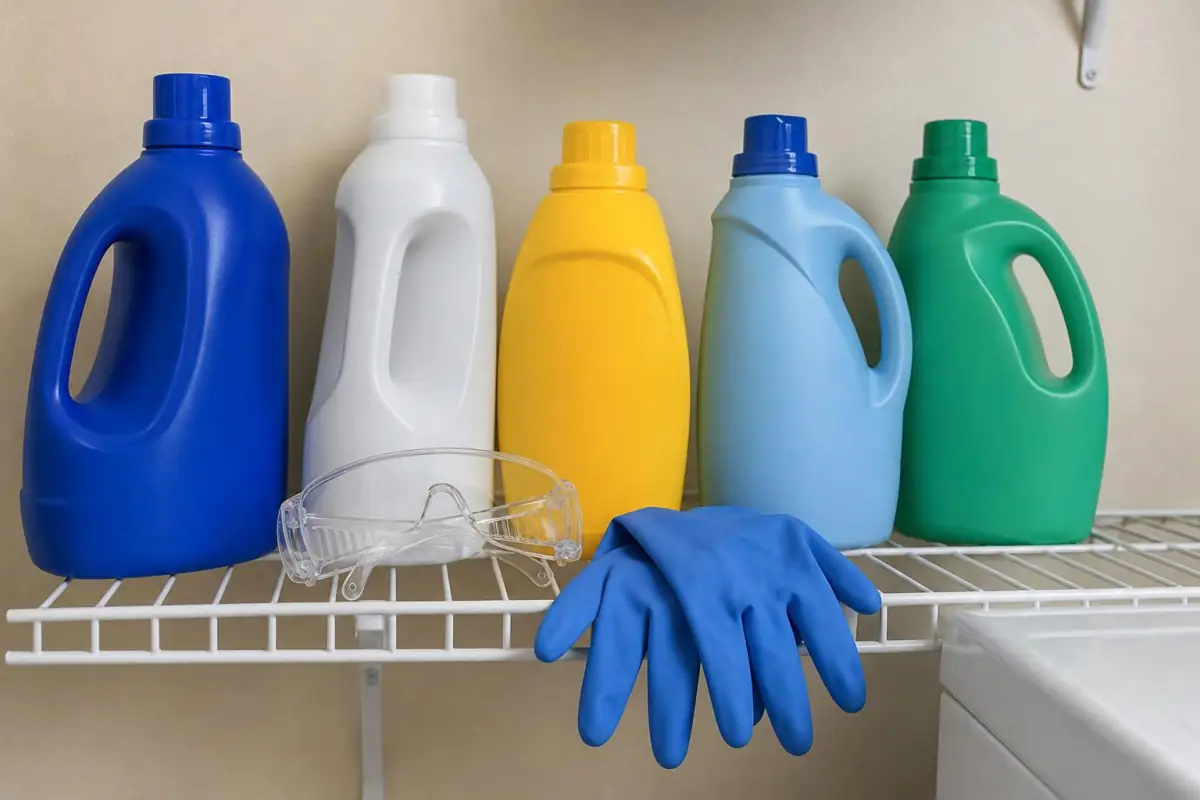
Every caustic product here pairs sodium hydroxide with sodium hypochlorite (bleach), the acid product is 93% sulfuric acid, and the enzyme product is the only one without a DANGER signal word. Section 3 of each safety data sheet gives the ingredient ranges; Section 8 names the gloves and eye protection.
| Product and document | Active ingredients | Listed hazards | Protection the document names |
|---|---|---|---|
| Drano Max Gel Ultra SDS, rev. 05/20/2015 | Sodium hypochlorite 5 to 10%, sodium hydroxide 1 to 5%, pH 11.5 to 13.5 | Danger; causes severe skin burns and eye damage; “Do not mix with bleach or any other household cleaners” | Rubber gloves, splash-resistant chemical goggles |
| Pro-Strength Liquid-Plumr Full Clog Destroyer SDS, issued 17-Aug-2022 | Sodium hypochlorite 5 to 10%, sodium hydroxide 1 to 5%, pH about 13 | Danger; causes serious eye damage; “Permanent eye damage including blindness could result” | Protective gloves and eye protection; rubber gloves for prolonged use |
| Liquid-Plumr Urgent Clear SDS, issued 6/25/2025 | Sodium hypochlorite 5 to 10%, sodium hydroxide 1 to 5%, pH about 13 | Danger; severe skin burns; reacts with toilet bowl cleaners, rust removers, acids and ammonia to produce chlorine gas | Chemical-resistant gloves, safety glasses with side shields or goggles |
| Jones Stephens Drain Strike spec sheet | 93% sulfuric acid | “Causes immediate, severe burns”; “NEVER ADD WATER TO PRODUCT. Reacts violently with water.” | Gloves, protective clothing, eye protection and face protection |
| Drano FlowGuard Enzymatic label | Natural enzymes, bacterial cultures, surfactants | Caution: eye irritant | Rinse eyes 15 minutes if splashed |
Two hazards in that table decide what you do next. The 2025 Urgent Clear SDS warns that bleach-based cleaners release chlorine gas when they meet acids, and the Drain Strike sheet says “Do not use before, with or after any other chemicals.” A sink that already holds a caustic gel must never get a sulfuric acid chaser.
How much product sits in the disposal, and for how long?
On a disposal sink, whatever you pour lands in the grind chamber first. We converted each of 6 labels’ fraction of a bottle into fluid ounces.
| Product | Label dose | Computed ounces in the drain | Label wait before flushing |
|---|---|---|---|
| Drano Max Gel, 32 fl oz | 1/5 bottle | 32 x 0.2 = 6.4 fl oz | 15 minutes, longer for tough clogs |
| Drano Max Gel Commercial Line, 42 fl oz | 1/2 bottle | 42 x 0.5 = 21 fl oz | 15 to 30 minutes |
| Drano Dual-Force Foamer, 17 fl oz | Entire bottle | 17 fl oz | 1 hour |
| Liquid-Plumr Industrial Strength Gel | 1/5 bottle, “2 cups” | 2 x 8 = 16 fl oz | At least 15 minutes |
| Jones Stephens Drain Strike, sink | 16 to 20 oz | 16 to 20 oz | 15 minutes, then 5 minutes of cold water |
| Drano FlowGuard Enzymatic, 30 oz | 10 oz start-up treatment | 10 oz | 6 to 8 hours with no running water |
The comparison that no bottle prints: the enzyme treatment holds its 10 oz in the drain 24 to 32 times longer than Max Gel’s 15 minutes (360 or 480 minutes divided by 15), yet it is the only product rated CAUTION rather than DANGER. Long dwell is harmless when the liquid is enzymes and bacterial cultures; 21 oz of Commercial Line gel sitting 30 minutes against a stalled grind plate is the case the Moen corrosion warning covers.
The acid option costs extra work even where it is allowed. The Drain Strike sheet says some state and local codes require neutralizing, using 1-1/4 cups of baking soda per quart of water and one quart for each 4 to 6 ounces poured. For a 16 to 20 oz sink dose that is 16/6 = 2.7 to 20/4 = 5 quarts, or 3.3 to 6.25 cups of baking soda.
Is the clog in the disposal, the trap or the branch line?
Check which of 3 places holds the blockage before buying anything; one of them is not a clog at all.
| Location | What you see | Right tool | Does drain cleaner help? |
|---|---|---|---|
| 1. Disposal jam | Motor hums but plate will not turn, or the red reset button trips | Jam-Buster wrench in the center hole on the bottom, worked back and forth until it turns 1 full revolution, then tongs | No. A stalled plate is a lodged object, which no label claims to dissolve. |
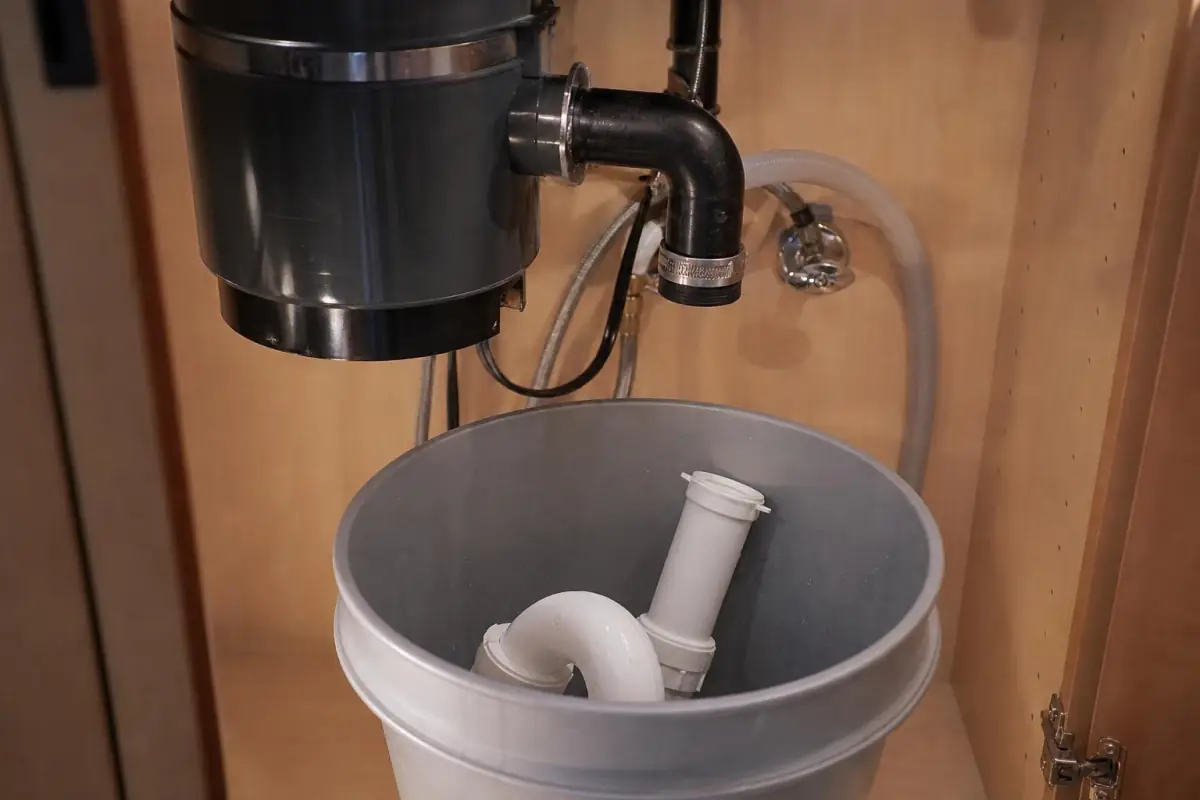
| 2. Trap clog | Disposal spins freely, sink still holds water | Bucket under the trap, loosen the 2 slip nuts, clear by hand | Label says yes; disposal maker says not through the disposal |
| 3. Branch line clog | Trap is clear and reinstalled, and the sink still holds water | Hand auger fed through the trap arm into the wall | Bottles rarely reach it; Liquid-Plumr says a worse clog after use may be “lodged further down the pipe” |
For row 1, the InSinkErator manual sequence is 4 steps: turn off disposer and water, free the plate with the wrench, remove the object with tongs, then “Allow disposer motor to cool for 3 – 5 minutes, then lightly push red reset button.” Our guide to a disposal that hums, trips or will not start covers models without a bottom socket. For rows 2 and 3, mechanical tools beat chemicals; see the drain cleaners we rank by clog type before buying a bottle.
Already poured drain cleaner into the disposal? Do these 6 things in order
Each step below traces to a label or SDS line.
- Leave the switch off. Waste King lists drain cleaner among materials a disposer may expel; wait the label time (15 minutes for Max Gel) and switch on only if the drain has cleared.
- Do not plunge. The Max Gel label says “Never use a plunger during or after use… because product may still be present if drain is not clear,” and Liquid-Plumr warns plunging can splash product “back and get on you.”
- Add nothing else. Max Gel warns “hazardous fumes or a violent reaction may result”; if gases release, the label says leave the area and ventilate.
- Gear up before touching the trap. Rubber gloves and splash-resistant chemical goggles, per Section 8 of the Max Gel Ultra SDS; Drain Strike adds face protection.
- Drain the trap into a bucket. Set a deep plastic container under it, loosen the slip nuts slowly, and treat the water as full-strength product, not rinse water.
- Tell the plumber the product name, ounces poured and time. The 2025 Urgent Clear SDS says bleach-based cleaners make chlorine gas with acids, and the Drain Strike sheet bars use “where other drain openers are present,” so a plumber planning an acid treatment needs to know.
If product reaches skin or eyes, the Max Gel label says flush for 15 minutes, and Poison Help at 1-800-222-1222 answers around the clock. For routine odor and grease, cleaning the grind chamber without chemicals avoids the warranty question entirely, and the same splash logic explains why makers warn against chemical drain cleaner in a toilet.
Drain cleaner and disposals: short answers
Can you put Drano in a garbage disposal?
The Drano Max Gel label lists garbage disposals among its uses, but Moen and Waste King say never to put lye or chemical drain cleaner in the disposer and state that all warranties are void if you do. If your disposal is under warranty, follow the disposal manual and clear the clog mechanically.
Is Liquid-Plumr safe for garbage disposals?
It depends on the bottle. The Liquid-Plumr FAQ answers yes for one product and says to flush it with the disposal running, yet answers no for Pro-Strength Hair Clog Eliminator. The Urgent Clear SDS lists sodium hydroxide under the synonym lye, the exact ingredient Moen and Waste King prohibit.
Is enzyme drain cleaner safe for a garbage disposal?
The Drano FlowGuard enzymatic label says it is safe for garbage disposals and carries only a CAUTION eye irritant warning. It also says it will not unclog your drain, so treat it as monthly maintenance with a 6 to 8 hour wait, not a fix for standing water.
Does drain cleaner void a garbage disposal warranty?
For Moen and Waste King units, yes in plain words. Both say resulting damage can be easily detected and all warranties are void. InSinkErator puts caustic drain cleaners or similar products on its do-not-put list in the Installation, Care and Use manual.
How long should drain cleaner sit before I flush it?
Read your bottle. The Drano Max Gel label says 15 minutes or longer for tough clogs, Drano Dual-Force says one hour, Liquid-Plumr says at least 15 minutes, and Drano FlowGuard enzymes need 6 to 8 hours with no running water. Flush only after the drain runs clear.
How we sourced this
We read the Moen Solutions drain cleaner article, the Waste King WLC-100 manual, the trilingual InSinkErator Installation, Care and Use manual, the Liquid-Plumr FAQ, Clorox SDS sheets for Full Clog Destroyer (2022) and Urgent Clear (2025), SC Johnson’s Drano Max Gel Ultra SDS (2015), Drano label text reproduced on Target product pages, and the Jones Stephens Drain Strike spec sheet. We computed label doses in ounces, wait-time ratios and the baking soda neutralizing range. Left out: Drano’s own disposal splash-back wording and claims about Drano crystal products, which we could not open at the source; the Jam-Buster wrench size; and any trap or code dimensions.