Can You Put a Dishwasher Drain After the P-Trap? Why Code Says No and What to Do Instead
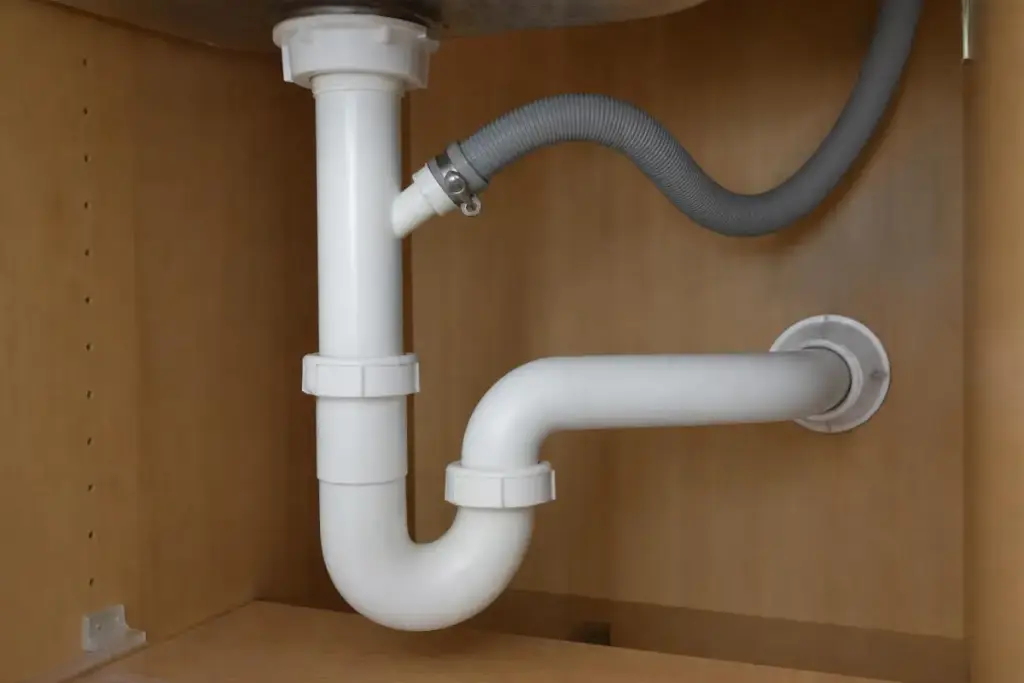
No, you cannot put a dishwasher drain after the P-trap. A hose tied in downstream of the trap has no water seal between the sewer and the dishwasher tub, so code sends it into the disposer inlet, a wye on the sink tailpiece above the trap, or a separately trapped standpipe.
Why does a hose tied in after the P-trap make the dishwasher smell like sewer gas?
A dishwasher hose connected past the trap opens a dry path from the building drain straight into the tub, so sewer air reaches the racks between cycles. The water that sits in a P-trap is the only thing stopping that air, and IPC Section 1002.4 sets that seal at not less than 2 inches and not more than 4 inches deep. A hose that joins the trap arm, the wall stub or the drain below the trap bypasses those 2 to 4 inches entirely.
The odor collects inside the closed tub between cycles, because the only water between that sump and the sewer in a downstream hookup is whatever settles in the hose low point, and the next pump-out pushes it out. Rule 1002.1 of the same IPC chapter also says each plumbing fixture is to be separately trapped, so a dishwasher with no trap ahead of its drain connection fails before anyone smells it.
A correct hookup fixes the problem a second way: every pump-out discharges into the inlet side of the sink trap and tops the seal back up, where a downstream hookup discharges past the trap and never refills it. Your P-trap’s seal depth and how it gets siphoned dry is the same physics that decides which side of the trap the hose belongs on.
How much pressure does a 2 to 4 inch trap seal hold back, compared with a dishwasher pump?
A 2 inch trap seal resists only 0.072 psi, while a pump that the Bosch installation instructions allow to lift water 43 inches pushes at least 1.55 psi, about 11 to 22 times the seal. The arithmetic uses one constant: 1 inch of water column equals 0.0361 psi. Pressure in psi is the water height in inches times 0.0361.
| Water height (input) | Where the number comes from | Pressure (inches x 0.0361) | Times a 2 in seal / 4 in seal |
|---|---|---|---|
| 2 in | Minimum trap seal, IPC 1002.4 | 0.072 psi | 1 / 0.5 |
| 4 in | Maximum trap seal, IPC 1002.4 | 0.144 psi | 2 / 1 |
| 6 in drop (example) | Hose outlet 6 in below the water in the dishwasher sump | 0.217 psi siphon pull | 3 / 1.5 |
| 12 in drop (example) | Hose outlet 12 in below the sump water line | 0.433 psi siphon pull | 6 / 3 |
| 18 in | Minimum standpipe height above the trap weir, IPC 802.4.3 | 0.650 psi | 9 / 4.5 |
| 43 in | Maximum drain hose height, Bosch instructions 9001831461 | 1.552 psi | 21.5 / 10.8 |
The table says two things a reader can act on. First, a pump strong enough to clear a 43 inch rise moves any water slug in a trapless hose out of the way at every drain, so a downstream hookup cannot count on a puddle in the hose as its seal. Second, a hose outlet set just 6 inches below the sump water line already pulls 3 times a 2 inch seal by siphon, which is why IPC Section 409.4 makes the waste line rise and fasten to the underside of the sink rim or countertop before it drops.
Which four connection points does code accept, and what part goes on each?
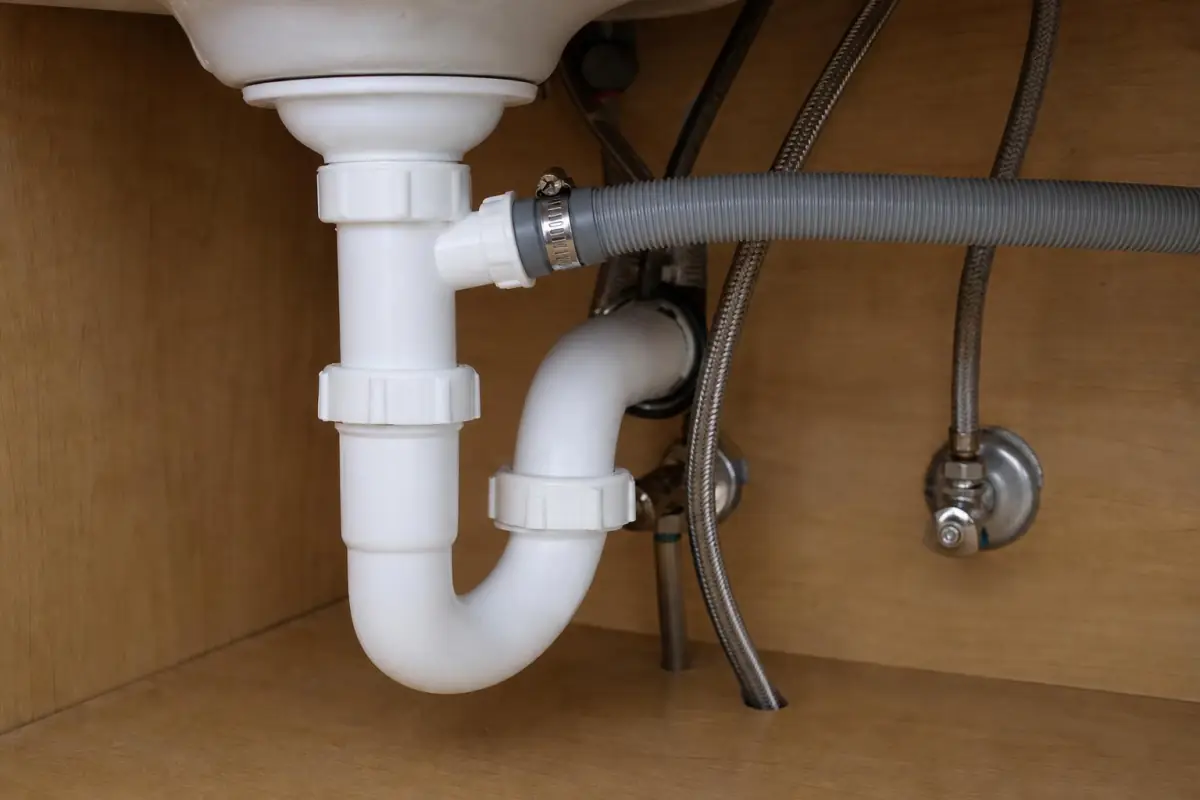
Code accepts four tie-ins, all of them on the fixture side of a trap: the disposer’s dishwasher inlet, a wye branch on the sink tailpiece, a wye on the tailpiece of either bowl of a two-bowl sink, or a standpipe with its own trap. The 2021 IPC lists the first, second and fourth in Section 409.4; the 2021 IPC Section 802.1.6 covers commercial dishwashing machines, not household units.
| Connection point | Code text read | Part to buy | What decides it |
|---|---|---|---|
| Food waste disposer dishwasher inlet | IPC 409.4: “directly to the dishwasher connection of a food waste disposer” | Knock out the inlet plug; large hose clamp supplied with the dishwasher | Disposer present and inlet sits above the trap inlet |
| Branch tailpiece above the trap | IPC 409.4: “a wye branch fitting on the tailpiece of the kitchen sink” | 1-1/2 x 8 in dishwasher branch tailpiece, such as Keeney P931-8PVC (plastic) or Keeney 30-8WK (7/8 in OD branch) | No disposer; branch must sit above the trap weir |
| Wye on one bowl of a two-bowl sink | IPC 409.4 tailpiece wye, plus IPC 1002.1 combination fixture rule | Same branch tailpiece, or a brass version such as Plumb Pak PP142CP, ahead of the single shared trap | Bowls not more than 6 in different in depth, outlets not more than 30 in apart |
| Separate standpipe | IPC 409.4 “through an air break to a standpipe”; IPC 802.4.3 | Standpipe with its own trap, 18 to 42 in above the trap weir | Sink too far away, or an island with its own drain |
| UPC states | UPC 807.3 as quoted in Minnesota Rule 4714.0807: no direct connection to a drainage system or disposer without an approved air gap fitting | Listed dishwasher air gap with FL mark at or above the sink flood level | California and other UPC adopters without a high loop amendment |
For a disposer, Whirlpool’s product help article on connecting the drain to a garbage disposal gives three steps: knock the plug into the disposer with a hammer and screwdriver, pull it out with needle-nose pliers, then clamp the hose to the inlet. A new disposer left with that plug in place blocks the drain on the first cycle. For the branch tailpiece route, match the branch OD to the hose cuff before buying, since Keeney sells the 1-1/2 x 8 in body with a 7/8 in OD branch under 30-8WK.
High loop or air gap: which one does your state accept?
Under the 2021 IPC a fastened high loop is enough, while the base UPC 807.3 wording demands a listed air gap fitting, and Minnesota is an exception that allows either. IPC 409.4 requires the residential waste line to “rise and be securely fastened to the underside of the sink rim or countertop.” Minnesota Rule 4714.0807 amends UPC 807.3 to permit an approved air gap “or run the discharge line as high as possible under the countertop, securely fastened,” and it requires a listed air gap’s FL marking at or above the flood level of the sink or drainboard, whichever is higher.
California adopts the UPC as its plumbing code without that high loop clause, so plan on a countertop air gap there. Bosch’s installation instructions 9001831461 say the drain hose “must be installed with either a high loop or an air gap,” cap hose height at 43 inches and cap total hose length, including the run to an air gap, at 150 inches with extension kit SGZ1010UC. The countertop air gap fitting and how it drains covers the two-hose layout, and the brand-by-brand hose length limits for an extended drain hose matter when the high loop or air gap sits far from the machine.
Neither device is a trap. A high loop or air gap stops dirty sink water from flowing back into the dishwasher; the 2 to 4 inch seal in the trap below the connection is what stops sewer air. A hose with a perfect high loop still fails if it lands after the trap.
Can you add a second trap on the dishwasher line instead?
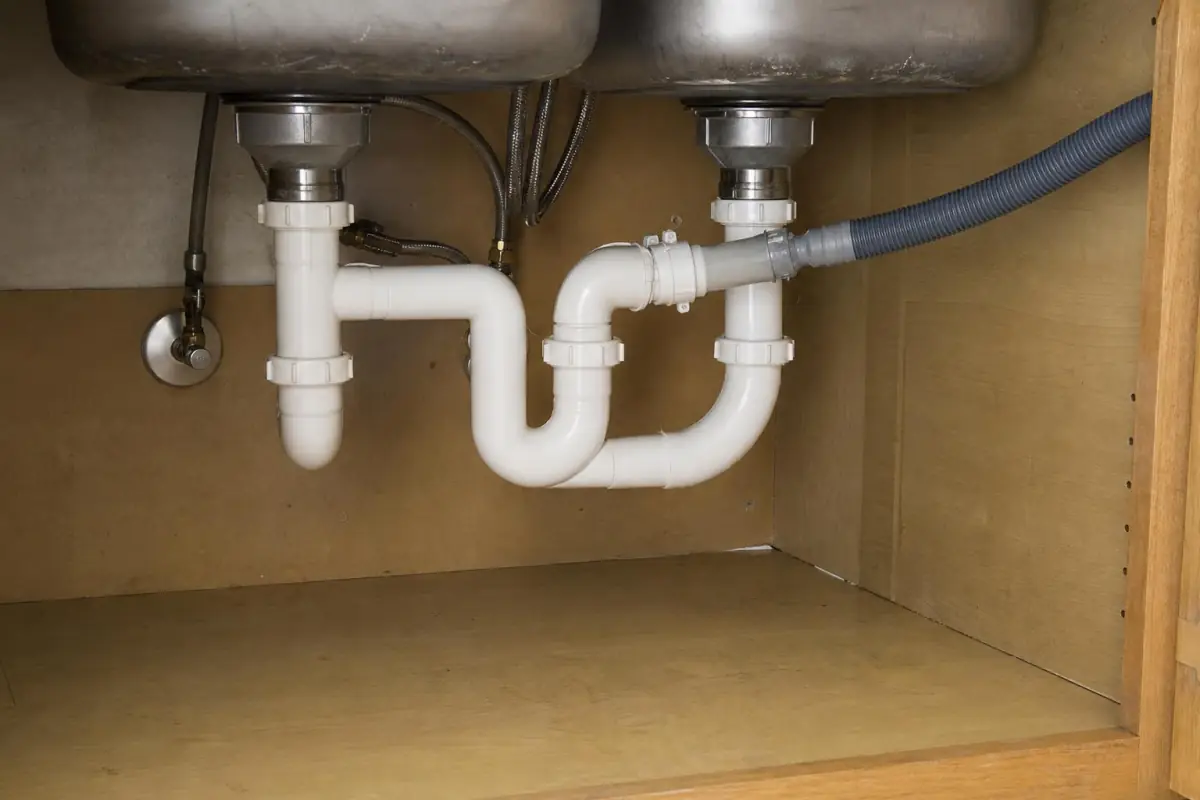
No, because a trap on the dishwasher hose feeding the sink tailpiece puts two traps in series, and IPC 1002.1 says a fixture is not to be double trapped. The one legal way to give a dishwasher its own trap is the standpipe route in IPC 409.4 and 802.4.3: the hose drops into the standpipe through an air break, and the standpipe carries its own trap 18 to 42 inches below its rim.
Two-bowl sinks follow the same logic. IPC 1002.1 lets a combination fixture share one trap when one compartment is not more than 6 inches deeper than the other and the waste outlets are not more than 30 inches apart. The dishwasher branch goes on a tailpiece of either bowl, or the continuous waste above the shared trap, and never on the horizontal arm that leaves the trap for the wall.
What happens to an existing install that already drains after the trap?
An existing downstream hookup gets written up at a home inspection and has to be moved to a fixture-side connection to pass a permit inspection. StructureTech, a Minnesota home inspection firm, calls an improperly installed dishwasher drain hose the most common dishwasher defect it finds and lists the wrong side of the trap among the faults. The repair is short: cut out or cap the tee on the trap arm, install a 1-1/2 x 8 in branch tailpiece or use the disposer inlet, add the high loop or air gap your code requires, and clamp the hose.
When the drain is a standpipe at a sink that sits too far away, ask a plumber to quote a trapped standpipe meeting IPC 802.4.3, with the 18 to 42 inch height stated on the quote. Stop and leave the work to a licensed plumber when the only nearby pipe is a wall drain below the trap, because tying into it means opening the drain and vent system. The full dishwasher plumbing hookup for supply and drain covers the hot water and electrical side of the same job.
Dishwasher drain and P-trap questions
Can a dishwasher drain into the wall drain below the sink trap?
Not directly. IPC 409.4 allows only a wye on the sink tailpiece, the disposer inlet, or an air break into a standpipe. A wall stub below the trap has no seal toward the dishwasher, so a separate trapped standpipe 18 to 42 inches tall is the only way to use that line.
How do you connect a dishwasher drain without a garbage disposal?
Replace the sink tailpiece with a 1-1/2 by 8 inch dishwasher branch tailpiece so the side inlet sits above the trap weir. Clamp the hose to the branch, run it up to a fastened high loop or a listed air gap first, and match the branch OD to the hose cuff.
Is the drain loop built into the side of a dishwasher enough?
Not under IPC 409.4, which wants the waste line itself to rise and be fastened under the sink rim or countertop. Bosch instructions 9001831461 likewise say the hose must use a high loop or an air gap, with hose height capped at 43 inches.
Does Minnesota require a dishwasher air gap?
No. Minnesota Rule 4714.0807 amends UPC 807.3 to allow either an approved air gap fitting or a discharge line run as high as possible under the countertop and securely fastened. An air gap installed there still needs its FL mark at or above the sink flood level.
Why does my dishwasher smell like sewage only after a few days?
A hose tied in after the trap leaves no water seal between the drain and the tub, so sewer air collects while the door stays shut. A clogged filter smells too, so check the hose connection point first. If it lands on the trap arm or wall stub, the hookup is the cause.
How we sourced this
Read in November 2026: 2021 IPC Section 409 (Dishwashing Machines), Section 802.1.6 and 802.4.3, and Sections 1002.1 and 1002.4 on UpCodes; Minnesota Rules 4714.0807, which reprints UPC 807.3 with Minnesota’s amendment; Bosch installation instructions 9001831461; Whirlpool’s product help article on connecting a dishwasher drain to a disposer; and retailer listings that name Keeney P931-8PVC, Keeney 30-8WK and Plumb Pak PP142CP tailpieces. The pressure table is our arithmetic at 0.0361 psi per inch of water; the 6 and 12 inch drops are example inputs, not measurements. Retail prices were left out because the listing pages would not load for checking. The task lead citing IPC 802.1.6 for household dishwashers was corrected to IPC 409.4, and UPC 807.4 was not cited because its text could not be read.