Well Pressure Tank: How It Works, Sizing, and Pre-Charge
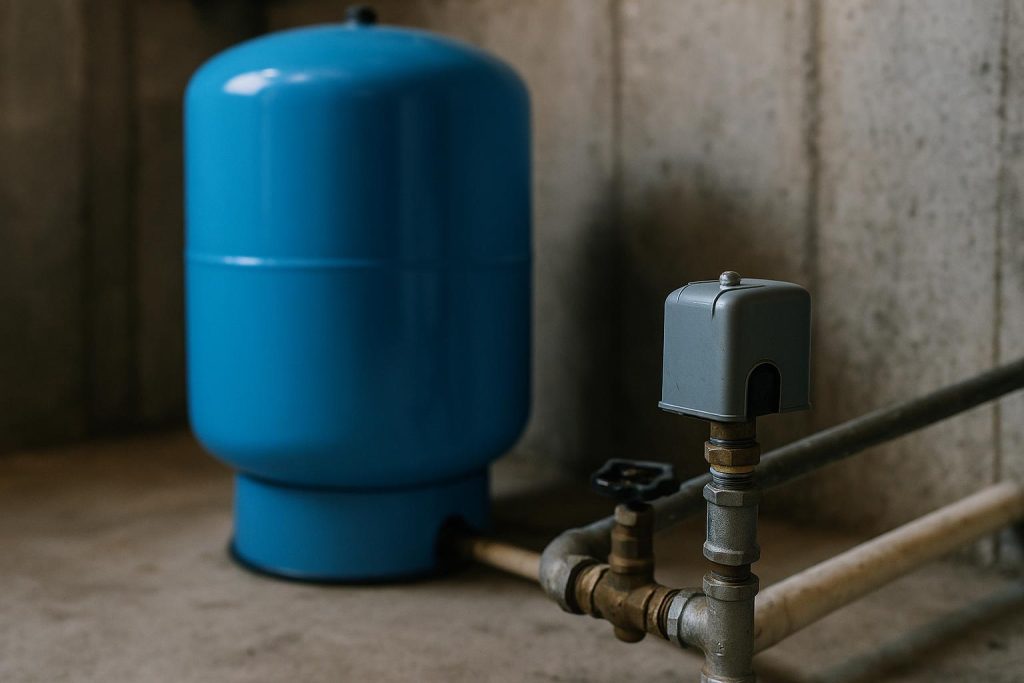
A well pressure tank stores pressurized water so your pump does not restart every time you open a tap, which stops short-cycling and holds steady household pressure between pump runs.
Key Takeaways
- The tank holds water under compressed air, so the pump only restarts when the tank drains to the cut-in pressure, not on every faucet.
- Set the air pre-charge to about 2 psi below the cut-in pressure, measured with the tank empty, per Amtrol; a 40/60 switch pairs with a 38 psi pre-charge.
- A 40/60 pressure switch starts the pump at 40 psi and stops it at 60 psi, keeping household pressure in the normal water pressure for a house band.
- Size by drawdown, the usable gallons delivered per cycle, not by the nominal tank size; a “44 gallon” Well-X-Trol WX-250 delivers about 13.6 gallons of drawdown at a 30/50 switch, per Amtrol.
- Aim for a pump run time of at least 60 seconds per cycle; running under 30 to 60 seconds is short-cycling and stresses the motor, per well-service sources.
- Rapid on-off cycling and pulsing pressure are the classic signs of a waterlogged tank or a torn bladder.
- Most diaphragm and bladder tanks last about 5 to 15 years.
What does a well pressure tank do?
A well pressure tank stores several gallons of water under air pressure and releases it on demand, so the pump can rest between cycles. Without the tank, the pump would kick on the instant you cracked a faucet and stop the moment you closed it. That constant starting, called short-cycling, overheats the motor and wears the pump out fast. The tank is the buffer that absorbs small draws. Getting the tank sized and pre-charged correctly protects that investment, which matters given well pump replacement cost when short-cycling finally takes its toll. Before that cost becomes reality, check out sputtering faucets from trapped air, a common symptom tied to pump and tank trouble.
The tank works as a team with the pump and the pressure switch. When you use water, the tank empties and pressure falls. At the cut-in pressure the switch closes and the pump runs, refilling the tank and the plumbing until pressure hits the cut-out point, then the pump stops. See well pump types for how submersible and jet pumps feed the tank. This guide is for private well homes, not houses on a city main.
What are the types of well pressure tanks?
Three designs cover almost every private well: a diaphragm tank, a bladder tank, and an older air-over-water galvanized tank. The first two keep air and water physically separated by a flexible barrier, which is why they hold their pre-charge for years. The galvanized style has no barrier, so air sits directly on the water and slowly dissolves into it, which is why those tanks waterlog and need periodic recharging.
| Tank type | How it separates air and water | Maintenance | Lifespan | Best for |
|---|---|---|---|---|
| Diaphragm | A fixed flexible diaphragm sits across the tank, air above and water below | Low; check pre-charge yearly, no air to add if sealed | About 5 to 15 yr | Most modern well systems |
| Bladder | Water fills a sealed balloon-like bladder, air surrounds it in the shell | Low; bladder is replaceable on some models | About 5 to 15 yr | Homes wanting a serviceable tank |
| Air-over-water (galvanized) | No barrier; air rests directly on the water surface | Higher; air is absorbed into water, needs an air volume control or periodic recharge | Steel shell can last 10 to 20+ yr but waterlogs often | Legacy and older installations |
Diaphragm and bladder tanks are both “pre-charged” tanks and behave almost identically in daily use. The practical difference is serviceability: a torn diaphragm usually means replacing the whole tank, while some bladder tanks allow a bladder swap. Both hold a factory air charge, so they are ready to install once you confirm the pre-charge matches your switch.
How does the tank work with the pressure switch?
The pressure switch is the brain, the tank is the buffer, and they set the pressure band your house feels. The switch has two set points: cut-in, where it starts the pump, and cut-out, where it stops it. A 40/60 switch runs the pump from 40 psi up to 60 psi, so pressure at your fixtures rides between those numbers, matching the normal water pressure for a house. A 30/50 switch is the other common setting.
Here is the full cycle, start to finish.
- You open a tap. Stored water leaves the tank and pressure begins to drop.
- Pressure falls to the cut-in point (40 psi on a 40/60 switch) and the switch starts the pump.
- The pump refills the plumbing and the tank, raising pressure toward cut-out.
- Pressure reaches cut-out (60 psi) and the switch shuts the pump off.
- The compressed air in the tank keeps delivering water for the next small draw, and the cycle repeats.
A well system already caps its pressure at the cut-out point, so it rarely needs a separate pressure-reducing valve the way a high-pressure city supply does. The switch and tank do the regulating.
How is a well pressure tank sized?
Size a tank by its drawdown, the usable gallons it actually delivers between pump cycles, not by the number stamped on the label. Drawdown is only a fraction of the nominal volume, because the air pre-charge occupies most of the tank. A “44 gallon” Well-X-Trol WX-250 delivers about 13.6 usable gallons at a 30/50 switch, per Amtrol, roughly a third of its nameplate size.
The goal is a long enough pump run. A widely used rule sets drawdown to roughly one minute of pump output, so a pump moving 10 gallons per minute wants about 10 gallons of drawdown. Undersize the tank and the pump short-cycles; oversize it and you simply get longer, gentler cycles, which does no harm. The chart below shows how drawdown climbs with tank size at a 30/50 switch.
Notice the pattern: the “44 gallon” tank gives about 13.6 usable gallons, so drawdown is well under half the nameplate. That is why plumbers size on the drawdown chart, not the tank name. A higher cut-out pressure also lowers drawdown for the same tank, so a 40/60 switch yields a bit less usable water than a 30/50 switch on the identical model. Switching pressure switch settings affects more than well tanks, so it helps to also understand thermal expansion tank sizing on the water heater side.
What are the signs of a waterlogged or failed tank?
The telltale sign of a failed pressure tank is rapid on-off cycling of the pump, often every few seconds while a single tap runs. A waterlogged tank has lost its air cushion, so it holds almost no usable water and cannot buffer demand. You may also feel pulsing or surging pressure at fixtures, and you might notice weak, uneven flow that reads like low water pressure.
Watch and listen for these tells:
- Rapid cycling: the pump clicks on and off every few seconds instead of running a minute or more.
- Pulsing pressure: shower or faucet flow surges and drops in rhythm with the pump.
- A tank that sounds solid: tap the shell low and high; a healthy tank rings hollow near the top where the air is, a waterlogged one sounds solid all the way up.
- Water at the air valve: pressing the Schrader valve on top pushes out water instead of air, which means the bladder or diaphragm has torn.
Short-cycling is not a cosmetic problem. Well-service sources note that a pump rated for hundreds of thousands of starts can fail in a year or two if it cycles every few minutes, because each start stresses the motor windings. Fix a waterlogged tank promptly to protect the far more expensive pump.
How do you check and set the pre-charge?
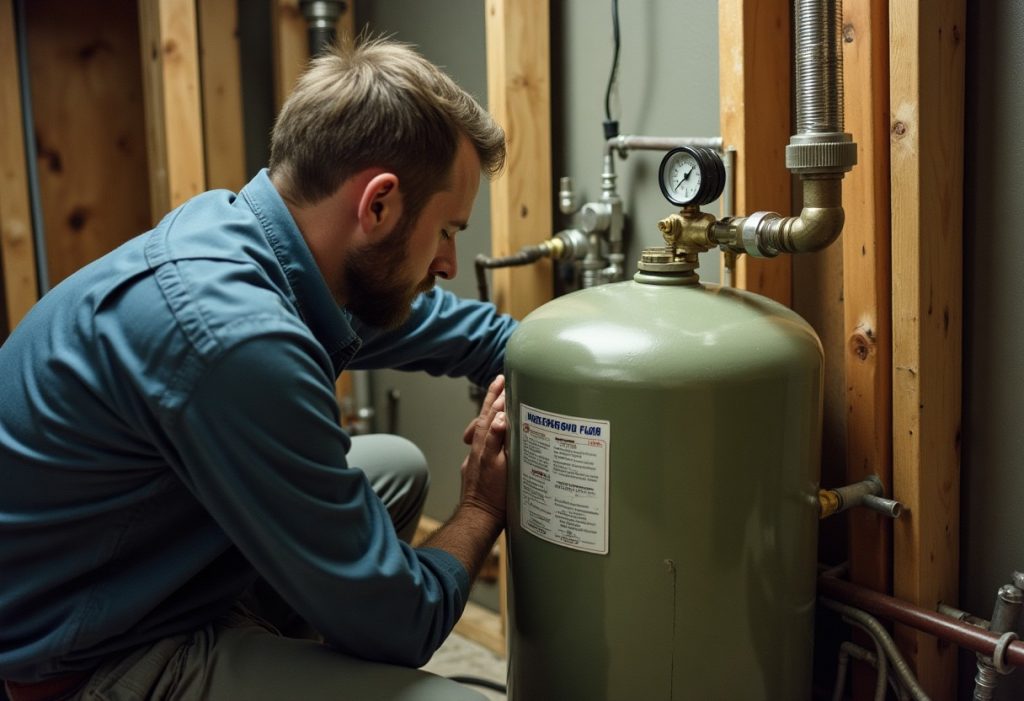
Check the air pre-charge with the system depressurized and the tank empty of water, then compare the reading to your switch. The target is about 2 psi below the cut-in pressure, per Amtrol, so a 40/60 switch calls for 38 psi and a 30/50 switch calls for 28 psi. Set it too high and the tank cannot fill; too low and drawdown shrinks and the pump short-cycles.
The check takes a tire gauge and a bicycle-style pump or a small compressor.
- Turn off power to the pump at the breaker or switch.
- Open the lowest faucet or a drain valve and let the tank empty completely, so no water pressure remains in the tank.
- Find the air valve (a Schrader valve, like a tire valve) on top of the tank and read the pressure with a gauge.
- Add or release air until it reads 2 psi below your cut-in, for example 38 psi on a 40/60 system.
- Cap the valve, close the faucet, and restore power. If water sprays from the air valve, the bladder is torn and the tank needs replacing.
Manufacturers suggest checking the pre-charge about once a year, since a slow leak at the valve or a natural air loss can pull it out of spec and start the pump short-cycling long before the tank truly fails.
How much does a well pressure tank cost?
A replacement well pressure tank commonly runs about $200 to $500 for the tank itself in typical residential sizes, with small tanks under $150 and large 44-plus gallon models toward $500 or more, per 2026 supplier and cost-guide pricing. Professional installation often adds a few hundred dollars in labor, so a full swap frequently lands in the $400 to $900 range depending on tank size and plumbing access.
Cost depends on the same things that drive most well work: tank size, whether the pressure switch or gauge is replaced at the same time, and how the tank ties into your plumbing. Prices vary by region and by contractor, so treat these as planning ranges rather than quotes. Replacing a failing tank early is far cheaper than replacing the pump it burns out through short-cycling.
How we sourced this
Pre-charge, drawdown, and sizing figures come from Amtrol Well-X-Trol technical and sizing documentation (the 2 psi below cut-in rule, the 38 psi factory pre-charge, and per-model drawdown at a 30/50 switch). Cycling behavior, minimum run time, and waterlogging signs draw on well-service field guides. Cost ranges reflect 2026 US supplier and cost-guide pricing and are planning ranges, not quotes. We excluded commercial and constant-pressure variable-speed systems, which follow different sizing logic, and we kept every figure attributed to a named source rather than estimated.
Frequently asked questions
What does a well pressure tank do?
A well pressure tank stores a few gallons of water under air pressure so your pump does not start every time you open a tap. The compressed air pushes stored water to fixtures between pump cycles, and the pump only restarts once the tank drains to the cut-in pressure. That buffer protects the pump motor from short-cycling and keeps household pressure steady.
What pre-charge should a well pressure tank have?
Set the air pre-charge to about 2 psi below the pump cut-in pressure, measured with the tank empty of water and the pump off, per Amtrol. A 40/60 switch cuts in at 40 psi, so the tank pre-charge is 38 psi, the factory setting on Well-X-Trol tanks. A 30/50 switch pairs with a 28 psi pre-charge.
How do I know if my pressure tank is waterlogged?
The clearest sign is rapid on-off cycling of the pump, often every few seconds while a tap runs, because a failed bladder or lost air charge leaves almost no water buffer. You may also feel pulsing or surging pressure at fixtures. A quick check: tap the tank low and high, a waterlogged tank sounds solid all the way up instead of hollow near the top.
What size well pressure tank do I need?
Size by drawdown, the usable gallons the tank actually delivers between pump cycles, not the nominal tank volume. Aim for enough drawdown that the pump runs at least one minute per cycle. A common rule matches drawdown to about one minute of pump output, so a 10 gallons-per-minute pump wants roughly 10 gallons of drawdown, which is a 40-plus gallon nominal tank.
How long does a well pressure tank last?
Most diaphragm and bladder pressure tanks last about 5 to 15 years, with lifespan driven by water chemistry, cycling frequency, and whether the pre-charge is kept correct. Older air-over-water galvanized tanks can last longer as steel but waterlog often. A tank forced to short-cycle from a wrong pre-charge or a torn bladder fails sooner.
Why does my pump turn on and off constantly?
Constant short-cycling almost always points to a waterlogged pressure tank or a lost air pre-charge, so the tank holds too little water to satisfy demand between cycles. A ruptured bladder, a leaking air valve, or a tank that was never pre-charged all cause it. Short-cycling overheats the motor and can cut pump life from years to months, so fix it quickly.
Does a well system need a pressure-reducing valve?
Usually no. A pressure-reducing valve limits incoming pressure on a municipal supply that arrives too high. A well system already caps its pressure at the switch cut-out, often 60 psi, so a separate reducing valve is rarely needed unless a downstream zone must run lower. The pressure switch and tank do the regulating on a private well.


