Does Water Work When the Power Is Out? City, Well, Toilets

Does water work when the power is out? On city water, usually yes: cold taps keep running and gravity toilets flush. On a private well you get only the pressure tank’s drawdown, about 4 to 19 gallons on common Amtrol tanks. Pump-fed sewer setups limit flushing even when taps run.
Pick your house from the table. Most homes match three rows: one for the water supply, one for where the waste goes, one for the heater. The worst of your three rows sets your outage.
| Your setup | Cold water | Hot water | Can you flush? | How long |
|---|---|---|---|---|
| City water, house or low-rise | Usually runs | Set by your heater row | Yes, on a gravity sewer | While the mains hold pressure; no utility figure applies to every town |
| High-rise with booster pumps | Upper floors stop when pumps stop, unless on backup power | Same limit as cold | Tank flush, then carried water | Ask the building about its generator or roof tank |
| Private well | Only the tank’s drawdown | Stored hot water, while pressure lasts | Until drawdown runs out, then carried water | 4.3 to 19.2 gal on Amtrol WX-200 to WX-251 at 30/50 psi |
| Grinder pump or low-pressure sewer | Not affected | Not affected | Yes, into the basin only | 38 to 150 gal of reserve, by utility |
| Basement ejector | Not affected | Not affected | Fixtures draining to the basin: sparingly | Until the basin fills; an 18 by 30 in basin holds about 33 gal to the brim |
| Septic with effluent pump | Not affected | Not affected | Yes, sparingly | Until the pump chamber fills; ask your installer for its volume |
| Gas tank, standing pilot, no power cord | Not affected | Should keep heating | Not affected | As long as gas and water last |
| Gas tank, power vent or electric ignition | Not affected | Stored water only | Not affected | No reheat until power returns |
| Electric tank | Not affected | Stored water only | Not affected | No reheat until power returns |
| Tankless gas | Not affected | None | Not affected | Needs 120 VAC to fire |
| Heat pump water heater | Not affected | Stored water only | Not affected | No reheat until power returns |
No single row covers a whole house, which is what most short answers miss. A well home with an effluent pump and a tankless heater has no hot water at once and about 9.9 gallons of cold at best on a WX-203. A city home with a gravity sewer and a standing pilot tank may notice nothing but the dark.
Why city water keeps running after the house loses power, and what stops it
City water keeps running because your house supplies none of the push. EPA’s Finished Water Storage Facilities issue paper says storage is built to reduce pressure swings and hold reserves for fire fighting, power outages and other emergencies. Elevated tanks and standpipes supply pressure by gravity. Ground-level tanks may need pump stations unless they sit high enough.
That last detail decides how long a given town lasts, and it is why the “6 to 12 hours” figure repeated on some pages has no source we could trace. Your utility’s outage line is the only answer for your mains. Pressure loss is the warning sign: in August 2016 a power outage cost Manhattan, Kansas, its system pressure, and the state issued a boil advisory that also told residents to discard ice cubes and icemaker ice.
If a notice comes, EPA’s emergency disinfection page says to hold a rolling boil for at least 1 minute, or 3 minutes above 5,000 feet.
Tall buildings work differently. Model plumbing codes accept a booster pump or a raised storage tank where street pressure falls short. The pump is electric; a roof tank feeds by gravity until it empties. Ask the building manager two things before the next storm: which floor street pressure reaches, and whether the pumps are on the generator.
How many gallons does a well give with the pump off?
A well gives you the tank’s drawdown, which is roughly 31% of the size printed on the tank. Pages saying a well tank stores “10 to 50 gallons” appear to be quoting tank volume. Amtrol’s Well-X-Trol specification table shows a 32-gallon WX-203 delivering 9.9 gallons between 50 and 30 psi, and only 7.6 gallons at a 50/70 setting.
| Amtrol model | Tank volume (gal) | Drawdown at 30/50 psi (gal) | Drawdown at 40/60 psi (gal) |
|---|---|---|---|
| WX-200 | 14.0 | 4.3 | 3.8 |
| WX-202 | 20.0 | 6.2 | 5.4 |
| WX-202XL | 26.0 | 8.0 | 7.0 |
| WX-203 | 32.0 | 9.9 | 8.6 |
| WX-250 | 44.0 | 13.6 | 11.8 |
| WX-251 | 62.0 | 19.2 | 16.6 |
Treat those numbers as ceilings. An outage can hit partway through a pump cycle, so you may start with far less than 9.9 gallons. Hot water stops when cold does, because incoming pressure is what pushes water out of the heater.
To run the pump on a generator, Franklin Electric’s AIM manual for submersible systems sets two rules: the generator must hold at least 65% of the motor’s nameplate voltage during starting, and a transfer switch must be used any time a generator backs up power lines. A pump that stays silent after the grid returns is a separate fault, and our well pump troubleshooting steps start at the breaker and pressure switch.
Where does the flush go when a pump sits between your toilet and the sewer?
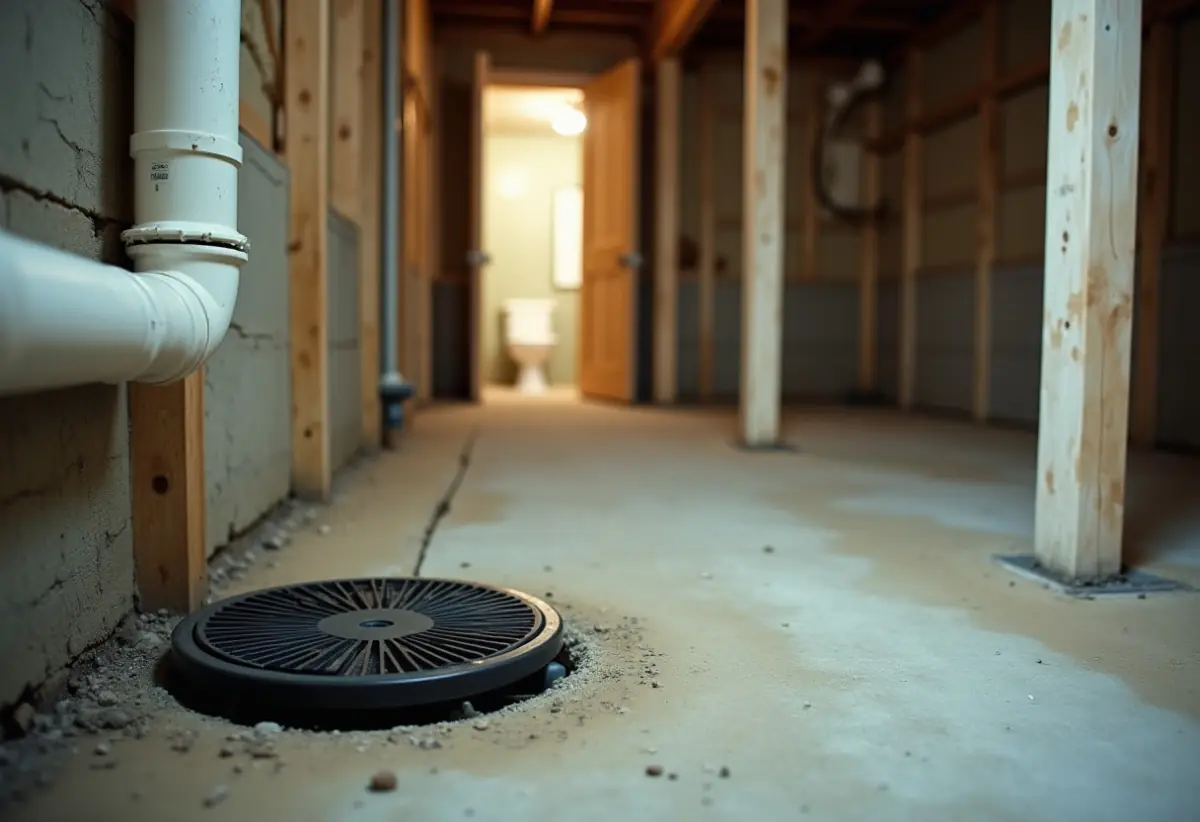
The flush goes into a basin that cannot empty until power returns. E/One’s homeowner manual says the grinder pump cannot dispose of wastewater without electrical power and asks you to keep water use to a minimum. Its operation and maintenance Q&A says storage covers necessities for several days, and the reserve is smaller than that phrase suggests:
| Utility | Stated reserve (gal) | Days at Martin County’s 74 gal sample day | Whole flushes at 1.6 gpf |
|---|---|---|---|
| Upper Providence Township, PA | 38 to 46 | 0.5 to 0.6 | 23 to 28 |
| Martin County, FL | a little over 80 | about 1.1 | 50 |
| High Springs, FL | roughly 150 | 2.0 | 93 |
Martin County’s sample day is 15 flushes, two 5-minute cold showers and 10 minutes at the kitchen tap. The nearly fourfold spread in stated reserves is the reason to ask your own utility for your station’s number. High Springs warns that a full basin may backflow into the home.
A generator can pump the basin down in 5 to 15 minutes, per Martin County, so it need not run all day. Connectors differ by station: Martin County specifies a NEMA L14-30R receptacle with 5,000 running and 6,500 peak watts, while High Springs and E/One’s indoor panel call for L14-20 at 240 volts. Match the plug on your control panel, and keep the generator outdoors and at least 20 feet from windows.
A sewage ejector pump behaves the same way on a smaller scale. An 18 by 30 inch basin holds about 33 gallons to the brim by geometry, so measure yours, and only fixtures draining to it are limited. Upstairs toilets that reach the main drain by gravity usually still work. A sump pump battery backup handles groundwater in a separate pit and will not move sewage. EPA’s septic system types page marks the other pump case: mound and sand filter systems send effluent from a pump chamber, and drip systems need electrical power and a dose tank.
How many flushes per gallon, by toilet rating, and what to pour
A 1.6 gallon per flush (gpf) toilet gets 0.63 flushes from each gallon, and the older the toilet the worse that ratio gets. EPA WaterSense puts the federal limit at 1.6 gpf, its label at 1.28 gpf, and older toilets as high as 6 gpf. We added 3.5 gpf as a worked example of an older bowl. Counts are rounded down to whole flushes.
| Toilet rating | Pour per flush | Flushes per gallon | 5 gal bucket | WX-203 drawdown, 9.9 gal | 38 gal basin reserve |
|---|---|---|---|---|---|
| 1.28 gpf | 5 quarts | 0.78 | 3 | 7 | 29 |
| 1.6 gpf | 6.4 quarts | 0.63 | 3 | 6 | 23 |
| 3.5 gpf | 14 quarts | 0.29 | 1 | 2 | 10 |
| 6 gpf | 24 quarts | 0.17 | 0 | 1 | 6 |
The 1.6 gpf row matches Upper Providence’s own count of 23 flushes from 38 gallons. For a bucket flush, pour the rated volume into the bowl in one fast stream so the siphon starts. No agency document we read sets a pour amount, so the 5 to 24 quart range comes from each toilet’s rating. The tank above a working toilet already holds one flush, so use that first. Stop if the bowl is rising, and remember every bucket adds to a grinder, ejector or effluent basin.
Which water heaters still make hot water, and which only hold it?
A gas tank with a standing pilot and no power cord should keep heating. A.O. Smith’s service handbook 327726 shows why: heat from the pilot makes the thermopile generate at least 350 millivolts, and that voltage opens the gas control. Bradford White’s outage FAQ gives the rule for the rest: any water heater that requires external power cannot provide hot water. A.O. Smith says that covers newer gas tank models with electronic ignition, and its GPVX-75L power vent manual requires a 120VAC supply for a blower and hot surface igniter. A power cord on the heater is the quick visual test.
Rinnai’s Technical Bulletin 51 says its tankless units need both electric power and gas, so a gas line alone gives no hot water. The unit takes 120 VAC, 60 Hz from a grounded circuit, and backup power is allowed following the backup maker’s instructions. ENERGY STAR files heat pump models under the name Hybrid Electric, so they stop reheating like any electric tank. Water already in an insulated tank keeps some of its heat, but we found no US maker figure in hours, so this page gives none.
What to store before the next outage, in gallons
Store at least 1 gallon per person per day, the figure in both Ready.gov and FEMA’s Food and Water in an Emergency, and add flush water on top of it. A single 1.6 gpf flush uses more than that whole daily ration.
- Drinking and hygiene: FEMA says consider a two-week supply. For 4 people that is 4 x 14 x 1 = 56 gallons. FEMA counts 2 quarts per day as the drinking minimum.
- Flush water: 15 flushes at 1.6 gpf, Martin County’s daily example, is 24 gallons. Fill the tub when a storm is forecast. On a grinder or effluent system, every flush still counts against the reserve.
- Well water in bottles: FEMA says to add 2 drops of unscented household chlorine bleach per gallon if the source is untreated, and date the container.
- Water already in the house: FEMA names the hot water tank, pipes and ice cubes as safe. To drain a tank, turn the gas or electricity off, open the bottom drain, close the intake valve and open a hot faucet. Refill it before restoring energy. FEMA says a professional is needed to turn shut-off gas back on.
- Valves and contacts: Tag the main shutoff, the first move in what to do in a plumbing emergency, and post your basin alarm service number beside it. FEMA says everyone at home should know that valve before a broken line is reported.
Frequently asked questions about water during a blackout
Can you take a shower when the power is out?
Yes, if water still reaches the shower and no boil notice says otherwise. Expect cold water once the tank runs out. A 5-minute shower at 2.5 gallons per minute uses 12.5 gallons, which is more than the 9.9-gallon drawdown of an Amtrol WX-203 well tank.
Is tap water safe to drink during a power outage?
Use it normally only while no notice is in force, because Ready.gov lists water contamination among outage effects. In Manhattan, Kansas, in 2016 the advisory followed lost system pressure. Private well owners get no utility notice, so Ready.gov’s rule to treat uncertain water before use applies to them directly.
Can you drink the water in a toilet tank during an outage?
No. FEMA’s Food and Water in an Emergency booklet lists toilet flush tanks and bowls among the sources you should not use, so save that 1.28 to 1.6 gallons for flushing. FEMA’s safe household sources are the hot water tank, the water left in your pipes, and ice cubes.
Can a portable generator run my well pump?
Often, if it is sized for the motor. Franklin Electric’s AIM manual requires at least 65% of nameplate voltage during starting and a transfer switch whenever a generator backs up power lines. Ask an electrician for the motor’s starting load, and never plug a generator into a house outlet.
What happens to a grinder pump when the power comes back?
It restarts by itself. E/One’s homeowner manual says the alarm may sound because the tank is at or near capacity, and it should clear within 5 to 10 minutes. If the alarm has not cleared after 15 minutes, stop using water and call for service.
How we sourced this
We read the EPA storage issue paper, EPA disinfection, WaterSense and septic pages, Ready.gov, an archived copy of FEMA’s booklet, the Amtrol Well-X-Trol table, Franklin Electric’s 2026 AIM manual, E/One homeowner documents, Rinnai TB-51, the A.O. Smith GPVX-75L manual, service handbook 327726 and tankless electricity page, Bradford White’s outage FAQ, and three utility grinder pages. We computed the flush counts, percentages, days of reserve and storage totals. CDC’s water pages refused our requests, so we cite EPA and Ready.gov instead. We left out how many hours a water tower lasts, how long a tank stays hot, effluent chamber volumes and a generator wattage for well pumps, because no primary document we could open gave one. Nothing here was tested or measured by The Plumbing Brief.