A.O. Smith Water Heater Blinking: 4, 6 and 7 Flash Codes
An A.O. Smith water heater blinking is the gas valve’s status light counting out a code. On standard Series 300/301 tanks, 4 flashes means over-temperature, 5 sensor failure, 7 internal control failure, each followed by a 3-second pause. One flash is normal, and those A.O. Smith and State charts list no 6-flash code.
Does a State water heater 4-flash code mean the same as an A.O. Smith one?
Yes: on standard atmospheric tanks the two brands publish the same chart. A.O. Smith’s fiscal 2025 Exhibit 21 lists State Industries, LLC as a subsidiary, and the 10-K says wholesale product sells “primarily under the A. O. Smith and State brands.”
We compared the extracted text of A.O. Smith service handbook 327726-001 (GCV, GVR, XCV and related Series 300/301) against State service handbook 327306-001 (GPX, GS6, GSX Series 300/301) line by line. Across about 1,610 lines, only 4 things differ: the model list, the document number, the copyright line and the support contact. Both name a Honeywell gas control valve/thermostat.
| Flashes | A.O. Smith 327726 | State 327306 | Resideo WV8840B table |
|---|---|---|---|
| 0 (LED dark) | Control off, pilot out | Same words | No entry |
| Solid on | Pilot recently out, thermopile cooling | Same words | Control in OFF mode |
| 1 | Normal operation (bright/dim heartbeat) | Same words | Normal, 1 flash every 3 seconds |
| 2 | Thermopile voltage low | Same words | Low thermopile voltage, main valve not on |
| 4 | Temperature exceeded (ECO activated) | Same words | Temperature cut-out limit reached |
| 5 | Sensor failure | Same words | Water temperature sensor failure |
| 6 | Not listed | Not listed | Tank leakage detected by accessory module |
| 7 | Internal control failure | Same words | Electronics failure |
| 8 | Power off failure | Same words | Warning: power not decaying with knob OFF |
Resideo’s WT8840/WT8860 sheet 34-00013EF ties WV8840B valves to A.O. Smith OEM numbers, which is why its WV8840B sheet 69-2450 sits in the last column. You can confirm your own family without a manual, because the handbook says status codes are printed on the face of the control.
Count a full cycle before you act. Resideo’s sheet says LED codes flash once per second with a 3-second pause, that at most 2 different errors can display, and that the higher count comes first. So 4 flashes, a pause, then 2 flashes is two faults, not a 6.
Does an A.O. Smith tank have a 6-flash code?
Not on a standard Series 300/301 tank: the handbook’s code list goes 1, 2, 4, 5, 7, 8, and use and care guide 100263112, which A.O. Smith’s ProLine GCR-40 410 page links, has the same gap on page 27. Six exists only on other documents, and it means something different on each.
| Control or family | 4 | 5 | 6 | 7 |
|---|---|---|---|---|
| A.O. Smith guide 100263112, standard atmospheric | Over heat sensor activated by high water temperature | Sensor failure | Not listed | Gas control valve/thermostat failure |
| Manual 326940, hotwater.com direct vent | Water too hot, burner and pilot shut off | Thermistor defective | Not listed | Gas control valve failure |
| State manual 100293470, power vent, hot surface ignition | ECO limit lockout | Flame out of sequence | 6-1 to 6-4, soft lockouts | Flammable vapor sensor lockout |
| Resideo WV8840B | Temperature cut-out | Water temperature sensor | Tank leak, from accessory module | Electronics failure |
| Resideo WT8860B, ultra-low NOx, A.O. Smith OEM | Temperature cut-out | Water temperature sensor | Combustion chamber high limit | Electronics failure |
The 7 row matters most: in State’s power-vent manual it points at flammable vapors or other contamination around the sensor, not a failed valve. Pages describing 6 flashes as a tank over-temperature code, or 4 flashes as an igniter fault, match none of these 5 documents. If you truly see 6 on a standing-pilot tank, check whether a leak accessory module is fitted, then give the technician the valve’s part number, since Resideo’s actions differ: the WV8840B control recovers on a message from the module, while the WT8860B sheet says “Replace burner.”
Some older State paperwork has no chart at all. Manual 186489-002, still linked from State’s GS6-40-BRUT page, gives lighting steps for White-Rodgers and Robertshaw valves and no flash table, so read your valve rather than the web listing.
What do 4 and 7 flashes make you do, and can either be cleared?
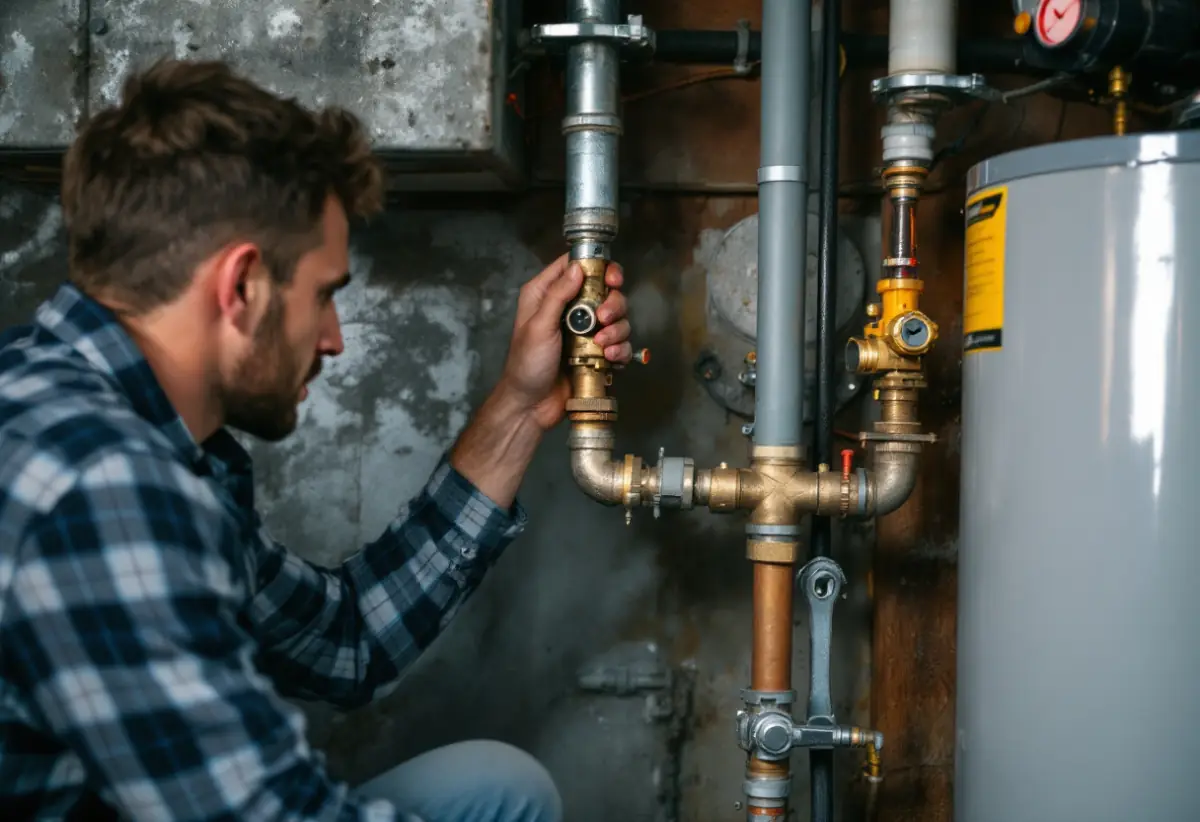
Neither clears by relighting on a standard tank: both handbooks end in the same 3 steps, which are knob to OFF, main gas supply OFF, replace the gas control valve/thermostat. The chart offers no other check for 7. For 4, the ECO shuts down burner and pilot, and the code displays only after a relight, so one relight is how you verify it.
Before a new valve goes on after a 4, have the technician look at why the tank overheated. Handbook page 8 lists incoming water above the set point (solar-heated water, for example), an attic or other hot location, and short hot water draws that let the tank climb above its setting. Those causes would still be present after the swap.
Valve replacement is licensed gas work, and replacing a gas control valve runs $150 to $550 installed by our guide. Ask for the direct replacement: Resideo says WT88xx controls are direct replacement only and gives these cross-references.
| Tank | Resideo aftermarket | A.O. Smith replacement part numbers |
|---|---|---|
| 1 in. insulation, 5 in. WC | WT8840B1000 | 100112336, 9007884005 |
| 2 in. insulation, 5 in. WC | WT8840B1500 | 100112337, 9007885005 |
| 2 in. insulation, 5 in. WC, ULN | WT8860B1000 | 100093970, 9007631005 |
Check coverage first. State’s warranty sheet 100286377 gives parts terms of 6 or 8 years by warranty code, so read the model number on the data plate before paying for a valve. Five flashes follows the same route in the handbooks, although manual 326940 says to replace the thermistor rather than the valve; give your technician the manual that matches your model.
What clears the status light, and what must you never do?
Four light states can clear without a new valve, and each has a fixed wait or test from handbook pages 9 to 12. The handbook is marked for qualified service professionals only, so relighting from the label is the owner’s part; wiring, meter readings, the thermal switch and parts go to a licensed gas pro.
| Light | What clears it | When to stop |
|---|---|---|
| Solid on | Knob OFF, wait 10 minutes, relight | Valve circuitry requires the 10 minutes between attempts |
| 0 flashes | Relight per the label: knob held in at Pilot, igniter clicked for up to 90 seconds. If the pilot will not hold, have a licensed gas pro check the thermal switch reset | Flammable vapors, or a discolored flame arrestor: do not relight |
| 2 flashes | A licensed gas pro tightens wiring, then reads the thermopile | Under 350 mV DC: replace the thermopile |
| 8 flashes | With no pilot flame showing, wait 10 minutes and relight | Flame present at OFF, or the code returns: replace the valve |
The full lighting routine is in our pilot light guide. Be careful with parts lists from older heaters: handbook page 7 says this valve “uses a thermopile instead of a thermocouple,” so thermocouple replacement steps apply to older thermocouple valves, not to it. The thermopile should read 750 to 900 mV open circuit and at least 350 mV under load.
Never jumper the thermal switch, sensor or ECO, and stop at the 2 to 3 relight attempts the handbook allows. Guide 100263112 says not to press the igniter if you suspect flammable vapors, to shut the manual gas supply valve and call a qualified person if the burner fails to shut off, and to replace the whole heater if it has been submerged. A gas smell means no relight attempt at all: leave the building and call the gas supplier or 911 from outside.
What clears a lockout on a plug-in power-vent State heater?
A soft lockout clears by sliding the ON/OFF switch to OFF, waiting 10 seconds and switching back to ON, per State manual 100293470. These heaters have a blower and a hot-surface igniter instead of a pilot, and their code table is not the one above: 1 flash is low flame signal, 2 and 3 are pressure switch faults, and an idle heater shows a short flash every 4 seconds.
The timing differs by code. Soft lockouts (6-1 to 6-4) retry on a 20-minute timer, while ECO and flammable vapor sensor lockouts are listed as indefinite. On 7 flashes, the manual says to look for gas vapors, solvents, paint and thinners, plus water and detergents, then reset; if the sources are gone and it will not reset, the sensor needs replacing. If you smell gas or solvent, leave first and call from outside. Four flashes after a restart again means a new gas control valve/thermostat. This table comes from State’s document only, so confirm it against the manual for an A.O. Smith power vent.
One flash, no hot water: what is left to check?
One flash says the valve is fine, so the fault sits elsewhere: confirm the knob is at HOT, then test several faucets, since guide 100263112 notes that a failed shower control or mixing valve can look like a dead heater. It also lists reversed connections, a melted dip tube and sediment, which is the one you can fix yourself with a tank flush.
Ignore one printed conflict. The A.O. Smith and State electronic valve troubleshooting sheets say the light “must flash once per second,” while guide 100263112 says once every three seconds. Resideo’s wording fits both: flashes run at 1 per second, separated by a 3-second pause, so a slow single blink is the normal one.
How we sourced this
Documents read: A.O. Smith service handbook 327726-001 and guide 100263112, State handbook 327306-001, manuals 326940, 186489-002 and 100293470, A.O. Smith’s fiscal 2025 10-K with Exhibit 21, and Resideo sheets 69-2450 and 34-00013EF. We ran the line-by-line text comparison of the two handbooks; nothing was installed or tested on a heater. Left out: Reliance, because the Reliance literature opened had no flash table, and an A.O. Smith power-vent table, because no such manual could be opened. The dollar figure comes from our own valve guide.
A.O. Smith and State flash code questions
Does the color of the light change the meaning of an A.O. Smith flash code?
No document read here assigns a meaning to red or any other color. The A.O. Smith and State handbooks and the Resideo tables all define the code by flash count, so a blinking red light on a tank valve is read by counting flashes between the 3-second pauses.
Can a bad thermocouple make an A.O. Smith heater blink 7 times?
Not on the Honeywell valve in handbooks 327726 and 327306, because that valve runs on a thermopile. Seven flashes there is internal control failure, and a weak thermopile shows as 2 flashes instead. Sites blaming a thermocouple for 7 flashes contradict both handbooks.
Will turning the gas off and on reset a 4-flash code?
Turning the knob off and relighting after 10 minutes only shows the code again if the fault remains. The 4-flash code appears after the pilot is relit, so a return of 4 flashes confirms the fault, and the chart then calls for a new gas control valve/thermostat.
Is it safe to keep using hot water while the status light shows 4 or 7 flashes?
The handbook procedure for both codes starts with the knob at OFF and the main gas supply OFF. Hot water already in the tank may still flow, but test it carefully after a 4-flash code, since the handbook table shows 140 degrees F can burn in under 5 seconds.
Who do I call about a flash code on a State heater versus an A.O. Smith?
State’s handbook lists residential technical assistance at 1-800-365-0024 and A.O. Smith’s lists 1-800-527-1953. Have the model and serial number from the data plate ready, plus the flash count, because both handbooks direct warranty questions to the selling dealer first.