3 Compartment Sink Requirements: Sizes, Drains and Health Code
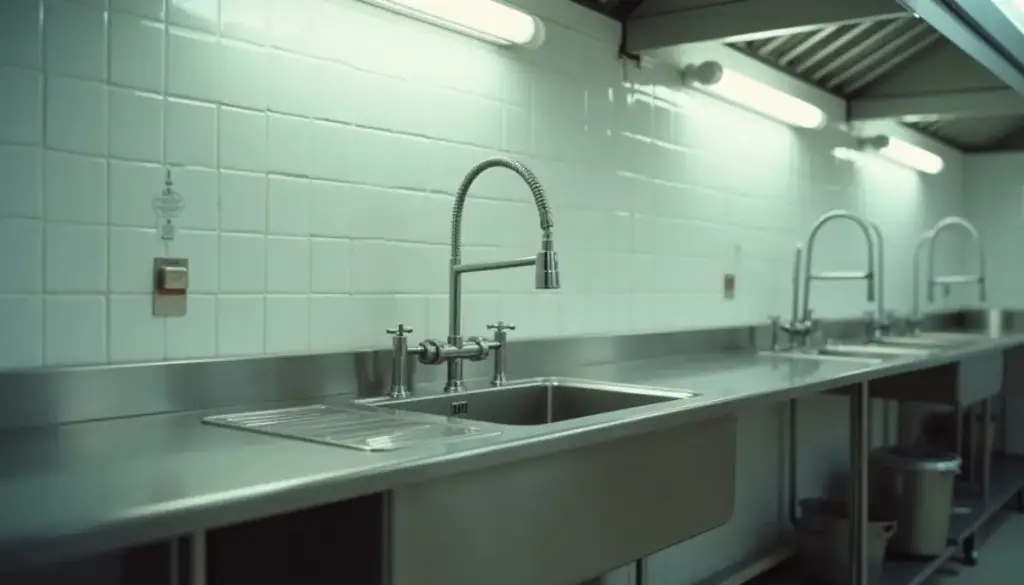
A 3 compartment sink needs three bowls that submerge your biggest pot, 110°F wash water, a test-strip-verified sanitizer and drainboards, and many local codes route its drains indirectly to a floor sink.
Key Takeaways
- FDA Food Code 2022 section 4-301.12 requires a sink with at least 3 compartments for manual warewashing, each large enough to fully immerse the largest equipment and utensils.
- Wash water must stay at 110°F (43°C) or higher, or at the detergent label temperature, under Food Code 4-501.19.
- Chlorine sanitizer runs 25 to 49 mg/L at 120°F, 50 to 99 mg/L at 75°F to 100°F depending on pH, or 100 mg/L at 55°F (Food Code 4-501.114). Iodine runs 12.5 to 25 mg/L at 68°F or warmer.
- Contact time is at least 10 seconds for chlorine, 7 seconds for 50 mg/L chlorine at the right pH and temperature, and 30 seconds for other chemicals (Food Code 4-703.11).
- Food Code 5-402.11 bars a direct sewer connection from utensil equipment drains unless local law allows it, which is why plan reviewers usually want an air gap to a floor sink.
What does the FDA Food Code require for a 3 compartment sink?
The FDA Food Code requires a 3 compartment sink for any manual warewashing of equipment and utensils, with every compartment large enough to fully immerse the largest item you wash. It also requires drainboards or racks for soiled and clean items, a wash solution of at least 110°F, a sanitizer at a set strength and temperature, and a test kit to prove it.
The rule lives in Food Code 2022 section 4-301.12. Paragraph (B) is the one inspectors cite most: if a sheet pan or stockpot will not go under the water, you need a warewashing machine or approved alternative equipment instead. States adopt it with their own amendments.
A 2 compartment sink is an exception that needs regulator approval under paragraph (D), and paragraph (E) bans it for any continuous flow of dishes.
| Requirement | Source | Spec |
|---|---|---|
| Number of compartments | Food Code 4-301.12(A) | At least 3 for washing, rinsing and sanitizing |
| Compartment size | Food Code 4-301.12(B) | Large enough to immerse the largest equipment and utensils |
| Drainboards | Food Code 4-301.13 | Drainboards, racks or tables large enough for all soiled and cleaned items during operating hours |
| Wash temperature | Food Code 4-501.19 | 110°F (43°C) minimum, or the cleaning agent label temperature |
| Hot water sanitizing | Food Code 4-501.111, 4-703.11(A) | 171°F (77°C) or above, 30 second immersion |
| Sanitizer test | Food Code 4-501.116 | Concentration measured with a test kit or other device |
| Drain connection | Food Code 5-402.11(A) and (D) | No direct sewer connection unless local law allows it |
| Separate hand sink | Food Code 5-203.11, 5-205.11(B) | At least 1 handwashing sink, used for nothing else |
What size should a commercial 3 compartment sink be?
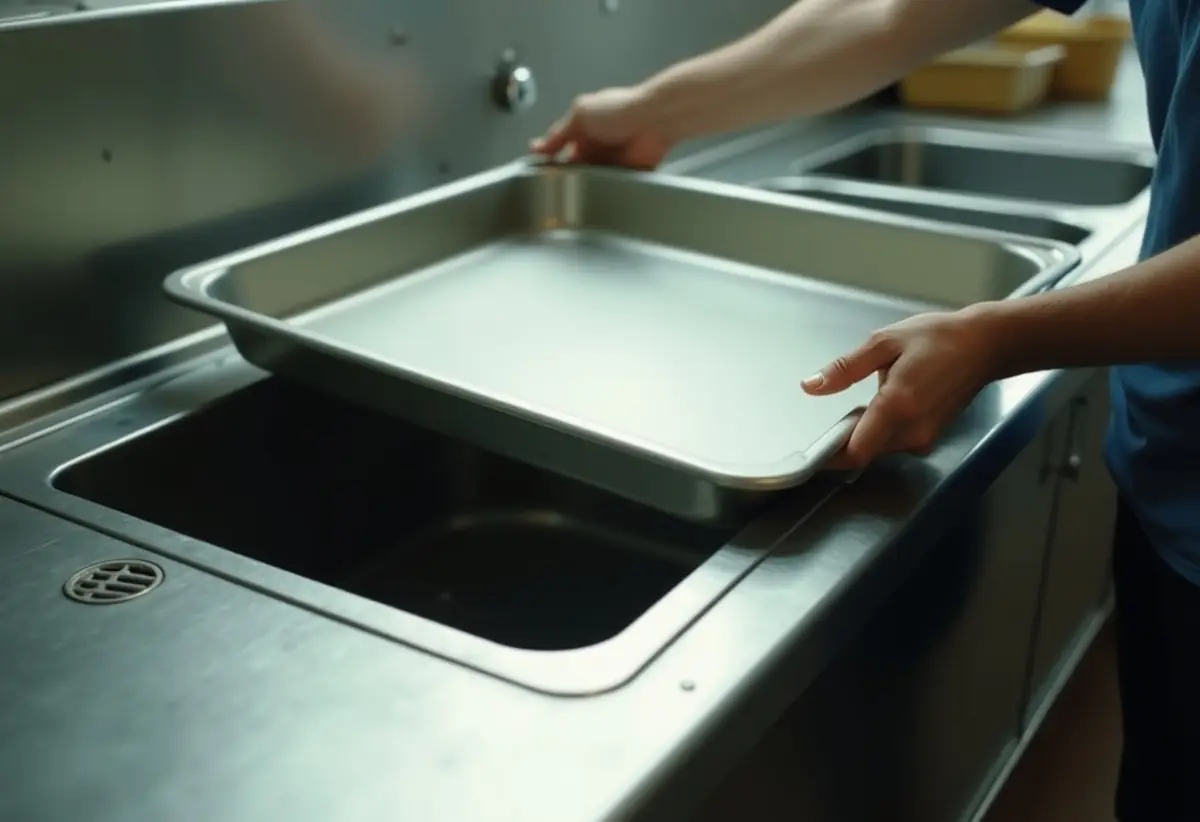
A commercial 3 compartment sink should have bowls that fully submerge your largest pan, because Food Code 4-301.12(B) sets size by immersion, not by inches. In practice, an 18 by 18 inch bowl that is 14 inches deep, such as the Advance Tabco FC-3-1818, handles half sheet pans and most stockpots. Full sheet pans and large mixer bowls push you toward bigger bowls or a dish machine.
Distributor listings for the Advance Tabco FC-3-1818 give 16 gauge type 304 stainless steel, 24 inches front to back, a backsplash of about 8.5 inches and NSF listing. Drainboards drive the footprint.
| Advance Tabco model | Bowls (L x W x D) | Drainboards | Overall length |
|---|---|---|---|
| FC-3-1818 | 18 x 18 x 14 in | None | 59 in |
| FC-3-1818-18R-X | 18 x 18 x 14 in | One 18 in, right side | About 75 in |
| FC-3-1818-18L-X | 18 x 18 x 14 in | One 18 in, left side | About 75 in |
| FC-3-1818-18RL-X | 18 x 18 x 14 in | 18 in, both sides | 90 in |
| FC-3-1818-24RL-X | 18 x 18 x 14 in | 24 in, both sides | 102 in |
The Food Code gives no inch figure for drainboards. Section 4-301.13 only says they must hold everything that piles up during service, so a busy line needs both a soiled side and a clean side. Some counties are stricter. Alameda County, California plan check examples for compact mobile food operations call for a stainless steel 3 compartment sink with dual integral drainboards at least the size of one compartment, and Minnesota Rule 4626.0680 requires mobile food units to carry at least a 3 compartment sink.
Do the bowl math before you buy. One 18 x 18 x 14 inch bowl holds 4,536 cubic inches, or about 19.6 gallons at 231 cubic inches per gallon, so three bowls hold about 59 gallons. That figure drives water heater and interceptor sizing. Residential kitchen sink types are not built to NSF food equipment standards.
What water temperatures does a 3 compartment sink need?
A 3 compartment sink needs wash water at 110°F (43°C) or higher, or at whatever temperature the detergent label specifies, under Food Code 4-501.19. The sanitizer bowl temperature depends on the chemical, from 55°F for 100 mg/L chlorine up to 120°F for weaker chlorine. If you sanitize with hot water alone, that bowl must hold 171°F (77°C) or above.
Hot water sanitizing also carries a time rule. Food Code 4-703.11(A) requires immersion for at least 30 seconds, and 171°F water needs a booster heater or an immersion heater in the third bowl because most building water heaters are set far lower.
How much sanitizer goes in a 3 compartment sink?
For chlorine, a 3 compartment sink needs 25 to 49 mg/L at 120°F, 50 to 99 mg/L at 100°F (pH 10 or less) or 75°F (pH 8 or less), or 100 mg/L at 55°F, per Food Code 4-501.114(A). Iodine runs 12.5 to 25 mg/L at 68°F or warmer. Quaternary ammonium follows its EPA-registered label, at 75°F or warmer.
| Sanitizer | Concentration | Minimum water temperature | Other limits | Contact time |
|---|---|---|---|---|
| Chlorine | 25 to 49 mg/L | 120°F (pH 10 or less, or pH 8 or less) | None beyond pH | 10 seconds |
| Chlorine | 50 to 99 mg/L | 100°F at pH 10 or less, 75°F at pH 8 or less | pH sets the temperature | 7 seconds |
| Chlorine | 100 mg/L | 55°F | None beyond pH | 10 seconds |
| Iodine | 12.5 to 25 mg/L | 68°F | pH 5.0 or less, or as the maker specifies | 30 seconds |
| Quaternary ammonium | Per EPA-registered label | 75°F | Water hardness 500 mg/L or less, or per label | 30 seconds, or per label |
Contact times come from Food Code 4-703.11(C), which also says they must match the EPA-registered label. Quat concentration is not printed in the Food Code. Section 7-204.11 points to 40 CFR 180.940, so read the dilution off your product label and test every batch.
Section 4-501.116 requires a test kit. Chlorine and quat strips are not interchangeable, so stock the strip that matches your chemical and log a reading at each refill.
What is the correct order for using a 3 compartment sink?
The correct order for a 3 compartment sink is scrape, wash, rinse, sanitize, then air dry. Food Code 4-603.16(A) requires a distinct, separate water rinse between washing and sanitizing in a 3 compartment sink, because leftover detergent weakens chlorine and quat. Section 4-901.11 then bans towel drying, so clean items go on the clean drainboard or a rack.
- Clean the sink bowls and drainboards before use and again throughout the day, as Food Code 4-501.14 requires.
- Scrape food debris into a waste receptacle or disposer (4-603.12).
- Wash in bowl 1 with detergent at 110°F or the label temperature (4-501.19).
- Rinse in bowl 2 with clean water to remove detergent (4-603.16).
- Sanitize in bowl 3 at the strength, temperature and contact time in the table above, checked with a test kit (4-501.114, 4-703.11).
- Air dry on the clean drainboard or rack, never with a cloth (4-901.11).
- Change any solution once it looks dirty, since 4-501.18 requires all three to be kept clean.
Does a 3 compartment sink need an air gap or a floor sink?
In most jurisdictions a 3 compartment sink drains indirectly, with each bowl’s waste pipe ending above a floor sink through an air gap or air break. Food Code 5-402.11(A) bars a direct connection between the sewer and any drain from equipment where utensils are placed. Paragraph (D) lets a warewashing sink connect directly only where local law allows it, so your plumbing code decides.
The plumbing side sits in IPC Chapter 8, which covers indirect and special waste, including food handling equipment and utensil sinks in commercial occupancies. An air gap leaves open vertical space between the end of the waste pipe and the receptor’s flood rim. An air break lets the pipe end below the rim without sealing it. Confirm which one your inspector accepts before rough-in.
State rules show how much this varies. Delaware’s food establishment plumbing regulation requires an indirect drain line piped separately from each warewashing sink bowl through an air gap (section 4.8.3). Flint, Michigan code section 46-38 sends 1, 2 and 3 compartment sink waste into a 12 by 12 by 8 inch floor sink with a minimum 1 inch air gap. South Dakota’s health department requires an air gap on the drain when a variance lets the third compartment serve as a prep sink.
The supply side has its own rule. Food Code 5-202.13 requires any air gap between a water inlet and a flood rim to be at least twice the inlet diameter and never less than 1 inch, and a faucet with a hose or sprayer may need one of the backflow preventer types approved for that hazard. A dish machine next to the sink follows different drain rules, which our guide to the dishwasher air gap covers.
Does a 3 compartment sink need a grease trap?
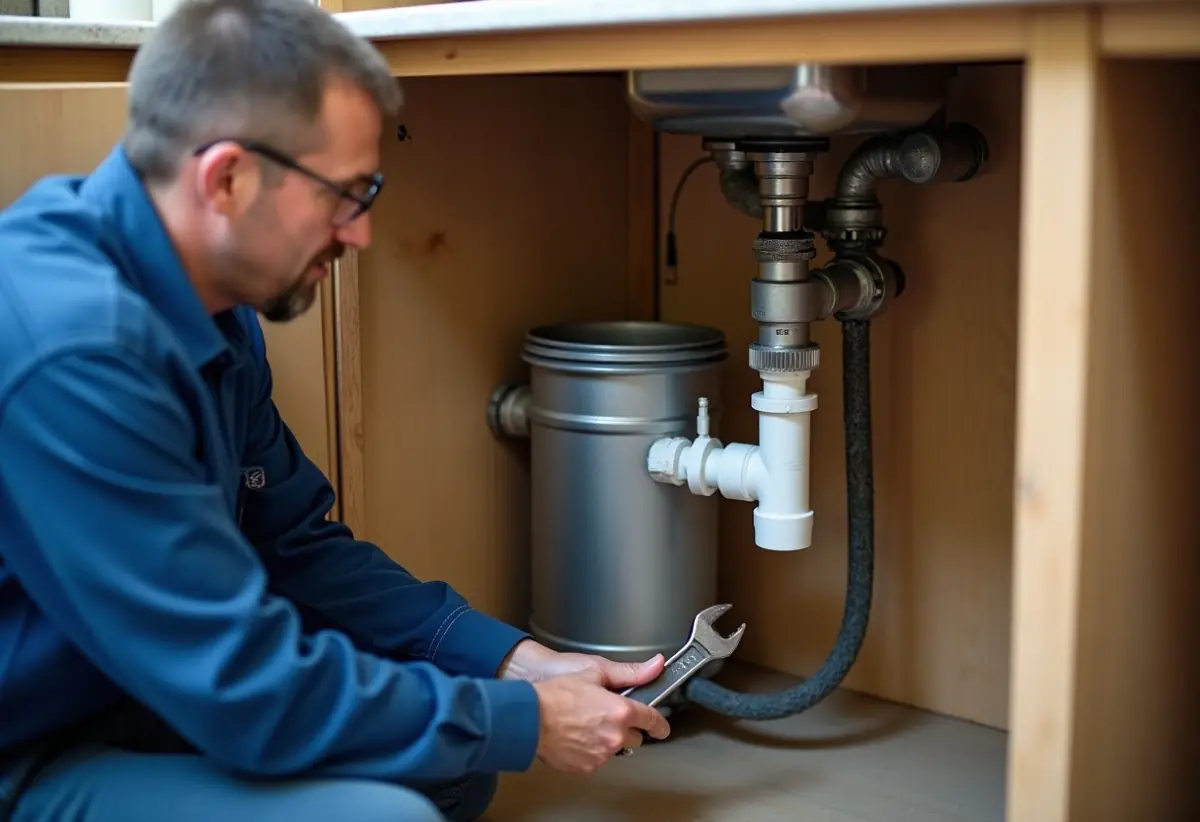
A 3 compartment sink usually drains to a grease interceptor, because it carries most of the fats, oils and grease from pot washing. IPC Chapter 10 section 1003 requires interceptors where grease-laden waste is discharged, and local FOG ordinances often name the pot sink outright. The Food Code adds only that a grease trap, if used, must be easy to reach for cleaning (5-402.12).
Sizing starts from the sink’s volume. The 59 gallon total for three 18 x 18 x 14 inch bowls is the input most flow-based methods use, and hydromechanical interceptors are commonly rated to standards such as PDI G-101 and ASME A112.14.3 for the rest of the math. Your local FOG program may set its own minimum, so get the number from them before ordering.
Set the interceptor downstream of the floor sink so the air gap stays visible. For pump-out intervals and sizing, read our grease trap guide.
Why does a 3 compartment sink not replace a handwashing sink?
A 3 compartment sink cannot double as a handwashing sink, because Food Code 5-205.11(B) says a handwashing sink may not be used for anything other than handwashing, and 5-203.11 requires at least one in every food establishment.
The hand sink has its own specs. Food Code 5-202.12 requires water at 85°F (29.4°C) or warmer through a mixing valve or combination faucet, and a self-closing or metering faucet must run at least 15 seconds per push. Section 5-204.11 requires it to be convenient to food prep and warewashing areas.
How we sourced this
We read the FDA Food Code 2022 text directly (Chapters 4 and 5) and used only figures printed there. Bowl and footprint dimensions come from distributor listings for the Advance Tabco FC-3-1818 series, which we checked against each other. ICC code pages for IPC Chapters 8 and 10 did not load for us, so we describe those requirements generally rather than quoting them. Local examples come from the linked rule text and health department documents. Reviewed October 2026.
Frequently asked questions
What are the requirements for a 3 compartment sink?
Under FDA Food Code 2022 section 4-301.12, the sink needs at least three compartments, each large enough to fully submerge the largest pan you wash. Section 4-301.13 adds drainboards or racks for soiled and clean items. Wash water stays at 110°F or higher, and sanitizer strength is checked with a test kit.
What temperature should the water be in a 3 compartment sink?
Wash water must stay at 110°F or higher, or at the detergent label temperature, under Food Code 4-501.19. Chlorine at 25 to 49 mg/L needs 120°F, iodine needs 68°F and quaternary ammonium needs 75°F. A hot water sanitizing bowl must hold 171°F with a 30 second immersion.
Does a 3 compartment sink need an air gap?
Usually, yes. FDA Food Code 5-402.11(A) bans a direct sewer connection from equipment where utensils are placed, though paragraph (D) allows one where local law permits. Most plan reviewers expect each bowl to drain through an air gap or air break into a floor sink, so confirm with your plumbing inspector.
Does a 3 compartment sink need a grease trap?
Usually, because pot washing carries most of a kitchen’s grease. Local FOG ordinances and IPC Chapter 10 often route the sink through a grease interceptor. The Food Code only says a grease trap, if used, must be easy to reach for cleaning (5-402.12). Sizing follows the standard your jurisdiction adopts.
Can I use a 2 compartment sink instead of a 3 compartment sink?
Only with approval and only for batch work. Food Code 4-301.12(D) requires regulator approval, limits use to jobs such as cleanup between raw meats or at shift end, and requires a detergent sanitizer or hot water immersion. Paragraph (E) bans it for any continuous flow of dishes.
Can you wash your hands in a 3 compartment sink?
No. Food Code 5-205.11(B) says a handwashing sink may be used only for handwashing, and 5-203.11 requires at least one separate hand sink. Washing hands or dumping mop water in a utensil sink contaminates it. Place a dedicated hand sink convenient to the warewashing area, as 5-204.11 requires.
What size is a standard 3 compartment sink?
A common model, the Advance Tabco FC-3-1818, has three 18 by 18 inch bowls 14 inches deep in 16 gauge type 304 stainless. It runs 59 inches long with no drainboards and about 90 inches with two 18 inch drainboards. Size bowls by your largest pan, since every item must fully submerge.