Reverse Osmosis Waste Water Ratio: Real Numbers
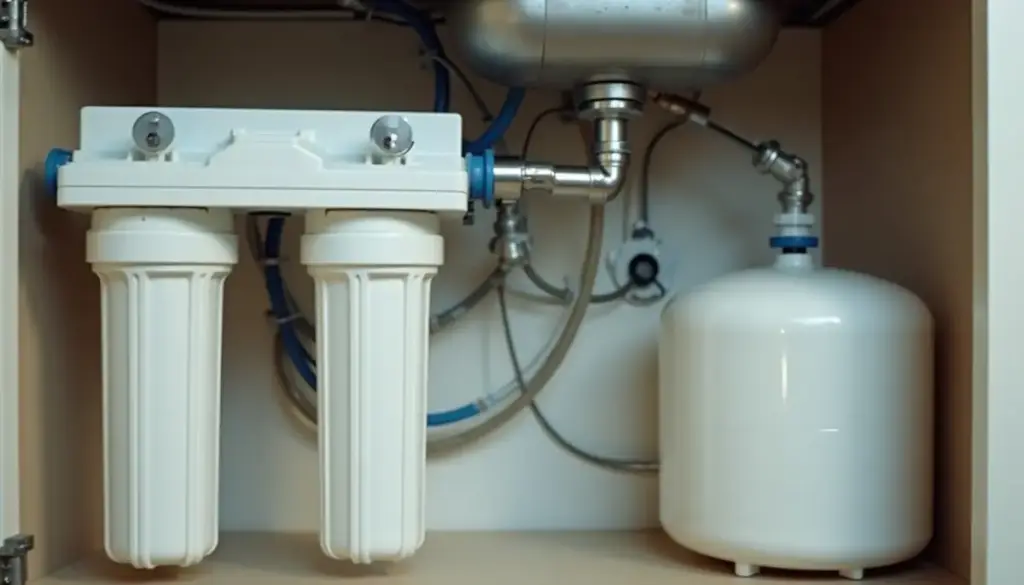
The reverse osmosis waste water ratio is 5-plus drain gallons per pure gallon on typical systems, 2.3 or less on WaterSense models, and 0.33 to 1 on tankless units such as Waterdrop’s G3P800.
Key Takeaways
- EPA WaterSense says a typical point-of-use RO system sends 5 or more gallons to the drain per gallon of treated water, and some inefficient units reach 10 gallons.
- WaterSense labeled systems must send 2.3 gallons or less to the drain per treated gallon, which is the 30 percent minimum efficiency rating in EPA’s November 2024 specification, Version 1.0.
- EPA’s supporting statement says typical POU RO systems run at 10 to 20 percent efficiency, which works out to 4 to 9 gallons of reject water per gallon.
- Maker spec sheets list tankless units far lower: APEC ROTL-600 at 1:1, Waterdrop G3P600 at 2:1 pure to drain, and Waterdrop G3P800 at a 3:1 minimum.
- Pressure moves the numbers. APEC rates its ROES-50 at 50 gallons per day at 60 psi but 30 gallons per day at 50 psi, and it lists a 40 psi minimum.
- EPA estimates a labeled model saves more than 3,100 gallons a year on average versus a conventional unit.
What is the reverse osmosis waste water ratio?
The reverse osmosis waste water ratio compares the water an RO system sends down the drain with the purified water it delivers. A 1:4 ratio written pure to drain means 4 gallons of reject water for each gallon you drink. The reject stream flushes away the dissolved solids the membrane holds back, so no RO system runs at zero waste.
Watch the notation. Waterdrop writes ratios pure to drain, so its “2:1” means 2 pure gallons per drain gallon; many blogs reverse it. We convert everything to gallons sent to the drain per 1 gallon of treated water.
Regulators use percentages. The NSF/ANSI 58 efficiency rating is the share of incoming water that ends up as treated water, per EPA’s WaterSense supporting statement. Tankless systems get a recovery rating instead. To convert, drain gallons per pure gallon equals (100 minus efficiency) divided by efficiency.
| Efficiency or recovery | Pure to drain | Gallons to drain per 1 gal treated | Where you see it |
|---|---|---|---|
| 10% | 1:9 | 9.0 | Low end of typical POU RO (EPA) |
| 20% | 1:4 | 4.0 | High end of typical POU RO (EPA) |
| 30% | 1:2.3 | 2.3 | WaterSense minimum, tank systems |
| 40% | 1:1.5 | 1.5 | ASSE 1086 minimum (cited by EPA) |
| 50% | 1:1 | 1.0 | APEC ROTL-600 listed ratio |
| 66.7% | 2:1 | 0.5 | Waterdrop G3P600 listed ratio |
| 75% | 3:1 | 0.33 | Waterdrop G3P800 listed minimum |
How much water does reverse osmosis waste per gallon?
A conventional under-sink RO system wastes 5 or more gallons per gallon of treated water, according to EPA WaterSense, and inefficient units can reach 10. Newer tankless systems with built-in pumps publish figures between 0.33 and 1 gallon of drain water per pure gallon. That is a 15-fold spread between the worst and best units on the market.
The common blog figure of 1:3 to 1:4 is optimistic. Waterdrop’s chart puts a traditional system at 1:3, but EPA’s 10 to 20 percent efficiency range implies 4 to 9 gallons. Assume an older tank unit sits in EPA’s range until you measure it.
| System type | Pure to drain | Gallons wasted per 1 gal | Notes |
|---|---|---|---|
| Inefficient under-sink RO | 1:10 | Up to 10 | EPA WaterSense upper figure for inefficient units |
| Typical tank RO | 1:5 or worse | 5 or more | EPA WaterSense “typical system” figure |
| Traditional RO (Waterdrop chart) | 1:3 | 3 | Waterdrop’s comparison baseline |
| Any WaterSense labeled RO | 1:2.3 or better | 2.3 max | 30% efficiency minimum, NSF/ANSI 58 certified |
| APEC ROTL-600 (tankless) | 1:1 | 1 | 600 GPD at 60 psi, 30 to 100 psi feed |
| Waterdrop G3P600 (tankless) | 2:1 | 0.5 | 600 GPD, 14.5 to 87 psi inlet |
| Waterdrop G3P800 (tankless) | 3:1 minimum | 0.33 | 800 GPD |
What does WaterSense require for the reverse osmosis waste water ratio?
WaterSense requires a labeled point-of-use RO system to send no more than 2.3 gallons to the drain for every gallon of treated water. The WaterSense specification, Version 1.0, released in November 2024, sets that as a minimum 30 percent efficiency rating, and the system must also be certified to NSF/ANSI 58.
Auto-flushing systems must hit 30 percent at both the lowest and highest flush settings, tankless systems are verified on recovery rating, and the membrane must last at least one year. EPA issued two technical clarifications in August 2026.
EPA’s 2022 notice used the 40 percent ASSE 1086 benchmark, then dropped to 30 percent because ASSE 1086 saw little industry uptake. NSF/ANSI 58 requires the verified efficiency rating on data sheets, so look for the line “This system has a XX% efficiency rating in the production of treated water.”
How much does an RO system waste per year for a family?
At 3 gallons of RO water a day, a typical 5:1 system sends about 15 gallons a day and 5,475 gallons a year to the drain. A WaterSense unit at the 2.3 cap cuts that to 2,519 gallons, and a Waterdrop G3P800 at its 3:1 minimum drops it to 365 gallons. Those are our calculations from published ratios, not measured household data.
We picked 3 gallons a day because EPA’s 3,100-gallon savings figure, divided by the 2.7-gallon gap between a 5:1 and a 2.3:1 unit, implies about 3.1 treated gallons a day. For your family, multiply daily RO draw by the drain figure, then by 365.
| Ratio (drain per pure gallon) | Drain water per day at 3 gal | Drain water per year |
|---|---|---|
| 10 (EPA inefficient) | 30 gal | 10,950 gal |
| 5 (EPA typical) | 15 gal | 5,475 gal |
| 3 (Waterdrop traditional) | 9 gal | 3,285 gal |
| 2.3 (WaterSense cap) | 6.9 gal | 2,519 gal |
| 1 (APEC ROTL-600) | 3 gal | 1,095 gal |
| 0.5 (Waterdrop G3P600) | 1.5 gal | 548 gal |
| 0.33 (Waterdrop G3P800) | 1 gal | 365 gal |
To price it, take the water plus sewer rate per 1,000 gallons from your bill, since reject water leaves through the drain. Then compare the total with how much water your household uses overall. A healthy RO drain is a small slice; a failed shutoff valve draining around the clock is not.
Why is my RO waste water ratio so high?
Low feed pressure is the usual cause, followed by cold water, high total dissolved solids, a fouled membrane, and a failed automatic shutoff valve. APEC rates its ROES-50 at 50 gallons per day at 60 psi but only 30 gallons per day at 50 psi, both at 77°F, and lists 40 to 85 psi as the working band. Below 40 psi the unit is outside its rating.
Pressure hits the ratio hard because the drain flow restrictor keeps reject flow fairly steady while pure output falls. If output drops from 50 to 30 gallons a day with steady drain flow, each pure gallon carries about 1.67 times as much reject water (our math on APEC’s figures). Check your static pressure against normal household water pressure with a hose-bib gauge before you blame the membrane.
| Model | Feed pressure range | Rated output |
|---|---|---|
| APEC ROES-50 | 40 to 85 psi | 50 GPD at 60 psi, 30 GPD at 50 psi (77°F) |
| APEC ROES-100 | 40 to 85 psi | 100 GPD at 60 psi, 80 GPD at 50 psi (77°F) |
| APEC RO-PERM (permeate pump) | 30 to 85 psi | 90 GPD at 60 psi, 45 GPD at 30 psi (77°F) |
| APEC ROTL-600 (tankless) | 30 to 100 psi | 600 GPD at 60 psi |
| Waterdrop G3P600 (tankless) | 14.5 to 87 psi | 600 GPD |
- Temperature: APEC rates output at 77°F, and the ROES-50 accepts 40 to 100°F feed. Colder winter water means less output and a worse ratio.
- TDS: The ROES-50 is rated for feed water up to 2,000 ppm. Saltier water pushes back harder on the membrane; a softener or a whole-house water filter upstream cuts the load.
- Membrane and prefilters: Clogged prefilters starve the membrane of pressure. WaterSense requires at least one year of membrane life, so an older membrane is a suspect.
- Shutoff failure: If water still runs to the drain with the tank full and the faucet closed, the automatic shutoff valve, the check valve or the tank’s air charge has failed.
Does a permeate pump or tankless design cut the reverse osmosis waste water ratio?
Yes. Both attack the same problem: a standard tank pushes back on the membrane as it fills, and that back-pressure kills production while the drain keeps flowing. APEC says its RO-PERM, built around a non-electric permeate pump, conserves up to 80 percent more water than standard systems and fills the tank two to three times faster. Tankless units drop the pressurized tank entirely.
The published tankless numbers are the best in this roundup: 1:1 for the APEC ROTL-600, 2:1 pure to drain for the Waterdrop G3P600, and a 3:1 minimum for the Waterdrop G3P800. Check each spec sheet for pump power and outlet needs before you buy. If you are choosing hardware, start with how an under-sink reverse osmosis system works.
Do not chase a 1:1 ratio on a 1:4 tank unit by swapping in a smaller flow restrictor. The restrictor is matched to the membrane, and starving the reject stream concentrates solids on it.
How do you measure your own RO drain water ratio?
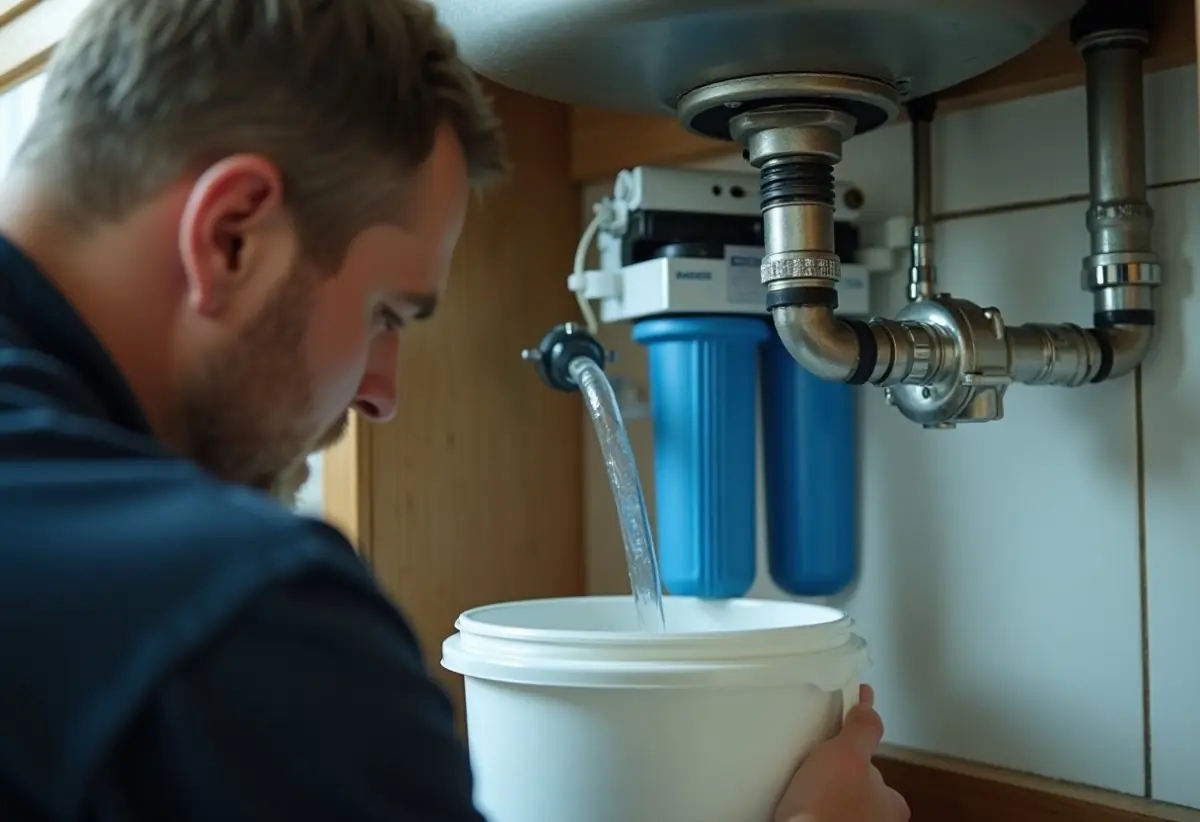
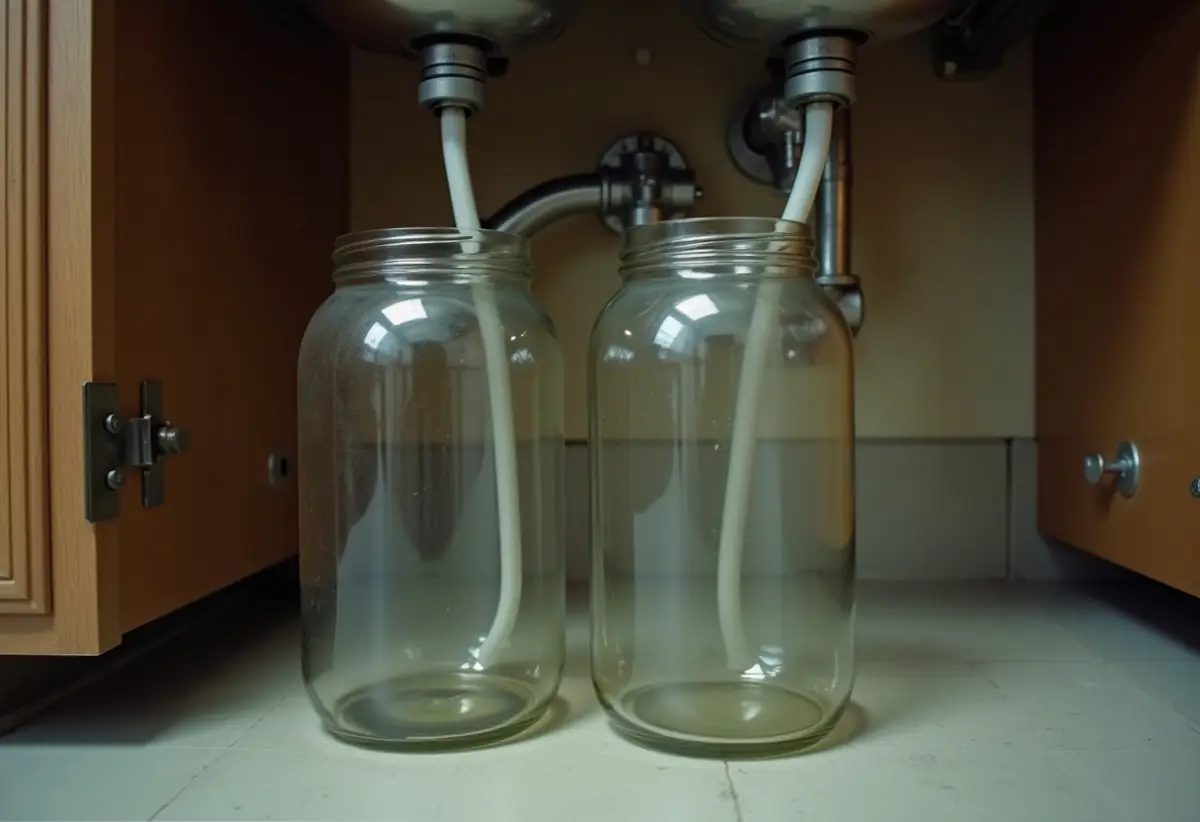
Measure it with two containers and a timer in about 15 minutes. Close the tank valve so all pure water goes to the faucet, catch the drain line and the faucet output for the same 5 minutes, then divide drain volume by faucet volume. A result above 5 puts your unit at or past EPA’s typical figure.
- Read static pressure at the nearest hose bib with a gauge and note it.
- Close the quarter-turn valve on top of the storage tank.
- Disconnect the drain tubing at the drain saddle and route it into a marked container.
- Open the RO faucet and let both streams run 2 minutes to settle, then empty both containers.
- Collect faucet water and drain water at the same time for exactly 5 minutes.
- Divide drain volume by faucet volume to get gallons wasted per gallon produced.
- Reconnect the drain line, reopen the tank valve and check both fittings for drips.
Treat this as a best-case reading. With the tank valve closed, the membrane works against an open faucet, not a filling tank, so your real ratio during tank refill will be worse.
What can you do with RO reject water?
RO reject water is your tap water plus the dissolved solids the membrane removed, so it works for most non-drinking jobs. Use it for lawns and shrubs, mopping, rinsing cars, filling toilet tanks by bucket, or soaking pots. Skip salt-sensitive houseplants and seedlings, and skip it when your feed water is already high in TDS.
Reject salinity rises with recovery. If the membrane holds back nearly everything, reject TDS is roughly feed TDS divided by (1 minus recovery): about 1.4 times tap TDS at 30 percent, 2 times at 50 percent and 4 times at 75 percent (our mass-balance estimate).
- Collect it: run the drain tubing into a covered container, outlet above the water line.
- Keep the air gap: plumbing codes generally require an air gap on the RO drain connection so sewage cannot back up into the system. Check your local code before rerouting.
- Keep it out of potable lines: reject water is untreated.
How we sourced this
We read the top-ranking pages for this keyword in October 2026, then cited only primary sources: the EPA WaterSense RO page (updated August 21, 2026), the WaterSense Specification Version 1.0 (November 2024) and its supporting statement, and maker spec pages for the APEC ROES-50, ROES-100, RO-PERM and ROTL-600 and the Waterdrop G3P600 and G3P800. Vendor blog ratios were excluded. Yearly totals, the pressure effect and reject TDS figures are our arithmetic on published numbers. State RO efficiency rules and booster pump thresholds were left out because we could not confirm them in primary text.
Frequently asked questions
What is a good waste water ratio for reverse osmosis?
A good ratio is 2.3 gallons or less sent to the drain per gallon of treated water, the ceiling EPA WaterSense sets for labeled point-of-use RO systems. That equals a 30 percent efficiency rating under NSF/ANSI 58. Tankless units do better on paper. APEC lists its ROTL-600 at 1 to 1 and Waterdrop lists its G3P800 at a minimum of 3 gallons pure to 1 gallon drain.
How much water does a reverse osmosis system waste?
EPA WaterSense says a typical under-sink RO system sends five gallons or more down the drain for every gallon of treated water, and some inefficient units reach 10 gallons. EPA estimates a WaterSense labeled model cuts water use by more than 3,100 gallons a year on average, or about 47,000 gallons over the life of the system.
Does water pressure affect RO waste water?
Yes. Most makers rate output at 60 psi, and output falls fast below that. APEC rates its ROES-50 at 50 gallons per day at 60 psi but only 30 gallons per day at 50 psi, with a 40 psi minimum feed pressure. When pure output drops and the drain flow holds steady, more water goes to the drain for each gallon you keep.
Do tankless RO systems waste less water?
The tankless models we checked publish better ratios than tank systems. Waterdrop lists its G3P600 at 2 gallons pure to 1 gallon drain and its G3P800 at a minimum of 3 to 1, while APEC lists its ROTL-600 at 1 to 1. EPA judges tankless units on a recovery rating, not the efficiency rating used for tank systems.
Is RO waste water safe for plants?
RO reject water is your tap water with the dissolved solids the membrane removed added back in, so it is usually fine for lawns, shrubs and outdoor washing. The higher a system’s recovery, the saltier the reject stream gets. At 75 percent recovery, reject water carries roughly four times the dissolved solids of your tap water, so skip salt-sensitive plants.
Why is my RO system constantly draining?
An RO system should stop sending water to the drain once the storage tank fills and the faucet is closed. Constant draining usually points to a failed automatic shutoff valve, a stuck check valve, a tank that has lost its air charge, or feed pressure too low to fill the tank. Each fault wastes water around the clock, not just during production.
How can I reduce RO waste water?
Raise feed pressure into the maker’s rated band, change prefilters on schedule so the membrane does not foul, and fix a failed shutoff valve. A permeate pump also helps, and APEC says its RO-PERM conserves up to 80 percent more water than standard systems. Replacing an old unit with a WaterSense labeled or tankless model gives the largest drop.