Cloudy Tap Water: The Glass Test, Causes, Safety and Fixes

Cloudy tap water is usually harmless dissolved air: if a glass clears from the bottom up within two minutes, drink it; if it stays cloudy, suspect minerals, sediment, or a well problem and test.
Key Takeaways
- Cold water holds more gas. Fresh water at 32°F can hold about 14.6 mg/L of oxygen versus about 9.1 mg/L at 68°F, per standard dissolved-oxygen saturation tables, which is why milky tap water peaks in winter.
- EPA requires filtered surface-water systems to keep turbidity at or below 0.3 NTU in 95% of monthly samples and never above 1 NTU, per the National Primary Drinking Water Regulations.
- USGS calls water above 180 mg/L as calcium carbonate “very hard” and says hardness itself is not a health concern.
- Methane dissolves in water up to about 28 to 30 mg/L, and the Office of Surface Mining treats 10 to 28 mg/L as an action level, per USGS Fact Sheet 2006-3011.
- Hot-only cloudiness with gel beads often traces to an aluminum anode in water with pH 8 or higher, per A.O. Smith Technical Bulletin 14.
Why is my tap water cloudy?
Cloudy tap water is most often caused by tiny air bubbles released when pressurized, cold water leaves the faucet. Less often it comes from dissolved minerals in hard water, suspended sediment stirred up by main work or a disturbed well, gas such as methane in private wells, or scale and anode byproducts inside a water heater. The glass test sorts these in two minutes.
Water in a distribution main is under pressure, and pressurized water holds more dissolved gas than water sitting in a glass. When it exits the aerator, pressure drops to atmospheric and the excess gas comes out as millions of microbubbles. Those bubbles scatter light and make the water look white or milky.
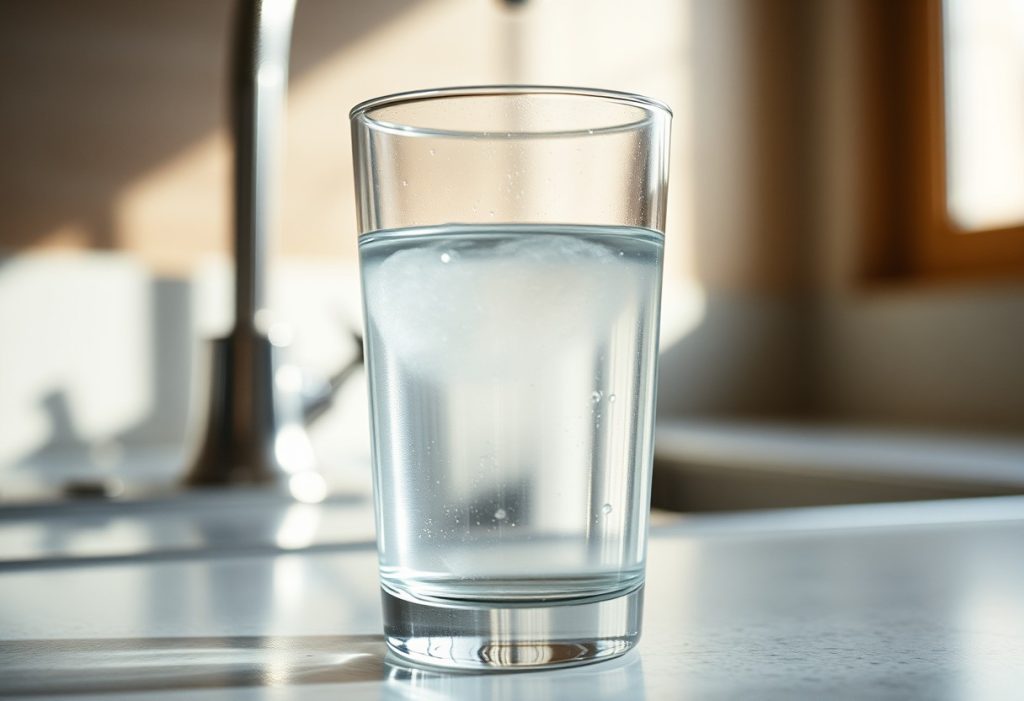
How does the glass test tell air from sediment or minerals?
Fill a clear glass from the cold tap, set it on the counter, and watch it for two minutes. If the cloudiness clears from the bottom up, it was dissolved air rising to the surface. If particles settle to the bottom and the water clears from the top down, it was sediment. If the haze stays evenly cloudy, suspect dissolved minerals or another contaminant.
- Run the cold tap for 15 to 30 seconds so you are not sampling water that sat in the faucet body.
- Fill a clear, clean glass and set it somewhere bright, against a dark background if you can.
- Watch for one to two minutes. Note which direction the water clears, or whether it clears at all.
- Repeat with hot water. A different result on the hot side points to the water heater.
- Repeat at a second faucet. One cloudy tap points to that fixture; every tap points to the supply.
Sediment may leave tan, gray, or white grit at the bottom of the glass. If the water runs tan, orange, or brown instead of white, that is usually rust or iron, and our guide to brown water from faucet problems covers that separate diagnosis.
| Glass test result | What it means | Next step |
|---|---|---|
| Clears bottom up in 1 to 2 minutes | Dissolved air (microbubbles) | Drink it; no action needed |
| Clears top down, grit settles | Suspended sediment from mains, pipes, or a well | Run cold tap, clean aerator, call utility if it persists |
| Stays evenly hazy | Dissolved minerals, high TDS, or other contaminant | Hardness and TDS test; call utility or test lab |
| Hot side only is cloudy | Gas release, scale, or anode byproduct in water heater | Flush heater; inspect anode |
| Milky and fizzing on a well, faucets sputter | Gas in the well, possibly methane | Ventilate, avoid sparks, order a methane test |
Why is cloudy tap water worse in winter or after plumbing repairs?
Cold water dissolves more gas than warm water, so winter supply water carries more air to release at your faucet. Standard saturation tables show fresh water at 32°F holding about 14.6 mg/L of oxygen versus about 9.1 mg/L at 68°F. As that cold water warms in your pipes and the glass, the extra gas comes out as bubbles.
Nitrogen follows the same pattern. The water is not different in winter. It is colder, and it was under main pressure until the instant it hit your glass.
Chart values are saturation dissolved oxygen in mg/L at sea-level pressure, from the table published by Victor Miguel Ponce at San Diego State University; USGS DOTABLES generates equivalent tables.
Repairs cause the same symptom by a different route. When a utility fixes a main or a plumber drains your lines, refilling traps air, and faucets spit and run milky until it works out, usually within a day of normal use. Running each cold tap for a minute or two speeds it up.
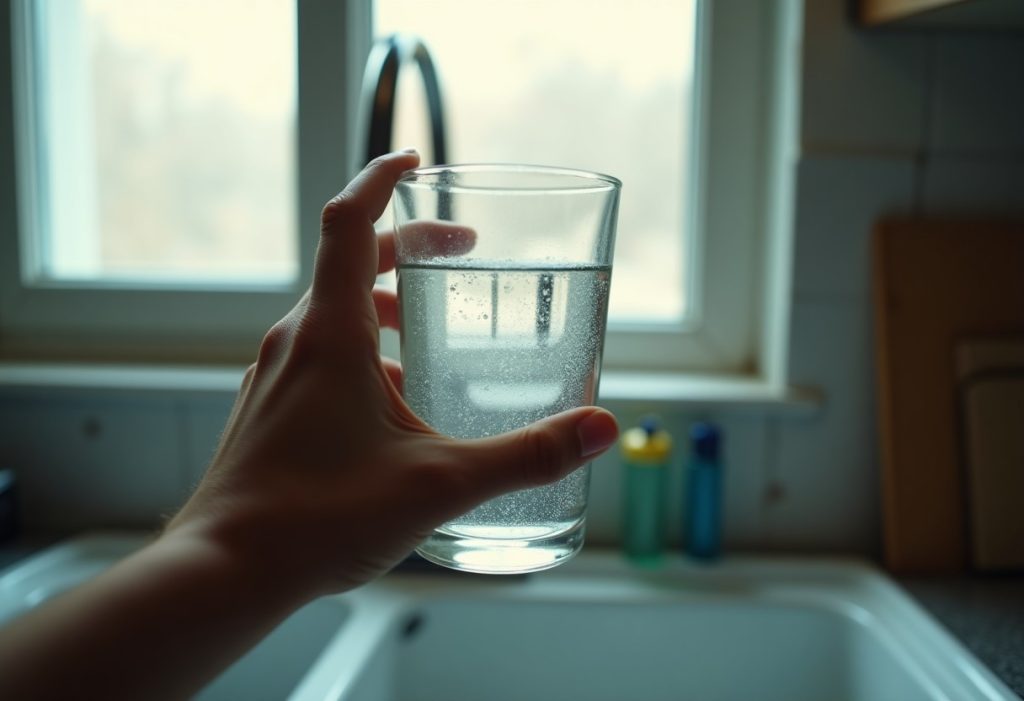
Is cloudy tap water safe to drink?
Cloudy tap water that clears from the bottom up is safe to drink; it is ordinary water with air in it. Water that stays cloudy is a different matter. EPA regulates turbidity because higher turbidity is often associated with viruses, parasites, and some bacteria, so persistent haze, haze with odor or color, or any cloudiness during a boil water notice means bottled water until you know more.
EPA lists turbidity in the National Primary Drinking Water Regulations as a treatment technique, not a simple limit. Systems using conventional or direct filtration must stay at or below 0.3 NTU in at least 95% of monthly samples and may never exceed 1 NTU. Systems using other filtration must meet state limits that may never exceed 5 NTU.
EPA lists nausea, cramps, diarrhea, and headaches as symptoms of the organisms higher turbidity can signal. That rule measures water leaving the treatment plant. Air bubbles at your faucet are not a violation.
Minerals are a cosmetic issue, not a health one. USGS says hardness is not a health concern, and EPA sets total dissolved solids at 500 mg/L as a secondary standard, a non-enforceable cosmetic guideline. For the broader question of contaminants you cannot see, read our breakdown of whether tap water is safe to drink.
Why is only my hot water cloudy?
Hot-only cloudiness has three common causes. Heating drives dissolved gas out of the water, so hot water can look milky for the same reason cold water does. Heat also makes calcium carbonate less soluble, so hard water drops white scale in the tank. And in water with pH 8 or higher, an aluminum anode rod can shed a gel-like aluminum hydroxide, per A.O. Smith.
Run the glass test on the hot tap. If it clears bottom up, it is gas and harmless. If white or tan grit settles out, the water heater is shedding sediment and scale. A tank flush often clears it, and it is the same routine maintenance that keeps scale from building on the tank bottom.
The anode case looks different. A.O. Smith Technical Bulletin 14 describes aluminum hydroxide as “jelly beads” or a green, blue, or gray gel in the heater drain or at faucet aerators. The bulletin says it forms where water pH is 8 or higher and notes it also shows up in many areas with high chlorine or chloramine. The fix it gives is replacing the aluminum anode with a magnesium anode.
Why is my well water cloudy?
Cloudy well water usually means disturbed sediment, surface water getting in, or gas in the aquifer. New pump work, a falling water table, or nearby drilling can stir silt and clay. Heavy rain can push soil and bacteria through a cracked casing or loose cap. Milky water that fizzes, with sputtering faucets, can signal methane, which USGS says dissolves in water up to about 28 to 30 mg/L.
Private wells are not covered by the EPA turbidity rule. CDC recommends that private well owners test at least once a year for total coliform bacteria, nitrates, total dissolved solids, and pH, and test again any time the water changes in look, taste, or smell.
Sediment after pump work or drilling often settles out within days. Run an outdoor spigot, not the kitchen tap, to clear it without loading fixtures and the water heater with grit. If it returns every time the pump runs hard, call a licensed well contractor.
USGS Fact Sheet 2006-3011 reports that the Office of Surface Mining treats methane between 10 and 28 mg/L as an action level to monitor, and above 28 mg/L as a condition to address immediately because the gas can collect in the well, well house, or basement. The concern is explosion and asphyxiation in enclosed spaces. If your water spurts and fizzes, keep flames and sparks away from the well and basement, vent the area, and order a dissolved methane test.
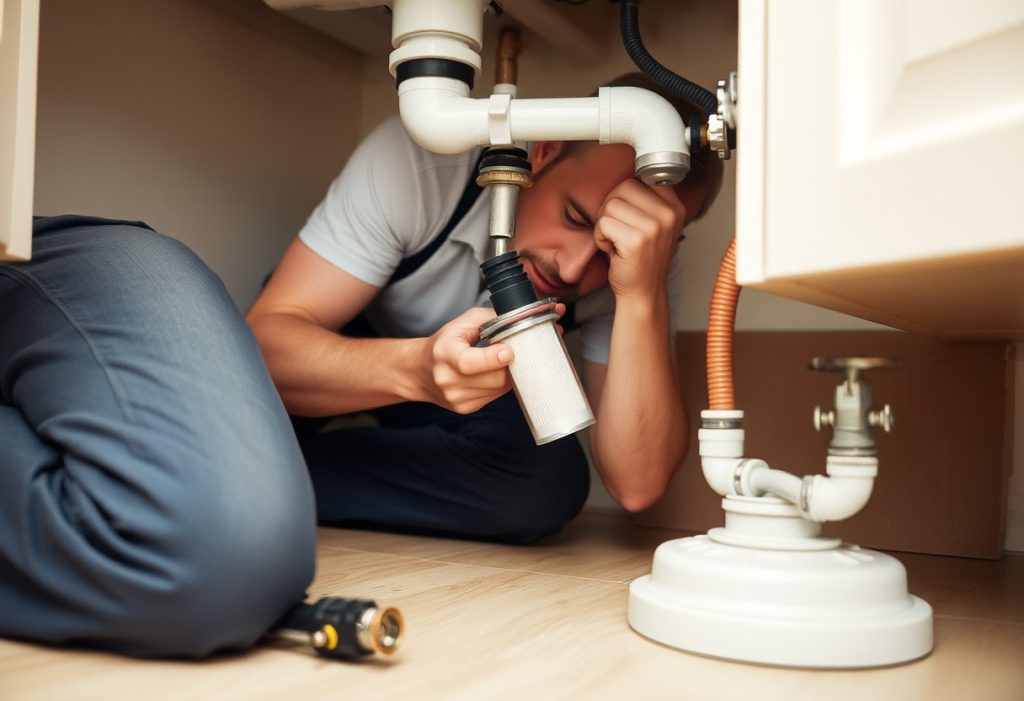
What fixes cloudy tap water for good?
The fix depends entirely on the cause. Air needs no fix. Sediment needs a flush, a clean aerator, or a sediment prefilter. Hardness and high dissolved solids need a softener or point-of-use treatment. Hot-only cloudiness needs a tank flush or an anode change. Well problems need a test first, then sediment filtration, disinfection, or gas venting depending on the result.
| What you see | Likely cause | Safe to drink? | Fix |
|---|---|---|---|
| White, clears bottom up in 1 to 2 min | Dissolved air, cold weather or recent repairs | Yes | None; run taps after repairs |
| Grit settles, clears top down | Sediment from main work, flushing, or old pipe | Wait until clear | Run cold tap, clean aerators, sediment prefilter |
| Stays hazy, white crust on fixtures | Hard water or high TDS | Generally yes (USGS: not a health concern) | Water softener or reverse osmosis |
| Hot only, white grit | Scale and sediment in water heater | Do not drink hot tap water anyway | Flush tank |
| Hot only, green, blue, or gray gel | Aluminum anode, pH 8+ (A.O. Smith) | Use cold tap for drinking | Magnesium anode |
| Well, milky and fizzing, sputtering | Gas, possibly methane (USGS) | Test first; vent and avoid sparks | Methane test, well venting, aeration system |
| Well, cloudy after heavy rain | Surface water or bacteria entering well | No, until tested | Coliform test, repair cap or casing, shock chlorination |
| City water, hazy plus odor or color | Treatment or distribution problem | No, until utility clears it | Call utility; bottled water |
For hardness, start with a test. A hardness strip or your utility’s water quality report will tell you where you land on the USGS scale, and our guide to hard water explains the softener, conditioner, and reverse osmosis options. A softener removes the calcium and magnesium that turn into white haze and flakes on heating.
For recurring sediment, a cartridge prefilter at the main line catches grit before it reaches faucets and appliances. If you also want to reduce chlorine taste or treat well water, a whole house water filter can pair a sediment stage with carbon or specialty media. Do not buy one to fix air, because air passes through every filter.
When should you call the utility or test your water?
Call your water utility when the glass test fails, every tap in the house is cloudy, neighbors report the same thing, the water smells or looks colored, or cloudiness lasts more than a couple of days. Utilities field these calls daily and can tell you about main work or flushing. Test your own water when you rely on a private well or the problem is inside your home.
Before you call, check for a boil water notice and pull your annual Consumer Confidence Report, which EPA requires community water systems to deliver to customers by July 1 each year. It lists hardness, turbidity, and other results for your supply.
- Call the utility: all taps cloudy, glass test fails, odor or color, neighbors affected, after a main break.
- Call a plumber: hot side only, one fixture only, cloudiness returns after the utility confirms its water is clear.
- Call a certified lab: private well, cloudiness after flooding or heavy rain, fizzing well water, an infant or immunocompromised person in the home.
How we sourced this
We reviewed top-ranking pages for “cloudy tap water” and “why is my water cloudy” in October 2026, then went to primary sources for every number. Cited: EPA National Primary Drinking Water Regulations (turbidity treatment technique and health language), EPA Secondary Drinking Water Standards (TDS guideline), USGS Water Science School (hardness classes), USGS Fact Sheet 2006-3011 (methane solubility and Office of Surface Mining action levels), A.O. Smith Technical Bulletin 14 (aluminum hydroxide), CDC private well testing guidance, and a sea-level dissolved-oxygen saturation table from San Diego State University (chart values). We excluded filter vendor claims. Testing and treatment rules vary by state and utility.
Frequently asked questions
Is cloudy tap water safe to drink?
Usually yes. If a glass clears from the bottom up within a minute or two, the cloudiness was dissolved air and the water is the same water you drink every day. Water that stays cloudy, smells, or shows up with a boil water notice is a different case. Use bottled water and call your utility or test the well before drinking it.
Why is my tap water cloudy all of a sudden?
Sudden cloudiness usually follows a change in pressure or temperature. Cold winter water holds more dissolved gas, and main repairs, hydrant flushing, or new plumbing work can trap air in the lines. Both release tiny bubbles at the faucet. If the glass clears in two minutes and the problem fades within a day or two, no action is needed.
How long does it take for cloudy tap water to clear?
Air cloudiness clears in the glass within about one to two minutes, rising from the bottom up. Air in the household lines after a repair usually works itself out within a day of normal use. Sediment that settles to the bottom of the glass can take longer. If cloudiness lasts more than a couple of days, call your water utility.
Why is my hot water cloudy but not my cold water?
Heating water drives dissolved gas out and makes calcium carbonate less soluble, so hot water can look milky even when cold water is clear. White grit points to scale and sediment in the water heater, which a flush often fixes. Green, blue, or gray gel beads point to aluminum hydroxide from an aluminum anode, which A.O. Smith says is fixed by switching to a magnesium anode.
Does boiling cloudy water make it safe?
Boiling kills bacteria, viruses, and parasites, which is why utilities issue boil water notices. It also drives off dissolved air. Boiling does not remove sediment, metals, or minerals, and in hard water it can make the water cloudier as calcium carbonate drops out as white flakes. Follow your utility notice when one is in effect.
Why is my well water cloudy after heavy rain?
Heavy rain can push surface water and soil into a shallow well or one with a cracked casing or loose cap. That brings sediment and possibly bacteria. Treat cloudy well water after rain as unsafe until tested. Use bottled water, inspect the well cap, and get a total coliform bacteria test, which CDC recommends at least once a year anyway.
Can cloudy water make you sick?
Cloudiness from air or hardness will not make you sick. EPA regulates turbidity because higher turbidity is often associated with viruses, parasites, and some bacteria that cause nausea, cramps, and diarrhea. That is why persistent cloudiness, cloudiness with odor, or cloudy well water after flooding deserves a test before anyone drinks it, especially infants and people with weak immune systems.
Who do I call about cloudy tap water?
Call your water utility if every tap is cloudy, the glass test fails, neighbors report it, or the water also smells or looks colored. The number is on your bill and in your annual Consumer Confidence Report. Call a plumber if only hot water is affected or only one fixture. Private well owners call a certified lab for testing.


