Backflow Test Cost: Who Needs It and What It Costs
Backflow test cost usually runs $30 to $300 per device, about $165 on average per HomeGuide, plus any city filing fee, and most utilities require the test every year on irrigation, fire and commercial assemblies.
Key Takeaways
- HomeGuide (2026) puts a backflow test at $30 to $300 per device, with a $165 national average, and notes that most homes have one device while commercial systems often have 2 to 3.
- Utility-run programs post exact prices. Longmont, Colorado charges $81.25 per above-ground assembly and $162.50 per assembly in a vault or crawlspace when its contracted tester does the work.
- Tualatin Valley Water District (TVWD) in Oregon offers a $40 per assembly Gold Plan and bills a $65 per assembly enforcement fee when results miss the September 1 deadline.
- City fees stack on top of the tester’s charge. Frisco, Texas lists a $40 backflow test fee and Columbus, Ohio charges $25 per device per year for administration.
- Longmont assesses a civil penalty of up to $500 per assembly 91 days after the due date and schedules service interruption on the main water line for accounts still out of compliance.
- California’s water board recognizes ABPA, ASSE 5110 and CA-NV AWWA tester certifications for July 1, 2026 to July 1, 2027, per its August 26, 2026 list.
How much does a backflow test cost?
A backflow test costs $30 to $300 per device in most U.S. markets, according to HomeGuide’s 2026 cost guide, which pegs the national average at $165. The spread comes from local labor rates, how hard the assembly is to reach, whether the city adds a filing fee, and whether the device passes. Commercial buildings with several assemblies pay per device.
The cleanest price data comes from utilities that hire testers on contract. Longmont’s backflow FAQ lists $81.25 for an easily accessible, above-ground assembly and $162.50 for one in a vault or crawlspace. Access alone doubles the price there.
HomeGuide puts plumber labor at $75 to $150 per hour, though most testers quote a flat per-device fee. For local labor context, see our guide to how much a plumber costs.
Sources for the chart: HomeGuide, the City of Longmont backflow FAQ, TVWD and Columbus program pages. Utility figures are posted rates, not surveys.
Who needs annual backflow testing?
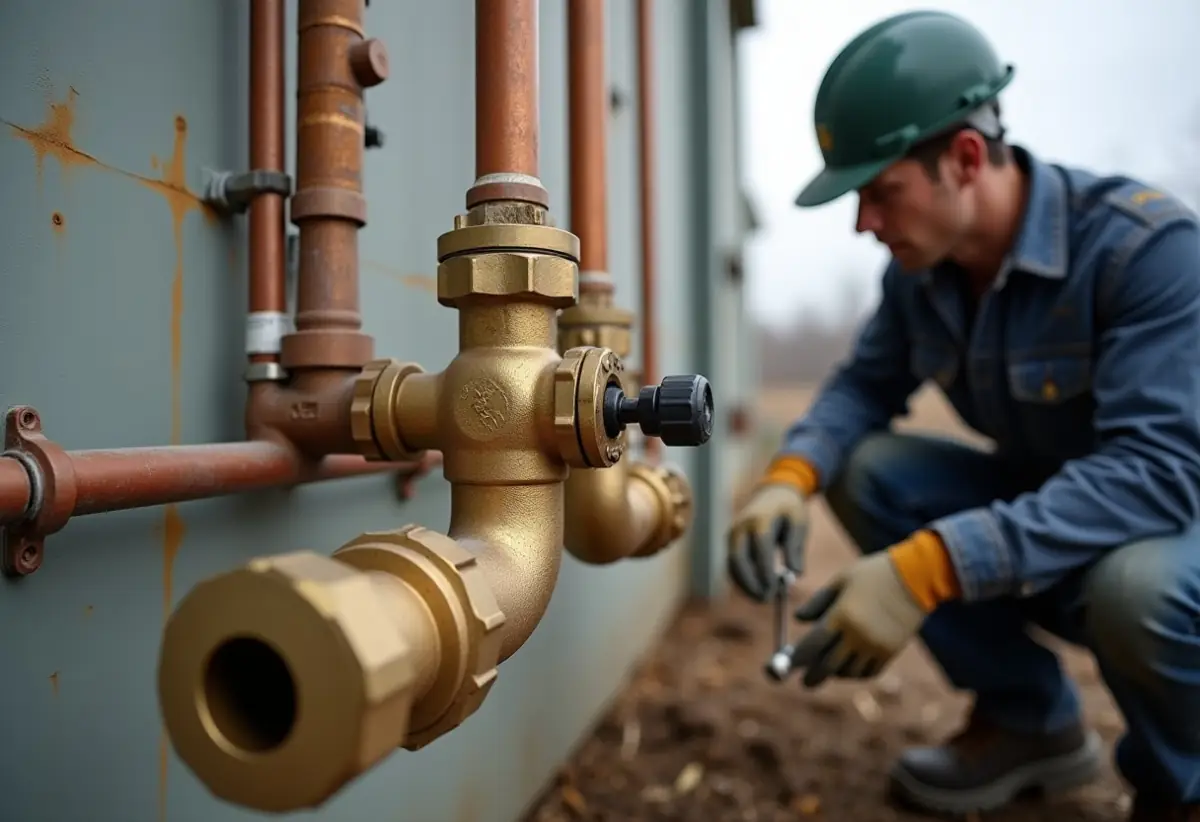
Anyone whose water service has a testable backflow assembly usually needs annual backflow testing. That covers lawn irrigation systems, fire sprinkler lines, most commercial and multifamily services, and equipment such as chemically treated boilers. The water utility decides which assemblies are required under its cross-connection control program, and the property owner, not the tenant or the utility, pays for the test.
The framework comes from the EPA Cross-Connection Control Manual (EPA 816-R-03-002), which explains how backpressure and backsiphonage pull contaminated water into the public system and how protection is matched to the degree of hazard. States write the rules and utilities enforce them.
- Irrigation systems. HomeGuide notes that many cities mandate installation and annual testing for homes with an irrigation system, septic system or inground pool.
- Commercial properties. Columbus requires non-residential customers to install a backflow preventer at the end of each water service line.
- Fire sprinkler systems. Fire lines connected to the public main typically carry a double check or reduced pressure assembly that the utility tracks like any other.
- Boilers and process equipment. Treated boilers, chemical feeders and booster pumps are classic high-hazard cross-connections, and Columbus specifically calls out booster pumps.
Assemblies have test cocks and shutoff valves so a tester can verify them in place. Simple devices such as atmospheric vacuum breakers and hose-bib vacuum breakers are not field-testable. Our breakdown of backflow preventer types covers which device fits which hazard.
How often is a backflow test required?
Most programs require a backflow test at installation and then at least once a year, with a retest after any repair. Oregon’s rule OAR 333-061-0070, cited by TVWD, requires approved assemblies to be tested at least once per calendar year. Los Angeles County says devices must be tested every year by a certified tester. Some cities allow longer intervals for low-risk residential irrigation.
Frisco, Texas states that assemblies with test ports must be tested upon installation and annually after that. South Carolina’s drinking water regulation R.61-58 likewise calls for a test by a certified tester after installation and at least once annually.
Kannapolis, North Carolina sets annual testing as the minimum for most assemblies but every 3 years for residential irrigation. Your due date comes from your utility’s notice. Our roundup of backflow testing rules for 2026 tracks how these requirements are shifting.
| Assembly type | Typical use | Test cost range | Notes |
|---|---|---|---|
| Pressure vacuum breaker (PVB) | Residential and commercial lawn irrigation | $30 to $300 per device (HomeGuide); $81.25 above ground in Longmont | Must sit above the highest downstream outlet; protects against backsiphonage only |
| Spill-resistant vacuum breaker (SVB) | Indoor or point-of-use irrigation and equipment supplies | $30 to $300 per device (HomeGuide) | Included in the ASSE 5110 hands-on exam alongside the PVB, DC and RP |
| Double check valve assembly (DCVA) | Low-hazard commercial services, irrigation, many fire sprinkler lines | $30 to $300 per device; $162.50 in a vault in Longmont | Often installed below grade in a vault, which raises the test price |
| Reduced pressure zone assembly (RPZ) | High-hazard services such as treated boilers, chemical feed, medical and industrial users | $30 to $300 per device; vault or confined-space pricing applies where allowed | Has a relief valve plus two checks, so the test has more steps; installed above grade with drainage |
| Double check detector assembly | Fire sprinkler services on the public main | Quoted per assembly; no posted utility rate found | Larger sizes and fire-system coordination usually push the price above residential tests |
Who can test a backflow preventer?
Only a certified backflow assembly tester recognized by your water utility or state can test a backflow preventer for compliance. Homeowners and general plumbers without that certification cannot file a valid report. Most programs accept testers certified through ASSE 5110, ABPA or an AWWA section, and many utilities also require the tester to register locally and use a calibrated test kit.
The U.S. Department of Labor’s O*NET listing for IAPMO’s backflow tester course describes a 40-hour class ending in the ASSE 5110 exam. The initial written test has 100 questions, and candidates must show the field test procedure on a reduced pressure principle assembly, a double check valve assembly, a pressure vacuum breaker and a spill-resistant vacuum breaker. Certification renews every 3 years.
California’s State Water Resources Control Board tester certification list, updated August 26, 2026, recognizes ABPA, ASSE 5110 and CA-NV AWWA certificates for July 1, 2026 to July 1, 2027. Los Angeles County Public Health notes that as of July 1, 2026, meter protection testers need certification through a recognized provider, while its own certificate remains valid for internal assemblies.

What happens during a backflow test?
During a backflow test, the certified tester briefly shuts off water through the assembly, connects a differential pressure gauge to its test cocks, and confirms each check valve and relief valve holds within the limits of the approved procedure. The tester then records readings, signs the report and files it with the utility.
- The tester records the make, model, size and serial number and inspects the shutoff valves and body for leaks or corrosion.
- Downstream shutoff valve number 2 is closed, which briefly cuts water to the property.
- A differential pressure gauge is attached to the test cocks in the order the approved procedure specifies.
- For a DCVA, each check valve is tested to confirm it holds a minimum pressure differential. For an RPZ, the relief valve opening point and both checks are tested. For a PVB, the air inlet and check valve are tested.
- Valves are reopened, water is restored, and the readings go on a signed test report.
- The tester submits the report to the utility, often through an online portal, and gives you a copy.
What does it cost when a backflow test fails?
A failed backflow test adds the repair cost plus a retest fee. Many failures can be fixed with a rubber-parts repair kit for the check valves or relief valve, installed by the tester or a plumber. If the body is cracked or frozen, replacement runs $200 to $1,000 per device installed, per HomeGuide, with larger and RPZ assemblies at the top of that range.
Longmont gives owners 60 days after a failed test to complete repairs or replacement with the contractor of their choice. An above-ground PVB or RPZ left charged through a hard freeze can split its body, which turns a kit repair into a replacement. HomeGuide lists add-ons such as a thermostatic freeze relief valve or anti-theft device at $100 to $300.
Repair kit prices vary by brand and size. Ask for the kit, labor and retest as separate lines so you can compare the total against a new assembly.
What happens if you skip your backflow test?
Skip a required backflow test and most utilities escalate from reminders to fees, a city-hired tester, civil penalties and finally water shutoff. Longmont’s published timeline issues a notice of violation 1 day after the due date, adds a fee at 31 days, warns of civil enforcement at 61 days, and at 91 days assesses up to $500 per assembly and schedules service interruption.
Paying the penalty does not end the obligation, since Longmont still requires that year’s test to avoid shutoff. TVWD takes the simpler route, billing a $65 enforcement fee per assembly and sending its own contracted, certified tester.
Frisco’s fee schedule warns that additional fines and restrictions, including meter confiscation, may apply when its backflow ordinance is not met. Call the backflow office before the deadline if you need an extension.
How are backflow test reports filed, and who pays the city fee?
The certified tester files the backflow test report with the water utility, usually electronically, and the property owner pays any city filing or administrative fee. TVWD requires the testing company to submit residential results electronically by September 1. Columbus customers check report status through its Backflow Compliance Office portal and pay a $25 annual fee per device.
The City of Frisco fee schedule lists a $40 backflow test fee, charged in addition to the tester’s own price. HomeGuide advises that any city filing fee should be included in the tester’s quoted total, so ask whether the quote covers it.
Keep a copy of every passing report. Buying a commercial building or a home with irrigation? Ask for the last test report during a plumbing inspection, since an overdue assembly transfers to the new owner. Longmont’s FAQ confirms the owner or HOA manager, not a tenant, is responsible for its service fee.
How can you lower your backflow test cost?
The cheapest backflow test is usually a utility subscription plan or a bundled visit. TVWD runs its Gold Plan at $40 per assembly per year for accessible residential devices, which is less than the $65 late enforcement fee and below HomeGuide’s $165 average. Easy access also helps.
- Book before the deadline. Late fees cost more than a scheduled visit.
- Keep it accessible. Longmont charges double for vault and crawlspace assemblies, and TVWD excludes assemblies behind locked gates, in crawl spaces or with animals in the yard from its Gold Plan.
- Winterize. Draining an above-ground assembly before freezing weather helps prevent freeze damage to the body and check valves.
How we sourced this
We consulted 17 sources between October 1 and October 18, 2026, and cited 12: HomeGuide’s backflow testing and backflow preventer cost guides; utility program pages from Longmont (CO), Tualatin Valley Water District (OR), Columbus (OH), Frisco (TX) and Kannapolis (NC); Los Angeles County Public Health; the California State Water Resources Control Board tester list; South Carolina R.61-58; the O*NET certification listing; and the EPA Cross-Connection Control Manual. We excluded templated cost pages with no stated method. Utility prices are posted program rates and may change at each budget cycle.
Frequently asked questions
How much does a backflow test cost?
Most owners pay $30 to $300 per device, and HomeGuide’s 2026 national average is $165. Utility programs post lower flat rates, such as $81.25 for an above-ground assembly in Longmont, Colorado or $40 through TVWD’s Gold Plan in Oregon. Vaults, crawlspaces, failed tests and city filing fees push the total higher.
Can I test my own backflow preventer?
Usually not for compliance. Utilities accept reports only from certified testers, typically holding ASSE 5110, ABPA or AWWA section certification and often registered locally. Los Angeles County, TVWD and Columbus all require a certified or city-approved tester. You can inspect your assembly for leaks and freeze damage yourself, but the official test must come from a certified professional.
How often does a backflow preventer need to be tested?
Most programs require a test at installation and at least once a year after that, plus a retest after repairs. Oregon’s OAR 333-061-0070 sets a once-per-calendar-year minimum, and Los Angeles County requires yearly tests. A few cities ease the rule for residential irrigation, with Kannapolis, North Carolina allowing every 3 years.
What happens if a backflow test fails?
The tester reports the failure and you must repair or replace the assembly, then pass a retest. Longmont gives owners 60 days after a failed test to finish repairs. Many failures need only a rubber-parts kit, while a cracked or frozen body means replacement at $200 to $1,000 per device installed, according to HomeGuide.
What happens if I do not get my backflow tested?
Expect fees, a city-hired tester and possibly shutoff. TVWD bills a $65 enforcement fee per assembly after its September 1 deadline. Longmont adds a fee at 31 days past due, assesses up to $500 per assembly at 91 days, and schedules interruption of the main water supply for accounts still out of compliance.
Does a residential irrigation system need a backflow test?
In many areas, yes. HomeGuide notes that many cities require annual testing for homes with irrigation systems, septic systems or inground pools, because sprinkler lines can siphon fertilizer and soil water back into the supply. TVWD requires residential results each year by September 1, while some utilities allow longer intervals for low-risk residential irrigation.
Who pays for backflow testing, the landlord or the tenant?
The property owner or HOA manager is normally responsible. Longmont’s FAQ states that tenants are not responsible for its backflow service fee and points to its municipal code. Columbus and TVWD bill the account holder, so landlords should confirm who receives the utility notices and schedule the test before the due date.