Should Hot Water Pressure Be the Same as Cold? Why Hot Runs Weaker and When It Is a Problem
Hot water pressure should be the same as cold when nothing is running, because both come from one supply. While water flows, hot runs a little weaker: a tankless heater alone costs about 11 psi at 4 gpm. A big drop at every tap points to the heater; at one tap, the fixture.
The first test takes two minutes and splits the problem in half. Open the hot side alone at two or three fixtures on different floors. If hot is weak everywhere, the restriction sits at or near the water heater. If hot is weak at one faucet or shower and strong elsewhere, the heater is fine and the fault is in that fixture’s cartridge, aerator or supply stop. If hot and cold are both weak, this is not a hot-side problem at all; start with the whole-house low water pressure causes instead.
Is static pressure on the hot side really the same as the cold side?
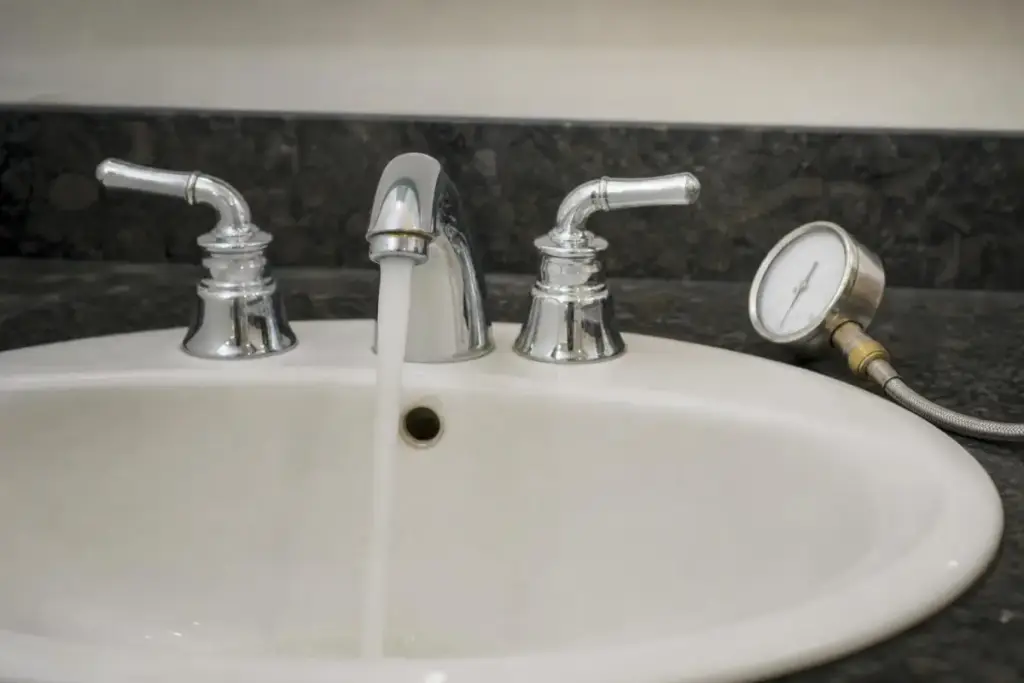
Yes: with every tap closed, the hot line holds the same pressure as the cold line, because the cold line feeds the water heater and the heater outlet is an open path to the hot taps. A tank heater is a pressure vessel at line pressure, not a pump or a reducer. You can confirm it with one hose-thread gauge on the washing machine valves: read the cold valve, then the hot valve, with nothing else running. Both should land in the 40 to 60 psi range for a house, and IPC Section 604.8 requires a pressure-reducing valve once static pressure passes 80 psi.
One exception runs the other way. In a closed system, such as one with a backflow preventer or check valve on the supply, heating water makes it expand, and the hot side can briefly read higher than cold. The A.O. Smith residential gas water heater guide (100366722, February 2023) warns that a closed system needs a means to control thermal expansion. A hot gauge that climbs past 80 psi after a heating cycle points to a missing or waterlogged expansion tank, not to low pressure.
How much weaker can flowing hot water be before it is a problem?
Flowing hot water loses more pressure than cold because it passes through the heater and usually through more pipe and more fittings before it reaches the tap. The size of that loss can be calculated. The table below uses the Hazen-Williams equation in the form used for water piping, loss in psi per foot = 4.52 x Q^1.85 / (C^1.85 x d^4.87), where Q is flow in gpm, C is the pipe roughness coefficient and d is the inside diameter in inches. Each pipe row is 50 ft of 1/2 in line, figured at 2 gpm (one faucet) and 4 gpm (a shower plus a sink).
| Component on the hot path | Inputs | Loss at 2 gpm | Loss at 4 gpm |
|---|---|---|---|
| Type L copper, new | ID 0.545 in, C = 150, 50 ft | 1.5 psi | 5.3 psi |
| Type L copper, scaled inside | ID 0.545 in, C = 100 (assumed for heavy scale), 50 ft | 3.1 psi | 11.3 psi |
| Galvanized steel, Schedule 40 | ID 0.622 in, C = 100, 50 ft | 1.6 psi | 5.9 psi |
| Galvanized steel with corrosion narrowing the bore | ID 0.40 in (illustration), C = 100, 50 ft | 14.1 psi | 50.8 psi |
| Navien NPE-240A2 tankless heat exchanger | Maker’s published curve | 3.0 psi | 10.8 psi |
The tankless row comes straight from the pressure-loss table in the Navien NPE-2 Series Commercial Application Guide, which lists 1.00 psi at 1 gpm, 3.00 psi at 2 gpm, 10.80 psi at 4 gpm and 16.50 psi at 5 gpm for the 199,900 Btu/h NPE-240A2/S2. Tank heaters lose far less inside the tank body itself; the A.O. Smith guide lists 3/4 in NPT water connections, but the maker does not publish a pressure-drop figure for the tank.
Add it up for a house with 60 psi static, new copper and a Navien NPE-240A2. At 4 gpm the cold tap sees 60 minus 5.3, or about 54.7 psi. The hot tap sees 60 minus 10.8 minus 5.3, or about 43.9 psi. Flow through a fixed faucet opening scales roughly with the square root of pressure, so the square root of 43.9 / 54.7 is 0.90: hot should deliver about 10 percent less than cold at that faucet. That is the normal gap. With a tank heater the gap shrinks to the extra pipe length and fittings on the hot run.
The same arithmetic gives a decision rule. If hot delivers 30 percent less than cold at the same tap, the square of 0.70 says hot has lost about half of its pressure to a restriction, which no clean heater or clean 1/2 in line explains. The galvanized row shows the usual culprit in older houses: narrowing the bore from 0.622 in to 0.40 in turns a 5.9 psi loss into a 50.8 psi loss at 4 gpm.
Where is the restriction? A diagnosis table by symptom
The pattern of where hot runs weak names the likely part. Work down the row that matches what you see.
| Where low hot pressure shows | Likely cause | Check | Fix and cost (checked November 2026) |
|---|---|---|---|
| Every hot tap, right after heater work or a water shutoff | Cold inlet valve on the heater left partly closed | Handle fully open; A.O. Smith says the cold supply valve must be left open in use | Open fully, $0. A stiff gate valve that will not open is a valve replacement |
| Every hot tap, new tank heater | Heat traps or dip tube damaged when copper was soldered at the heater | Ask whether the connections were soldered at the tank | Installer replaces the nipples; the A.O. Smith guide says to solder to an adapter first |
| Every hot tap, old tank heater, hard water | Sediment at the tank outlet or in lines downstream | Aerators clogged with grit on hot side only | Flush the tank, $0 DIY; A.O. Smith recommends every 6 months |
| Every hot tap, tankless heater | Clogged inlet water filter or scale in the heat exchanger | Navien code 760 or Rinnai code LC or 00 | Clean filter, then descale per maker: Rinnai calls for 4 gallons of undiluted white vinegar for at least 1 hour |
| Hot weak on one branch or floor | Corroded galvanized hot line | Hot weak at all fixtures on that branch, cold fine | Replace that run; the 0.40 in bore case loses 50.8 psi at 4 gpm |
| One shower only | Pressure-balancing cartridge fouled | Sink hot on same floor runs strong | Replace cartridge by model, such as Moen 1222 for Posi-Temp |
| One sink only | Aerator screen or hot supply stop under the sink | Remove aerator and run hot; check stop is fully open | Clean aerator or replace the 1/4-turn stop |
What should you check at the water heater first?
Check the cold inlet valve on top of the heater first, because it is the one part that throttles every hot tap at once and costs nothing to fix. A ball valve is open when the lever sits in line with the pipe; a gate valve with a round wheel must be turned fully counterclockwise. The A.O. Smith guide’s fill procedure tells the owner to open the cold-water supply valve and states that it must be left open while the heater is in use.
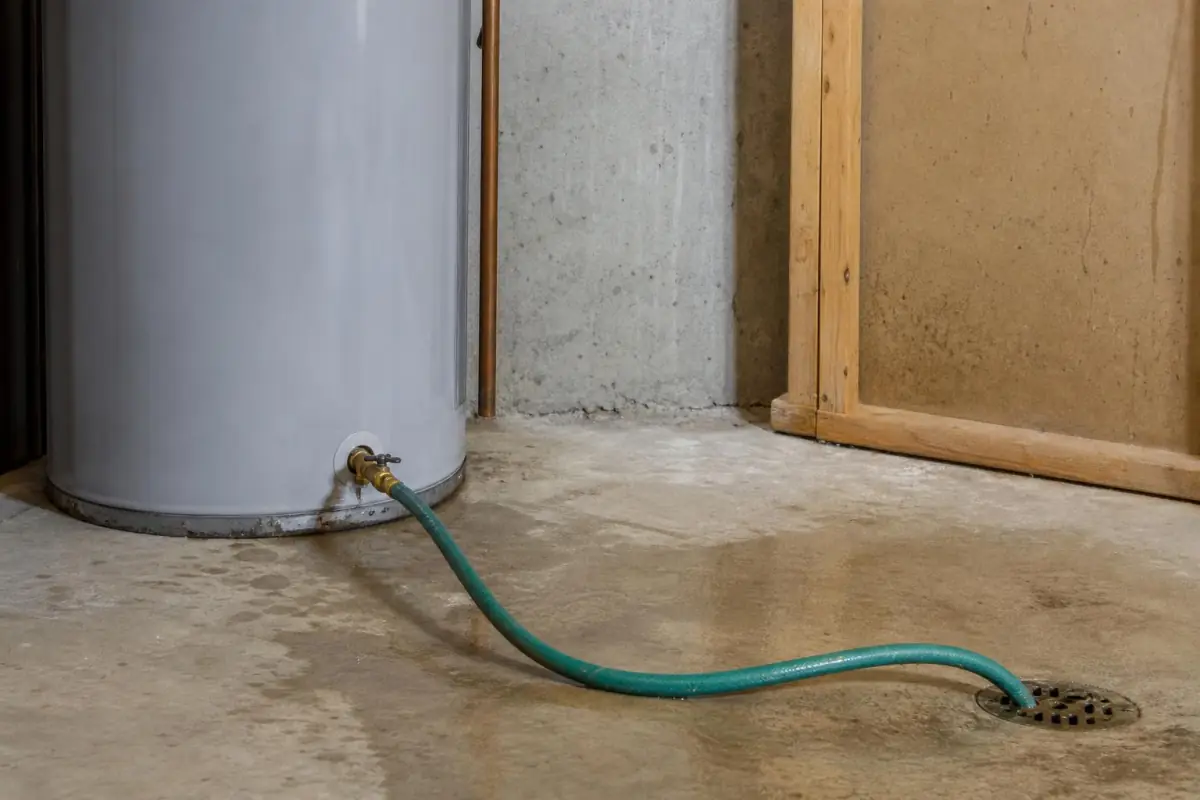
On a tank heater, sediment is the next suspect. Grit stirred up from the tank bottom lodges in aerator screens and cartridge inlets on the hot side only. A.O. Smith recommends draining and flushing every 6 months, done with the cold inlet valve open so supply pressure pushes water out the drain until it runs clean; the step-by-step version is in our guide to draining and flushing a tank water heater. Sediment that takes up tank volume also shows as hot water that runs out fast, so the two symptoms together point at the tank.
On a tankless heater, clean the inlet water filter before descaling. The Navien NPE installation manual places the filter inside the cold water inlet and tells installers to instruct owners that it must be cleaned periodically to maintain proper water flow; the NPE-240A parts list numbers that filter 30008351A. If flow is still short, scale in the heat exchanger is likely. Rinnai’s flushing instructions call for isolation valves on the unit, and its manuals say an LC or 00 code means the unit has begun to lime up. Gas valve and venting work stays with a licensed gas technician; the flush itself uses only the water isolation valves.
Can a mixing valve make hot water feel weak?
Yes: a single-handle shower valve meters hot and cold through one cartridge, so a fouled hot port or a tight limit stop cuts hot flow at that shower only. IPC Table 604.3 sets a showerhead served by a balanced-pressure, thermostatic or combination mixing valve at 2.5 gpm and 20 psi flow pressure, against 8 psi for a plain shower, per the IPC 2021 Chapter 6 text. A heater-side loss that is harmless at a sink can therefore show up first at a thermostatic shower. The rotational limit stop on a pressure-balancing valve caps how far the handle turns toward hot; IPC 412.3 (2021) requires shower valves to meet ASSE 1016 with the limit set no higher than 120 F, and that stop is adjusted inside the cartridge, not at the heater.
How do you measure hot versus cold flow with a bucket?
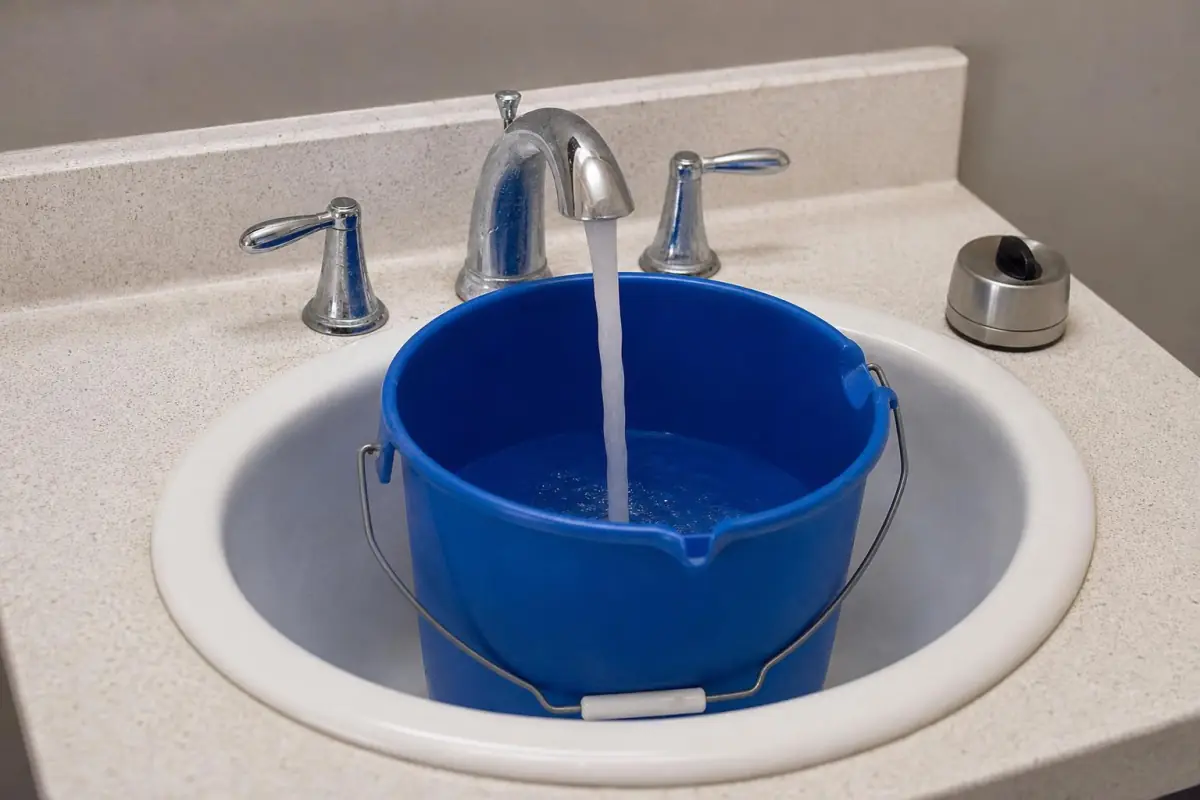
Time how long one tap takes to fill a 1 gallon container on full hot, then on full cold, and divide 60 by each time in seconds to get gpm. A 1.5 gpm lavatory faucet, the EPA WaterSense maximum, fills a gallon in 40 seconds; a 2.5 gpm showerhead, the IPC Table 604.4 maximum at 80 psi, fills it in 24 seconds. Compare the two numbers using the rule above: hot at 90 percent or more of cold is the friction you should expect, and hot at 70 percent or less means about half the hot pressure is being lost to a restriction you can find in the diagnosis table.
How we sourced this
We read the Navien NPE-2 Series Commercial Application Guide pressure-loss table and the Navien NPE installation manual, the A.O. Smith residential power-vented gas water heater guide 100366722 Rev. A (February 2023), Rinnai flushing guidance, IPC 2021 Chapter 6 via UpCodes and EPA WaterSense faucet specifications. Pipe losses were computed with Hazen-Williams; C = 150 for new copper is the common design value, while C = 100 and the 0.40 in narrowed bore are stated assumptions to show the effect of scale. The flow ratio uses a square-root orifice approximation. No tank heater maker publishes a pressure-drop figure, so none is shown. Nothing was tested or measured by The Plumbing Brief.
Questions about hot water pressure lower than cold
Can a water softener make only the hot water pressure low?
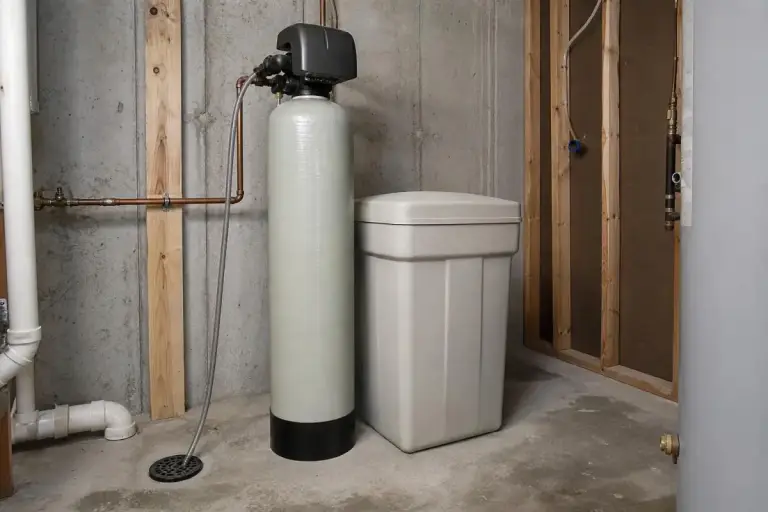
Not by itself in most homes, because a whole-house softener sits on the main line ahead of the tee that splits hot from cold, so a clogged softener drops both sides in the same 1 gallon bucket test. If only hot is weak, start at the water heater valves and the heater itself.
Why is hot water pressure low in my shower but fine at the sink?
A single-handle shower valve has its own cartridge, and debris or scale in that cartridge restricts one side. A Moen Posi-Temp valve, for example, uses the 1222 cartridge. If the sink hot runs strong, the heater and main hot line are clear, so the fault is inside that shower valve.
Did my new water heater cause low hot water pressure?
It can. A.O. Smith warns that soldering copper directly onto the heater connections harms the dip tube and heat traps, and a cold inlet valve left partly closed after the swap throttles every hot tap. Check that valve first, then ask whether the connections were soldered at the heater.
Does hot water have lower pressure because heat changes the water?
No. A gauge on an idle hot line reads the same as the cold line because both come from one supply, and in a closed system thermal expansion can push the hot side higher, even past the 80 psi limit in IPC 604.8. The weaker feel comes from friction in the heater and piping while water flows.
How often should a tankless heater be descaled to keep hot pressure up?
Navien lets the installer set a lime alarm for 6, 12 or 24 months, which shows code 760 when a flush is due. Rinnai shows code LC or 00 when the unit begins to lime up, and its manuals call for 4 gallons of undiluted white vinegar circulated for at least 1 hour.