Septic Tank Backing Up After Being Pumped? 6 Causes a Pump-Out Does Not Fix
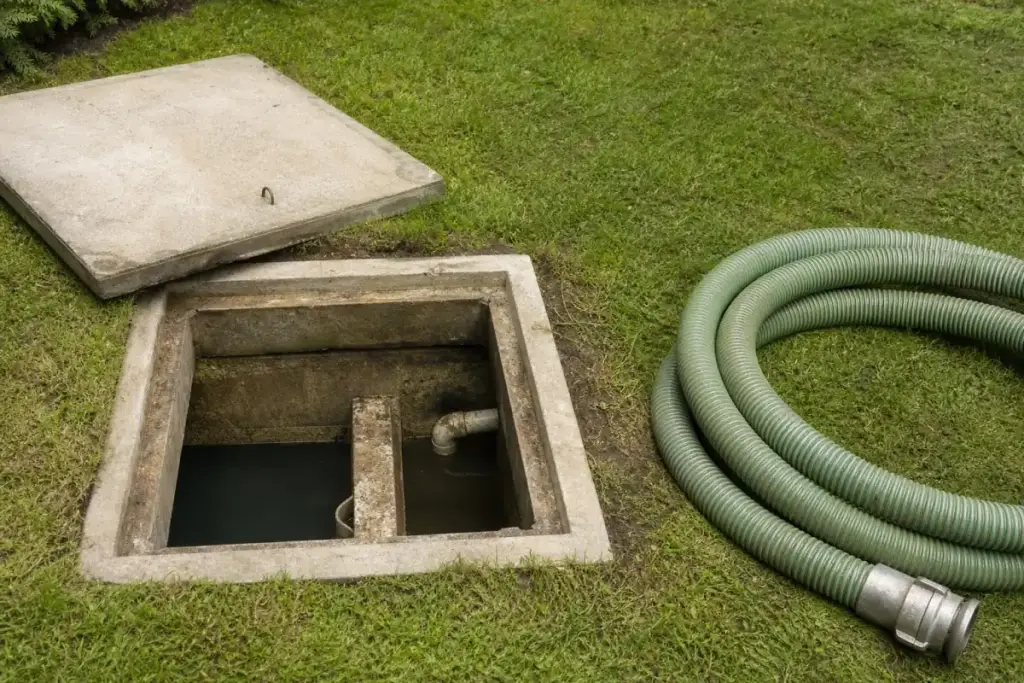
Your septic tank is backing up after being pumped because pumping only empties the tank. It does not clear a blocked house drain, a clogged effluent filter, a broken baffle or a saturated drain field. A tank that reads full again in 2 to 11 days is normal; sewage in the house is not.
How many days should a pumped septic tank take to read full again?
A pumped tank should climb back to its outlet pipe in roughly 2 to 11 days, depending on tank size and how many people live in the house. “Full” in septic terms means liquid at the bottom of the outlet pipe, the outlet invert, where every gallon that enters pushes one gallon out to the field. The EPA’s SepticSmart care page puts indoor use at as much as 70 gallons per person per day and a single running toilet at as much as 200 extra gallons per day. Dividing tank capacity by daily flow gives the refill time.
| Occupants | Daily flow (70 gal each) | 1,000 gal tank | 1,500 gal tank | Same house plus one running toilet (+200 gal) |
|---|---|---|---|---|
| 2 | 140 gal | 7.1 days | 10.7 days | 2.9 days / 4.4 days |
| 4 | 280 gal | 3.6 days | 5.4 days | 2.1 days / 3.1 days |
| 6 | 420 gal | 2.4 days | 3.6 days | 1.6 days / 2.4 days |
Inputs: capacity divided by (occupants x 70 gallons), with the running toilet column adding 200 gallons per day for the 1,000 and 1,500 gallon tanks. The 70 gallon figure is the EPA’s upper bound, so a real household usually takes longer than these numbers, and any liquid the pumper leaves behind shortens them.
Three decision rules come out of the table. A 1,000 gallon tank serving 2 people that is at its outlet the morning after pumping took on more than 7 days of household water overnight, which points to groundwater leaking in or effluent flowing back from a saturated field. Reaching the outlet on schedule proves nothing is wrong. Liquid above the outlet invert at any point means something downstream is holding it back.
Is the blockage before the tank, at the outlet or after it?
Two readings locate the blockage: the house cleanout and the tank liquid level compared with the outlet invert. Under Minnesota rule 7080.1920, item D, a tank’s inlet invert sits at least 2 inches above its outlet invert, so a healthy tank shows a dry-bottomed inlet pipe above a liquid surface that sits level with the outlet pipe.
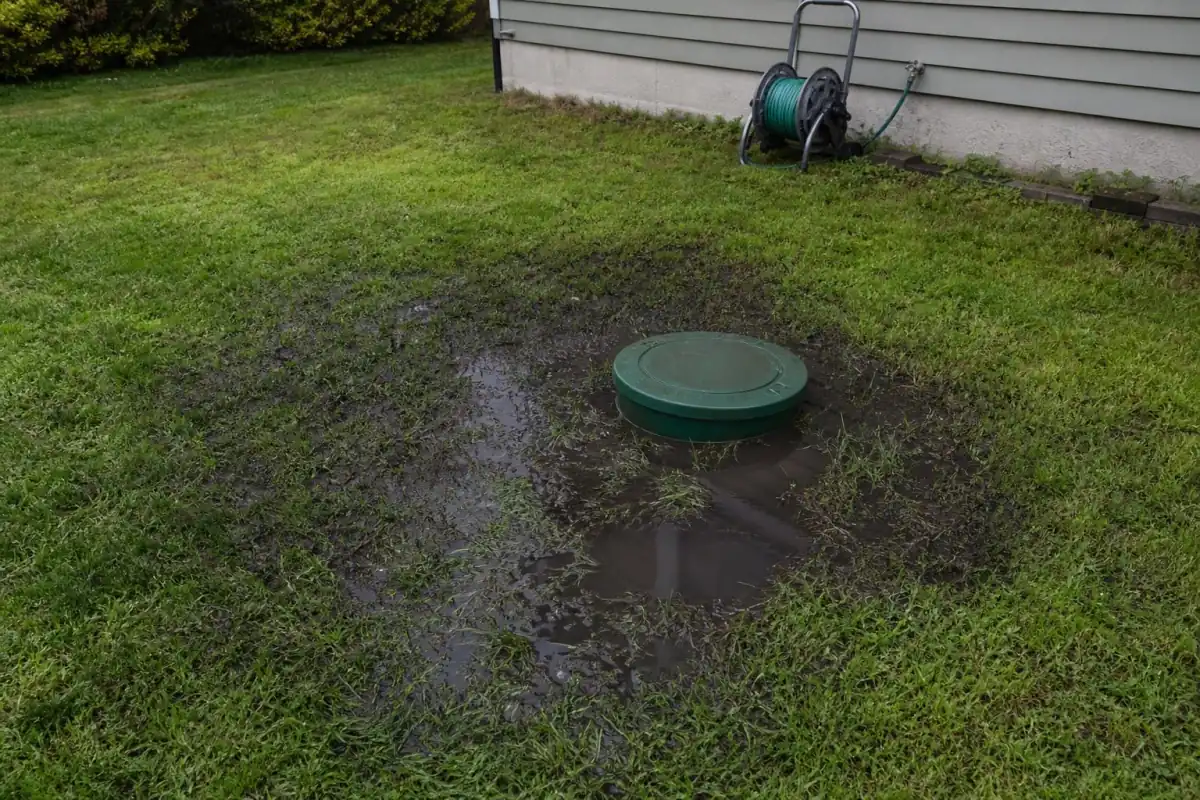
Read the two checks together. Sewage standing in the cleanout while the tank sits at its outlet invert puts the fault between the house and the tank. Liquid above the outlet invert, often covering the inlet pipe, puts the fault at the effluent filter, the outlet baffle or anything downstream. A distribution box flooded to its outlets while the tank is high points to the field; a dry D-box beside a high tank points to the filter or the pipe between them.
Which symptom matches which failure, and what does the fix cost?
The table maps where the backup appears to its likely location, using repair prices from HomeGuide’s septic tank repair cost guide, updated December 22, 2025.
| Where the backup shows | Tank level reading | Likely location | The check | Typical repair, cost |
|---|---|---|---|---|
| Lowest drain only (basement shower, floor drain) | At outlet invert | House drain or line to tank | Open cleanout; camera the line | Root removal $600 to $1,600; line repair $150 to $3,800 |
| All drains slow, toilets gurgle | At outlet, inlet pipe dry but sewage in it | Inlet baffle or tee clogged or collapsed | Look into the inlet riser | Baffle repair $250 to $900 |
| All drains slow, yard dry | Above outlet, D-box dry | Clogged effluent filter | Pull and hose the cartridge | Filter replacement $200 to $300 |
| Wet strip over trenches, all drains slow | Above outlet, D-box flooded | Saturated or failed field | Inspection ports; load test | Rejuvenation $1,000 to $5,000; replacement $3,000 to $15,000 |
| Alarm sounding, drains slow | Septic tank normal, pump chamber high | Effluent pump or float | Breaker, then pump amperage | Pump replacement $500 to $1,300; pump repair $250 to $400 |
| Tank high the morning after pumping | At or above outlet within 24 hours | Groundwater leak or field backflow | Recheck after 3 dry days | Cracked tank repair $500 to $850 |
The cheapest rows sit at the top of the system, so rule them out first: a $125 to $500 sewer camera inspection, per the same HomeGuide guide, costs less than one day of drain field digging.
The 6 causes a pump-out leaves in place
1. A crushed or root-filled line between the house and the tank
A vacuum truck pulls from inside the tank, so roots or a collapsed section in the 4 inch line upstream stay exactly where they were. The tell is sewage standing in the cleanout while the tank reads at its outlet invert; the fix is a cable or jetter, then a camera to find the break.
2. A broken or missing inlet baffle
Under Minnesota rule 7080.1960, the inlet baffle must reach at least 6 inches below the liquid surface and no more than 20 percent of the liquid depth, and it must not restrict the movement of solids. A tee that fell off or packed with paper and wipes dams the inlet; a pumper sees it only with the inlet lid open, so ask whether that lid came off.
3. A clogged effluent filter, or one the pumper skipped
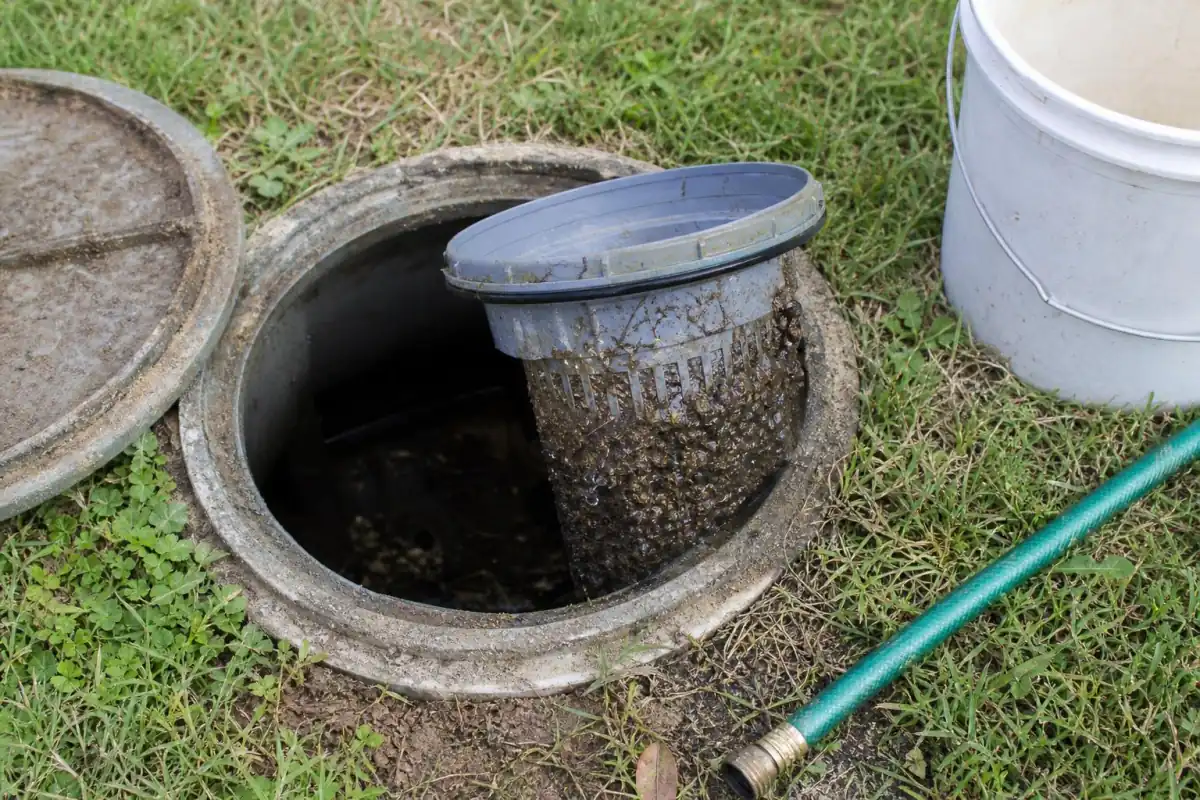
The Polylok PL-122 product sheet describes 122 linear feet of 1/16 inch slots in a 4 inch outlet tee, rated to 3,000 gallons per day, and calls for cleaning every time the tank is pumped or at least every 3 years. When the cartridge comes out, a shut-off ball floats up to block the outlet; Polylok’s steps are to stop all plumbing use, pull the cartridge and hose it off over the tank so solids fall back in. A filter left uncleaned at pump-out can hold the level above the outlet within the refill window in the first table.
4. A broken outlet baffle that already sent solids downstream
Minnesota rule 7080.1960 sets the outlet baffle at 40 percent of liquid depth below the surface, 35 percent in horizontal cylindrical tanks, so it draws from the clear middle layer. Once it breaks, scum and sludge ride into the D-box and laterals, and pumping the tank removes none of what already left. The same rule allows an effluent screen in place of an outlet baffle.
5. A saturated or failed drain field
When the soil under the trenches cannot take effluent as fast as the house sends it, the level backs up through the D-box into the tank, and a pump-out buys only the days shown in the refill table. Spring-only or after-rain backups point to a seasonal water table; year-round backups point to biomat sealing, covered in our piece on a drain field that stops accepting water, and the background on how the trenches and soil treat effluent explains where the field’s absorption limit comes from.
6. A dead effluent pump on a pump-tank system
Mound, pressure-dosed and drip systems lift effluent from a second chamber, and pumping the septic tank does nothing for a pump with a failed motor or a float hung on its cord. A red light on the control panel is the first sign; our guide to what a septic tank alarm means walks through the breaker and float checks before the $500 to $1,300 replacement.
What should the pumping invoice have recorded?
A useful pump-out record states 4 things: the liquid level on arrival compared with the outlet, the sludge and scum depths, the condition of both baffles, and whether the filter was cleaned. The EPA’s care page says to pump when the scum bottom is within 6 inches of the outlet or the sludge top is within 12 inches of it, so those two numbers tell the next technician how fast solids are building. A liquid level above the outlet on arrival is the single most useful line on the ticket, because it shows the downstream blockage existed before the truck arrived. If the invoice is blank on all four, compare it against what a standard pump-out should cost and ask for the inspection notes before booking a second visit.
When do you need a hydraulic load test or a camera?
Order a camera when the backup sits before the tank, and a hydraulic load test when the tank and filter check out but the field is suspect. The NAWT standard operating procedure for a gravity soil treatment area, dated January 2011, runs 24 to 48 hours and adds water downstream of the tank at the peak hourly rate, half the design flow per hour. Its worked example: 150 gallons per bedroom per day for 3 bedrooms is 450 gallons, so 3.75 gallons per minute for 2 hours, repeated the next day while inspection ports are read every 30 minutes.
The NAWT procedure lists a tank pumped within the past 30 days as a reason to run the test, because an empty tank can hide a weak field for a week. It also says not to run one on a field in use under 6 months or one already showing surfacing effluent, since that field has failed without a test. A field that cannot take the full test volume on day 2 before water reaches the top of the media is rated “Unacceptable”.
Why is my septic tank filling up so fast?
A tank that climbs faster than the refill table above predicts is taking on water that your normal use does not explain. Three sources account for most of it, and each leaves a different sign.
Groundwater through seams, risers and lids. Minnesota rule 7080.2000 requires tanks and risers to be installed watertight, the final cover crowned or sloped to shed surface water, and upslope drainage diverted away from the tank. Rule 7080.2450 tells owners to check at least every 3 years whether the tank leaks below its operating depth and whether tank tops, riser joints and riser connections leak. Open the lid after a rain with nothing running in the house: a trickle at a riser joint or a wet seam above the liquid line is infiltration.
Fixtures leaking into the drains. EPA WaterSense’s Fix a Leak Week page gives two checks: put a few drops of food coloring in the toilet tank, and color in the bowl after 10 minutes means a leak; on a metered supply, a reading that changes across 2 hours with no water use means a leak somewhere. The running toilet column in the refill table shows how fast that adds up.
A full drain field. If both checks come back clean but the liquid sits above the outlet invert, effluent is draining back from the field, which is cause 5 above and the case for the hydraulic load test.
Questions about backups after a septic pump-out
Why are my toilets gurgling after the septic tank was pumped?
Gurgling means air is being pushed back up through a trap because water cannot leave the building drain freely. If the tank liquid sits at the outlet invert, the restriction is in the house drain or inlet baffle. If the liquid is above the inlet pipe, the outlet filter or the field is holding it back.
Can heavy rain make a septic tank back up right after pumping?
Yes. A tank that refills overnight in a 1,000 gallon size is taking water faster than 2 to 6 people can supply it, so groundwater is leaking in through joints or risers, or effluent is draining back from a saturated field. Recheck the level after 3 dry days before you pay for a field repair.
Should I keep using water while I wait for the septic company?
No. Every gallon you send lands in a tank that cannot discharge, so it rises toward the inlet and the lowest drain. Skip laundry and the dishwasher, flush only when needed, and never run water while an effluent filter is out of its housing, which is the first rule on the Polylok PL-122 sheet.
Do I need an effluent filter if my tank does not have one?
A filter is cheap insurance. Minnesota rule 7080.1960 lets a screen replace the outlet baffle, and the Polylok PL-122 drops into a standard 4 inch outlet tee. HomeGuide prices a filter replacement at 200 to 300 dollars, far below the 3,000 to 15,000 dollar field it protects.
Who should I call first, a plumber or a septic company?
Open the cleanout and the tank lid first. Sewage standing in the cleanout with the tank at its outlet level is a drain line job for a plumber with a cable and camera. Liquid above the tank outlet or a flooded distribution box is a septic contractor job, because the fault sits at the filter, baffle or field.
How we sourced this
Documents read: the EPA SepticSmart page “How to Care for Your Septic System” (70 gallons per person per day, 200 gallons per day for a running toilet, pumping thresholds); Minnesota Rules 7080.1920 and 7080.1960 (inlet and outlet inverts, baffle depths, effluent screens); the Polylok PL-122 product sheet (slot size, rating, cleaning interval and steps); the NAWT hydraulic load test SOP, January 2011; and HomeGuide’s septic repair cost guide, updated December 22, 2025. The refill table is our arithmetic from the EPA figure. State rules on mandatory effluent filters for new systems and pumper practice on which lid to pump through could not be confirmed from primary text and were left out.