How to Become a Plumber: Steps, Timeline, Costs, and Pay
How to become a plumber: finish high school or a GED, complete a paid 4 to 5 year apprenticeship, pass your state’s journeyman exam, then work toward a master license.
Key Takeaways
- The BLS says most plumbers learn the trade through a 4 or 5 year apprenticeship with about 2,000 hours of paid on-the-job training each year.
- UA Local 155’s program in Arkansas requires at least 1,700 work hours and 246 classroom hours in each of its five years, per its program listing.
- Texas requires 8,000 hours of plumbing experience plus a 48-hour approved course (or a DOL-approved apprenticeship) before the journeyman exam, per the TSBPE.
- Texas board fees from journeyman exam to master license total about $308.50, based on TSBPE fee schedules.
- The BLS puts the May 2025 median plumber wage at $63,800, with the top 10% above $108,420.
- The BLS projects 7% employment growth from 2025 to 2035 and about 42,000 openings a year.
What are the steps to become a plumber?
There are five steps to become a plumber in the US: earn a high school diploma or GED, decide whether trade school is worth it for you, complete a 4 to 5 year apprenticeship, pass the journeyman license exam, then qualify for a master license. The BLS says most states and some localities license plumbers, so the exact hours and exams depend on where you work.
- Finish high school or a GED. The BLS lists a high school diploma or equivalent as the typical entry-level education.
- Consider trade school. It is optional, but it can teach basics and code before you hit a job site.
- Get into an apprenticeship. Unions, trade associations, and businesses sponsor programs, per the BLS.
- Pass the journeyman exam. Most states want 2 to 5 years of experience plus a passing score, the BLS reports.
- Earn a master license. This tier lets you run jobs and, in many states, pull permits or own a shop.
Every step after high school builds on documented hours. Keep your own log of work hours, classroom hours, and supervisors from day one, because license boards ask for proof.

What education do you need to become a plumber?
Plumber education requirements are short: a high school diploma or equivalent is the typical entry point, according to the BLS Occupational Outlook Handbook. No college degree is needed. What matters is math and science, because apprentices study mathematics, applied physics, and chemistry alongside codes and blueprint reading during their technical instruction.
If you are still in school, take algebra, geometry, and any shop or drafting class you can get. Pipe sizing, slope, offsets, and pressure loss all come down to arithmetic you will do in your head on site.
A plumbing trade school program is a second route into the field. It is not required by the BLS, and it does not replace the supervised work hours most states demand for a license. Its value is a head start on code and tools, which can make you a stronger apprenticeship applicant. In some areas, school hours may count toward an apprenticeship’s classroom requirement, so ask the program and your state board before you pay tuition.
How does a plumbing apprenticeship work?
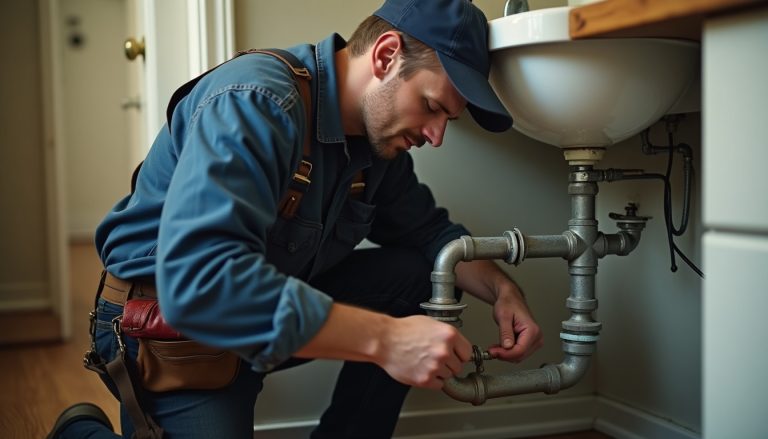
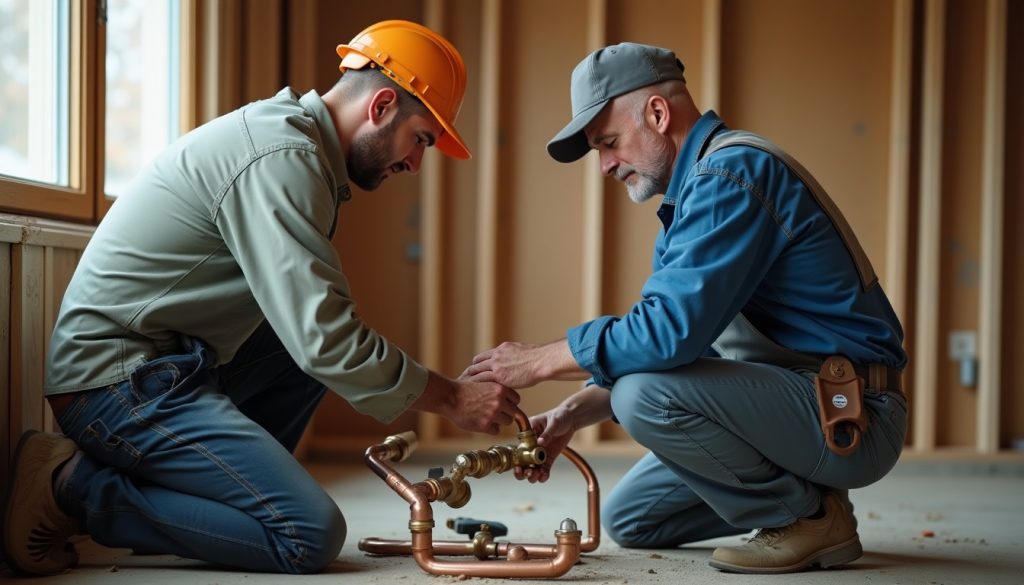
A plumbing apprenticeship is a paid job plus school. The BLS says most programs run 4 or 5 years, with about 2,000 hours of paid on-the-job training and some technical instruction each year. You work under licensed plumbers by day and take classes on safety, local codes, and blueprint reading, usually at night or in blocks.
Real programs put hard numbers on that split. UA Local 155’s apprenticeship in Arkansas divides its five years into one-year segments, each with a minimum of 1,700 hours of on-the-job training and 246 hours of classroom instruction, according to its program listing. Across five years, that adds up to at least 8,500 work hours and 1,230 classroom hours.
The BLS notes that apprenticeship sponsors include unions, trade associations, and individual businesses. Union programs run through the United Association (UA) and its local joint training committees. Non-union programs often run through contractor associations or a single shop. Our guide on how to find and land a plumbing apprenticeship covers applications, aptitude tests, and how to pick between union and non-union routes.
Pay starts low and climbs. The BLS says apprentices earn less than fully trained plumbers, but their pay increases as they learn to do more. Many programs raise the rate at set steps tied to years or hours completed, so ask for the wage schedule up front.
How do you get a journeyman and master plumber license?
You get a journeyman plumber license by logging the required supervised hours and passing a state exam, then you earn a master license after more time at the journeyman level. The BLS says most states want 2 to 5 years of experience plus an exam before plumbers can work on their own. Texas offers a clear, published example.
The Texas State Board of Plumbing Examiners (TSBPE) lets you sit the journeyman exam once you have at least 8,000 hours of plumbing experience and have completed a 48-hour board-approved course, or are enrolled in or have completed a program approved by the US Department of Labor Office of Apprenticeship. At 2,000 hours a year, the BLS full-time pace, 8,000 hours is four years.
The Texas master exam requires holding a journeyman license for at least two years, or one year if you completed a DOL-approved apprenticeship. That is a real reward for finishing a registered program. A journeyman plumber in Texas also works under a Responsible Master Plumber, so the master tier is where independent work starts.
Other states set their own hours, exams, and tiers, and some cities license on top of the state. Check our breakdown of plumbing license requirements by state before you plan your hours, since a move across a state line can change the count and the exam. Some boards give credit for an out-of-state license; Texas, for one, waives its 48-hour course for applicants who already hold a journeyman or master license from another state.
How long does it take to become a plumber?
It takes about 4 to 5 years to become a licensed journeyman plumber and roughly 5 to 7 years to reach master, depending on your state. The BLS puts most apprenticeships at 4 or 5 years. Texas requires 8,000 hours before the journeyman exam and one or two more years before the master exam.
| Stage | Typical duration | Requirement | Cost |
|---|---|---|---|
| High school diploma or GED | Before you apply | Typical entry-level education (BLS) | Free at public schools; GED test fees vary by state |
| Trade school (optional) | Varies by program | Not required by BLS; may count toward classroom hours in some programs | Tuition varies by school |
| Apprenticeship (UA Local 155 example) | 4 to 5 years (BLS); 5 years at Local 155 | About 2,000 paid work hours a year (BLS); at least 1,700 work and 246 classroom hours a year at Local 155 | You are paid; tools and books vary by program |
| Journeyman license (Texas) | After 8,000 hours, about 4 years full time | 8,000 hours plus a 48-hour course or DOL-approved program (TSBPE) | $40 exam fee plus $40 license fee (TSBPE) |
| Master license (Texas) | 1 to 2 more years | Journeyman license held 2 years, or 1 year with a DOL-approved program (TSBPE) | $25 processing, $128.50 exam, $75 license (TSBPE) |
| Total to master | About 5 to 7 years | Varies by state and local rules | About $308.50 in Texas board fees |
The total row is our arithmetic from the BLS and TSBPE figures above. The fastest Texas path is four full-time years to 8,000 hours, plus one year as a journeyman after a DOL-approved program, or five years in all. Part-time work, layoffs, or a state with a longer hour count push the timeline out.
How much does it cost to become a plumber?
Becoming a plumber can cost very little, because the apprenticeship is a paid job rather than tuition. Your main costs are any trade school you choose, personal tools, and licensing fees. In Texas, board fees from the journeyman exam through the first master license add up to about $308.50, based on TSBPE fee schedules.
Here is how the Texas board fees break down:
- Journeyman: $40 exam fee and $40 initial license fee, plus $40 to renew.
- Master: $25 exam processing, $128.50 exam fee paid to Pearson VUE, and $75 for the initial license, plus $75 to renew.
Trade school is the swing cost. Tuition ranges widely by school and length, so get the full price, the hours of instruction, and whether those hours count toward your state’s license before you enroll. Some people skip it and go straight to an apprenticeship, which pays them from the first week.
Tool policies differ by employer. Some shops supply everything and others expect apprentices to bring a hand-tool kit, so ask during the interview what you need on day one.
How much do plumbers make?
Plumbers, pipefitters, and steamfitters earned a median of $63,800 a year, or $30.67 an hour, in May 2025, according to the BLS Occupational Outlook Handbook. The lowest 10% earned less than $44,150 and the highest 10% earned more than $108,420. Where you work matters too, with government employers paying a median of $71,660.
The chart mixes two BLS views on purpose: the spread between the bottom and top 10% of earners, and the median pay in each of the largest employing industries. Most plumbers land near the middle, since 65% work for plumbing, heating, and air-conditioning contractors, where the median was $63,010.
The spread is the point for a new apprentice. A license, overtime on emergency calls, a high-cost metro, and union scale can all push pay toward the top of the range. The BLS notes most plumbers work full time, and nights, weekends, and on-call shifts are common.
Is plumbing a good career?
Plumbing is a good career on the federal numbers: the BLS projects 7% employment growth from 2025 to 2035, which it rates as much faster than the average for all occupations, plus about 42,000 openings a year. Pay is strong for a job that needs no degree, and apprentices earn while they learn instead of borrowing for tuition.
The BLS ties demand to two sources: new construction and the upkeep of existing plumbing systems. Building codes that require fire suppression systems should also lift demand for sprinklerfitters, a related specialty in the same BLS group.
Most openings come from turnover, not growth. The BLS projects 34,500 new jobs over the whole decade but about 42,000 openings every year, so the bulk of hiring replaces plumbers who retire or leave the trade.
The career also has a ceiling most jobs lack. The BLS counts 8% of the workforce as self-employed, and a master license is often the ticket to running your own shop. Some licensed plumbers move into estimating, inspection, or teaching later in their careers.
Is plumbing hard?
Plumbing is hard work, both physically and mentally. The BLS says plumbers lift heavy materials, climb ladders, and work in tight spaces, and it lists cuts from sharp tools, burns from hot pipes and soldering equipment, and falls from ladders as common injuries. The classroom side adds codes, blueprint reading, math, applied physics, and chemistry.
The physical load is the part people underestimate. Crawlspaces, attics, trenches, and under-sink cabinets are the office. Knees, back, and shoulders take years of strain, so lifting technique and kneepads matter from the first month.
The mental load is steady. The BLS names troubleshooting, mechanical skill, dexterity, physical strength, and communication as the key qualities for the job. Service plumbers diagnose problems they cannot see, then explain the fix and the price to a homeowner standing in a wet basement.
The exam is the last hurdle. The BLS says most states require an exam before plumbers can work on their own. Codes are revised in new editions, so the studying does not stop at the license.
How we sourced this
We reviewed the top-ranking guides for “how to become a plumber” and related questions in October 2026, then went to primary sources for every number. Pay, employment, projections, industry mix, and job demands come from the BLS Occupational Outlook Handbook for plumbers, pipefitters, and steamfitters (May 2025 wages, 2025 to 2035 projections). Hour and classroom figures come from UA Local 155’s published program listing in Arkansas. License hours, rules, and fees come from the Texas State Board of Plumbing Examiners. We used Texas as a worked example only; other states differ. We excluded vendor and job-board salary estimates. The BLS does not publish a plumber-specific injury rate in its handbook, so we report its listed injury types only. Timeline and fee totals are our own arithmetic from these sources.
Frequently asked questions
How long does it take to become a plumber?
Most people need 4 to 5 years to become a licensed journeyman plumber, because that is the typical length of an apprenticeship, according to the BLS. Texas, for example, requires 8,000 hours of plumbing work before the journeyman exam. A master license takes one or two more years in Texas, so the full path usually runs about 5 to 7 years.
Is plumbing a good career?
By the federal numbers, yes. The BLS puts the May 2025 median plumber wage at $63,800 a year and projects 7% job growth from 2025 to 2035, which it calls much faster than average. It also expects about 42,000 openings a year. Apprentices are paid while they train, so most people start the career without school debt.
Is plumbing hard?
Plumbing is hard on the body and demanding on the brain. The BLS says plumbers lift heavy materials, climb ladders, and work in tight spaces, and it lists cuts, burns, and falls as common injuries. Apprentices also study codes, blueprint reading, math, applied physics, and chemistry, and most states require a written exam before you can work on your own.
Do you need college to become a plumber?
No. The BLS lists a high school diploma or equivalent as the typical entry-level education, and most plumbers learn the trade through a paid apprenticeship. Trade school is optional. Some union programs, such as UA Local 155 in Arkansas, point members toward college credit options, but Texas, our worked example, asks for hours and an exam rather than a degree.
Do plumbing apprentices get paid?
Yes. The BLS describes apprenticeship as paid on-the-job training, with about 2,000 paid hours a year. Apprentices earn less than fully trained plumbers, and the BLS says their pay rises as they learn to do more. Pay scales are set by each program or employer, so ask for the step schedule before you sign on.
What is the fastest way to become a plumber?
Join a registered apprenticeship and log full-time hours. In Texas, 8,000 hours at a full-time pace is about 4 years to the journeyman exam. Finishing a program approved by the US Department of Labor also cuts the wait for the Texas master exam from two years as a journeyman to one. There is no shortcut around the hour requirement itself.
How much do plumbers make an hour?
The BLS reports a median wage of $30.67 an hour for plumbers, pipefitters, and steamfitters as of May 2025, or $63,800 a year. The lowest 10% earned less than $44,150 a year and the top 10% earned more than $108,420. Government employers paid the highest industry median of the groups the BLS lists, at $71,660.
Is plumbing a high paying job?
Plumbing pays well for a job that needs no degree. The BLS puts the May 2025 median plumber wage at $63,800 a year, or $30.67 an hour, with the top 10% earning more than $108,420. Government employers paid a median of $71,660. Most plumbers work for contractors, where the median was $63,010, and apprentices earn while training instead of paying tuition.